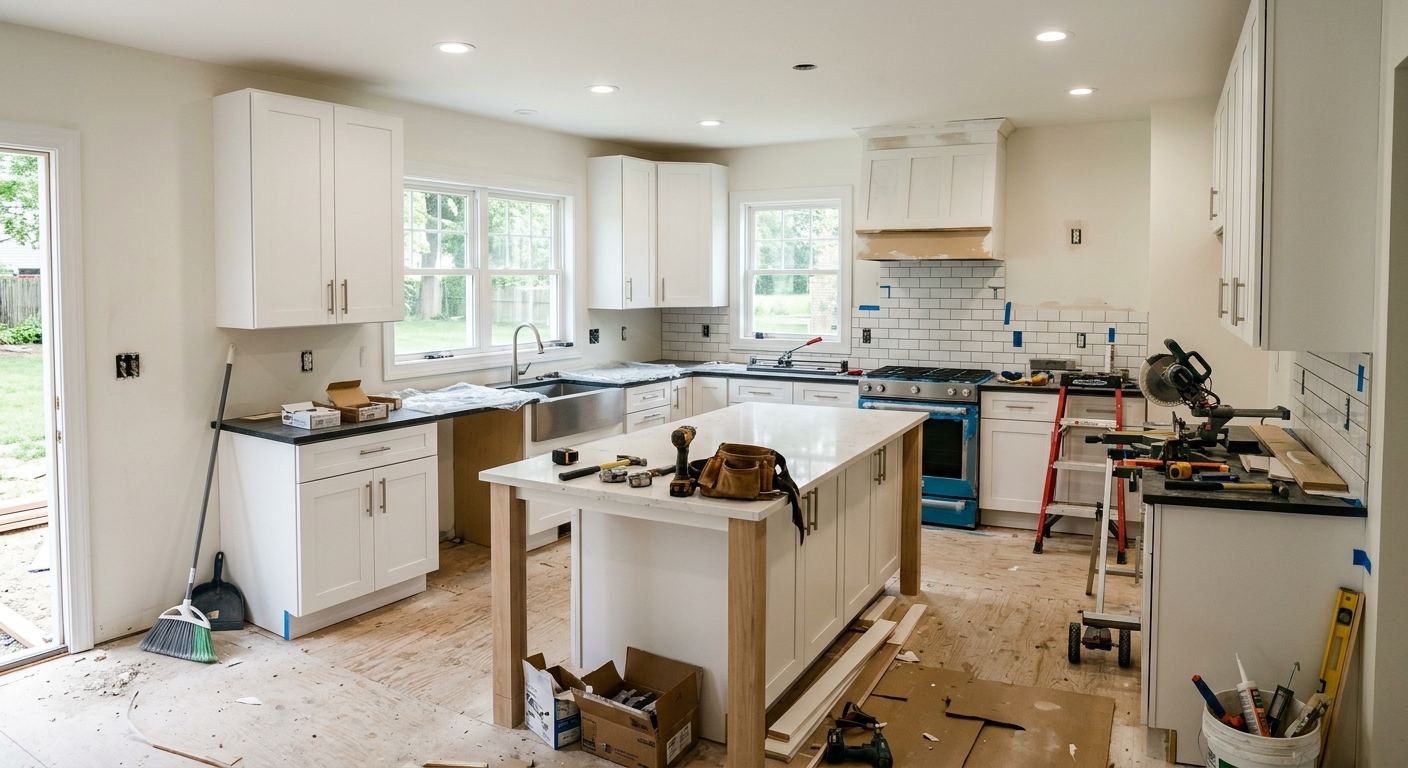
Kitchen renovation options and costs in Bradner
Kitchen renovations in Bradner, British Columbia, typically fall into a few clear tiers—mainly because the Lower Mainland–Southwest market has a wide range of finish expectations. While Bradner’s local population is small (3,213 people in 2021), homeowners still feel the pricing pressure from nearby, higher-value Metro Vancouver areas, where buyers often expect semi-custom or custom cabinetry and stone counters. In practice, that means the “same-size” kitchen can look like two different projects depending on whether you’re choosing laminate surfaces for a refresh or made-to-fit millwork with quartz/stone for a full rebuild.
Climate doesn’t drive costs as much as it does in colder regions—Bradner’s coastal-influenced conditions mainly affect drying time for finishes, exterior moisture control around the home, and ventilation choices after replacing cooking appliances. The bigger driver is market economics: available trades, homeowner budgets, and the resale value logic many people apply when deciding on cabinet tier and counter material. In areas of high demand, like the Abbotsford–Mission corridor that many Bradner residents commute through for shopping and services, contractors can book quickly for mid-year renovation schedules, so timing can influence labour availability.
To compare options realistically, use the tier ranges below as a starting point. Then we’ll break down which factors most often push quotes up or down.
| Renovation Tier |
What's Included |
Typical Duration |
Price Range |
| Cosmetic refresh (paint, hardware, new appliances only) |
Paint/trim touch-ups, new cabinet hardware, new appliances (non-plumbing), minor caulking, basic clean-up |
1–3 weeks |
$8,000–$20,000 |
| Mid-range full renovation (new cabinets, counters, sink, tile) |
New cabinets, countertops, sink + faucet, backsplash tile, tile flooring or countertop-ready prep, plumbing hook-ups for sink, basic electrical for lighting/hood where applicable |
4–8 weeks |
$45,000–$85,000 |
| High-end full renovation (custom cabinets, stone counters, island) |
Custom or premium cabinetry, quartz/granite/stone counters, island (including electrical/plumbing if needed), upgraded backsplash (often stone or premium tile), designer-style layout, extended finishes and detailing |
8–14 weeks |
$85,000–$120,000 |
| Cabinet refacing only (new doors + drawer fronts, same boxes) |
Remove/replace doors and drawer fronts, new hardware, refinish existing boxes, new trim pieces, careful alignment and hardware adjustments |
2–5 weeks |
$12,000–$35,000 |
| Countertop swap only (laminate to quartz or stone) |
Remove old surface, measure/template, install new countertop, new sink cut-out where required, sealing/finishing at seams |
1–2 weeks |
$5,000–$12,000 |
| Backsplash tile installation only |
Tile supply and install, surface prep, grout/seal where needed, cut-outs around outlets and edges, caulking |
5–10 days |
$1,500–$6,000 |
Prices are estimates only and vary by project scope, site access and material selection.
What affects the price of kitchen renovation in Bradner
In the Lower Mainland–Southwest, quotes for the same kitchen can vary by 30–50% across British Columbia because the “finish tier” is often decided by resale expectations, not by seasonal construction conditions. In higher-value pockets around the region, homeowners more frequently move toward quartz or stone counters, upgraded hardware, and semi-custom cabinetry—choices that raise material and fabrication costs. In more modest scopes, laminate surfaces and stock cabinets can deliver a strong return because the renovation cost stays closer to labour + standard finishes.
Local home values and income expectations shape typical budgets far more than climate. When homeowners believe they can recover investment on resale, they’re more likely to standardize on quartz/stone and higher cabinet tolerances. When they’re prioritizing value, laminate and stock options dominate because they keep the project inside the commonly referenced bands (a full renovation often starts around the $40,000 range and climbs as cabinetry and stone increase). Either way, layout changes are the most unpredictable cost driver regardless of finish level.
Here are a few Bradner-specific examples we see in the field. First, older homes and renovations tied to original plumbing routes can make sink moves expensive once drain slopes and supply lines are assessed. Second, when you add an island, you may need new electrical circuits and sometimes a gas line relocation, which can increase permitting and trade coordination time. Third, ventilation and cabinet spacing around a cooktop can affect how cabinets are built and finished—changing cabinet tier from stock-ready to semi-custom fit, even if the overall look stays “mid-range.”
| Price Factor |
Why It Matters |
Cost Impact |
| Cabinet tier — stock vs. semi-custom vs. fully custom millwork |
Controls fabrication time, fit/tolerance, door/drawer options, and how many custom pieces are needed for awkward corners or ceilings |
Can shift cabinet portion dramatically—often adding thousands when moving from stock to semi-custom |
| Countertop material — laminate vs. quartz vs. granite vs. stone |
Material cost and install complexity; stone requires careful handling, seam planning, and edge profiling |
Countertop installations can range from budget swaps to premium stone totals (commonly $3,000–$12,000 by scope) |
| Layout change — wall removal, island add, plumbing/gas move |
Mechanical and structural work drives labour, inspection steps, and schedule risk |
Most unpredictable; can move a “mid-range” plan toward “high-end” totals even without premium finishes |
| Appliance package tier — builder vs. mid-range vs. pro-grade |
Electrical and ventilation requirements, cut-out tolerances, and whether panels/trim are included |
Can add meaningful cost and sometimes triggers added electrical/hood work |
| Flooring — refinish existing vs. full replacement |
Protecting during demo vs. replacing after cabinet and tile changes |
Refinishing reduces demo waste; full replacement increases labour and materials |
| Backsplash — ceramic tile vs. marble vs. full-height slab |
Tile size, pattern complexity, and moisture/waterfall detailing increase install time and material waste |
Backsplashes can range from $1,500 up to $6,000+ depending on finish type |
| Electrical — new circuits for island, under-cabinet lighting |
Changes receptacle placement and adds licensed work and inspection coordination |
Often increases both labour and schedule; essential for island seating and modern lighting |
| Permit fees and licensed trade requirements |
Moving plumbing/gas and adding electrical circuits generally require permits and inspections |
Adds administrative cost and coordination time, especially for layout changes |
Permits & regulations in British Columbia
In British Columbia, not every kitchen change needs a permit. For example, cabinet and countertop swaps typically do not require permits when you’re keeping existing plumbing and gas in the same locations and you’re not altering structural elements. Backsplash installation and appliance swaps are usually permit-free as well—assuming no new gas line runs, no drain/supply relocation, and no electrical panel modifications beyond permitted work by licensed trades.
Work that does require permits and licensed trades includes: moving plumbing supply or drain lines (including changing sink locations), relocating gas (stove/range and related connections, including range hood work where gas appliances are involved), removing a load-bearing wall, and adding new electrical circuits (for example, dedicated island receptacles, hardwired under-cabinet lighting, or any new circuit that isn’t simply replacing like-for-like). Gas work must be performed by a licensed gas fitter, and electrical work by a licensed electrician, with inspections required for permitted scope.
To verify a contractor before signing in Bradner, ask for three things: (1) proof of current liability insurance (certificate of insurance), (2) proof of coverage for workers—WSIB/WCB clearance letter or equivalent evidence depending on the contractor’s setup—and (3) licence credentials for the specific trades involved (gas/electrical subcontractors where applicable). Then confirm what your contract says about permit responsibility: who pulls the permit, who schedules inspections, and whether any costs are owner-billed.
Cabinets, countertops and layout decisions in Bradner
In a Bradner kitchen renovation, the biggest wins usually come from three decisions: cabinet tier, countertop material, and whether to change the layout. Cabinet tier affects speed and cost—stock cabinets are fastest and typically cheapest, semi-custom is the most popular mid-range choice, and fully custom millwork is best for tricky spaces and built-ins. Countertop material then determines day-to-day usability: laminate can be a good budget move, quartz offers consistent performance with low maintenance, granite/stone adds natural variation and durability, butcher block adds warmth (but needs more care), and marble looks premium but is more sensitive to etching.
Layout changes are the most “space versus cost” decision. In the Lower Mainland–Southwest resale market, buyers often like open sightlines and functional islands, but the cost of moving plumbing or gas can quickly erase savings from keeping finishes mid-range. In older Bradner homes (many with established plumbing routes), adding an island may be justified when it creates real seating and flow—especially if you’re already planning new electrical receptacles and lighting. If you keep the existing sink and cooktop locations, you can usually stay closer to mid-range full renovation totals (commonly around the $45,000–$85,000 band).
Concrete example: if you upgrade from laminate to quartz while keeping the cabinet layout the same, the countertop swap may land in the countertop installation range (often $3,000–$12,000 depending on size and edges). But if you also move the sink and add a second faucet run, you may trigger the type of plumbing work that requires permits and licensed coordination—pushing labour, inspection steps, and schedule risk upward, even before you consider premium cabinetry.
| Option |
Durability |
Maintenance |
Best For |
Price Range |
| Stock cabinets (big-box) |
Good for straight runs; less tolerant of uneven walls and odd dimensions without fillers |
Low day-to-day care; hardware upgrades recommended for longevity |
Fast projects and cost-conscious refreshes |
$8,000–$25,000 |
| Semi-custom cabinets (local dealer) |
Strong build quality; better fit for typical Lower Mainland homes with minor layout irregularities |
Easy to maintain; can be tuned with soft-close and better internal storage |
Most Bradner homeowners aiming for a modern look with mid-range budget |
$20,000–$55,000 |
| Custom cabinets (local millwork shop) |
Excellent fit around ceilings, corners, and appliance niches; premium joinery options |
Low care requirements; long-term value for heavy daily use |
Design-led renovations and unusual layouts |
$45,000–$90,000 |
| Laminate countertop |
Reasonable impact resistance; sensitive around seams and heat exposure |
Wipe clean; avoid prolonged heat and standing water at edges |
Budget-first remodels that prioritize a refreshed look |
$3,000–$7,000 |
| Quartz engineered countertop |
Very durable for everyday cooking; resistant to staining and normal wear |
Low maintenance; non-porous surface with straightforward cleaning |
Bradner kitchens where you want “looks premium” with practical durability |
$6,000–$12,000 |
| Granite / natural stone countertop |
High durability and heat resistance; unique patterning |
May require periodic sealing; needs careful care for long-term performance |
Homeowners wanting natural stone character and premium curb appeal |
$7,000–$14,000 |
| Butcher block countertop |
Strong for normal use; can dent or scratch with heavy impacts |
Needs periodic oiling/sanding for best appearance and moisture management |
Warm, farmhouse or transitional looks in family-used kitchens |
$4,500–$10,000 |
| Marble countertop |
Beautiful but more delicate; can be etched or stained more easily than quartz |
Requires cautious cleaning; sealing and prompt spill cleanup are important |
Design-focused renovations where the look is the priority |
$9,000–$16,000 |
How to choose a kitchen renovation contractor in Bradner
Choosing the right contractor is where Bradner homeowners can protect both budget and schedule. Start with licensing and coverage. Confirm that any licensed trades (gas fitter and electrician) are properly credentialed for the work described. Ask your contractor for liability insurance certificate and evidence of workers’ coverage (WSIB/WCB clearance letter or equivalent documentation). Don’t accept “we’re covered” without paperwork—request the documents and ensure names and scope align with your project.
Then get 2–3 itemised written quotes. You want a breakdown that separates labour and materials, including cabinetry supply, countertop fabrication/installation, tile supply and install, and line-item plumbing/electrical allowances where needed. A good quote also states what’s included: permit pull, disposal/dump fees, protection of existing flooring, drywall patching, and whether you’re paying extra for site conditions like tight access or old subfloor removal.
Warranty matters too. Ask for a written workmanship warranty length, and whether the manufacturer warranties for cabinets/counters are included and transferable if you sell the home. Payment schedules should be conservative: never more than about 10–15% upfront, and use a holdback until key milestones are finished. Finally, insist on a start date and completion estimate in writing so you can plan around school schedules and commuting.
- Ask for current liability insurance (certificate of insurance) and confirm project name/address coverage.
- Request WSIB/WCB clearance (or equivalent) documentation and verify it’s up to date.
- Confirm who pulls permits and which permits apply to your planned scope.
- Get an itemised quote with labour and materials line items (no “lump sum only” approach).
- Clarify inclusions: demolition, disposal, drywall patching, underlayments, and caulking.
- Ask who supplies and installs appliance cut-out accessories and trim panels (if required).
- Check whether countertop templates and scheduling are included in the timeline.
- Confirm electrical scope: are island receptacles and lighting included where you want them?
- Request a written workmanship warranty (length, coverage details, and exclusions).
- Verify manufacturer warranties for cabinets and countertops, and whether they’re transferable.
- Keep upfront payment at 10–15% maximum; hold back until completion and punch-list sign-off.
- Ensure the quote includes site protection (floor/cabinet protection) and cleaning at each phase.
Red flags we commonly see in Bradner-area kitchen jobs include: quotes that don’t specify disposal and drywall patching, “allowances” that are too low to complete the scope, no written warranty terms, contractors asking for large upfront payments, and vague timelines that don’t include countertop templating and delivery windows.
Frequently asked questions — kitchen renovation in Bradner
Custom vs stock cabinets — is custom worth it?
In Bradner and across the Lower Mainland–Southwest, custom is worth it when your kitchen has uncommon constraints: sloped ceilings, very tight corners, or a layout that needs built-ins for appliances and pantry depth. If your walls are reasonably square and your design is straightforward, stock or semi-custom usually gives you better value per dollar. Many homeowners choose semi-custom because it’s a practical mid-point—better fit and more door/drawer options without the long lead times of fully custom millwork. If you’re comparing totals, it’s common to see a mid-range full renovation land in the $45,000–$85,000 band, while a high-end custom rebuild can move toward $85,000–$120,000 once custom pieces and premium finishes are included. (Statistics Canada, 2021 Census)
How do I choose a kitchen contractor in Bradner?
Start by verifying British Columbia licensing for trades involved in permit-requiring work. Ask for insurance paperwork (liability certificate) and evidence of workers’ coverage (WSIB/WCB clearance letter or equivalent). Next, request 2–3 itemised quotes that break down labour and materials—cabinet supply, countertop fabrication/installation, tile work, and any plumbing/electrical allowances. Then read the scope carefully: confirm whether permits and disposal are included, who handles utility disconnects/reconnects, and what’s excluded (for example, structural changes or additional electrical circuits). A good contractor in Bradner will also provide a written start date, completion estimate, and a workmanship warranty with clear terms. (Statistics Canada, 2021 Census)
What order do kitchen renovation steps happen in?
Typically, the sequence is: confirm measurements and final design, schedule fabrication (especially cabinets and countertops), complete demolition, and address any rough-in needs (electrical/plumbing) once the layout is locked. After rough-ins, drywall/patch work and flooring/tile prep happen, then cabinet installation follows. Countertops usually go in after cabinets are set and leveled, and finally you install the backsplash, finishing hardware, and appliances. If your scope includes an island, electrical work for under-cabinet lighting and island receptacles is often coordinated early to avoid rework. A contractor should build the plan around countertop templating lead times so you don’t lose weeks waiting. This planning approach is critical in British Columbia where trades availability can tighten during busy renovation seasons.
Can I live at home during a kitchen renovation in Bradner?
Often yes—many Bradner homeowners stay in the home during a refresh or mid-range remodel, particularly when plumbing and gas stays in the same locations and the project is contained to one main work area. You’ll need dust control (plastic containment), a safe path to key rooms, and a temporary kitchen setup—usually a microwave, kettle, and a small fridge in a different area. For full renovations involving cabinets, tile, and countertop installs, disruption is still manageable but longer, commonly 4–8 weeks depending on complexity. For high-end layouts with island plumbing or more extensive electrical, some homeowners choose to stay out longer. A good contractor will outline your daily access plan, cleaning routine, and dust mitigation in writing.
Should I renovate my kitchen before selling in Bradner?
Renovating before selling can make sense if you’re targeting buyers’ expectations and you avoid over-spending relative to the local market. In the Lower Mainland–Southwest, buyers commonly pay attention to cabinetry condition, countertop appearance, and functional layout. If your goal is to refresh without major construction, a cosmetic upgrade or a mid-range renovation can help buyers visualize the space—often with controlled spend that stays closer to the $40,000–$120,000 full-reno spectrum depending on scope. If you’re considering a major layout change, remember it can raise risk and timeline—plus permits and licensed trade coordination. A practical approach is to align finishes with the tiers buyers expect at that price point and keep mechanical moves limited unless the layout gain is clear.
What's the most popular kitchen style in Bradner right now?
Right now, the most common direction we see in Bradner-area kitchens is a clean, modern transitional look: flat or gently framed cabinet doors, warm neutral colours, and brighter lighting with under-cabinet illumination. Homeowners frequently pair semi-custom cabinets with quartz countertops because quartz reads “premium” in photos while staying low maintenance for everyday cooking. Backsplashes often lean toward large-format ceramic tile or simple stone-look surfaces rather than highly busy patterns. That said, some households still prefer a classic shaker profile when the home’s era matches the style. If you’re budgeting, it’s typical to keep most of your spend in cabinet tier and counters, then build the rest around backsplash and lighting—because those elements shape how buyers judge the kitchen’s overall quality at first glance. (Statistics Canada, 2021 Census)