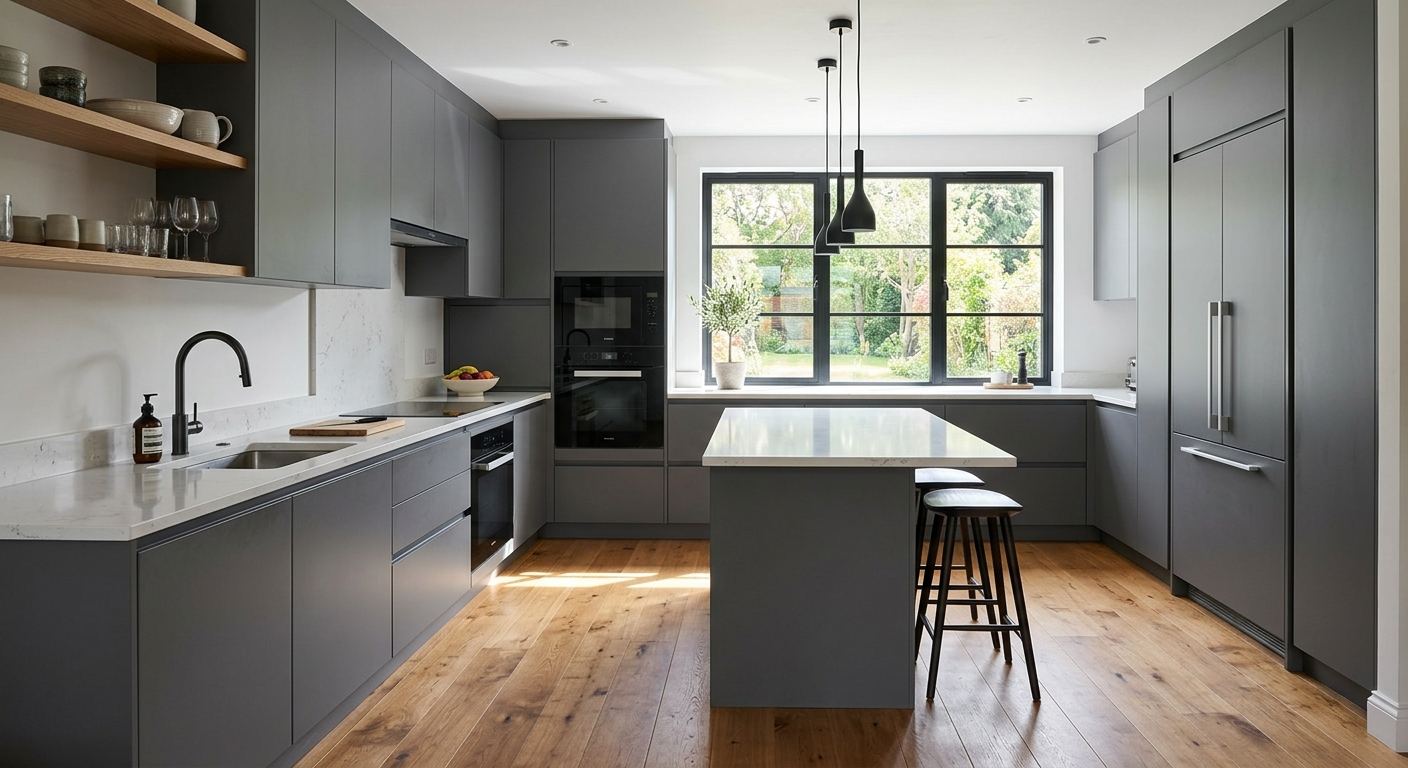
Kitchen renovation options and costs in Caulfeild
In Caulfeild, kitchen renovations are largely shaped by what buyers expect for a higher-value neighbourhood, not by “extreme” weather. With a population of 3,757 (Statistics Canada, 2021 Census), Caulfeild is small, so many projects rely on crews that also support the broader Lower Mainland–Southwest demand. In the region, homeowners often price renovations against the resale value of upgraded finishes—so you’ll see more semi-custom cabinetry and upgraded surfaces than you might in slower markets. Even when the home itself is older, the kitchen scope is usually planned to feel current and durable.
Across the Lower Mainland–Southwest, costs come from contractor availability, material lead times, and how “finish-forward” the project is. Climate plays a supporting role: coastal humidity and frequent seasonal temperature swings can affect how cabinetry and adhesives perform, and it can raise the importance of good ventilation and moisture-safe detailing. That’s why high-end installs in Caulfeild frequently include more careful sealing, better under-cabinet detailing, and upgraded ventilation coverage.
Trade demand is especially strong around Caulfeild’s built-up residential corridors where homeowners are preparing for resale or downsizing without losing comfort—expect active scheduling in the Caulfeild South and west-view areas where access can be tight and requires careful staging. From there, the pricing path splits: a cosmetic refresh can be comparatively contained, while any scope that changes cabinetry layout, plumbing, or adds an island tends to climb quickly. Use the comparison table below to anchor your expectations before you request quotes.
| Renovation Tier |
What's Included |
Typical Duration |
Price Range |
| Cosmetic refresh (paint, hardware, new appliances only) |
Cabinet paint or refinishing, new cabinet hardware, fresh wall paint/trim touch-ups, replacement of like-for-like appliances, basic caulking and alignment adjustments |
1–3 weeks |
$8,000–$20,000 |
| Mid-range full renovation (new cabinets, counters, sink, tile) |
New semi-custom cabinets, new countertop (quartz or similar), sink and faucet, backsplash tile, under-cabinet work (as needed), flooring updates limited to kitchen area, standard electrical/tap-in allowances |
4–8 weeks |
$40,000–$85,000 |
| High-end full renovation (custom cabinets, stone counters, island) |
Fully custom millwork, premium stone counters and island build-out, upgraded hardware and soft-close systems, extended backsplash (often to height), coordinated plumbing/electrical for island features, upgraded ventilation and layout changes |
8–16 weeks |
$85,000–$120,000 |
| Cabinet refacing only (new doors + drawer fronts, same boxes) |
Removal and replacement of cabinet doors/drawer fronts, new hardware, refinishing or minor box repairs, spot sealing, optional repaint for visible framing, simple backsplash matching |
2–6 weeks |
$8,000–$35,000 |
| Countertop swap only (laminate to quartz or stone) |
Template, removal of existing top, install new quartz/stone, reseal seams, sink/faucet set (if compatible), limited backsplash tie-in as needed |
3–10 days |
$3,000–$12,000 |
| Backsplash tile installation only |
Surface prep, tile supply and install, caulking and grout, edge finishing, optional outlets/trim adjustments if required |
1–2 weeks |
$1,500–$6,000 |
Prices are estimates only and vary by project scope, site access and material selection.
What affects the price of kitchen renovation in Caulfeild
The same kitchen can quote 30–50% differently across the Lower Mainland–Southwest and other parts of British Columbia because the biggest drivers aren’t climate—they’re home value, household income expectations, finish level, and how many changes are bundled into the scope. In Caulfeild and nearby high-value pockets, homeowners more often choose quartz or stone counters and semi-custom cabinetry because those costs tend to “fit” the resale narrative; when you compare apples to apples, the renovation premium is easier to recoup on a higher-end listing than it is in more price-sensitive markets. By contrast, in more modest markets, laminate and stock cabinetry dominate because the ROI is better when budgets stay closer to a cosmetic refresh or mid-range package.
Layout decisions are where quotes can diverge fastest. Removing a wall to open the kitchen, adding an island, or moving plumbing can add complexity whether your counters are laminate or premium stone—because trades, inspection coordination, and sub-surface prep increase labour hours and scheduling risk. In Caulfeild specifically, older housing stock (common in coastal communities) may include dated rough-in plumbing or electrical that needs updating, which can push a mid-range renovation toward high-end timelines even when the finish list looks similar.
Two practical examples from the area: first, choosing a quartz swap alone can often stay near the countertop-only band (around $3,000–$12,000), but adding new outlets for under-cabinet lighting can increase electrical coordination and extend the timeline. Second, a backsplash-only scope can remain in the tile band ($1,500–$6,000), yet if your contractor must correct uneven wall planes or replace water-damaged drywall behind a stove wall, the labour grows quickly. That’s why I encourage homeowners to decide on “where change is worth it” before ordering cabinets or counters.
| Price Factor |
Why It Matters |
Cost Impact |
| Cabinet tier — stock vs. semi-custom vs. fully custom millwork |
Higher tiers mean more made-to-fit sizing, better interior options, upgraded hardware, and tighter tolerances that reduce callbacks but cost more upfront |
Often the biggest swing factor; can move a mid-range project toward the high-end band quickly |
| Countertop material — laminate vs. quartz vs. granite vs. stone |
Material cost, fabrication complexity, edge profiles, and installation time vary significantly; premium stone also affects template and scheduling |
May add thousands; countertop swaps commonly sit around the $3,000–$12,000 band, but whole-kitchen upgrades climb with the cabinet tier |
| Layout change — wall removal, island add, plumbing/gas move |
Any structural, plumbing, or gas movement requires coordination and usually more permits and licensed trades |
Unpredictable; can be the difference between staying mid-range and reaching $85,000–$120,000 for a full rebuild |
| Appliance package tier — builder vs. mid-range vs. pro-grade |
Pro-grade units can require different clearances, electrical readiness, ventilation sizing, and sometimes custom cabinetry integration |
Can add substantial cost even when “footprint” stays the same |
| Flooring — refinish existing vs. full replacement |
Kitchen renos frequently expose subfloor damage, and coastal humidity can reveal expansion gaps that need correction |
Refinishing is usually cheaper; full replacement can add several thousand depending on patching needs |
| Backsplash — ceramic tile vs. marble vs. full-height slab |
Natural stone and tall-format installs increase labour, material weight, and edge finishing requirements |
Tile work typically fits around $1,500–$6,000, but upgraded materials can push beyond the band |
| Electrical — new circuits for island, under-cabinet lighting |
New lighting and dedicated circuits affect trade time and may require inspection scheduling |
Can add hours and coordination; impacts timeline even if finish tier stays mid-range |
| Permit fees and licensed trade requirements |
Licensed work and inspections introduce process steps and documentation; costs are harder to estimate without a clear scope |
Usually not the largest line item, but it affects total budget risk and scheduling |
Permits & regulations in British Columbia
In British Columbia, a straightforward cabinet or countertop swap typically does not require permits. That means replacing cabinet doors/drawer fronts (refacing), swapping laminate for quartz, or reinstalling countertops on the existing layout is usually permit-free. However, when you change the “systems” of the kitchen, permits and licensed trades usually come into play. Moving plumbing supply or drain lines, relocating a gas stove or changing where a gas range/hood vents, removing or altering a load-bearing wall, and adding new electrical circuits (for example, power to an island or additional under-cabinet lighting runs that require new wiring) generally require permits and inspections.
For a homeowner in Caulfeild, the best approach is to verify before work starts. Step one: ask your contractor which scopes require a permit and who will apply. Step two: confirm the contractor’s licence status using the appropriate provincial licence registry for their trade discipline (and ensure subcontractors provide their own licence/credentials). Step three: request a current certificate of insurance (liability) and review it for validity dates and coverage limits. Step four: obtain proof of coverage for workplace injury protection (WSIB coverage where applicable) or the applicable coverage evidence for the employer and subcontractors—your contractor should provide documentation without hesitation.
Also ask for a written clearance letter/coverage confirmation if your contractor uses subcontractors. Finally, ensure permit responsibility is clearly stated in the contract—who pulls permits, who schedules inspections, and what happens if scope changes.
Cabinets, countertops and layout decisions in Caulfeild
When homeowners renovate in Caulfeild, three decisions determine most of the budget: (1) cabinet tier, (2) countertop material, and (3) whether the layout changes. Start with cabinet tier. Stock cabinets are the fastest and usually cheapest, but they can create gaps or awkward filler sizing in older homes with less-perfect wall alignment. Semi-custom cabinets are the “most popular mid-range” because they allow better sizing and interior organization without fully custom pricing. Custom cabinets offer the best fit and can be worth it when you’re building around unusual ceiling heights, angled walls, or a new island concept.
Next, choose countertop material with maintenance and coastal performance in mind. Laminate is budget-friendly and easy to replace later, but it’s less forgiving for impact and can show wear at seams. Quartz is the usual sweet spot: durable, low maintenance, and it holds up well to the day-to-day moisture and cleaning patterns common in Lower Mainland homes. Granite/natural stone looks premium and ages well, but it may require periodic sealing depending on the stone and finish. Butcher block adds warmth and can work beautifully, yet you’ll want a clear sealing and wipe-down routine.
Finally, layout changes are where “good design” becomes “expensive reality.” Opening the kitchen by removing a wall or adding an island often creates value through better flow, but it’s justified when you gain usable space—not just when you rearrange it. As a concrete example: a countertop swap alone commonly lands around $3,000–$12,000, while bundling that with a layout change and upgraded electrical for an island can quickly push the project into the mid-range full renovation band (roughly $40,000–$85,000) or beyond if cabinets go semi-custom to custom.
| Option |
Durability |
Maintenance |
Best For |
Price Range |
| Stock cabinets (big-box) |
Good for general use; durability depends on door construction and finish quality |
Low; keep hardware tightened and wipe spills promptly |
Fast turnarounds and budget-focused refreshes |
$8,000–$25,000 |
| Semi-custom cabinets (local dealer) |
Very solid day-to-day performance; better options for storage and alignment |
Low; requires normal care of finishes and soft-close hardware |
Most Caulfeild mid-range renos where fit and resale appeal matter |
$25,000–$55,000 |
| Custom cabinets (local millwork shop) |
Highest fit and finish; excellent for irregular openings and premium hardware integration |
Low to moderate; premium finishes may need gentle cleaners |
Design-led kitchens, islands, and difficult layouts |
$55,000–$90,000 |
| Laminate countertop |
Moderate; more susceptible to chips and seam wear |
Easy day-to-day cleaning; avoid standing water at seams |
Budget upgrades where the goal is a clean look |
$3,000–$6,000 |
| Quartz engineered countertop |
High; resistant to staining and everyday impacts |
Low; wipe with mild cleaner and keep edges sealed by install standard |
Balanced performance for busy households and resale expectations |
$6,000–$10,000 |
| Granite / natural stone countertop |
High; strong and heat resistant, varies by stone type |
Moderate; may need periodic sealing and careful cleaning |
Premium look with a more “natural” character |
$8,000–$12,000 |
| Butcher block countertop |
Moderate to high if maintained; can dent but can be repaired/refinished |
Higher; regular oiling and drying habits required |
Warm, casual kitchens and families who want a functional surface |
$5,000–$9,000 |
| Marble countertop |
Moderate; elegant but can etch or stain depending on use |
Higher care; use pH-neutral products and protect from acids |
Statement kitchens where homeowners commit to upkeep |
$10,000–$14,000 |
How to choose a kitchen renovation contractor in Caulfeild
Choosing the right contractor in Caulfeild comes down to proof, clarity, and control over risk. First, verify British Columbia licensing for the trades involved. Ask for the specific licence number and confirm it online where applicable for the discipline they perform. Next, request a certificate of liability insurance and confirm the coverage is current and includes construction work. For workplace injury protection, ask for evidence of WSIB (or the applicable employer coverage documentation for the contractor and their subcontractors). A reputable kitchen renovator will provide these documents at your first request—no pressure tactics, no delays.
Second, request 2–3 itemised written quotes—not a single lump sum. The best quotes separate labour and materials (cabinet supply, countertop fabrication and install, tile labour, electrical/plumbing allowances, demolition and disposal). Read the exclusions carefully: is permit pulling included, and who pays permit fees? Is disposal and recycling included, or is that an extra charge? Confirm warranty details: workmanship warranty length (for example, for installation, water-sealing, and tile grout cracking), manufacturer warranty for cabinetry/counters, and whether the warranty transfers if you sell.
Third, manage payments. Never pay the bulk up front—keep upfront deposits typically around 10–15%, then hold back a portion until key milestones are complete. Fourth, get your timeline in writing: a start date, major phases (demolition, rough-in, install, trim), and a realistic completion estimate that accounts for cabinet and countertop lead times.
- Use a signed contract that lists exact scope, inclusions, and exclusions
- Require itemised labour/material line items (not “misc.” or “allowance” only)
- Confirm who pulls permits and schedules inspections (written responsibility)
- Ask for proof of liability insurance and request updated certificates annually
- Verify WSIB coverage documentation (or applicable employer coverage evidence)
- Confirm subcontractors’ licences for plumbing/gas and electrical
- Ensure the quote specifies disposal, protection (floor/cabinets), and site cleanup
- Check warranty terms for workmanship and products, including transferability
- Set milestone-based payment terms with a holdback until punch list completion
- Get cabinet/countertop lead times in writing before ordering
- Confirm measurements and template responsibility (who measures and who is accountable)
- Require a start date and completion estimate with a change-order process
Red flags I commonly see with lower-quality kitchen renos in Caulfeild: vague scopes (“similar materials”), unwillingness to provide licensing/insurance documents, no itemised quote (just lump sums), missed lead-time coordination for cabinets/counters, and payment requests that exceed 10–15% upfront without clear milestones.
Frequently asked questions — kitchen renovation in Caulfeild
Can I move my kitchen sink or stove?
In Caulfeild and across British Columbia, you can usually move a sink or stove, but the feasibility depends on what you’re changing in the wall/ceiling cavities and whether services can be rerouted. A sink move typically means plumbing supply and drain work—this is the kind of change that usually triggers permits and licensed plumbing trades, plus inspection scheduling. Moving a stove can add additional constraints if gas is involved; gas relocation must be done by a licensed gas fitter. Budget-wise, the “systems” work is often the hidden driver that pushes a project from a countertop-only scope (often around $3,000–$12,000) into a full mid-range renovation scope (roughly $40,000–$85,000). Confirm the contractor’s plan in writing before demolition.
What's the most cost-effective kitchen upgrade?
For many Caulfeild homeowners, the most cost-effective upgrade is a controlled cosmetic refresh paired with one high-visibility change. Cabinet hardware and fresh paint can modernize the room quickly, and adding new appliances (only if they’re truly like-for-like in dimensions and hookups) keeps trades minimal. If you want a bigger visual impact, a backsplash installation or a countertop swap can be a strong value move: backsplash tile often lands in the $1,500–$6,000 band, while countertop swaps commonly sit around $3,000–$12,000. The key is avoiding layout changes—wall removal, island additions, or plumbing/gas moves are the items that most often blow up budgets. If you’re unsure, ask for a two-scope quote: “refresh only” versus “refresh plus one premium element.”
Custom vs stock cabinets — is custom worth it?
Custom cabinets are worth it when you need made-to-fit solutions: unusual wall angles, a new island plan, ceiling height variations, or a layout where you want every inch optimized. In Caulfeild’s housing stock, older homes sometimes have imperfect walls and floors, and custom or semi-custom often produces fewer awkward filler strips and more stable alignments for doors and drawers. Stock cabinets are fastest and usually cheapest, but they can look less seamless when the room isn’t “square” or when you want interior organization (pantries, specialized drawers, pull-outs) that stock lines don’t offer. Budget-wise, many projects stay mid-range when you choose semi-custom, while full custom is more common when the overall kitchen reaches high-end totals (often $85,000–$120,000 for a high-end full renovation). If you’re aiming for resale appeal, semi-custom is often the best balance.
How do I choose a kitchen contractor in Caulfeild?
Start by confirming licensing and insurance documentation for each trade involved in the scope. In British Columbia, ask for the contractor’s proof of liability insurance and workplace injury protection coverage evidence (WSIB where applicable), and verify subcontractors for electrical and gas/plumbing work. Next, get 2–3 itemised written quotes that separate labour and materials and clearly list inclusions like permit pulling responsibility, disposal, and site protection. Watch for vague wording such as “allowances” that aren’t itemised. Also check warranty terms: workmanship warranty length, manufacturer warranties for cabinets and countertops, and whether warranties transfer if you sell. Finally, use payment milestones—avoid paying more than about 10–15% upfront and retain a holdback until the punch list is complete. If the contractor won’t provide documents or a clear scope, that’s usually your answer.
What order do kitchen renovation steps happen in?
A practical kitchen renovation order in Caulfeild is usually: design/measurement confirmation and material selection, demolition, rough-in work (plumbing, electrical, and gas if applicable), inspections, cabinet installation, countertop fabrication/template coordination, then install counters and sinks. After that, finishes happen: backsplash tile, trim/caulking, paint touch-ups, flooring transitions, and finally appliance installation and commissioning. This sequence matters because cabinets and counters need correct rough-in locations for drains, shutoffs, and electrical outlets. In the Lower Mainland–Southwest, lead times for cabinets and quartz can affect the calendar, so a good contractor sequences tasks to avoid idle trades. If a change order is needed, it should be handled before fabrication templates go in—otherwise you can pay reroute or remanufacturing costs.
Can I live at home during a kitchen renovation in Caulfeild?
Many homeowners in Caulfeild do live at home, but it depends on how extensive the work is and whether your project can keep a functioning “temporary kitchen.” For a cosmetic refresh or a limited countertop swap, living at home is often straightforward. For a full mid-range or high-end renovation, you’ll usually need a temporary cooking plan because demolition and rough-in typically remove your main sink and appliance access for days. You also need a workable path to bathrooms and safe dust control. If plumbing/electrical changes are underway, plan for a period where water access in the kitchen is restricted. Timeline expectations matter: mid-range full renovations often run about 4–8 weeks, and high-end renos can extend beyond that. Discuss dust containment, parking/staging, and meal plans before signing.