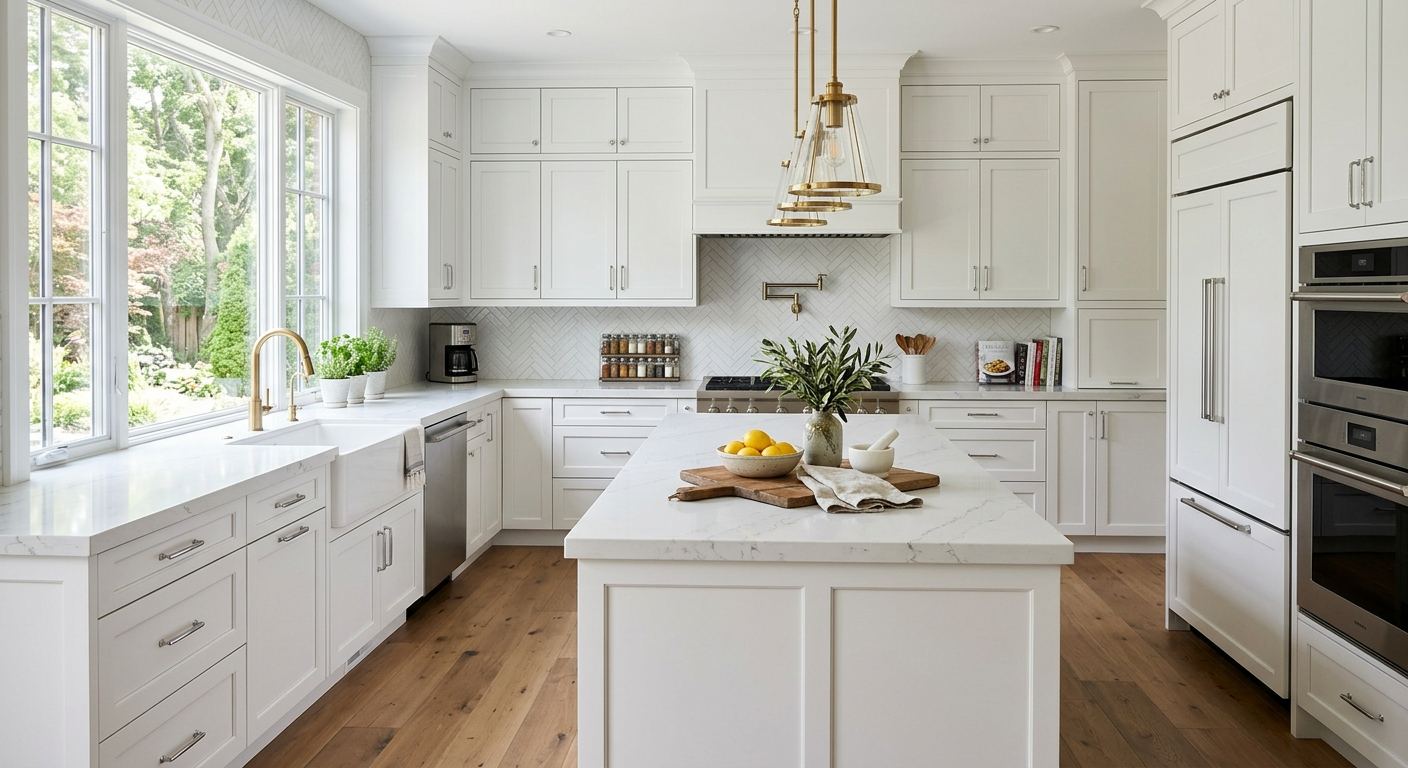
Kitchen renovation options and costs in Tweed
Tweed kitchen renovations typically start with a budget decision, because “the same kitchen” can land in very different cost tiers depending on finishes. In Tweed and nearby in the Kingston–Pembroke economic region, the homeowner profile matters: the median household income is $69,000 (Statistics Canada, 2021 Census), and the housing stock is older, with 61.2% of homes built before 1981 (Statistics Canada, 2021 Census). That older stock often means dated electrical panels, smaller service spaces, and plumbing runs that can’t always be reused when you change layout.
Even though Ontario weather doesn’t directly drive labour or material costs the way it might in climate-exposed envelope work, it does affect scheduling. Winter can slow on-site work that requires extended interior drying time, and spring scheduling is in higher demand as contractors ramp back up across the region. In practical terms, availability and inspection turnarounds are what homeowners feel—not the temperature itself. For many Tweed homeowners, projects are especially active around the town’s more established residential pockets near the central core, where turn-key renovations are common as families modernize compact kitchens.
Most quotes also track with the local market’s resale expectations more than “season.” Contractors often advise allocating about 7–10% of your home’s value for a full renovation, and then steering finish choices accordingly. In mid-market neighbourhoods, many clients choose laminate or mid-range quartz and semi-custom cabinetry, while higher-value homes can support fully custom cabinetry and premium stone—pushing budgets toward the upper part of Ontario’s typical band. Use the comparison below as a baseline, then we can tighten it with your cabinet and countertop selections.
| Renovation Tier |
What's Included |
Typical Duration |
Price Range |
| Cosmetic refresh (paint, hardware, new appliances only) |
New cabinet hardware, paint/stain refresh, trim touch-ups, appliance swap (no major plumbing/gas/electrical changes) |
1–3 weeks |
$8,000–$18,000 |
| Mid-range full renovation (new cabinets, counters, sink, tile) |
Semi-custom or stock cabinets, new countertops, new sink + faucet, backsplash tile, basic lighting adjustments, flooring replacement or refinishing depending on condition |
4–7 weeks |
$25,000–$55,000 |
| High-end full renovation (custom cabinets, stone counters, island) |
Fully custom cabinetry, premium quartz or natural stone counters, island fabrication, upgraded lighting plan, extensive backsplash (often to full-height sections), coordinated flooring |
7–12 weeks |
$55,000–$65,000 |
| Cabinet refacing only (new doors + drawer fronts, same boxes) |
Refaced cabinet fronts, new hardware, interior refresh options where feasible; excludes structural changes |
2–4 weeks |
$6,000–$18,000 |
| Countertop swap only (laminate to quartz or stone) |
Removal of existing countertop, new quartz/stone install, sink cut-out adjustments as needed |
3–7 days install time (often 2–3 weeks total with lead times) |
$2,500–$12,000 |
| Backsplash tile installation only |
Tile supply (mid-range ceramic/porcelain typical), underlay/prep, grouting and finishing; limited scope excludes full wall replacement |
3–8 days |
$1,500–$8,000 |
Prices are estimates only and vary by project scope, site access and material selection.
What affects the price of kitchen renovation in Tweed
In the Kingston–Pembroke region, two homeowners in Tweed can receive quotes that differ by 30–50% for the “same” kitchen, because the biggest cost drivers aren’t climate—they’re selections and uncertainty. Across Ontario, the finish tier choices (stock vs semi-custom vs custom cabinets, and laminate vs quartz/stone) usually move the needle more than weather. Local home values and median incomes also influence what buyers consider “normal” upgrades. With a median household income of $69,000 (Statistics Canada, 2021 Census), many Tweed renovations land in the mid-range band where laminate or mid-range quartz and semi-custom cabinetry are the best balance. In higher-value pockets of the region—where buyers expect premium surfaces—homeowners often upgrade directly to quartz or stone and custom millwork, pushing totals toward the $55,000–$65,000 end of the full renovation range.
Layout changes are where uncertainty spikes regardless of finish. Removing a wall for a more open flow, adding an island, or moving plumbing/gas lines can add labour, specialty trades, and material surprises (like subfloor reinforcement, new framing, and electrical rework). For example, older homes built before 1981 (Statistics Canada, 2021 Census) often have smaller wiring routes and older shutoff valves, which can add hours and replacement parts when you relocate a sink or dishwasher. Conversely, if you keep the sink and dishwasher in the same footprint and only swap counters and cabinets, projects tend to stay closer to the $25,000–$55,000 mid-range band.
Concrete Tweed examples we commonly price differently: (1) corner cabinets and out-of-square walls—common in older housing—can increase cabinet installation time, (2) venting paths for range hoods can require ducting changes that aren’t visible until demolition, and (3) if your existing flooring can be refinished instead of replaced, you avoid underlayment and subfloor prep costs. In practice, the quote swings most when scope is still “in the air” around layout and how much you plan to upgrade electrically and mechanically.
| Price Factor |
Why It Matters |
Cost Impact |
| Cabinet tier — stock vs. semi-custom vs. fully custom millwork |
Tier changes how doors/boxes are made, available storage options, and how much labour is spent fitting and finishing |
Often the largest single swing (can move total by ~40% across similar scopes) |
| Countertop material — laminate vs. quartz vs. granite vs. stone |
Material price, templating complexity, seam visibility, and edge profiles drive both material and install time |
Can add thousands quickly; typically a major portion of the mid-to-high tier jump |
| Layout change — wall removal, island add, plumbing/gas move |
Triggers framing, new supports, routing for lines, electrical tie-ins, and trades scheduling |
High variability; commonly the difference between a straightforward and premium renovation |
| Appliance package tier — builder vs. mid-range vs. pro-grade |
Pro-grade units may require different clearances, ventilation needs, and sometimes electrical spec changes |
Usually moderate, but can raise budgets notably when multiple appliances upgrade together |
| Flooring — refinish existing vs. full replacement |
Older subfloors can be uneven; replacing is more disruptive but sometimes necessary for a level base |
Typically moderate to high; can be low if existing floor is salvageable |
| Backsplash — ceramic tile vs. marble vs. full-height slab |
More expensive tile/stone needs heavier prep, more cutting, and careful pattern alignment |
Material can double or triple backsplash cost depending on coverage |
| Electrical — new circuits for island, under-cabinet lighting |
Additional lighting points and new circuits require licensed work, planning and inspections |
Can be small or significant; unpredictable when walls are opened late |
| Permit fees and licensed trade requirements |
Work that involves plumbing/electrical/gas often triggers inspections and licensed trade scope |
Usually manageable but adds complexity and timeline risk if discovered late |
Permits & regulations in Ontario
In Ontario, many “swap-only” kitchen updates typically don’t require permits—especially when you keep plumbing, gas, structure and wiring in the same locations. Cabinet and countertop swaps are usually straightforward from a permit standpoint. If you’re replacing cabinets in place, updating a backsplash, or changing countertops without moving the sink or changing mechanical connections, permits often aren’t required. That said, Tweed homeowners run into permit needs quickly when the project starts changing systems rather than surfaces.
Work that typically does require permits and licensed trades includes moving plumbing supply or drain lines, relocating a gas stove or any range/hood tied to gas (including changes that affect gas venting and connections), removing a load-bearing wall (structural changes), and adding electrical circuits (common when you add an island, increase receptacles, or install under-cabinet lighting that requires new runs). Gas work must be done by a licensed gas fitter, and electrical work by a licensed electrician; both typically require inspections.
Step-by-step, here’s how a homeowner in Tweed can verify a contractor and their trades: (1) request their Ontario licence information (and the licence details for gas and electrical subcontractors if applicable), (2) ask for a certificate of liability insurance, and confirm the coverage is active for the project period, (3) request WSIB/WCB clearance evidence for workers performing the work, and (4) confirm in writing who pulls permits and who is responsible for inspections. Don’t rely on verbal promises—make permit responsibility part of the contract scope.
Cabinets, countertops and layout decisions in Tweed
For a Tweed kitchen renovation, the three most consequential decisions are cabinet tier, countertop material, and layout. Cabinet tier controls look, storage performance, and how well the finished kitchen fits older rooms—important when many homes were built before 1981 (Statistics Canada, 2021 Census), and walls may be less than perfectly square. Layout decisions control cost unpredictability: opening up space with a wall removal, adding an island, or relocating plumbing/gas lines can shift the project from a predictable install into a multi-trade, permit-and-inspection job. Countertops then decide the “wow” factor and durability you’ll live with daily.
In the Kingston–Pembroke resale market, buyers tend to respond strongly to cohesive cabinetry and durable surfaces. At the mid-range end (often around the $25,000–$55,000 full renovation band), semi-custom cabinets paired with quartz usually deliver the best balance of price and long-term satisfaction. For higher-value buyers and more statement renovations approaching the $55,000–$65,000 range, fully custom cabinetry and premium natural stone or higher-end engineered stone are common—and the cost is easier to recover because the expected finish tier is aligned with buyer preferences.
Durability should be matched to Tweed’s practical realities: older homes can have slightly higher humidity swings indoors, so you want materials that tolerate routine cleaning without showing wear quickly. For a concrete dollar example, moving from laminate to quartz is often a worthwhile upgrade because quartz typically holds up better to daily use and resists staining; if a laminate countertop swap is in the lower end of countertop work (e.g., a few thousand dollars), moving to quartz or stone can push you toward the upper part of the same countertop band (often closer to several extra thousand). However, if your layout is already being changed—especially sink relocation—don’t overspend on premium stone at the expense of keeping cabinetry functional and properly fitted.
| Option |
Durability |
Maintenance |
Best For |
Price Range |
| Stock cabinets (big-box) |
Good for standard sizes; durability depends on box and finish quality |
Low to moderate; hardware and sealing matter |
Fast timelines and tight budgets where layout is straightforward |
$6,000–$15,000 |
| Semi-custom cabinets (local dealer) |
Very durable with better storage options and more sizing flexibility |
Low; keep hinges aligned and clean buildup from tracks |
The most common choice for mid-range full renovations in Tweed |
$15,000–$30,000 |
| Custom cabinets (local millwork shop) |
Highest durability and fit; best for irregular spaces and unique storage |
Low; occasional adjustment of hardware is typical |
High-end renovations with island/showcase storage and perfect fit |
$30,000–$45,000 |
| Laminate countertop |
Decent daily durability but more prone to edge wear if poorly finished |
Low; avoid long-standing water pooling on seams |
Best ROI for budget-focused refreshes and rental-friendly installs |
$2,500–$6,000 |
| Quartz engineered countertop |
High durability for scratches and staining |
Low; wipe and clean—no sealing needed |
Mid-range and high-value kitchens where appearance stays consistent |
$5,000–$12,000 |
| Granite / natural stone countertop |
Very durable and heat tolerant |
Moderate; periodic sealing may be recommended depending on stone |
Premium looks for homeowners targeting higher-end resale appeal |
$8,000–$14,000 |
| Butcher block countertop |
Good durability but vulnerable to deep cuts and heavy water exposure |
Moderate to high; regular oiling and dry wiping are important |
Farmhouse or warm designs and when you’re willing to maintain the surface |
$3,500–$9,000 |
| Marble countertop |
Beautiful but more susceptible to etching/staining than quartz |
Higher; requires attentive cleaning and often sealing |
Statement kitchens where the homeowner values premium look over maximum practicality |
$9,000–$18,000 |
How to choose a kitchen renovation contractor in Tweed
Choosing the right kitchen contractor in Tweed starts with proof, not promises. Verify Ontario licensing for the trades involved: a licensed electrician for electrical work, and a licensed gas fitter where gas is touched. Ask for their certificate of liability insurance and confirm it covers renovation work for the project’s duration. For worker coverage, ask for WSIB/WCB clearance documentation—this protects you as the homeowner if a worker is injured on site. If any subcontractors are involved, request the same documentation for them or confirm it’s included in the contractor’s own coverage and paperwork package.
Next, get 2–3 itemised written quotes. You want line items that separate labour from materials and show allowances (for cabinets, countertops, tile, disposal, and any sub-trades). Avoid lump-sum quotes that don’t specify what’s excluded. Read the scope carefully: is permit pulling included, who pays permit fees, and is demolition/disposal included in the price? Check warranty details too—ask for the workmanship warranty length and whether manufacturer warranties transfer with the installation.
Payment schedule matters in Ontario renovators’ best practice. Never pay more than 10–15% upfront, and set a holdback until key completion milestones are met. Finally, insist on a timeline with a written start date and a realistic completion estimate, including cabinet/counter lead times.
- Request licence details for the trades doing electrical and gas work.
- Confirm certificate of liability insurance (and project dates).
- Provide WSIB/WCB clearance evidence for workers.
- Get 2–3 itemised quotes (labour + materials breakdown, not one lump).
- Ensure the contract lists what’s included for demolition and disposal.
- Ask who pulls permits and whether permit fees are included.
- Confirm electrical scope: outlets, lighting, island circuits if added.
- Confirm plumbing/gas scope: whether supply/drain/gas venting changes are priced.
- Check cabinet warranty terms and installation workmanship warranty.
- Verify countertop template timing and responsibility for re-cuts.
- Set a payment schedule with a holdback (completion-based).
- Get a written schedule that includes material lead times.
Red flags to watch for in Tweed: a contractor who won’t provide licence/insurance/clearance documentation; quotes that don’t specify disposal and permit responsibility; “too good to be true” pricing that lacks allowances or engineering for layout changes; pressure to sign quickly without a detailed scope; and vague timelines that ignore cabinet/counter lead times (a common reason mid-renovation schedules slip).
Frequently asked questions — kitchen renovation in Tweed
Can I live at home during a kitchen renovation in Tweed?
Often yes, especially for a cosmetic refresh or a mid-range full renovation where the crew can work in phases. In Tweed (and across Ontario), most kitchens can be set up with a temporary cooking area—commonly a microwave, kettle, and small induction/burners—while cabinets and counters are removed and installed. The main practical question is whether your project requires moving plumbing or creating a new layout; that’s when access to sinks and gas appliances can be limited. For example, a cabinet refacing only job is frequently easier to live through than a full renovation where the sink, dishwasher, and countertop are all removed together. If your budget sits in the $25,000–$55,000 band, ask your contractor to map out the sequence (demolition, rough-ins, install, finishing) so you know when each function returns.
Should I renovate my kitchen before selling in Tweed?
In many cases, yes—but it depends on how dated the kitchen is and whether the renovation supports what local buyers expect. Tweed and the wider Kingston–Pembroke region have a mix of homeowners and households, including many owner-occupiers; the median household income is $69,000 (Statistics Canada, 2021 Census), which often influences what buyers can justify paying for finishes. A smart approach is targeting a mid-range full renovation level (roughly $25,000–$55,000) rather than overspending on custom stone if the rest of the home doesn’t match. Buyers also notice layout and functionality: fresh cabinets and quartz with an updated backsplash can modernize the space without the risk of major plumbing relocation. If your home is older (61.2% built before 1981, Statistics Canada, 2021 Census), consider fixing functional issues (like electrical receptacles and plumbing condition) alongside aesthetics, because buyers may discount heavily for safety or maintenance concerns.
What's the most popular kitchen style in Tweed right now?
Right now, homeowners in Tweed commonly choose a bright, modern look with warm neutrals: simple shaker-style or clean-lined cabinetry, lighter countertop colours, and a backsplash that adds texture without being overly busy. In practical terms, most mid-range projects lean toward semi-custom cabinetry and quartz because the finish is consistent and low-maintenance for daily use. At the same time, you still see some character-driven choices—especially in older homes—like butcher block accents or subtle tile patterns. Style popularity is closely tied to budget realities: homes renovated near the $25,000–$55,000 range typically balance longevity with cost, while higher-end kitchens near $55,000–$65,000 are more likely to include custom cabinetry and stone counters or islands. The best “popular” style is the one that fits your room size and layout, because Tweed’s older housing stock often has smaller or oddly shaped kitchens.
How do I know if I need to update my kitchen plumbing in Tweed?
You usually don’t know until you open walls or inspect shutoffs, supply lines, and the drain configuration—especially in older homes. Since 61.2% of homes in the area were built before 1981 (Statistics Canada, 2021 Census), plumbing components and valves can be older, and sometimes you’ll find mixed materials, aging shutoffs, or drain runs that don’t meet the new layout cleanly. Signs include slow drains, frequent dishwasher leaks, corroded supply lines, low water pressure at the sink, or repeated backups when you run multiple fixtures. Plumbing updates also matter when you change your sink location, add an island, or relocate the dishwasher—those moves can turn a cosmetic refresh into a more involved job with licensed plumbing work and potential permits. If your contractor finds issues during demolition, ask for a written options list so you understand cost and timeline impacts before approving changes.
What is the difference between a galley and open-concept kitchen?
A galley kitchen is a long, corridor-style layout with two parallel runs of cabinets and usually a door or small passage at each end. It’s efficient for cooking and works well in narrower rooms, which is common in older housing plans. An open-concept kitchen removes barriers and visually connects the kitchen with living/dining areas; it often includes larger openings and sometimes an island to define the space. In Tweed renovations, the cost difference is often less about “style” and more about what changes you make to structure and mechanical runs. Converting to open-concept may involve removing a wall, upgrading ventilation, and potentially adding electrical circuits—steps that typically require permits and licensed trades. Keeping a galley layout can help you stay closer to a mid-range band like $25,000–$55,000, whereas wall removal and line relocations can push budgets upward even if you choose similar cabinet finishes.
How do I get accurate kitchen renovation quotes in Tweed?
Accurate quotes come from scope clarity and documented selections. Start by gathering your measurements and a clear wishlist: cabinet tier (stock, semi-custom, or custom), countertop material (laminate, quartz, granite/stone), backsplash coverage, and whether you’re changing the sink location, adding an island, or upgrading lighting. Then request 2–3 itemised quotes with labour and materials separated, plus allowances where selections aren’t final. Make sure the contractor specifies what’s included for demolition and disposal, and whether permit pulling is included or handled separately. It’s also critical to confirm who is responsible for plumbing/gas/electrical permitting because licensed work can change the price and timeline. For budgeting, use the local bands as a reality check: full renovations typically sit around $25,000–$65,000, while cabinet refacing or countertop-only work is much narrower. Avoid quotes that don’t explain what happens if your kitchen layout needs surprises during demolition.