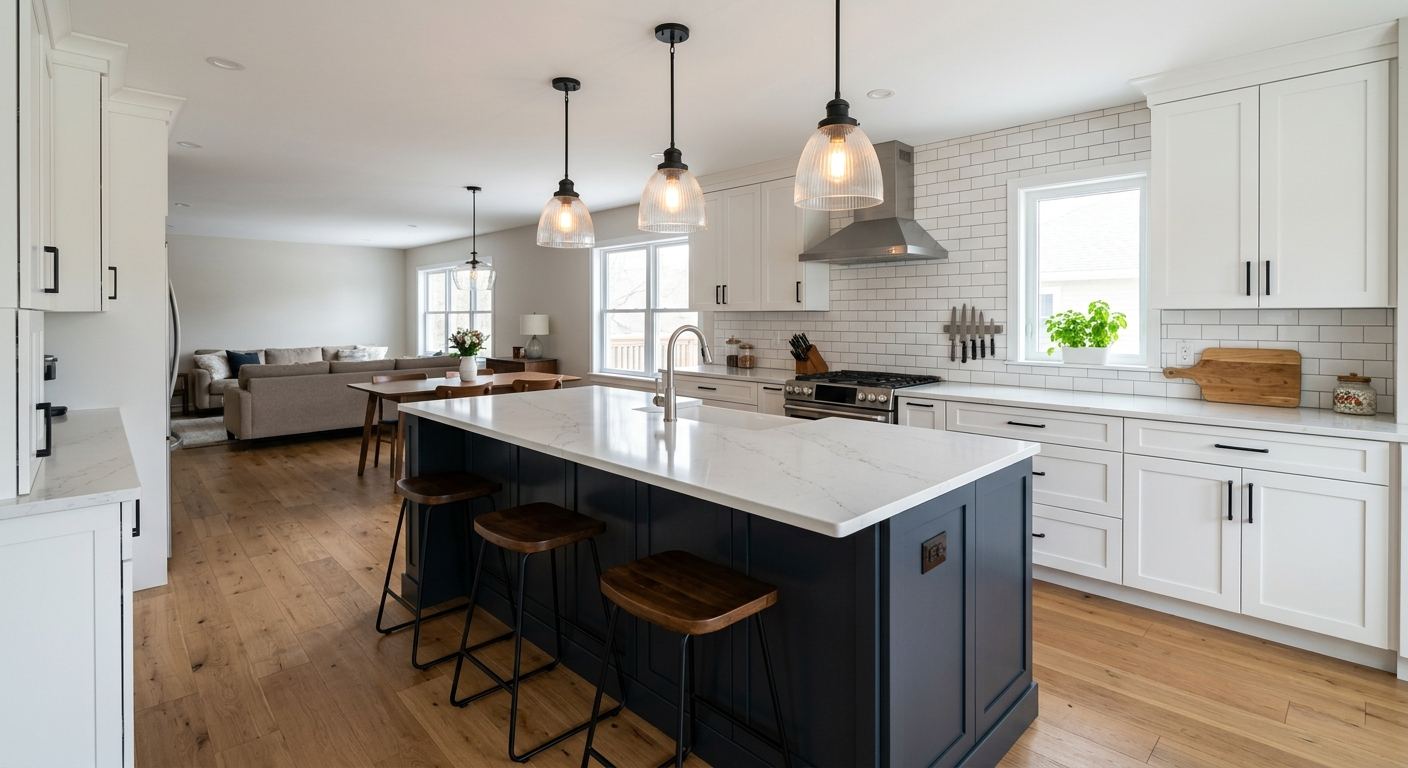
Kitchen renovation options and costs in Cabbagetown-South St.James Town
Cabbagetown-South St.James Town is one of Toronto’s most renovation-active neighbourhoods, and homeowners there often want their kitchens to feel “updated” while still matching the pace of the housing market. With a population of 11,669 (Statistics Canada, 2021 Census) in the local profile and a steady demand for resale-ready finishes, most kitchens are planned around buyer expectations, not just personal taste. That reality matters for pricing: in the Toronto economic region, kitchen budgets tend to track local home values and household income, which is why higher-finish choices—quartz counters, upgraded appliances, and semi-custom cabinetry—show up more frequently in central Toronto than in price-sensitive GTA pockets. In practice, finish tier is the main driver rather than climate.
Ontario’s weather does influence kitchen renovation costs indirectly. Moisture swings and cold winters can make subflooring, caulking, and poorly detailed tile installations fail sooner, so good contractors build in better ventilation, water-resistant materials, and proper underlay details—especially in older homes common around Cabbagetown-South St.James Town. At the same time, contractor availability is strong in Toronto, but peak-season scheduling can add acceleration costs if you want a fast timeline.
One local area where the trade is especially in demand is the Cabbagetown pocket around Carlton Street and the St. James Park edges, where homeowners frequently renovate while preparing for listing photos and open houses. From there, the next step is choosing the right scope—so use the table below to compare realistic budgets by renovation tier.
| Renovation Tier |
What's Included |
Typical Duration |
Price Range |
| Cosmetic refresh (paint, hardware, new appliances only) |
Prep and paint, cabinet hardware swap, appliance replacement, minor caulk/trim touch-ups; usually no cabinet or countertop demolition |
3–7 days |
$2,500–$10,000 |
| Mid-range full renovation (new cabinets, counters, sink, tile) |
New semi-custom or stock cabinets, new countertops (often quartz or good laminate), sink and faucet, backsplash tile, basic electrical updates as required |
3–6 weeks |
$25,000–$55,000 |
| High-end full renovation (custom cabinets, stone counters, island) |
Custom millwork, premium quartz/natural stone, island (often with upgraded lighting), full-height backsplash options, more extensive lighting and finish carpentry |
6–12 weeks |
$70,000–$90,000 |
| Cabinet refacing only (new doors + drawer fronts, same boxes) |
Refacing of existing cabinet boxes, new door/drawer fronts, upgraded hardware, repaint where needed, usually no countertop replacement |
1–2.5 weeks |
$8,000–$20,000 |
| Countertop swap only (laminate to quartz or stone) |
Remove existing top (and often old sink), install new countertop and backsplash lineal finish, seal where required, minor plumbing adjustments |
3–10 days |
$3,000–$15,000 |
| Backsplash tile installation only |
Tile supply allowance, prep, tile setting, grouting, sealing as needed, finish trims, and cleanup |
3–7 days |
$2,000–$10,000 |
Prices are estimates only and vary by project scope, site access and material selection.
What affects the price of kitchen renovation in Cabbagetown-South St.James Town
Even when two homeowners in Cabbagetown-South St.James Town describe the “same” kitchen renovation, quotes can land 30–50% apart. The main reason is that line items rarely match: cabinet tier, countertop type, and the amount of hidden labour (demo, reinforcement, electrical rough-in, subfloor preparation) can swing widely. In Toronto, local home values and median income shape what finish tier homeowners choose far more than climate. In higher-value economic pockets, many owners lean into quartz or natural stone and semi-custom cabinetry because that spend is easier to recoup on resale when buyers expect a more “finished” look. In more modest-market projects, laminate and stock cabinets keep budgets closer to the lower side of the $25,000–$90,000 full-renovation band.
Layout changes create the most unpredictable costs regardless of finish. Removing a wall for an open-concept feel, adding an island, or moving plumbing and gas lines forces rework of subfloor, framing, insulation, venting, and often electrical routing. For example, if you target a mid-range full renovation around the $25,000–$55,000 range but then add an island and move a sink, it can quickly behave like a higher-scope build in the $55,000–$90,000 band due to added trades and long-lead materials.
In Cabbagetown-South St.James Town specifically, older housing stock can raise costs in a few common ways: tight service routes can make electrical and plumbing work slower, and uneven floors sometimes require more leveling before cabinets go in. Also, winter schedules can affect drying and curing windows for adhesives and thinset, so contractors may recommend sequencing that protects tile and stone installs in cold Ontario conditions.
| Price Factor |
Why It Matters |
Cost Impact |
| Cabinet tier — stock vs. semi-custom vs. fully custom millwork |
Tier affects box quality, internal storage, finishing, hardware allowance, and lead times |
- Stock: lowers total budget and speeds install
- Semi-custom: most common mid-range choice
- Custom: largest swing within full renovations
|
| Countertop material — laminate vs. quartz vs. granite vs. stone |
Material cost, fabrication complexity, and edge/detail options drive pricing |
- Laminate: lowest installed cost
- Quartz: common “best value” tier
- Granite/natural stone: premium pricing and heavier install considerations
|
| Layout change — wall removal, island add, plumbing/gas move |
Reframes, reroutes utilities, and adds inspections and patch work |
- Typically the biggest variance: rework can add days and multiple trades
- Can move a project from mid-range into high-end scope
|
| Appliance package tier — builder vs. mid-range vs. pro-grade |
Appliances change installation requirements, finish details, and sometimes electrical/venting needs |
- Builder grade: usually fits tight budgets
- Mid-range: balances features and resale appeal
- Pro-grade: higher cost and often more precise installation
|
| Flooring — refinish existing vs. full replacement |
Kitchen demo affects adjacent flooring; matching existing can be cheaper or difficult depending on age |
- Refinish: can hold costs down if surfaces are stable
- Replacement: common when subfloor or layout changes require it
|
| Backsplash — ceramic tile vs. marble vs. full-height slab |
Coverage area and material premium change labour intensity and breakage risk |
- Ceramic: moderate labour and most flexible
- Marble/stone: higher material and careful detailing
- Full-height slab: highest labour and sealing complexity
|
| Electrical — new circuits for island, under-cabinet lighting |
Adding outlets/lighting often requires panel planning and licensed electrical work |
- Basic updates: smaller add
- Island/outlet density: noticeable jump in labour and parts
|
| Permit fees and licensed trade requirements |
Some work triggers permits and inspection schedules |
- Often modest for countertop/cabinet-only scopes
- Can add cost and time when plumbing, gas, or electrical circuits are changed
|
Permits & regulations in Ontario
In Ontario, cabinet and countertop swaps typically do not require a permit. If you’re replacing cabinets with the same layout, swapping a countertop, changing hardware, or installing a backsplash without moving utilities, most projects stay permit-free. However, if your kitchen renovation in Cabbagetown-South St.James Town involves anything that changes building services or structural conditions, permits and licensed trades can be required. Moving plumbing supply or drain lines, relocating a gas appliance (like a stove) or any gas-related venting work, removing a load-bearing wall (or structural alterations), and adding new electrical circuits (for example, island outlets or significant under-cabinet lighting with new wiring) are common triggers that require permits and inspections.
For homeowner verification, do this step-by-step before you sign: (1) confirm the contractor’s Ontario licence and business details through the appropriate provincial/industry licensing information they provide and any searchable public registry entry; (2) ask for a certificate of insurance and make sure it lists coverage suitable for your project (liability coverage for property damage and worker injuries); and (3) confirm WSIB/WCB coverage for the trades they employ or subcontract—request a clearance letter or current proof of coverage. Get the answers in writing with the quote. Permit responsibility—who pulls the permit and who is accountable for code compliance—should be clearly stated in your signed contract.
Cabinets, countertops and layout decisions in Cabbagetown-South St.James Town
In a Cabbagetown-South St.James Town kitchen renovation, the three biggest decisions that affect both cost and satisfaction are: (1) cabinet tier, (2) countertop material, and (3) layout changes. Cabinet tier is your “daily use” foundation. Stock cabinets are the fastest and cheapest, but they can feel less tailored. Semi-custom cabinets are the most popular mid-range option because you get better storage and size flexibility without the premium of custom millwork. Custom cabinets deliver the best fit and storage design, but they carry the highest cost and often longer lead times.
Countertop choice is where the Toronto resale market shows strongly. Laminate is budget-friendly and can look clean with modern edge profiles, but it’s more sensitive to burns and impacts. Quartz is a common value sweet spot: durable, consistent, and easier to maintain—an advantage in a kitchen that gets heavy weekday use. Granite and other natural stones offer prestige and unique patterns, while butcher block adds warmth but needs oiling and care. Marble is elegant but is higher-maintenance, especially in a family kitchen where acidic spills are common.
Layout changes—open-concept wall removal, island additions, or plumbing/gas relocation—are justified when the space gain solves a real problem: poor traffic flow, too little counter space, or inadequate seating. For example, if you start in the $25,000–$55,000 mid-range tier and then move a sink to support an island, you’re often paying for rough-in labour, patching, and finishing time; in that case, the project may need to move toward the $55,000–$90,000 range to cover utilities and the extra work scope. Ontario’s temperature swings also make proper sealing and ventilation details important, especially for tile edges and countertop seams.
| Option |
Durability |
Maintenance |
Best For |
Price Range |
| Stock cabinets (big-box) |
Good day-to-day durability with basic hardware; limited customization |
Low; standard cleaning, tighten hardware as needed |
Budget-conscious upgrades with minimal changes to layout |
$8,000–$18,000 |
| Semi-custom cabinets (local dealer) |
Very good durability and better internal organization options |
Low to moderate; keep hinges aligned and wipe surfaces regularly |
Most Toronto-area homeowners seeking resale-ready storage |
$15,000–$35,000 |
| Custom cabinets (local millwork shop) |
Excellent build quality with tailored storage and fit |
Low; premium finishes may require slightly more careful cleaning |
Unique layouts, built-in appliances, and high-end finish goals |
$30,000–$60,000 |
| Laminate countertop |
Moderate; can chip with heavy impacts and is sensitive to heat |
Low; avoid standing water at seams and use heat protection |
Keeping costs down while updating appearance |
$3,000–$7,000 |
| Quartz engineered countertop |
High; resistant to staining and everyday wear |
Low; routine cleaning with non-abrasives |
Busy households and buyers expecting “modern premium” |
$5,000–$12,000 |
| Granite / natural stone countertop |
High; strong and resilient with proper sealing (as applicable) |
Moderate; periodic sealing and careful cleaning |
Premium look with natural variation and a timeless feel |
$7,000–$15,000 |
| Butcher block countertop |
Moderate to high; susceptible to cuts and moisture if neglected |
Moderate; regular oiling and prompt drying |
Warm, traditional style and light-to-moderate cooking |
$4,000–$10,000 |
| Marble countertop |
Moderate; can etch or stain with acids and abrasive cleaners |
Higher; requires careful cleaning and periodic sealing |
Low-to-moderate kitchen traffic and a luxury aesthetic |
$8,000–$18,000 |
How to choose a kitchen renovation contractor in Cabbagetown-South St.James Town
Choosing the right contractor for a kitchen renovation in Cabbagetown-South St.James Town starts with proof, not promises. In Ontario, verify licensing, liability insurance, and WSIB/WCB coverage before work begins. Ask for the contractor’s current certificate of insurance—confirm the dates are valid and the coverage is appropriate for renovation work. For WSIB/WCB, request proof or a clearance letter and make sure it applies to the trades that will be on site, whether the contractor employs them directly or through subs. If they can’t provide documentation quickly, that’s a practical red flag.
Next, get 2–3 itemised written quotes with labour and materials broken out. A detailed quote should show what’s included for demo, cabinet installation, countertop fabrication/installation, tile prep, electrical allowances, disposal, and finishing details. Read the scope carefully: what is excluded (for example, floor replacement if damaged during demo), who pulls permits (if required), and whether disposal is included. Warranty matters too—ask for the workmanship warranty length and product/manufacturer warranties, and whether warranties are transferable if you sell your home. For payment schedule, don’t give away leverage: never pay more than about 10–15% upfront, and use a holdback until key milestones are complete. Finally, insist on a written start date and completion estimate; kitchens are multi-trade, so your timeline needs to reflect fabrication lead times.
- Provide insurance certificate with valid coverage dates
- Provide WSIB/WCB proof or clearance letter for their workers/subs
- Show Ontario licensing information and confirm who does permit pulling if needed
- Use itemised quotes (labour vs materials) instead of a single lump-sum line
- Include disposal/haul-away scope in writing
- State what’s included for demolition protection (doorways, floors, adjacent rooms)
- Confirm allowance pricing for fixtures, flooring trims, and tile patterns
- Clarify countertop template timing and responsibility for delays
- List warranty terms: workmanship start/end date and exclusions
- Require a written change-order process before any extra work
- Ask about how they handle cold-weather curing for tile/adhesives in Ontario winters
- Lock the schedule with milestones (demo complete, cabinet install, countertop install, final trim)
Red flags in Cabbagetown-South St.James Town: (1) they won’t provide WSIB/WCB clearance or insurance paperwork; (2) quotes are vague and don’t separate labour and materials; (3) they insist on large upfront payments beyond 10–15%; (4) they can’t explain who pulls permits when plumbing/gas/electrical is involved; and (5) warranty is offered verbally without specifics in the contract.
Frequently asked questions — kitchen renovation in Cabbagetown-South St.James Town
Do I need a permit for a kitchen renovation in Ontario?
In most Ontario kitchen refreshes in Cabbagetown-South St.James Town, cabinet and countertop swaps typically do not require a permit. If you’re only painting, replacing hardware, swapping appliances, and installing a backsplash without moving plumbing or electrical, you usually remain permit-free. Where it changes is when you move plumbing supply/drain lines, relocate a gas stove/range hood involving gas, remove a load-bearing wall, or add new electrical circuits (common with island outlets or new under-cabinet lighting runs). Those scenarios generally require permits and inspections. Always confirm in your written contract who is responsible for permit applications and licensed trade scheduling—then verify the contractor’s documentation before work starts.
What's the ROI on a kitchen renovation?
ROI is not guaranteed, but in the Toronto market many homeowners recover a meaningful portion of the value when the renovation improves function and finishes buyers expect. In higher-value areas of the Toronto economic region, owners often invest roughly 8–15% of home value into a kitchen, which aligns with more premium choices like quartz/natural stone and semi-custom cabinetry. Practically, a “mid-range” renovation in the $25,000–$55,000 band can help resale when the existing kitchen is dated or poorly laid out, while high-end builds pushing toward the $70,000–$90,000 range need a realistic match to the home’s overall value and buyer segment. The best ROI usually comes from solving layout and storage issues plus upgrading visible surfaces—rather than upgrading every fixture to the highest tier.
How do I budget for a kitchen renovation?
Budgeting should start with scope, then finish tier. In Cabbagetown-South St.James Town, realistic full-kitchen budgets commonly land from mid-$20k into the $80k+ range depending on cabinets, countertops, and whether utilities move. If you want a quick, lower disruption update, plan for a cosmetic refresh or smaller sub-projects (backsplash or countertop swap). If you’re changing cabinets and counters and adding tile, a mid-range full renovation is often in the $25,000–$55,000 area. For custom millwork, premium stone, and island work, plan closer to $70,000–$90,000. Build in contingencies for older-home surprises (uneven floors, outdated electrical routes) and ask your contractor to itemise labour and materials so you can see where the money is actually going.
Can I move my kitchen sink or stove?
Yes, you can move a sink or stove in Ontario, but it’s the work that creates most of the permitting and added cost in Cabbagetown-South St.James Town. Moving a sink usually means rerouting plumbing supply and drain lines, plus patching and re-sealing around the countertop and tile. Relocating a stove involves additional considerations, especially if it’s gas—gas work must be done by a licensed gas fitter and inspected. Because these are the areas with the most variability, your best approach is to confirm your feasibility early (measuring, existing venting, floor joists, and service routes) and then request an itemised quote that clearly separates countertop/cabinet work from rough-in plumbing/electrical/gas work.
What's the most cost-effective kitchen upgrade?
Often, the most cost-effective upgrade is one that gives the biggest visual and functional change without triggering extensive demolition. Many Toronto homeowners choose either cabinet refacing (new doors/drawer fronts on existing boxes) or a countertop swap paired with a new backsplash. Refacing can refresh the entire look while controlling labour and materials, and a quartz countertop can dramatically modernize the kitchen with less disruption than a full gut. If your cabinets are already structurally sound and your layout works, a targeted plan can keep you in the $8,000–$35,000 range for cabinets/refacing plus a countertop and backsplash approach rather than moving into a full renovation budget of $25,000–$90,000. The “best” choice depends on whether your existing boxes, plumbing locations, and wall condition are still in good shape.
Custom vs stock cabinets — is custom worth it?
Custom cabinets can be worth it when you need a perfect fit for an unusual layout, built-in appliances, or high-end storage solutions—common reasons homeowners move beyond stock in Cabbagetown-South St.James Town. But stock cabinets are usually the better value when your measurements are standard and you’re trying to keep the kitchen renovation inside the mid-range full-renovation band ($25,000–$55,000). Custom millwork tends to push budgets toward the higher end ($70,000–$90,000 full renovation) because of design time, fabrication, and longer lead times. A practical middle-ground is semi-custom: it’s often the “most popular” way to get better storage and more finish options without the full cost of custom. Ask your contractor for examples of cabinetry that match your measurements and resale expectations.