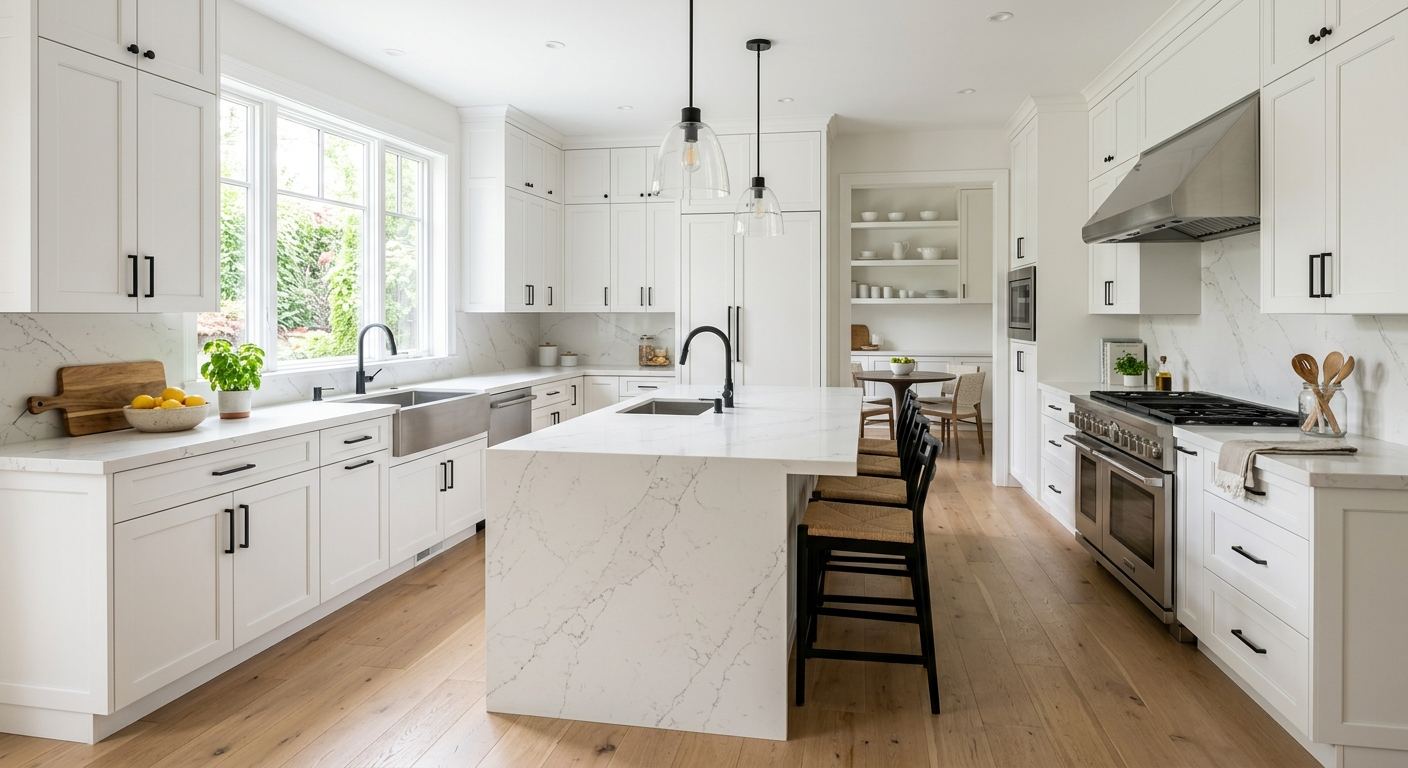
Kitchen renovation options and costs in Cobden
Cobden homeowners typically start with a “refresh” idea, then quickly find the real budget depends on the finish tier and whether the project stays cosmetic or touches plumbing, gas, electrical, or the layout. With Cobden’s small population of 1,071 people (Statistics Canada, 2021 Census), many kitchen renovations are scheduled around contractor availability from the broader Ottawa area, so lead times for cabinetry and stone can be longer during peak home-renovation months. In the Toronto economic region, pricing behaviour tracks home values and household incomes far more than weather—owners often choose the finish that best matches what buyers expect on resale. In higher-value pockets, it’s common to see kitchens targeted at the “8–15% of home value” level, which pushes projects toward quartz or natural stone and more custom millwork; in more price-sensitive pockets, budgets more often land in a mid-range tier with stock or refaced cabinets and good solid-surface options. (Statistics Canada, 2021 Census)
Ontario’s climate doesn’t drive “kitchen-specific” costs the way it does in exterior work, but it affects building operations: winters can slow drying times after paint and tile set-up, and moisture management matters if you’re installing new flooring that interfaces with base cabinets. Market conditions in the Toronto economic region also influence material pricing and scheduling: stone suppliers and semi-custom cabinet lines can jump in cost when demand spikes, even if your design stays the same. For Cobden, the trade is especially active with older bungalow and cottage-style homes where layouts and dated cabinetry need upgrading—commonly around local waterfront and lake-adjacent properties where storage and durable surfaces matter. With that context, here’s a practical cost comparison to help you place your project on the right budget path.
| Renovation Tier |
What's Included |
Typical Duration |
Price Range |
| Cosmetic refresh (paint, hardware, new appliances only) |
Paint, new cabinet hardware, appliance swap, basic trim touch-ups |
3–7 days |
$8,000–$18,000 |
| Mid-range full renovation (new cabinets, counters, sink, tile) |
New or refaced cabinetry (semi-custom style), quartz or quality laminate counters, sink & faucet, backsplash tile, new flooring prep/repairs as needed |
3–5 weeks |
$25,000–$60,000 |
| High-end full renovation (custom cabinets, stone counters, island) |
Fully custom cabinetry, natural stone or premium quartz counters, island cabinetry, enhanced backsplash (often full-height), upgraded fixtures and appliance package |
6–10+ weeks |
$60,000–$90,000 |
| Cabinet refacing only (new doors + drawer fronts, same boxes) |
New doors/drawer fronts, hardware, finish/touch-up, optional interior shelving upgrades |
1–2+ weeks |
$8,000–$35,000 |
| Countertop swap only (laminate to quartz or stone) |
Remove existing tops, template, install new quartz/stone, seal where required, connect/disconnect sink |
1–2 weeks |
$3,000–$15,000 |
| Backsplash tile installation only |
Tile supply & install (ceramic or upgraded tile), surface prep, grout/seal, edge finishing |
3–7 days |
$2,000–$10,000 |
Prices are estimates only and vary by project scope, site access and material selection.
What affects the price of kitchen renovation in Cobden
For the same basic kitchen, Cobden quotes can swing by 30–50% across the Toronto economic region and Ontario because the scope is rarely identical: one contractor counts demolition and protected dust control as part of labour, another includes or excludes countertop templating, appliance hookups, or changes to the electrical plan. In practice, local home values and household incomes shape the typical finish tier far more than climate. In higher-value markets around Toronto and parts of Vaughan/Markham, homeowners more often default to quartz or natural stone and semi-custom cabinetry because the spend is easier to justify at resale—many buyers expect an “updated, move-in-ready” look with durable surfaces. In more modest-budget markets, laminate or stock cabinets dominate because they deliver a stronger value-to-cost ratio.
Here are concrete Cobden examples that routinely raise or lower costs. Example one: if your kitchen is older and the existing base boxes aren’t square, cabinet installation time can increase, and you may need filler panels or a rebuild around the wall—pushing a job toward mid-range budgets like $25,000–$60,000 even when you planned “simple” cabinets. Example two: if you’re replacing laminate counters with quartz, the cost difference is often manageable when plumbing stays put, but if you’re also upgrading the sink and faucet and reworking the drain connection, countertop swap-only budgets like $3,000–$15,000 can expand quickly. Example three: layout changes—removing a wall, adding an island, or moving a gas line—introduce permit work, licensed trade coordination, and extra carpentry/electrical/plumbing time, which is the main unpredictable cost regardless of whether you choose stock or custom cabinetry.
Bottom line: Toronto-region material and scheduling patterns influence price consistency, but in Cobden the biggest lever is still whether you keep the layout and utilities where they are, then choose the finish tier that matches how you want the kitchen to sell.
| Price Factor |
Why It Matters |
Cost Impact |
| Cabinet tier — stock vs. semi-custom vs. fully custom millwork |
Material quality, fit/finish, drawer upgrades and lead times vary greatly |
Often shifts total project cost by the largest margin within the same layout |
| Countertop material — laminate vs. quartz vs. granite vs. stone |
Installed cost, fabrication method, and edge/seam complexity change |
Can move countertop budgets from lower single-digit thousands to premium ranges |
| Layout change — wall removal, island add, plumbing/gas move |
Triggers coordination across trades and increases demolition and restoration scope |
Typically adds major cost beyond finish-only upgrades |
| Appliance package tier — builder vs. mid-range vs. pro-grade |
Electrical draw, ventilation needs, and accessory fit can change installation |
Moderate to significant swings depending on venting and fuel type |
| Flooring — refinish existing vs. full replacement |
Cabinets often cover flooring edges; replacement requires full removal/installation |
Refinishing keeps costs lower; full replacement increases both labour and waste |
| Backsplash — ceramic tile vs. marble vs. full-height slab |
Coverage area and material thickness drive prep and install complexity |
From a few thousand to premium “wow-factor” levels |
| Electrical — new circuits for island, under-cabinet lighting |
Additional circuits require licensed work and inspection coordination |
Can raise costs noticeably even when cabinetry and counters stay the same |
| Permit fees and licensed trade requirements |
Permits, inspections, and scheduling licensed trades add both time and admin |
Often a smaller line item than materials, but it controls the schedule and risk |
Prices are estimates only and vary by project scope, site access and material selection.
Permits & regulations in Ontario
In Ontario, a straightforward cabinet or countertop swap generally does not require permits: replacing existing tops, swapping cabinet doors, refacing with the same box layout, or painting is typically treated as renovation work that doesn’t alter structural, plumbing, gas, or electrical systems. Where permits and licensed trade involvement start is when you change the services or the structure. Moving plumbing supply or drain lines, relocating a sink, relocating a dishwasher that changes rough-in locations, relocating a gas stove or adjusting gas lines (including some range hood ventilation setups), removing a load-bearing wall, or adding new electrical circuits (for example, powering island outlets or adding dedicated under-cabinet lighting circuits) typically requires permits and inspection.
For homeowners in Cobden, the safest way to verify contractor compliance is to treat it like a checklist before you sign and before work starts:
Step 1: Request the contractor’s business licence details (where applicable in your area) and confirm who will pull permits. Step 2: Ask for Certificate of Insurance and ensure you have coverage limits that match renovation risk (general liability, and if applicable, WSIB/WCB clearance documents). Step 3: For licensed trades, verify the electrician and gas fitter credentials directly through Ontario’s licence/registry information and ask for their clearance letter or evidence of coverage for each trade involved. Step 4: Make sure permit responsibility is written clearly in the contract—who files, who pays, and who schedules inspections. Step 5: Keep copies of permit numbers and inspection receipts for your records and future resale documentation.
Cabinets, countertops and layout decisions in Cobden
The three most consequential decisions in a Cobden kitchen renovation are: (1) cabinet tier, (2) countertop material, and (3) layout changes. Cabinet tier affects not just appearance, but how quickly the kitchen can be installed and how well it fits the existing walls—important in older homes where framing isn’t always perfectly plumb. Stock cabinets are fastest and cheapest, semi-custom is the most popular mid-range route (best balance of style and cost), and custom millwork is the highest-cost choice but delivers the best fit for odd corners, pantry configurations, and built-in appliance layouts that buyers notice on walkthrough.
Countertops then determine day-to-day durability and maintenance. Laminate is budget-friendly and can look excellent, but it’s more prone to damage at seams and edges. Quartz is a strong Toronto-market default because it resists staining and holds up well to busy household use. Granite/natural stone looks premium, but it typically needs sealing and careful attention to etching from acidic products. Butcher block can be warm and inviting in Cobden cottages and bungalow kitchens, yet it requires regular oiling and is less forgiving if you want a low-maintenance “never think about it” surface.
Layout changes—like opening an old wall, adding an island, or relocating plumbing/gas—are justified when you’re gaining real space and function, not just chasing a trend. In Ontario, moving services usually increases unpredictability because it adds trade coordination and potential permit work. For example, if you keep the sink and stove where they are, you might keep your kitchen within a mid-range budget around $25,000–$60,000. If you add an island with moved electrical and plumbing rough-ins, you’re much more likely to drift toward the upper $60,000–$90,000 range even with “reasonable” cabinet and countertop selections.
| Option |
Durability |
Maintenance |
Best For |
Price Range |
| Stock cabinets (big-box) |
Good for standard layouts; can show fit gaps on older walls |
Low day-to-day care; hardware upgrades are usually easy |
Fast projects and buyers who want a clean look without big custom costs |
$8,000–$25,000 |
| Semi-custom cabinets (local dealer) |
Very good durability; improved drawer/hinge options |
Low maintenance; better options for storage and pull-outs |
The most common choice in the Toronto economic region for resale balance |
$15,000–$45,000 |
| Custom cabinets (local millwork shop) |
Excellent fit and finish; best for unique dimensions and built-ins |
Low maintenance; premium hardware and finishes often included |
Premium kitchens, built-ins, and homeowners who want “designed for you” |
$30,000–$65,000 |
| Laminate countertop |
Moderate; sensitive at seams/edges |
Wipe clean; avoid cutting directly on the surface and protect seams |
Budget-focused refreshes where the goal is updated surfaces |
$3,000–$7,000 |
| Quartz engineered countertop |
High; resistant to most staining and everyday wear |
Low maintenance; no sealing typically required |
Move-in-ready kitchens that match what many Toronto-area buyers expect |
$7,000–$15,000 |
| Granite / natural stone countertop |
High; strong heat resistance with proper care |
Periodic sealing; needs protection against etching and acidic spills |
Premium visual impact and homeowners willing to maintain stone properly |
$10,000–$18,000 |
| Butcher block countertop |
Moderate to good; can dent/scratch but can be sanded |
Higher maintenance; requires oiling and periodic refresh |
Cobden cottage-style kitchens or families who enjoy upkeep and a warmer look |
$6,000–$12,000 |
| Marble countertop |
Moderate; shows wear and can etch with acids |
High maintenance; sealing and careful cleaning habits required |
High-end “statement” kitchens where aesthetics are the priority |
$12,000–$22,000 |
Prices are estimates only and vary by project scope, site access and material selection.
How to choose a kitchen renovation contractor in Cobden
Choosing the right contractor in Cobden starts with proof, not promises. Verify Ontario licensing for any trades involved: electricians must be licensed, and gas work must be performed by a licensed gas fitter. Ask for liability insurance certificates and, importantly, WSIB/WCB coverage documents or clearance evidence for the company doing the work. If a contractor can’t provide documentation on request, treat it as a risk—kitchen renovations involve trade stacking, site debris handling, and electrical/plumbing tie-ins that can’t be “patched later.”
Next, get 2–3 itemised quotes that break out labour and materials instead of a single lump sum. You want to see line items for demolition, cabinet installation/refacing, countertop templating and install, plumbing and electrical allowances (if included), backsplash prep and tile setting, and disposal. Read the scope carefully for exclusions: what’s not included in demolition, are there provisions for subfloor repair, does the quote include permit pulls if changes are required, and is disposal/haul-away included? Confirm warranty terms in writing: workmanship warranty length, what product/manufacturer warranty covers, and whether the warranty is transferable if you sell the home.
Payment schedule matters too. Never pay more than 10–15% upfront—hold back part of the payment until key milestones are complete (for example, counters installed and sealed, punch list done, and final cleanup). Finally, get your start date and completion estimate in writing, including lead times for cabinets and countertops.
- Provide licence numbers (or trade licence details) for all licensed trades involved.
- Show a current Certificate of Insurance and confirm named insured for the project.
- Request WSIB/WCB clearance or coverage documentation before work begins.
- Use itemised quotes: labour + materials + allowances, not one global number.
- Clarify what happens if cabinet/counter lead times slip (schedule and cost responsibility).
- Confirm disposal/haul-away is included and where debris is staged.
- Ask whether permit pulls are included or if you’re responsible for permits.
- Verify electrical scope: outlets, island circuits, and lighting plans included or allowed for.
- Verify plumbing scope: sink, faucet, dishwasher hookups, and drain changes included or not.
- Check warranty: workmanship length, product warranties, and whether they’re transferable.
- Set a detailed timeline with start date, intermediate milestones, and completion date.
- Use a payment schedule with 10–15% max upfront and holdback until punch list completion.
Red flags I see with kitchen contractors in Cobden include: vague “allowances” that quietly expand (especially for cabinets, plumbing, and electrical), refusing to provide insurance/WSIB documentation, no clear permit responsibility when layout/services change, a quote that doesn’t list brands/model numbers for appliances and fixtures, and change-order terms that charge you for “confirming” selections instead of tracking variations properly.
Frequently asked questions — kitchen renovation in Cobden
Do I need a permit for a kitchen renovation in Ontario?
In Cobden, many kitchen updates don’t require permits—for example, swapping existing cabinets and countertops, refacing with the same cabinet footprint, replacing hardware, and painting are typically treated as non-structural renovation work. Permits usually come into play when you change services or structure: moving plumbing supply or drain lines (like relocating the sink), relocating gas appliances or adjusting gas lines, removing a load-bearing wall, or adding new electrical circuits (such as wiring an island outlet plan) typically requires permits and licensed trade work. The best practice is to have your contractor confirm permit responsibility in writing before you sign, including who pulls permits and who pays associated inspection fees. A reliable contractor will also coordinate inspections and provide the paperwork afterward for your records.
What's the ROI on a kitchen renovation?
In the Toronto economic region, kitchen ROI depends heavily on finish tier and how much of the layout changes. Higher-value pockets often justify upgrades when budgets are aligned with what buyers expect—commonly targeting a level of spend that fits the “8–15% of home value” approach. That said, ROI isn’t guaranteed: over-customizing or making layout choices buyers don’t want can hurt recoup. A more consistent path is balancing durable finishes (like quartz rather than laminate) with a practical layout and storage upgrades. As a planning reference, many homeowners keep costs within mid-range full renovations around $25,000–$60,000 unless they’re adding significant features like an island and service relocations. In Cobden, where contractor availability can be more limited, staying organised with materials and timelines also reduces costly rework that can reduce ROI.
How do I budget for a kitchen renovation?
Budgeting starts with your renovation tier. For a cosmetic refresh (paint, hardware, and new appliances only), many projects cluster around $8,000–$18,000—assuming you’re not changing plumbing/electrical. If you want a real update with new cabinets and counters plus sink and tile, plan for a mid-range full renovation around $25,000–$60,000. If you’re going custom with premium stone and an island, the realistic range moves into $60,000–$90,000. Then add a contingency for hidden conditions: older homes may need extra repairs after demolition (subfloor, wall straightening, or rewiring adjustments). Because Cobden is small (population 1,071) (Statistics Canada, 2021 Census), lead times can be longer, so build in schedule buffers to avoid rush fees or missed inspection coordination. Ask your contractor for an itemised quote and a clear allowance list so you can control spend.
Can I move my kitchen sink or stove?
Yes, you can move a sink or stove, but it’s where costs and permitting become unpredictable. Moving a sink usually means changing drain and supply lines, which typically requires permit work and licensed plumbing involvement. Relocating a stove can be even more involved: if it’s gas, gas line relocation generally requires a licensed gas fitter and inspection. If it’s electric, electrical planning can still require a permit, especially when adding new circuits or relocating outlets. In many Cobden renovations, the most cost-effective strategy is to keep major plumbing and gas points where they are, then focus your budget on cabinetry, countertops, and storage. If you do move them, ask for a detailed plan in the quote: routing, fixture placement, and allowances for demolition and patching. This protects you from surprise change orders late in the schedule.
What's the most cost-effective kitchen upgrade?
The most cost-effective upgrades are the ones that change the kitchen’s visual impact while minimizing structural and service work. In practice for Cobden homes, that often means a cabinet-focused refresh (new doors/drawer fronts or refacing) plus a countertop update, or—on tighter budgets—hardware upgrades and a high-quality paint job paired with a backsplash. If you want a major look shift without tearing into utilities, consider cabinet refacing only, which often lands around $8,000–$35,000 depending on door styles and how much interior rework you add. Countertop-only swaps can be even more targeted, frequently falling in $3,000–$15,000, and backsplash tile installation only is commonly $2,000–$10,000. The key is to avoid unnecessary layout changes: when plumbing, gas, or electrical get moved, you’re not just paying for finishes—you’re paying for trade coordination and permit/scheduling overhead.
Custom vs stock cabinets — is custom worth it?
Custom cabinets can be worth it when you need an exact fit—odd wall dimensions, built-in appliance bays, a pantry layout that maximizes storage, or a premium design that matches higher-end Toronto-area resale expectations. But if your goal is mainly to modernize appearance and you’re working with a straightforward layout, stock or semi-custom often delivers better value. Stock cabinets are usually faster and cheaper because they’re standard sizes, which helps keep labour predictable. Semi-custom is the most common “sweet spot” for Cobden homeowners who want better drawer upgrades and more style options without custom pricing. Custom typically becomes a better investment when the added cost replaces other spending—like fillers, costly modifications, or extra time fixing fit issues from standard sizes. A practical budgeting approach is to choose your cabinet tier first, then decide on quartz or premium counters. If you’re aiming to stay near $25,000–$60,000 for a mid-range renovation, custom may require you to limit stone upgrades or layout changes to keep the project aligned with resale value.