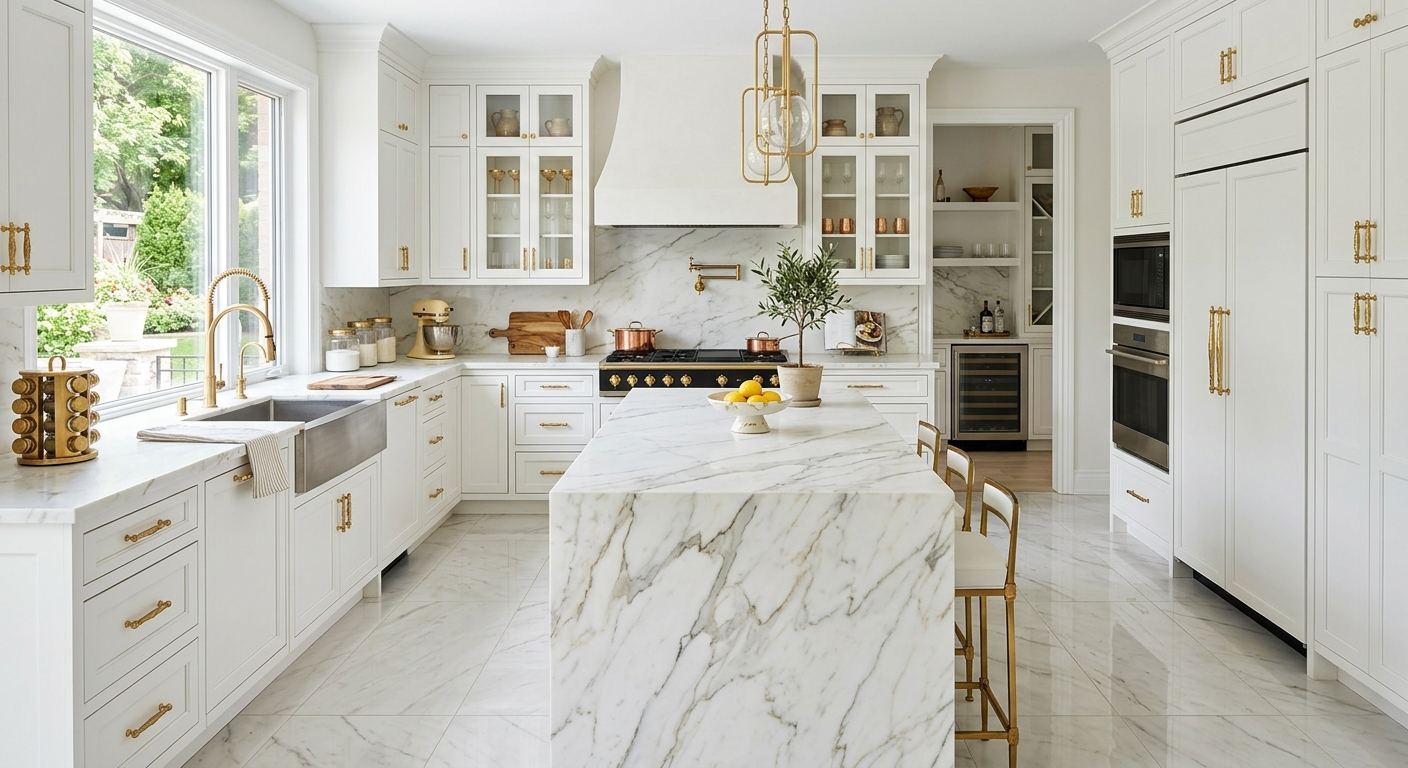
Kitchen renovation options and costs in New Hamburg
Kitchen renovation costs in New Hamburg are shaped less by weather than by what homeowners expect at resale in the Toronto economic region. With a population of 13,595 (Statistics Canada, 2021 Census), the local market tends to follow GTA spending patterns: owners commonly invest to keep kitchens competitive, especially in neighbourhood pockets where buyers pay a premium for updated finishes. In high-value pockets across the region, kitchens can absorb roughly 8%–15% of a home’s value—so you’ll see more quartz, stone, and custom features. In practical terms, that means contractor availability and pricing are driven mainly by finish tier and scope, not seasonal climate.
Toronto-area winters also indirectly affect timelines: crews often need more time for careful protection of flooring, venting, and dust control while homes are sealed up, and delivery scheduling can tighten around cold snaps. Still, the biggest swings in budgets come from whether you’re doing a refresh versus a full rebuild with layout changes, new plumbing/gas, and upgraded electrical. If you live near the river/older residential streets, where many homes are mid-century and cabinets weren’t built for today’s wider appliances, it’s common to budget for small structural and electrical adjustments during demolition.
Below are realistic budget bands to help you compare options before you request quotes; they’re the backbone for New Hamburg project planning.
| Renovation Tier |
What's Included |
Typical Duration |
Price Range |
| Cosmetic refresh (paint, hardware, new appliances only) |
Cabinet paint/finish, new hardware/pulls, backsplash touch-ups or small sections, appliance swaps (no plumbing/gas relocation) |
3–7 days |
$25,000–$30,000 |
| Mid-range full renovation (new cabinets, counters, sink, tile) |
Semi-custom or upgraded stock cabinets, countertop installation, sink + faucet, backsplash tile, new flooring where needed, basic electrical refresh |
3–6 weeks |
$35,000–$60,000 |
| High-end full renovation (custom cabinets, stone counters, island) |
Fully custom millwork, premium quartz/stone, island (often with electrical), upgraded appliance package, extended backsplash, more comprehensive plumbing/electrical |
6–12 weeks |
$70,000–$90,000 |
| Cabinet refacing only (new doors + drawer fronts, same boxes) |
Refaced cabinet doors/drawer fronts, new trim/edges, hardware, matching interior updates where feasible |
1–3 weeks |
$8,000–$22,000 |
| Countertop swap only (laminate to quartz or stone) |
Removal of old top, install new countertop, new sink cut-out if needed, caulking/edge finishing (no layout changes) |
3–7 days |
$3,500–$15,000 |
| Backsplash tile installation only |
Ceramic tile or similar backsplash installation, prep of wall surface, grout/seal where required |
3–7 days |
$2,000–$7,000 |
Prices are estimates only and vary by project scope, site access and material selection.
What affects the price of kitchen renovation in New Hamburg
In New Hamburg, two contractors can quote the “same” kitchen renovation 30%–50% apart because the budget depends on what’s behind the walls and how premium the finishes are. Across Ontario and the Toronto economic region, labour and permitting mechanics are relatively consistent, but homeowners choose different finish tiers—stock or refaced cabinets with laminate can keep budgets in the mid-range, while fully custom millwork and natural stone push projects into the $80,000+ reality for many full builds. That finish choice is often tied to home value and household purchasing power: in higher-value GTA areas, people commonly default to quartz or stone counters and better appliance packages because the upgrade is easier to justify on resale. In more price-sensitive areas, laminate and stock cabinetry remain popular because they deliver the “new kitchen” look without overextending.
Layout changes are the most unpredictable cost driver regardless of finish tier. Moving a wall, adding an island, or relocating a gas line for a cooktop can trigger plumbing, venting, electrical, and sometimes structural review—this is where quotes diverge. For example, if your current kitchen is older and has narrower cabinet runs, you may need to adjust framing and electrical locations even when you keep the same footprint. If you’re adding under-cabinet lighting or a new circuit for an island, the electrical scope can quietly move a project from a $25,000–$45,000 band into a higher full-renovation range. Also, kitchens in older housing stock often have mixed materials (older subfloors, irregular walls), which can add prep time and raise tile/backer-board and countertop install hours.
| Price Factor |
Why It Matters |
Cost Impact |
| Cabinet tier — stock vs. semi-custom vs. fully custom millwork |
Higher tiers increase material cost, lead time, and installation precision |
Often moves the project by $10,000+ depending on scope |
| Countertop material — laminate vs. quartz vs. granite vs. stone |
Material pricing and fabrication complexity affect labour and install time |
Can add $3,000–$12,000 versus laminate/entry options |
| Layout change — wall removal, island add, plumbing/gas move |
Triggers structural checks, additional trades, and longer timelines |
Typically adds the largest variability; often $8,000–$25,000+ |
| Appliance package tier — builder vs. mid-range vs. pro-grade |
Higher-grade appliances cost more and may require electrical/venting upgrades |
Often $2,000–$8,000+ difference depending on brands/features |
| Flooring — refinish existing vs. full replacement |
Floor replacement adds demo, underlayment, and finishing labour |
Can add $2,000–$10,000 based on what’s underneath |
| Backsplash — ceramic tile vs. marble vs. full-height slab |
Premium materials need more careful cutting and sealing |
Can shift a simple job by $2,000–$6,000+ |
| Electrical — new circuits for island, under-cabinet lighting |
New loads require licensed electrical work and may affect panel capacity |
Frequently adds $1,500–$6,000+ |
| Permit fees and licensed trade requirements |
Permits and inspections add admin cost and require specific licensed trades |
Often $500–$3,000+, plus scheduling time |
Permits & regulations in Ontario
In Ontario, not all kitchen changes trigger permits. A straightforward cabinet and countertop swap generally does not require a permit because you’re not changing the building systems. However, the moment you move plumbing supply or drain lines, relocate gas components (like the stove or a gas-powered range hood), remove a load-bearing wall, or add new electrical circuits (for example, outlets and lighting for an island), permits and licensed trades typically come into play. Gas work must be completed by a licensed gas fitter, and electrical work must be completed by a licensed electrician, followed by inspections as required.
For a homeowner in New Hamburg, the safest approach is to verify three things before work begins: licensing, liability insurance, and workers’ compensation coverage. Step-by-step: (1) ask the contractor for their Ontario licence details (and confirm them using the relevant online registry for their trade/credentials); (2) request a current certificate of insurance showing general liability—review dates and confirm the address/jobsite is covered; and (3) confirm WSIB/WCB coverage for workers. If the contractor provides a clearance letter, keep it with your contract paperwork.
Finally, confirm in writing who pulls the permits and who pays the permit fees. Responsibility needs to be explicit in your signed agreement, because that determines what’s included in your quote and what could become a surprise line item later.
Cabinets, countertops and layout decisions in New Hamburg
When you’re planning a New Hamburg kitchen renovation, the three decisions that most influence both budget and long-term satisfaction are: (1) cabinet tier, (2) countertop material, and (3) whether you change layout. Cabinet tier sets the “fit and finish” baseline. Stock cabinets are the fastest and usually cheapest, semi-custom is the most common mid-range choice in the Toronto economic region, and custom millwork is where you spend for perfect sizing, integrated features, and less compromise. Countertops then determine day-to-day maintenance: laminate offers the lowest upfront cost, while quartz and granite bring durability and resale-friendly looks. Layout changes can justify costs—if the space gain actually improves workflow.
Toronto-market resale expectations often reward quartz or natural stone looks, particularly when buyers can see an island or open sightlines. In colder months, kitchens see more indoor drying and heating cycles, so smooth, well-sealed surfaces help reduce staining risk and make cleaning easier. If you’re debating materials, a realistic example: replacing laminate with quartz in a mid-range renovation might add around several thousand dollars—often worthwhile when you’re already budgeting for new cabinets and tile. But if your project is more of a cosmetic refresh, upgrading just the countertop may deliver a better ROI than jumping all the way to fully custom cabinets.
Layout is where costs can escalate quickly in older homes—especially around plumbing and electrical locations. If you want an island, you may need new electrical for task lighting and outlets, and sometimes a gas adjustment if the cooktop is being relocated. When the footprint allows, that space gain can feel “worth it” immediately; when it doesn’t, consider a smaller peninsula or reorganized storage as the more economical path.
| Option |
Durability |
Maintenance |
Best For |
Price Range |
| Stock cabinets (big-box) |
Solid for typical wear; tolerances can be less forgiving |
Basic cleaning; hardware adjustments if needed over time |
Budget-focused refresh with quick timelines |
$12,000–$22,000 |
| Semi-custom cabinets (local dealer) |
Better sizing and options; reliable performance over years |
Easy cleaning; fewer “workarounds” for imperfect walls |
Most New Hamburg renovations balancing cost and look |
$18,000–$35,000 |
| Custom cabinets (local millwork shop) |
Highest fit, strongest finishing details |
Premium surfaces; maintain like other finished wood products |
Unusual layouts, integrated storage, premium kitchens |
$30,000–$60,000 |
| Laminate countertop |
Good everyday use; can chip at edges if abused |
Wipe clean; avoid prolonged water pooling at seams |
Cost-controlled renovations and rentals |
$3,000–$6,000 |
| Quartz engineered countertop |
High stain and scratch resistance for busy households |
Low maintenance; avoid very high heat directly on surface |
Most popular premium-but-practical GTA choice |
$5,000–$12,000 |
| Granite / natural stone countertop |
Very durable; natural variation adds character |
Typically needs periodic sealing |
Buyers who want natural stone uniqueness |
$7,000–$15,000 |
| Butcher block countertop |
Resilient to impacts; can show marks over time |
Oil and recondition periodically |
Warm, traditional looks and cooks who maintain surfaces |
$4,500–$10,000 |
| Marble countertop |
Elegant but more susceptible to etching and staining |
Frequent sealing and careful maintenance needed |
Statement kitchens where appearance is the priority |
$8,000–$18,000 |
How to choose a kitchen renovation contractor in New Hamburg
Choosing the right contractor in New Hamburg starts with verification. For Ontario licensing, ask for the contractor’s trade credentials for the specific work being done (and confirm through the appropriate online registry for their trade category). Request a current certificate of liability insurance and ensure it’s not expired and covers the jobsite—have them list the project address. Then confirm WSIB/WCB coverage: ask for a clearance letter or proof of coverage for their workers. If a contractor can’t provide these items promptly, that’s a major warning sign.
Next, get 2–3 itemised written quotes, not a single lump sum. A proper quote separates labour and materials (cabinets, countertops, tile, demo, installation, electrical/plumbing labour where applicable), notes what’s included and what’s excluded, and clarifies whether permits and disposal are included. Pay attention to warranty details: you want a clear workmanship warranty length, separate product/manufacturer warranties, and confirmation whether warranties are transferable if you sell your home. For payment schedule, avoid large upfront amounts—never pay more than 10%–15% upfront—and use a holdback until major milestones are complete. Finally, require a start date and an estimated completion timeline in writing, with an explanation of what could change it (cabinet lead times, inspection scheduling, material backorders).
- Provide Ontario licensing details for each trade involved (gas, electrical, cabinetry, general contracting).
- Show a certificate of insurance (liability) and ensure it covers the project address.
- Confirm WSIB/WCB coverage with a clearance letter or proof.
- Use an itemised quote: labour, materials, and allowances broken out separately.
- Clearly state whether permits are included and who pulls them.
- Confirm disposal/dump fees (demo debris, packaging, tile waste) are included or priced.
- Include scope details: wall prep, subfloor leveling, patching, and caulking responsibility.
- Verify countertop templating and fabrication lead times in the written schedule.
- Ask about electrical scope: outlets, under-cabinet lighting, island power—if applicable.
- Ensure tile work includes backer board/prep and grout/adhesive type as specified.
- Request warranty terms in writing (workmanship and product warranties).
- Use milestone-based payments; keep a holdback until final inspection and punch list.
In New Hamburg, watch for red flags like: a quote that’s not itemised (no line-by-line labour/materials), vague wording around permits/disposal, pushing for a high upfront payment, missing or expired insurance/WSIB documentation, or promising a fixed completion date while ignoring cabinet/stone lead times.
Frequently asked questions — kitchen renovation in New Hamburg
What's the best countertop material for a busy New Hamburg kitchen?
For most busy New Hamburg and Ontario households, quartz is the practical “best overall” choice: it’s stain-resistant, forgiving for daily cooking, and doesn’t require periodic sealing like many natural stones. If you want the premium look that buyers in the Toronto economic region typically expect at resale, quartz often lands in the mid-to-upper band—commonly around $5,000–$12,000 for a countertop swap depending on size and edge profiles. Granite can be an excellent option if you love natural variation, but it usually needs more maintenance (sealing). Laminate is budget-friendly, yet it’s easier to damage at edges and at seams if the kitchen sees heavy use.
How do I add an island to my New Hamburg kitchen?
Adding an island usually starts with confirming your layout dimensions: clearances for walking paths, whether you can keep safe circulation, and where you’ll place electrical and plumbing/gas connections. In Ontario, electrical work for island outlets and task lighting typically requires a licensed electrician, and if the island includes a sink or cooktop, you may also need permitted plumbing or gas work. Budget-wise, island projects are often the reason kitchens climb into full-renovation ranges like $35,000–$60,000 (mid-range) or higher if you’re doing custom cabinetry or stone. In older New Hamburg homes, we also commonly plan for adjustments to subfloor, existing wiring routes, or venting constraints before demolition.
How much does a kitchen renovation cost in New Hamburg?
The most common budgeting approach in New Hamburg is to start with your intended tier and finish level, then add allowances for any hidden issues behind cabinets. A mid-range full renovation often falls around $35,000–$60,000, especially when you’re keeping the footprint and focusing on upgraded cabinets, counters, and tile. If you’re choosing fully custom millwork, premium stone, and significant layout changes, budgets often reach the $70,000–$90,000 band. Refacing can be much lower—commonly $8,000–$22,000 when the existing boxes are in good shape. Prices depend heavily on cabinet tier, countertop material, and whether plumbing/gas/electrical are being moved.
How long does a kitchen renovation take in New Hamburg?
Timelines in New Hamburg typically depend on finish lead times and whether permits and licensed trades are required. A cosmetic refresh (paint, hardware, appliances only) can be done in about 3–7 days. A mid-range full renovation usually takes 3–6 weeks when the layout is staying fairly consistent and materials are available on schedule. If you’re doing a high-end build with custom cabinetry and an island—plus more complex electrical/plumbing/gas scopes—plan for 6–12 weeks. Winter can add small coordination delays due to home heating/cold conditions affecting dust control and scheduling, but the biggest schedule driver is still cabinet and stone fabrication lead times and inspection booking windows.
Quartz vs granite countertops — which is better?
“Better” depends on your priorities. Quartz is usually the better pick for busy Ontario kitchens because it’s engineered for consistent performance and typically needs no sealing—making it easier to live with day to day. Granite is extremely durable and beautiful, but because it’s natural stone it often requires periodic sealing and you may see more variation from slab to slab. In typical New Hamburg renovation scopes, quartz frequently fits well in budgets like $5,000–$12,000, while granite often trends higher because of slab selection and installation considerations, commonly $7,000–$15,000. If you entertain often and want a low-maintenance surface, quartz usually wins. If you love natural character and don’t mind maintenance, granite can be outstanding.
Should I reface or replace my cabinets?
Refacing is a strong option when your cabinet boxes are sound: straight, structurally solid, level, and not suffering from major water damage. It can deliver a “new cabinet look” for a fraction of full replacement, often in the $8,000–$22,000 range, and it’s usually faster than a full cabinet replacement. Replacement is better when you need changes like resizing cabinets for modern appliances, fixing warped frames, improving storage layout substantially, or preparing for major layout modifications (like an island) that require a different cabinet footprint. In Ontario and the Toronto economic region, resale-minded homeowners often choose replacement when they’re upgrading to premium counters and want a fully coordinated, modern system; refacing is more cost-effective when you’re updating the visual face while keeping the underlying structure.