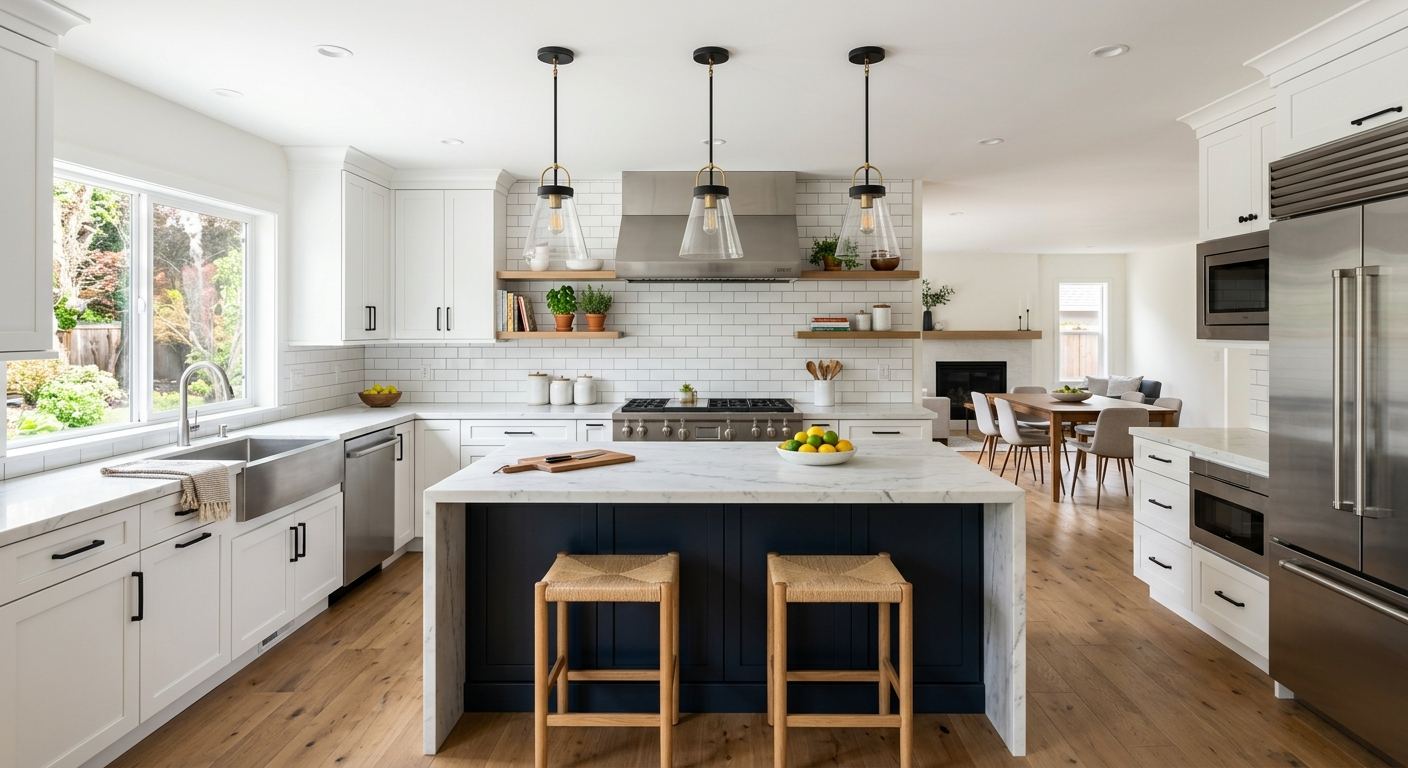
Kitchen renovation options and costs in Pioneer Park
Pioneer Park is a great place to refresh a kitchen because many homes are in active resale circulation, and buyers in the Toronto economic region often look for a clean, modern finish the moment they step inside. With a population of 9,108 (Statistics Canada, 2021 Census), the local market tends to support contractors who can handle both straightforward refreshes and fully detailed upgrades. In practice, what you choose—stock, semi-custom, or fully custom—tracks less with weather and more with how homeowners position the home for resale in the broader Toronto market, where higher-value areas typically see more premium cabinetry and stone.
Toronto-area costs are shaped by demand cycles and labour availability: when more neighbours are renovating at the same time, scheduling and trade coordination (carpenters, electricians, plumbers/gas fitters) can add friction to timelines and cost. Climate matters indirectly as well—freeze-thaw cycles and humidity swings can affect installation tolerances for floors and tile, and they can highlight older subfloor issues that you only discover once cabinets are out. That’s why even a “simple” renovation can expand if the original base, wall framing, or electrical routing isn’t up to current expectations.
In Pioneer Park, contractor demand is especially strong in the older, established pocket around the Parkway/nearby residential streets where renovations often include layout improvements and mid-range finishes. If you’re comparing budgets across options, the table below shows typical tiers and durations to help you plan your next step.
| Renovation Tier |
What's Included |
Typical Duration |
Price Range |
| Cosmetic refresh (paint, hardware, new appliances only) |
Cabinet paint (or touch-up), new hardware, new appliances (no changes to plumbing/gas), and basic cleaning/caulking |
1–3 weeks |
$25,000–$35,000 |
| Mid-range full renovation (new cabinets, counters, sink, tile) |
New semi-custom cabinets, quartz or quality laminate counters, sink + faucet, tile backsplash, floor patching or partial replacement, standard plumbing tie-ins |
4–7 weeks |
$45,000–$70,000 |
| High-end full renovation (custom cabinets, stone counters, island) |
Fully custom millwork, premium stone counters (granite/stone), island with upgraded features, advanced tile/backsplash, improved lighting, and more extensive electrical/plumbing coordination |
7–12 weeks |
$80,000–$90,000 |
| Cabinet refacing only (new doors + drawer fronts, same boxes) |
Door/drawer replacement, new end panels and trim where needed, new hardware, optional matching panels at appliances, limited countertop changes |
2–4 weeks |
$8,000–$35,000 |
| Countertop swap only (laminate to quartz or stone) |
Removal and installation of new countertop, cut-outs for sink/cooktop, sealants and finishing at edges (no layout or cabinet box changes) |
3–6 days to 2 weeks |
$3,000–$15,000 |
| Backsplash tile installation only |
Demolition and prep, new tile installation, grout/seal, caulking at transitions |
3–7 days |
$2,000–$10,000 |
Prices are estimates only and vary by project scope, site access and material selection.
What affects the price of kitchen renovation in Pioneer Park
In and around Pioneer Park, it’s common to see quotes for the “same kitchen” land 30–50% apart once finish tier and hidden conditions are factored in. Toronto buyers often treat the kitchen as a value driver, so homeowners in higher-value pockets usually default toward quartz or natural stone and semi-custom cabinetry—finish choices that move budgets from the $25,000–$90,000 full-renovation range quickly. Meanwhile, more price-sensitive projects often stay in a mid-range lane using stock or refaced cabinetry plus laminate or select quartz, keeping costs closer to the lower bands.
Across the GTA, local home values and typical household purchasing power shape the finish tier far more than weather. Climate affects the supporting work—underlay prep for floors, grout/set quality for tile, and moisture handling around exterior-facing walls—but it rarely determines whether your counters are quartz or stone. What really swings totals is layout: removing a wall for an open feel, adding an island, or moving a gas line/plumbing supply changes the scope unpredictably regardless of how “simple” the design looks.
Here are a few Pioneer Park examples I see frequently: (1) Kitchens in older homes sometimes have dated subfloor flatness, so tile may require additional underlayment prep before you can hit a clean, level finish—this can add days and labour. (2) If your island requires new electrical for outlets and under-cabinet lighting, the added circuits and rough-in can push a mid-range renovation toward the higher end of the $45,000–$70,000 band. (3) If you’re upgrading from laminate to stone or granite, the material jump is predictable (often within the $3,000–$15,000 countertop install band), but the real variability comes from how many cut-outs and edge details you add.
| Price Factor |
Why It Matters |
Cost Impact |
| Cabinet tier — stock vs. semi-custom vs. fully custom millwork |
Different build quality, fit tolerances, and customization levels affect both material cost and installation time |
Can shift the project by roughly $15,000–$40,000 depending on how much is customized |
| Countertop material — laminate vs. quartz vs. granite vs. stone |
Material price and fabrication/edge complexity drive the cost more than most homeowners expect |
Typically lands around the $3,000–$15,000 countertop install band |
| Layout change — wall removal, island add, plumbing/gas move |
Reframing, inspections, and added trades create major scope changes |
Often the single biggest swing factor: add-up effects can push you 20%+ higher |
| Appliance package tier — builder vs. mid-range vs. pro-grade |
Premium appliances may require different electrical or venting choices and more detailed trim |
Can add several thousand dollars and extend install coordination time |
| Flooring — refinish existing vs. full replacement |
Removing cabinets exposes subfloor; mismatched flooring can increase patch work |
Minor refresh: lower; full replacement: moderate to high, depending on repairs |
| Backsplash — ceramic tile vs. marble vs. full-height slab |
Sheet sizing, substrate prep, and grout/finishing complexity change labour intensity |
Commonly aligns with the $2,000–$10,000 backsplash & tile range |
| Electrical — new circuits for island, under-cabinet lighting |
Lighting and outlets are straightforward when planned; they get expensive when discovered late |
Often moves a project toward the higher mid-range when added during construction |
| Permit fees and licensed trade requirements |
Permits and inspections are costed into labour planning and can affect scheduling |
Typically small relative to cabinets/stone, but they can add time and coordination |
Permits & regulations in Ontario
In Ontario, a cabinet and countertop swap typically does not require a building permit when you’re replacing fixtures in place (same footprint, no structural removals). That usually means: swapping cabinets with the same layout, installing new counters, changing a sink faucet, and fitting a new backsplash on the existing wall surface—these are often straightforward from a permitting perspective.
Permits and licensed trade involvement come into play when you’re changing the services or structure. You generally need permits (and licensed trades) for moving plumbing supply or drain lines, relocating a gas appliance or gas line (including certain range hood venting scenarios), removing a load-bearing wall, and adding new electrical circuits—especially for island outlets or new lighting circuits. Gas work must be done by a licensed gas fitter; electrical work by a licensed electrician. Both should be inspected per Ontario practice.
For a homeowner in Pioneer Park, here’s the verification workflow before you sign: (1) Ask the contractor for their Ontario licence/proof, plus the legal name they operate under. (2) Request a certificate of insurance showing liability coverage and the relevant workers coverage (WSIB/WCB clearance evidence where applicable). (3) Ask for the clearance letter or equivalent proof of coverage. (4) Confirm in writing what permit(s), inspections, and responsibility belong to the contractor versus the homeowner.
Always confirm permit responsibility in the contract—“we’ll handle it” is not the same as “it’s included in the price and scheduled.”
Cabinets, countertops and layout decisions in Pioneer Park
If you want the biggest improvement per dollar in Pioneer Park, focus on three decisions: cabinet tier, countertop material, and whether (and why) you’ll change the layout. In the Toronto resale market, buyers tend to expect modern, consistent cabinetry and durable surfaces. That doesn’t mean you must go fully custom—semi-custom is often the sweet spot because you get better organization (soft-close, drawers where you’ll actually use them) without fully custom lead times.
Countertop choice is the second anchor. Laminate is budget-friendly and can look very current, but it’s less resilient to heat and deep staining. Quartz offers an easy-clean surface and strong stain resistance, while granite and other natural stones add depth and “luxury” appeal—though they require more mindful sealing and care depending on the stone type. In Pioneer Park’s temperature swings and winter humidity cycles, your best protection is choosing materials with predictable performance and ensuring installer-ready substrate prep, especially near exterior-facing walls and near tile transitions.
Third, layout. Removing a wall for open concept, adding an island, or relocating plumbing/gas can be justified when the goal is functional flow—more seating, better work triangle, or storage that solves a real problem. But these changes add uncertainty because they trigger coordination across trades and often require permits. A practical example: moving from quartz to granite might cost you within the countertop install band (around the $3,000–$15,000 range for install), but if you also relocate plumbing to fit an island sink, your costs typically jump well beyond just material—this is where you should only spend extra when the space gain is measurable.
| Option |
Durability |
Maintenance |
Best For |
Price Range |
| Stock cabinets (big-box) |
Durable for everyday use, but fewer sizing options can reduce perfect fit |
Low; hardware upgrades help longevity |
Fast refreshes and budget-focused renovations |
$8,000–$25,000 |
| Semi-custom cabinets (local dealer) |
Good strength and better internal organization; improved fit and finishing |
Low; soft-close hardware reduces wear |
Most Pioneer Park homeowners targeting resale-ready kitchens |
$25,000–$45,000 |
| Custom cabinets (local millwork shop) |
Highest build quality and best space utilization (odd corners, ceilings, custom storage) |
Low to moderate; depends on finish and hardware choice |
High-end builds where every inch matters |
$45,000–$70,000 |
| Laminate countertop |
Good for daily life, but can chip or scorch if mishandled |
Easy; avoid excessive heat and heavy abrasion |
Value renovations where you want a clean look without high material cost |
$3,000–$6,500 |
| Quartz engineered countertop |
Very durable and consistent; resists stains well for most households |
Low; wipe-and-clean routine |
Busy kitchens that need predictable performance in the Toronto climate |
$6,500–$11,500 |
| Granite / natural stone countertop |
Excellent durability; unique patterning and heat resistance vary by stone |
Moderate; sealing and stain prevention matter |
Homeowners prioritizing a high-end look and natural variation |
$9,000–$15,000 |
| Butcher block countertop |
Strong, but susceptible to water ingress at seams without good sealing |
Moderate; periodic oiling and careful drying required |
Warm, traditional styles and light/moderate daily use |
$4,500–$10,000 |
| Marble countertop |
Beautiful and durable enough for everyday use, but more prone to etching/staining |
Higher maintenance; more careful cleaning and protection |
Lower-heat, more design-forward kitchens with dedicated care |
$10,000–$15,000 |
How to choose a kitchen renovation contractor in Pioneer Park
Choosing the right contractor in Pioneer Park comes down to proof, transparency, and scheduling control. In Ontario, verify three things before you commit: (1) licensing status for the trades involved—especially electrical and gas work; (2) liability insurance; and (3) WSIB/WCB coverage evidence for workers on the job. You can usually check insurance certificates directly from the contractor, and you should ask for a WSIB/WCB clearance letter or equivalent proof before demolition starts. If they can’t provide documentation promptly, that’s your first signal to pause.
Next, get 2–3 itemised written quotes. You want a labour + materials breakdown (labour to install cabinets, labour to fabricate/install counters, tile labour, electrical rough-in, plumbing/gas tie-ins, disposal). Avoid lump-sum quotes that don’t explain what’s included. Read the scope carefully: is permit pulling included? Is dust control part of the job? Is material delivery timing stated? Is waste disposal included? Are any exclusions listed for subfloor repair, electrical upgrades, or concealed damage?
Warranty matters too: ask for the workmanship warranty length and whether it’s transferable if you sell. Also request the product/manufacturer warranty details for cabinets, counters, and hardware. Payment schedules should be conservative—never more than 10–15% upfront, then use a holdback until key milestones and final cleanup are complete.
- Confirm their Ontario operating name matches the contract.
- Request licence/permit responsibility in writing (especially if you’re changing services).
- Collect insurance certificate and verify liability coverage amount.
- Ask for WSIB/WCB clearance evidence before work begins.
- Require itemised labour and material pricing (no vague allowances).
- Ensure demolition, protection, and disposal are explicitly included.
- Confirm whether your quote includes cabinet adjustments for out-of-level floors/walls.
- Get an electrical/plumbing schedule if you’re adding an island or moving lines.
- Verify countertop lead time and who templates and measures.
- Ask for a clear warranty document for workmanship and products.
- Hold back 10–15% until punch list completion and final walkthrough.
- Set a start date and target completion date in writing, with change-order rules.
Common Pioneer Park red flags: (1) they won’t provide itemised pricing or a written scope; (2) they dodge permit responsibility questions when services or structure are changing; (3) they ask for large upfront payments (beyond 10–15%); (4) they can’t show insurance/WSIB/WCB documentation; and (5) they give an “instant start” promise without realistic lead-time planning for cabinets and stone.
Frequently asked questions — kitchen renovation in Pioneer Park
What's the best countertop material for a busy Pioneer Park kitchen?
For most busy households in Pioneer Park and across Ontario, quartz is usually the best balance of durability and low maintenance. It resists staining well, doesn’t require routine sealing, and handles daily cooking messes more predictably than natural porous stones. That said, the “best” choice depends on how you cook and how you maintain surfaces. If you want a premium look and natural patterning, granite is a strong option, but it typically needs periodic sealing. Budget matters too: a countertop swap alone often falls in the $3,000–$15,000 range, and going from laminate to quartz or stone usually costs more mainly because of fabrication and edge details—not because of the home’s weather. If your kitchen has exterior-facing walls, ask your contractor about moisture-ready installation and proper underlayment for adjacent flooring and tile.
How do I add an island to my Pioneer Park kitchen?
Adding an island is one of the most impactful upgrades in Pioneer Park, but it’s also where permitting and trade coordination can change the budget. First, confirm whether you’re keeping plumbing and gas in the same locations. If the island includes a sink or cooktop, you’ll likely need plumbing/drain work and possibly gas work via a licensed gas fitter, plus an inspection workflow. For a simple island with seating and storage only, you can often avoid service relocation—making the project more predictable. Next, plan electrical early for outlets and under-cabinet lighting; this can involve new circuits. Finally, measure clearances around the island for comfortable traffic flow. In most GTA-style full renovations, the island work is a key reason projects move from mid-range to higher-end budgeting within the broader $25,000–$90,000 bands.
How much does a kitchen renovation cost in Pioneer Park?
In Pioneer Park, realistic full kitchen renovation budgets usually land in the $25,000–$90,000 range depending on size, layout changes, and finish tier. A cosmetic refresh (paint, hardware, and new appliances only) is typically cheaper, but true “full” renovations move quickly once you add cabinets, counters, tile, and coordinated trade work. Mid-range full renovations—new cabinets and counters plus sink and tile—often target the $45,000–$70,000 portion of the band when layout stays mostly intact. If you go custom with stone counters and an island, budgets commonly push toward the $80,000–$90,000 end. The biggest cost drivers are cabinet tier, countertop selection, and whether you’re moving plumbing/gas or adding electrical circuits. Weather doesn’t usually drive the price directly, but older Toronto-area housing can reveal subfloor and electrical surprises once the demo starts.
How long does a kitchen renovation take in Pioneer Park?
Timelines in Pioneer Park typically depend on whether you’re doing a refresh versus a full renovation and whether you’re waiting on custom elements. Cosmetic refreshes (paint, hardware, new appliances only) are often the fastest—commonly around 1–3 weeks. A mid-range full renovation with new cabinets, counters, sink, and tile usually takes about 4–7 weeks, assuming services remain in the same place and materials arrive on schedule. High-end projects with custom cabinetry, stone counters, and an island commonly run 7–12 weeks because lead times and coordination increase. Delays can also happen if concealed damage is found after demolition (subfloor leveling, outdated wiring, or tile substrate issues). Because Toronto scheduling is busy, it helps to lock your start date, confirm cabinet/counter lead times in writing, and keep decisions (finishes, colours, hardware) finalized before fabrication begins.
Quartz vs granite countertops — which is better?
Quartz is usually the better choice for most busy Pioneer Park kitchens because it’s highly consistent, resists staining well, and is low maintenance—no routine sealing. Granite can be “better” if you love natural variation and want a premium, organic look; many people also like its unique pattern and heat performance (though performance varies by stone). The practical difference shows up in care: granite typically needs sealing and more careful stain prevention, while quartz is more forgiving for everyday messes and wipes. Budget-wise, countertop installs often fall in the $3,000–$15,000 band; the difference between quartz and granite usually comes down to material thickness, edges, and the complexity of cut-outs (sink, cooktop, and backsplash returns). If you want the smoothest ownership experience in an Ontario winter routine, quartz is hard to beat.
Should I reface or replace my cabinets?
If your cabinet boxes are structurally sound and level, refacing is often the smarter move in Pioneer Park because it keeps demolition low and reduces labour and disposal. Refacing can refresh the look with new doors, drawer fronts, and hardware while leaving the existing interior framework in place. It’s commonly a mid-cost option compared to full replacement, and it typically falls within the $8,000–$35,000 range for cabinet installation/refacing depending on how much trim and repair is needed. Replace cabinets when boxes are damaged, not square, have poor storage layouts, or when you need significant layout/height changes. Also replace if you’re planning a major design shift that requires new plumbing/electrical rework around cabinet bays. A good contractor will evaluate box condition in person and be honest about whether refacing will solve the real issues or just cover them.