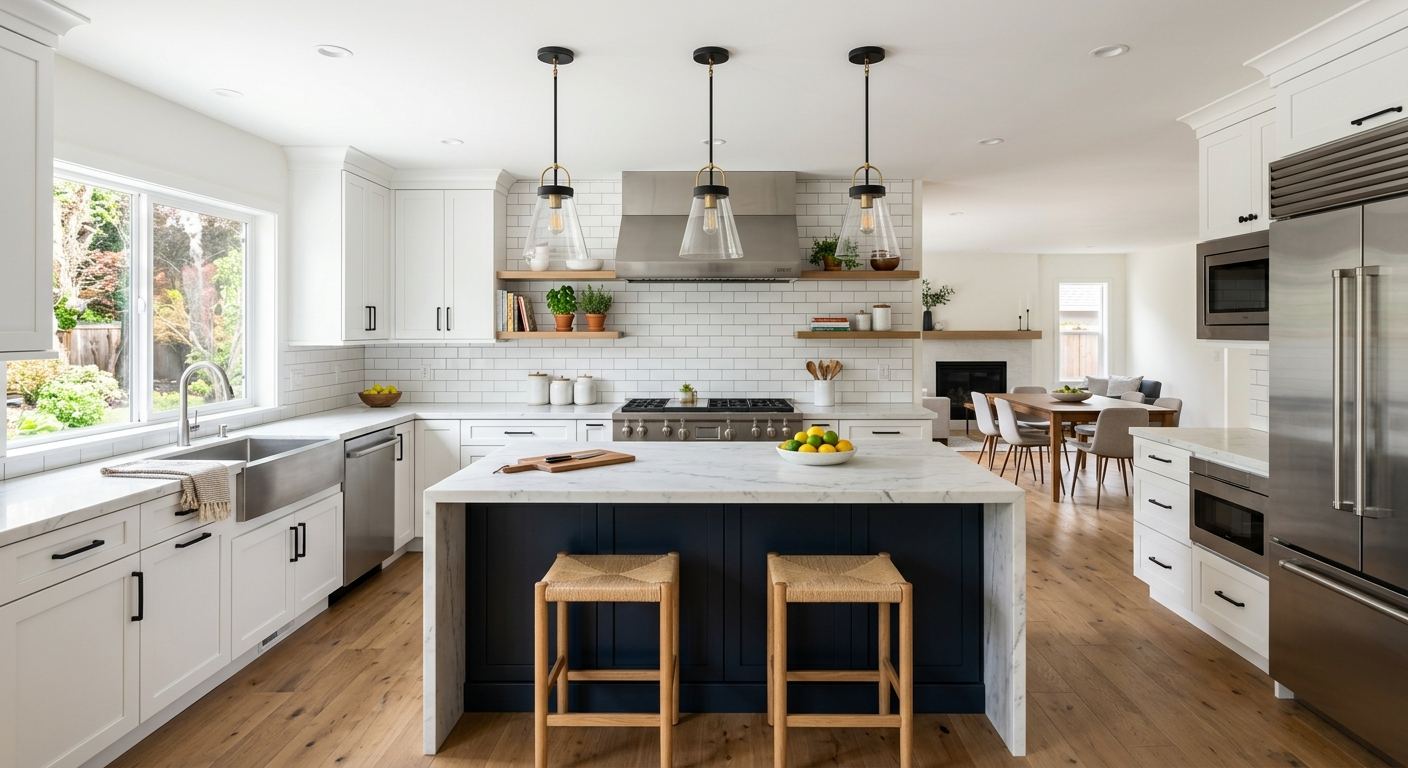
Kitchen renovation options and costs in Clanton Park
Clanton Park is a lively pocket in Toronto where kitchen renovations are driven more by buyers’ expectations and home values than by day-to-day weather. With a population of 16,472 (Statistics Canada, 2021 Census), homeowners here tend to renovate for resale appeal, not just personal taste. In Toronto’s higher-value areas, many owners treat the kitchen as an “upfront equity” upgrade—often targeting a finish tier that looks right on showings—so you’ll see more quartz, more upgraded hardware, and more semi-custom layouts than you’d get in more price-sensitive GTA pockets.
Toronto-area projects also move with household purchasing patterns: when incomes are steadier, homeowners feel comfortable moving beyond a refresh into a full mid-range or even high-end build. That matters because the Toronto economic region’s kitchen budgets commonly run from about mid-$20k for modest refreshes up through $80k+ for larger, custom builds. Contractor availability and pricing can be influenced by market demand peaks—especially when multiple homeowners in the same neighbourhood are renovating—so scheduling can affect labour rates and material lead times.
In Clanton Park, demand is especially strong around the neighbourhood core where homes are often older and kitchens are more likely to need layout tuning (walkways, peninsula vs. island fit, and dated cabinet widths). As a result, most quotes land in predictable tiers—so it’s easier to compare apples-to-apples before you book design.
Here’s a practical cost comparison table to align your scope with realistic budgets.
| Renovation Tier |
What's Included |
Typical Duration |
Price Range |
| Cosmetic refresh (paint, hardware, new appliances only) |
Prep/paint, new pulls/handles, appliance set-up, minor caulking/trim touch-ups (no cabinet box changes) |
1–3 weeks |
$5,000–$18,000 |
| Mid-range full renovation (new cabinets, counters, sink, tile) |
New stock or semi-custom cabinets, new countertop, sink/faucet, backsplash tile, basic plumbing refresh |
4–8 weeks |
$25,000–$60,000 |
| High-end full renovation (custom cabinets, stone counters, island) |
Fully custom millwork, premium quartz/stone, island build, upgraded plumbing/electrical, full backsplash upgrade |
8–16 weeks |
$70,000–$90,000 |
| Cabinet refacing only (new doors + drawer fronts, same boxes) |
Door/drawer replacement, new hardware, refinishing/repairs to existing boxes, often includes new valances |
2–5 weeks |
$8,000–$28,000 |
| Countertop swap only (laminate to quartz or stone) |
Remove old top, fabricate/install new countertop, seam finishing, reconnect sink |
3–10 days (often 2–3 weeks to schedule around lead times) |
$3,000–$15,000 |
| Backsplash tile installation only |
Tile removal/installation, wall prep, waterproofing/backer where needed, grout/seal |
1–2 weeks |
$2,000–$10,000 |
Prices are estimates only and vary by project scope, site access and material selection.
What affects the price of kitchen renovation in Clanton Park
In Toronto and across Ontario, the same “kitchen refresh” can produce quotes that differ by roughly 30–50% because builders price risk differently: hidden conditions (out-of-square walls, older subfloor), how much demolition is assumed, and how labour schedules line up with material lead times. Two contractors can both install new cabinets and counters, yet one includes more wall repair, new electrical work, or better plumbing prep—and that’s where the spread shows up.
In Clanton Park specifically, local housing economics shape the finish tier far more than climate. Toronto’s higher-value pockets encourage homeowners to choose quartz or natural stone and semi-custom cabinetry because the renovation is easier to “sell with” on resale. In contrast, more price-sensitive GTA areas often lean toward laminate tops and stock or refaced cabinets to keep budgets closer to the low–mid range. That finish tier shift alone can move a full renovation from the mid-$20k band toward the $80k+ band if you add an island or upgrade beyond basic materials.
Layout changes are the cost wildcard regardless of finish. Removing a wall, adding an island, or moving plumbing/gas can trigger demolition, framing, and trade coordination—especially if your kitchen has older rough-in that doesn’t line up with modern appliance specs. For example, relocating a sink to a new run commonly adds plumbing labour and wall repair; adding an island can increase electrical cost due to new circuits and wiring for outlets and under-cabinet lighting.
Concrete Clanton Park examples we see often: (1) older homes sometimes have uneven plaster/drywall, which adds prep before tile backsplashes—pushing backsplash & tile toward the upper part of the $2,000–$10,000 band; (2) replacing a worn laminate top with quartz tends to cost more than homeowners expect when you need improved substrate support, often landing within the countertop installation $3,000–$15,000 range; and (3) if your existing floor is sound, refinishing can reduce flooring replacement compared to full replacement, helping keep a renovation closer to mid-range full renovation budgets like $25,000–$60,000.
Climate and seasonality still play a supporting role: Toronto winter schedules can affect drying time for patching/paint and can slow site mobilization, but it rarely changes the “finish tier” the way resale expectations and material choice do.
| Price Factor |
Why It Matters |
Cost Impact |
| Cabinet tier — stock vs. semi-custom vs. fully custom millwork |
Different build quality, customization level, and production lead times |
Can swing most of the total budget; commonly shifts jobs between mid-range and high-end bands |
| Countertop material — laminate vs. quartz vs. granite vs. stone |
Material cost, fabrication complexity, and installation requirements |
Typically drives a large part of the $3,000–$15,000 countertop installation band; stone can push higher |
| Layout change — wall removal, island add, plumbing/gas move |
Structural and trade coordination risk; more demo and repairs |
Often the biggest unpredictable cost; can be more expensive than upgrading finishes |
| Appliance package tier — builder vs. mid-range vs. pro-grade |
Electrical/gas hookups, ventilation requirements, and fit/finish standards |
May add thousands; pro-grade tends to cost more and can require additional electrical work |
| Flooring — refinish existing vs. full replacement |
Removal/replacement vs. prep and refinishing lowers demo and disposal |
Refinishing keeps costs down; replacement raises both material and labour |
| Backsplash — ceramic tile vs. marble vs. full-height slab |
Tile layout complexity, stone weight, and wall prep requirements |
Can move backsplash & tile work toward the top of the $2,000–$10,000 band |
| Electrical — new circuits for island, under-cabinet lighting |
Licensed electrician labour, code-compliant wiring, and inspection scheduling |
Often adds cost even when finishes are simple |
| Permit fees and licensed trade requirements |
Inspection lead time and administrative requirements |
Varies by scope; impacts both total price and scheduling |
Permits & regulations in Ontario
In Ontario, not every kitchen update needs a permit, but changing “systems” does. Cabinet and countertop swaps are generally treated as renovations that typically do not require permits. Likewise, many cosmetic updates (paint, hardware, replacing fixtures that don’t change rough-in locations) are usually straightforward.
Permits and licensed trades are commonly required when you move plumbing supply or drain lines, relocate gas appliances or related components (including work tied to a gas stove/range hood), remove a load-bearing wall, or add new electrical circuits—such as wiring for an island outlet run or under-cabinet lighting that requires code-compliant modifications. Gas work must be done by a licensed gas fitter, and electrical work must be performed by a licensed electrician, with inspections for the completed work.
For a homeowner in Clanton Park, the best process is verification before signing and again before work starts:
- Ask your contractor for their Ontario business licence details (if applicable in their business model) and confirm they’re using licensed trades for gas and electrical.
- Request proof of liability insurance (certificate of insurance) and confirm the coverage amount and jobsite address.
- Request WSIB/WCB clearance or documentation showing coverage status for the trades that will be on-site.
- For licensing verification, use the applicable online trade licence registry for the gas fitter and electrician names provided by the contractor.
- Confirm in writing who is pulling permits (you don’t want any surprises on responsibility or inspection scheduling).
Always ensure permit responsibility and inspection expectations are spelled out in the contract—because the cheapest quote often hides scope around licensing and compliance.
Cabinets, countertops and layout decisions in Clanton Park
When you renovate in Clanton Park, three decisions shape both your budget and your long-term satisfaction more than anything else: (1) cabinet tier, (2) countertop material, and (3) whether you change the layout (especially opening a wall, adding an island, or relocating plumbing/gas). In the Toronto resale market, buyers typically expect kitchens to look clean, bright, and durable, which usually pushes renovations toward modern hardware, consistent cabinet fronts, and surfaces that handle daily wear—especially around the sink and cooking zone.
Cabinet tier affects cost and fit. Stock cabinets are the fastest and cheapest, but semi-custom offers more realistic compromises for common Toronto kitchen sizes and awkward wall lines. Fully custom is best when you’re trying to solve a layout challenge—like creating a true appliance wall landing that aligns doors and drawers with your fridge and range.
Countertops are the biggest “surface credibility” item. Quartz is a common mid-to-premium choice because it’s less maintenance than natural stone and typically performs well through Ontario temperature swings. Laminate can still be a smart ROI choice for keeping a kitchen near the $25,000–$60,000 mid-range full renovation band. A concrete example: if you upgrade from laminate to quartz, you might pay within the countertop installation $3,000–$15,000 range depending on edges, thickness, and sink cut-outs—yet many homeowners find it justified because it upgrades the look for showings with fewer maintenance headaches than stone.
Layout changes are where you spend for space gain. In Toronto homes, kitchens can feel tight due to older planning and narrower corridors; adding an island or opening toward an adjacent area can make the kitchen function better. But plumbing or gas relocation adds the cost unpredictability—sometimes more than the difference between semi-custom and stock cabinet tiers—so the decision should be tied to your actual space needs and how long you’ll stay in the home.
| Option |
Durability |
Maintenance |
Best For |
Price Range |
| Stock cabinets (big-box) |
Good durability with standard hardware; limited sizing flexibility |
Low—keep hinges adjusted and wipe surfaces regularly |
Fast turnarounds and budget-conscious full renos |
$8,000–$20,000 |
| Semi-custom cabinets (local dealer) |
Very solid construction with better options for drawers, finishes, and sizing |
Low to moderate; requires basic care like any wood-based finish |
Most Clanton Park renovations that target strong resale appeal |
$15,000–$35,000 |
| Custom cabinets (local millwork shop) |
Highest durability and best tailoring; ideal for irregular spaces |
Low—designed for long service life; finish quality matters |
When you need a perfect fit, special storage, or a standout design |
$30,000–$60,000 |
| Laminate countertop |
Durable for day-to-day use; seams can be a stress point |
Low; avoid prolonged standing water at seams and damaged edges |
Keeping a renovation in the low–mid range without major structural changes |
$3,000–$7,000 |
| Quartz engineered countertop |
Very durable and consistent; resistant to stains and chipping |
Low—wipe clean; avoid abrasive pads on polished finishes |
Most popular premium look for resale in Toronto-area kitchens |
$6,000–$12,000 |
| Granite / natural stone countertop |
Extremely durable; variation in hardness and finish is normal |
Moderate—may require periodic sealing depending on stone and finish |
Homeowners seeking a unique natural look and willing to maintain it |
$8,000–$15,000 |
| Butcher block countertop |
Strong for chopping; can be sensitive to long water exposure |
Higher—regular oiling/sealing to prevent drying and staining |
Warm, traditional styles and hands-on cooking households |
$4,500–$9,000 |
| Marble countertop |
Beautiful but more delicate; can etch/stain compared to quartz |
Higher—needs careful cleaning and sealing; less forgiving |
Statement kitchens where aesthetics outweigh strict durability priorities |
$10,000–$15,000 |
How to choose a kitchen renovation contractor in Clanton Park
Choosing the right contractor in Clanton Park comes down to proof, clarity, and scheduling discipline. Start with verification: confirm the contractor has liability insurance (request their certificate of insurance and ensure it lists the jobsite/address scope) and that any gas and electrical work is done by licensed trades. For WSIB/WCB coverage, ask for the contractor’s clearance letter or documentation showing coverage status before work begins—kitchen trades frequently overlap, and you want to know who is responsible if something goes wrong on-site.
Next, demand 2–3 itemised, written quotes. You should see labour and materials separated, not a single lump sum—especially for cabinets, countertops, tile/backsplash, demolition, electrical allowances, plumbing allowances, and disposal. Ask whether permits are included and who pulls them. Confirm disposal: will the contractor handle hauling away old materials, and is there a stated allowance for dump fees? Also ask about exclusions: for example, some quotes exclude floor patching behind cabinets, wall drywall repair after removing old tile, or electrical changes needed for an island.
Warranty matters. Get the workmanship warranty length and confirm whether product warranties (cabinet finish, countertop fabrication, labour) are provided and whether they’re transferable if you sell. Payment schedule should be conservative—never more than 10–15% upfront. Hold back a portion until key milestones are complete, like cabinet install, countertop templating/installation, and final tile grouting.
Finally, timelines should be in writing: a start date, a completion target, and lead-time expectations for cabinets and countertops. In Toronto-area projects, material lead times can affect the whole schedule, so clarity prevents “delay creep.”
- Request proof of liability insurance (certificate of insurance) before signing.
- Confirm WSIB/WCB clearance or documentation in writing.
- Ask which parts of the job require licensed trades (gas/electrical) and verify names and licence status.
- Get itemised quotes: labour + materials breakdown, not only totals.
- Check scope details: disposal included? wall repair allowance included?
- Confirm permit responsibility and whether inspections are included.
- Ensure countertop template/install dates are scheduled, not just “sometime after cabinets.”
- Ask about tolerances: cabinet level/flush requirements and shimming plan.
- Request backsplash tile spec: backer type, waterproofing, grout selection, and height limits.
- Review warranty: workmanship length and product/manufacturer warranty terms.
- Use milestone-based payments; keep retainage until final cleanup.
- Get start and completion dates in writing, with what happens if materials arrive late.
Red flags we often see in Clanton Park include: “all-in” quotes with no itemisation, refusal to provide insurance/WSIB/WCB documentation, vague permit language (“we’ll handle it”), charging more than 10–15% upfront without a clear deposit agreement, and no written warranty terms or timeline. If any of these appear, pause and ask for corrections before work starts.
Frequently asked questions — kitchen renovation in Clanton Park
What order do kitchen renovation steps happen in?
In Clanton Park (and across Ontario), the safest sequence is: confirm design and measurements, complete demolition, then rough-ins, then cabinetry installation, countertop templating/fabrication, and final finishes. Typically, we start with layout verification, appliance planning, and electrical/plumbing rough work if you’re changing supply/drain runs or adding island circuits. After demolition, we handle wall and floor prep—patching, leveling, and setting any backer needed for tile. Cabinet installation comes next, followed by countertop templating once drawers/doors are set to final positions. Only after countertops are installed do we finish backsplash and seal transitions around sinks and cooktops. This ordering helps avoid damaging the new counters and reduces the chance of rework due to out-of-plane cabinets.
Can I live at home during a kitchen renovation in Clanton Park?
Often yes, but it depends on how disruptive your scope is. If you’re doing a cosmetic refresh or a cabinet refacing (and you’re not moving plumbing or electrical), you can usually stay in the home with a workable temporary kitchen setup. For mid-range full renovations ($25,000–$60,000) or anything involving countertop swap plus tile and sink changes, you may still live at home if you can secure a safe cooking zone, manage dust control, and keep traffic through the workspace clear. If you’re doing a high-end full renovation with an island and multiple trades (and potentially permit-required changes), you may prefer alternate arrangements for the busiest demolition and rough-in phases. In older Toronto-area homes common around Clanton Park, demolition can reveal surprises, so plan for flexibility—especially if you’re targeting stone or custom millwork with longer lead times.
Should I renovate my kitchen before selling in Clanton Park?
Usually, yes—if the kitchen is visibly dated or functionally frustrating and you choose improvements that buyers recognize. In Toronto’s market, kitchens are a major decision driver, and many buyers expect clean surfaces, reliable storage, and a modern look. A refresh (paint, hardware, and appliances only) can help if your layout and major components are already sound, but a full renovation may be worth it when cabinets/counters are worn or the space doesn’t work. Practically, stick to a balanced scope: upgrading to quartz within the countertop installation range ($6,000–$12,000) can give a noticeable premium look without going straight to custom millwork. If you’re aiming for the mid-range full renovation band ($25,000–$60,000), you’ll typically get the best “showroom effect” for resale value. Avoid over-improving if structural changes or bespoke features won’t fit the buyer pool for your specific street and home type.
What's the most popular kitchen style in Clanton Park right now?
Across Clanton Park and the Toronto area, the most common direction I see is modern transitional: flat-panel or simple shaker-style cabinetry, brighter whites/creams or warm greys, and hardware that’s understated. Homeowners also frequently pair semi-custom cabinetry with quartz countertops because it looks premium in photos and wipes down easily for daily use. Many renovations include an updated backsplash tile that’s not overly busy, plus lighting upgrades that brighten the cooking zone. High-end projects often add an island with seating and a more custom layout, but even mid-range renos lean toward quartz and a cleaner cabinet line. While styles vary street-to-street, the unifying trend is “easy resale compatibility”: finishes that photograph well and don’t require heavy maintenance.
How do I know if I need to update my kitchen plumbing in Clanton Park?
You may need plumbing updates if your supply/drain lines are old, leaking, or poorly vented, or if you’re changing the sink location or adding a dishwasher with a different layout. Clues include slow drains, persistent odours, corrosion at shutoff valves, or water staining near base cabinets. If you’re keeping the sink in the same rough-in and your inspections show sound piping, you might only need fixture swaps and minor repairs. But if you’re moving plumbing during your renovation, plan for more work and time. In Ontario, moving supply or drain lines typically triggers more complex scope and permit/inspection expectations through the licensed trades involved. The safest approach is to have the contractor check shutoffs, supply lines, and under-sink connections before you lock in cabinets and countertop lead times.
What is the difference between a galley and open-concept kitchen?
A galley kitchen is a narrow, corridor-style layout with counters on two opposing walls—efficient for cooking but can feel tight for multiple people and often limits views into the living space. An open-concept kitchen removes barriers to connect the kitchen with the living/dining area, usually to improve sightlines and how space “flows.” In Clanton Park’s older housing stock, galley layouts are common, and homeowners sometimes consider opening to create a more functional zone. That said, opening a wall can require careful structural evaluation and may change your permit needs, especially if the wall is load-bearing. Costs also differ: open-concept layouts frequently involve electrical and sometimes plumbing/gas coordination, so they can move a project from mid-range toward higher-end full renovation territory even when finishes stay similar.