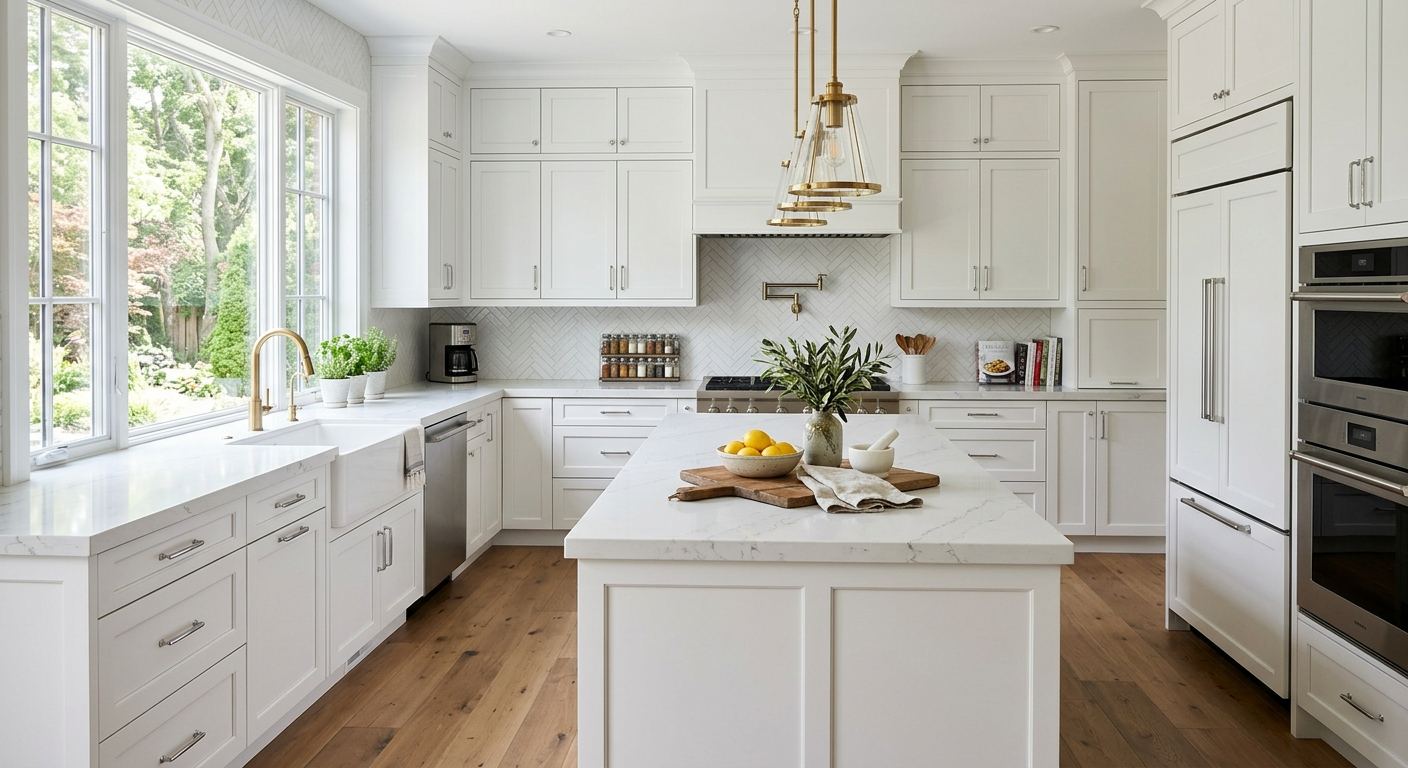
Kitchen renovation options and costs in Intercity
In Intercity, Ontario, homeowners usually plan kitchen renovations around resale expectations and the value of their property—not around weather. With a population of 1,486 (Statistics Canada, 2021 Census), the local market is small, so contractor availability can vary by season and by how many crews are already booked in the GTA. In the Toronto economic region, many owners also spend more when the home value is higher, because premium finishes help the kitchen “fit” the rest of the property. In practical terms, kitchen budgets often land higher in value-dense pockets where owners expect custom cabinetry and upgraded surfaces.
Seasonality still matters, just not in the way people think. In Ontario’s freeze–thaw cycles, keeping the home sealed during work is important for protecting flooring, cabinetry adhesives, and fresh paint curing times. That said, pricing is driven far more by finish tier and scope. Because labour rates and material pricing are relatively consistent across the Toronto region, the biggest swing is whether you’re staying cosmetic or moving into a full high-end build (especially if you’re changing plumbing, adding electrical, or upgrading to stone counters).
In Intercity, demand is especially strong for kitchens in older neighbourhood pockets where layouts are dated and buyers prefer modern storage and cleaner sightlines. If you’re deciding between “refresh” and “full,” the table below breaks down realistic options and typical timelines so you can compare quotes apples-to-apples.
| Renovation Tier |
What's Included |
Typical Duration |
Price Range |
| Cosmetic refresh (paint, hardware, new appliances only) |
Paint, new cabinet hardware, appliance swap, minor caulking/touch-ups |
3–7 days |
$8,000–$18,000 |
| Mid-range full renovation (new cabinets, counters, sink, tile) |
Semi-custom or upgraded stock cabinets, countertop install, sink/faucet, backsplash tile, disposal reconnect, basic plumbing and electrical hookups |
3–6 weeks |
$25,000–$60,000 |
| High-end full renovation (custom cabinets, stone counters, island) |
Custom millwork, quartz/natural stone counters, island build, upgraded appliance package, full backsplash, pot lights/under-cabinet lighting, upgraded sink/faucet, often layout changes |
6–12 weeks |
$65,000–$90,000 |
| Cabinet refacing only (new doors + drawer fronts, same boxes) |
Reface doors/drawer fronts, new trim, hardware, new finish overlay on existing cabinet boxes, removal and install of doors and hardware |
1–2 weeks |
$8,000–$28,000 |
| Countertop swap only (laminate to quartz or stone) |
Remove old top, template and install new countertop (quartz/stone), new sink cut-out (if applicable), fresh caulking and backsplash tie-in |
4–10 days |
$3,000–$15,000 |
| Backsplash tile installation only |
Tile supply and install, surface prep, grout/seal (as needed), caulking at counters and corners |
3–7 days |
$2,000–$10,000 |
Prices are estimates only and vary by project scope, site access and material selection.
What affects the price of kitchen renovation in Intercity
In Intercity and across the Toronto economic region, you can see quotes for the “same” kitchen that differ by 30–50% because contractors price different risk and different finish tiers. Two teams may both plan “new cabinets and counters,” but one quote may include structural changes, electrical upgrades, or a better cabinet line with stronger hardware. The same is true for countertops: a quartz slab install behaves differently than laminate, especially if you’re changing sink type, adding an island, or adjusting seams and edge profiles.
Local home values and median income expectations shape the typical finish tier far more than climate. In higher-value GTA pockets, homeowners often default to quartz or natural stone and semi-custom cabinetry because the upgrade is easier to recoup on resale; in more price-sensitive areas, laminate and stock cabinets keep budgets closer to the lower end of the $25,000–$90,000 band by limiting custom millwork and reducing change orders. That doesn’t mean “cheap is bad”—it means the typical ROI strategy differs.
Layout changes are the most unpredictable cost regardless of finish tier. Removing a wall, adding an island, or moving a gas line/plumbing run can introduce subfloor, venting, and electrical rework. For example: (1) a small island may look cosmetic, but adding power for under-cabinet lighting or relocating a circuit can push labour hours quickly; (2) upgrading from mid-range counters to full stone can add cost even before installation because templating, slab lead times, and edge finishing are more labour-intensive; (3) older Ontario housing stock can hide older rough-in that needs repairs, raising contingency—even when cabinets and counters are “straight” installs.
| Price Factor |
Why It Matters |
Cost Impact |
| Cabinet tier — stock vs. semi-custom vs. fully custom millwork |
Material quality, fit/finish tolerances, hinge hardware, interior options and lead times |
Small refreshes may stay near $25,000; custom millwork often pushes higher-end projects toward $80k+ |
| Countertop material — laminate vs. quartz vs. granite vs. stone |
Slab cost, fabrication complexity, seam placement, and durability/heat resistance |
Laminate swaps can sit near the lower band (around $3,000–$7,000); stone can move installs toward $10,000–$15,000+ |
| Layout change — wall removal, island add, plumbing/gas move |
Structural work, permits, and hidden rough-in adjustments |
Typically adds the most variability—can swing projects by tens of thousands even with similar cabinet finishes |
| Appliance package tier — builder vs. mid-range vs. pro-grade |
Dimensions, electrical/gas requirements, installation complexity and finish compatibility |
Can move a “mid-range” job noticeably within the overall $25,000–$90,000 band |
| Flooring — refinish existing vs. full replacement |
Protection, transition details, and matching subfloor height after demo |
May keep costs mid-range if protected well; full replacement typically increases the budget |
| Backsplash — ceramic tile vs. marble vs. full-height slab |
Surface prep, grout/granular difficulty, and premium material handling |
Ceramic tile may fit around $2,000–$6,000; premium options can rise toward $8,000–$10,000 |
| Electrical — new circuits for island, under-cabinet lighting |
Code compliance, load calculation, and licensed labour hours |
Often becomes a “surprise” line item unless scoped early |
| Permit fees and licensed trade requirements |
Permits, inspections, and scheduling time for licensed work |
Costs are usually modest, but delays and rework can add overall project cost |
Permits & regulations in Ontario
In Ontario, not every kitchen job needs a permit. Swapping cabinets and replacing countertops typically don’t require permits, because you’re not changing major systems. However, permits and licensed trades often apply when you move plumbing supply/drain lines, relocate a gas stove or gas components (including certain range hood scenarios), remove a load-bearing wall, or add new electrical circuits (like for an island outlet layout or under-cabinet lighting changes). In those cases, permits are tied to safety inspections—so the schedule and the paperwork can become part of the real cost.
For an Intercity homeowner, I recommend a simple step-by-step verification before you sign:
- Ask the contractor to confirm in writing what will be permitted and by whom (contractor scope vs homeowner scope).
- Verify the gas work: the gas fitter must be licensed and carry appropriate insurance; confirm the inspection plan.
- Verify electrical: a licensed electrician should pull permits where required and complete an inspection-ready installation.
- Request certificates of liability insurance and proof of WSIB/WCB clearance (or the applicable equivalent) from your contractor and key subcontractors.
- Check licence status using the appropriate Ontario online licence/registration sources for the trades involved, and keep the clearance documentation in your project file.
- Ensure the permit responsibility and inspection sign-off are named in the contract, not left as “as required.”
Always confirm permit responsibility with the contractor before signing—especially on scope that involves plumbing, gas, structural changes, or new wiring.
Cabinets, countertops and layout decisions in Intercity
The three biggest decisions in an Intercity kitchen renovation are (1) cabinet tier, (2) countertop material, and (3) whether you change the layout. These choices drive the resale “feel” buyers expect in the Toronto market and determine how likely your project stays within a realistic $25,000–$60,000 mid-range budget versus drifting toward the $65,000–$90,000 high-end band.
Cabinet tier: Stock cabinets install fastest and cost less, but fit and internal storage options can be limited. Semi-custom cabinets are the most popular mid-range option because they balance price and better storage. Custom cabinets provide the best fit for awkward wall lines and can support a high-end island look, but they’re slower and cost more.
Countertops: Laminate is budget-friendly, quartz is a common “best value” upgrade, granite/natural stone reads premium, and butcher block brings warmth (and needs more maintenance). In Ontario’s freeze–thaw climate, keeping humidity stable helps stone and adhesives cure correctly, but the bigger difference is everyday wear: quartz resists staining well; laminate is more vulnerable to burns and edge wear.
Layout: Open-concept wall removal or island additions can be worth it when the room gains real function—more prep space, better traffic flow, and improved storage. But moving plumbing or gas is where cost justification needs to be clear.
Example: upgrading from laminate to quartz on a modest counter run might add only a few thousand dollars, often making it a justified mid-range move. By contrast, an island that requires relocating plumbing/gas and adding electrical frequently turns a “refresh” into a full renovation budget quickly—regardless of whether you select laminate or stone.
| Option |
Durability |
Maintenance |
Best For |
Price Range |
| Stock cabinets (big-box) |
Good for daily use; finish and internal upgrades limited by standard sizes |
Low; typically just cleaning and hardware checks |
Fast timelines and budgets that need to stay controlled |
$8,000–$20,000 |
| Semi-custom cabinets (local dealer) |
Very good; better hardware options and more layout flexibility |
Low; wipe-clean surfaces and normal tightening |
Most homeowners targeting resale-ready finishes without custom lead times |
$18,000–$35,000 |
| Custom cabinets (local millwork shop) |
Excellent; tailored fit, premium hardware, and specialty storage |
Low; high-quality finishes typically hold up well |
Complex layouts, high-end islands, and maximum fit and design control |
$35,000–$60,000 |
| Laminate countertop |
Moderate; can chip at edges and is less heat-tolerant than engineered stone |
Low to moderate; avoid heat and heavy impact at seams |
Budget refreshes where you want a clean new look quickly |
$3,000–$7,000 |
| Quartz engineered countertop |
High; very resistant to staining and everyday wear |
Low; wipe with mild cleaner, avoid harsh abrasives |
Resale-ready kitchens needing a premium look with practical maintenance |
$8,000–$13,000 |
| Granite / natural stone countertop |
High; heat-tolerant and long-lasting, unique visual patterning |
Moderate; may require periodic sealing depending on stone type |
Homeowners who want true “natural” premium appearance |
$10,000–$15,000+ |
| Butcher block countertop |
Moderate to high; handles cutting but can mark or scorch if misused |
Higher; periodic oiling and careful protection from moisture |
Warm, traditional styles and families who actually use the countertop |
$4,000–$10,000 |
| Marble countertop |
Moderate; premium look but can be more sensitive to etching and staining |
Moderate to higher; needs careful cleaning and sealing habits |
High-end aesthetics where maintenance expectations are clear |
$12,000–$18,000+ |
How to choose a kitchen renovation contractor in Intercity
Choosing the right kitchen contractor in Intercity starts with verification and clear documentation. First, confirm Ontario licensing where applicable: a licensed electrician must handle new circuits, and gas work must be completed by a licensed gas fitter. Ask for proof of liability insurance and WSIB/WCB coverage (or the relevant clearance documentation). In practice, you want certificates that match the company doing the work on your site—not just a generic brochure. If a contractor can’t provide coverage details quickly, that’s a warning sign.
Next, get 2–3 itemised written quotes, not lump sums. The best quotes separate labour and materials, and they clearly list what’s included in each trade line: demo, cabinet install, countertop templating, tile substrate prep, electrical scope, plumbing scope, and disposal. Make sure the quote states whether permits are pulled and who pays, and whether disposal and protection of floors/fixtures are included.
Warranty matters for workmanship and products. Ask how long the labour warranty is, whether the manufacturer warranty is included for cabinets/counters, and if warranties transfer to the next owner. Finally, payment schedule should protect you: never pay more than 10–15% upfront, and use a holdback until key milestones are complete (cabinet install, countertop install, and punch list completion). Get a start date and completion estimate in writing, including lead-time assumptions for cabinets and countertops.
- Request licence and trade credentials for electrical/gas work in writing.
- Confirm liability insurance certificate and WSIB/WCB clearance before work begins.
- Use itemised quotes: labour, materials, and allowances broken out clearly.
- Confirm who pulls permits, who pays fees, and who schedules inspections.
- Verify disposal is included (demo debris and construction waste removal).
- Check that countertop templating and fabrication lead times are stated.
- Ask how they protect flooring and adjacent rooms during demo.
- Clarify backsplash prep: drywall skimcoat/board work included or not.
- Confirm plumbing/electrical “tie-ins” are part of scope (or excluded).
- Get a detailed schedule: demolition → rough-in → install → trim → final.
- Ask about change-order process and pricing for extras.
- Ensure warranty details are in writing and not verbal only.
Red flags I see in Intercity include: (1) quotes that omit electrical/plumbing scope until later; (2) refusing to provide insurance/WSIB/WCB documentation; (3) lump-sum pricing with no allowances or line items for cabinets/counters; (4) a vague timeline with no lead-time assumptions; and (5) requesting large upfront payments beyond 10–15%.
Frequently asked questions — kitchen renovation in Intercity
How do I add an island to my Intercity kitchen?
Adding an island in Intercity typically comes down to whether you’re only extending cabinetry or whether you’re also relocating services. If you want outlets, an under-cabinet lighting run, or any sink/dishwasher changes, you’ll likely need new electrical circuits and plumbing tie-ins, and those often require permits and licensed trades in Ontario. From a pricing standpoint, islands push many projects toward the mid-range or higher depending on complexity—simple cosmetic islands may still be possible within the $25,000–$60,000 range, while islands that require service relocations commonly move costs closer to the $65,000–$90,000 band. Before you commit, ask your contractor for an on-site measurement plan showing clearances and a services map (where power/plumbing/gas is located) so you can avoid expensive rework.
How much does a kitchen renovation cost in Intercity?
For Intercity homeowners, realistic kitchen renovation budgets generally fall within two common lanes: modest projects in the $25,000–$60,000 range and full high-end renovations in the $65,000–$90,000 range. What you choose determines the lane fast—cabinet tier, countertop material, and whether you change layout services (like moving plumbing or adding electrical). Cosmetic-only refreshes can be far lower, but they don’t usually capture the same resale impact buyers look for in the GTA market. Because Intercity is a small local market (population 1,486, Statistics Canada, 2021 Census), scheduling and contractor availability can affect your timeline and can influence where quotes land if work needs to be coordinated around other GTA jobs. Use itemised quotes to confirm what’s included before deciding between bidders.
How long does a kitchen renovation take in Intercity?
Most kitchen renovations in Intercity take between 3–12 weeks depending on scope. A cosmetic refresh can be as quick as 3–7 days. Mid-range full renovations—new cabinets, counters, sink, and backsplash—commonly run about 3–6 weeks, assuming cabinet and countertop lead times are available and services don’t require major rework. High-end builds with custom cabinetry, stone counters, and island work often land in the 6–12 week range, largely because custom millwork and slab fabrication take time. Ontario’s freeze–thaw weather can affect interior conditions if the home isn’t well sealed during demolition; contractors manage this with dust control and proper curing windows. To keep your schedule realistic, ask for a written timeline with milestone dates and lead-time assumptions for the specific cabinet and countertop products chosen.
Quartz vs granite countertops — which is better?
“Better” depends on how you live in your kitchen. In Ontario kitchens, quartz is often the practical winner for day-to-day use: it’s engineered, very resistant to staining, and typically needs only routine cleaning. Granite/natural stone looks premium and is heat-tolerant, but it may require periodic sealing depending on the stone type and your maintenance habits. If you’re targeting resale in Intercity’s broader Toronto market, both materials read high-end; quartz tends to be a safer bet for homeowners who want low maintenance. Cost-wise, quartz installs often fall in the mid range (commonly around the $8,000–$13,000 band for counter-only scope), while granite/natural stone can push higher (often $10,000–$15,000+ depending on cuts, thickness, and edges). The real differentiator is whether you’re keeping the layout simple or adding an island and specialty seams.
Should I reface or replace my cabinets?
Refacing is usually best when your existing cabinet boxes are solid, straight, and well fastened—meaning doors and drawer fronts can be replaced to modernize the look without full demolition. If the boxes are damaged from moisture, sagging, or poorly constructed, replacement becomes the better long-term choice, even if it costs more. For budgeting, refacing often sits around the cabinet refacing band ($8,000–$35,000), while full cabinet replacement is commonly part of a mid-range or higher full renovation ($25,000–$60,000 for many mid-range projects, and higher for custom builds). In older Ontario homes, I often see refacing succeed when the cabinet frames are structurally fine and only finish updates are needed; but if you need layout rework or major storage changes, replacement is more practical. Ask for a site assessment of cabinet box condition and door alignment before deciding.
Do I need a permit for a kitchen renovation in Ontario?
In Ontario, cabinet and countertop swaps typically don’t require permits. You generally do need permits (and licensed trades) when you change major systems—moving plumbing supply/drain lines, relocating gas appliances or certain gas-related venting scenarios, removing a load-bearing wall, or adding new electrical circuits (such as outlets or island lighting). For Intercity homeowners, the key is written clarity: confirm which work is permit-required in your contract and who pulls the permits. Before work starts, verify the contractor’s credentials—electrical work by a licensed electrician and gas work by a licensed gas fitter—then request proof of liability insurance and WSIB/WCB coverage or clearance documentation. Also ask for inspection scheduling so you’re not surprised by delays after rough-in is complete.