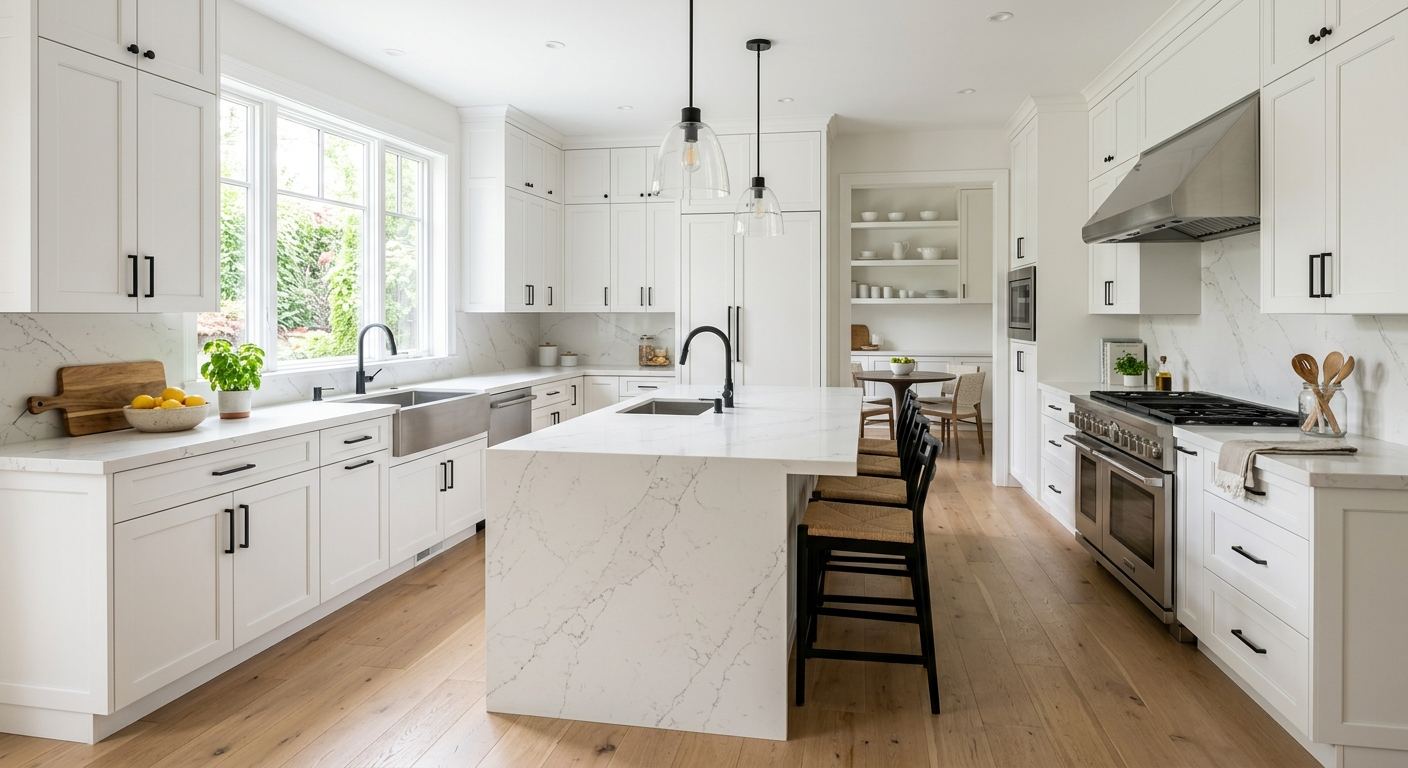
Kitchen renovation options and costs in Kanata
Kitchen renovations in Kanata, Ontario are driven less by winter weather and more by what buyers expect when they tour homes. Kanata’s population is growing and diversified (Statistics Canada, 2021 Census), and the Ottawa economic region’s higher purchasing expectations often show up as premium finishes—especially in neighbourhoods like Stonehaven Estates where homeowners commonly plan renovations around long-term comfort and resale value. In practical budgeting, many owners align kitchen spend to a home-value strategy; in Canada’s Ottawa area, remodel decisions often cluster in a range that can be meaningful on a resale appraisal.
Across Ottawa, quotes for the “same” kitchen can land far apart because finish tier is chosen with future value in mind, not just today’s function. Ottawa-area contractors typically see full kitchen renovations in $45,000 to $150,000+, with mid-tier work around $60,000 to $90,000. That’s why you’ll see more quartz counters, upgraded hardware, and designer tile in higher-value pockets of Kanata, even though the climate conditions are similar across the city.
Climate still matters in the background: winter humidity swings and frequent salt-brined exterior air can add wear to doors, hinges and caulking if ventilation and sealing aren’t planned. That said, in this market, cost differences are usually dominated by cabinetry selection, countertop material, and whether you change layout or plumbing/gas routing. If you want a clear way to compare options, review the tiered cost ranges below.
| Renovation Tier |
What's Included |
Typical Duration |
Price Range |
| Cosmetic refresh (paint, hardware, new appliances only) |
Cabinet paint/finish (if refinishing), new pulls/knobs, new appliances (not moving gas/plumbing), minor touch-ups, basic cleaning and protection |
1–3 weeks |
$12,000–$28,000 |
| Mid-range full renovation (new cabinets, counters, sink, tile) |
New semi-custom or quality stock cabinets, countertop (quartz or premium laminate), sink and taps, backsplash/tile, new hardware, typical lighting updates, disposal and trimming |
3–7 weeks |
$60,000–$90,000 |
| High-end full renovation (custom cabinets, stone counters, island) |
Fully custom millwork, stone counters (natural stone), island (casework + countertop), upgraded tile (often designer ceramic), premium fixtures and hardware, more complex electrical/lighting |
6–12 weeks |
$120,000–$160,000 |
| Cabinet refacing only (new doors + drawer fronts, same boxes) |
Refacing panels, new doors/drawer fronts, hardware, new toe-kick finish where needed, re-sealing; countertops typically not replaced |
2–4 weeks |
$18,000–$45,000 |
| Countertop swap only (laminate to quartz or stone) |
Remove and reinstall existing countertop, install new quartz/stone, reconnect/fit sink and taps as allowed, basic caulking and cleanup; no cabinet replacement |
3–10 days |
$4,500–$18,000 |
| Backsplash tile installation only |
Remove existing backsplash (if required), prep surfaces, install ceramic tile; caulking/grouting; simple trim; typically no plumbing relocation |
5–10 days |
$2,500–$12,000 |
Prices are estimates only and vary by project scope, site access and material selection.
What affects the price of kitchen renovation in Kanata
In Kanata and across the Ottawa area, two contractors can quote the “same” kitchen with a difference of roughly 30–50% because the hidden cost drivers are often different: material tier, how many trades are stacked in the schedule, and how much layout change you’re actually planning. In higher-value Ottawa communities and affluent Kanata pockets, homeowners more often default to quartz or stone counters and semi-custom cabinetry because the renovation cost can be easier to recover at resale. In more budget-focused scenarios, laminate and stock cabinets dominate because they deliver a strong visual upgrade without carrying the premium. The result is that mid-tier projects commonly land in the $60,000–$90,000 band, while luxury/custom work frequently pushes past $120,000.
Local conditions in Kanata can nudge costs up or down in a few concrete ways, even though Ottawa’s climate isn’t usually the main pricing factor. First, many homes were built across different eras, so older walls may have mismatched electrical runs and older shutoffs—expect more time for troubleshooting if you’re adding circuits or changing sink location. Second, winter humidity cycles can reveal weak bathroom-style ventilation habits in kitchens; when we see outdated range hood ducting, we often recommend correcting it during the renovation to reduce condensation near cabinets. Third, island additions are a common request in Stonehaven Estates and similar areas, but they almost always trigger extra electrical work and potential gas/plumbing considerations.
Finally, layout changes are the biggest unpredictable variable regardless of finish level: removing a wall, adding an island, or moving a gas line introduces permitting, licensed trades, demolition risk, and new rough-in work—those steps can quickly outweigh whether you selected quartz versus laminate.
| Price Factor |
Why It Matters |
Cost Impact |
| Cabinet tier — stock vs. semi-custom vs. fully custom millwork |
Better fit, different door styles, internal storage, and lead times change both labour and material cost |
Typically swings total kitchen spend by tens of thousands (e.g., mid-range vs. $120,000+ custom) |
| Countertop material — laminate vs. quartz vs. granite vs. stone |
Material cost, cutouts, edge profiles, and install complexity vary by tier |
Countertop installation alone can move from roughly $4,000+ up to the $18,000+ range depending on material |
| Layout change — wall removal, island add, plumbing/gas move |
Rough-in work (and often permits) adds labour, inspection steps, and schedule risk |
Can add major cost regardless of finish; often the difference between “mid-tier” and “high-end” |
| Appliance package tier — builder vs. mid-range vs. pro-grade |
Pro-grade appliances cost more and may require specific electrical/venting setups |
Upgrades can shift the project’s appliance line by several thousand dollars or more |
| Flooring — refinish existing vs. full replacement |
Cabinets may need to be removed or floors matched; subfloor condition affects repair time |
Full replacement adds material and demo/patching time beyond cabinet-only work |
| Backsplash — ceramic tile vs. marble vs. full-height slab |
Specialty tile/slabs require more precision cuts, sealing, and often more labour time |
Backsplash-only can range roughly $2,500 to $12,000+ |
| Electrical — new circuits for island, under-cabinet lighting |
New runs, pot lights/LED drivers, and island outlets require certified work |
Can add cost quickly if you’re expanding beyond an appliance swap |
| Permit fees and licensed trade requirements |
Permits and inspections add admin steps and compel specific qualified trades |
Increases certainty cost even when finish tier is “mid-range” |
Permits & regulations in Ontario
In Ontario, not every kitchen change needs a permit. Cabinet and countertop swaps typically do not require permits when you are keeping existing plumbing and gas locations as-is. Likewise, cosmetic refresh work (paint, hardware, and appliance replacement) is usually simpler from a permitting standpoint—provided you’re not altering key services.
Permits and licensed trade involvement are usually required when you do any of the following: moving plumbing supply/drain lines, relocating gas (including changes involving a gas stove or gas-fired range hood), removing a load-bearing wall or altering structural elements, or adding new electrical circuits (for example, island outlets, under-cabinet lighting tied into a new feed, or expanding power loads). Gas work must be completed by a licensed gas fitter, and electrical work by a licensed electrician, with inspections as required.
Before signing in Kanata, verify the basics in writing. First, ask for the contractor’s licensing details (and confirm their status through the appropriate Ontario online registry), then request certificate of insurance showing liability coverage and whether subcontractors are covered. For workers, look for WSIB/WCB clearance documentation. A straightforward step is to ask: “Can you provide your COI and WSIB/WCB clearance letter with your quote package?” It’s one of the fastest ways to separate a well-run renovation from one that creates risk at closeout.
Cabinets, countertops and layout decisions in Kanata
For a Kanata renovation, the three decisions that most influence both cost and resale appeal are: (1) cabinet tier, (2) countertop material, and (3) layout changes. Cabinet tier controls how quickly the project moves and how tightly the kitchen “fits” your lifestyle. Stock cabinets are fastest and often cheapest, semi-custom is the most popular mid-range option because it balances storage and price, and custom cabinets deliver the best fit but at the highest cost due to made-to-order work and longer timelines.
Countertop choice affects daily performance and buyer perception. Laminate is budget-friendly and can look clean, but it’s more vulnerable to damage at seams and hot spots. Quartz is usually the sweet spot in Ottawa-area budgets: durable, consistent, and typically lower maintenance than natural stone. Granite/stone adds premium character but can increase costs due to material selection, edge finishing, and install care; the kitchen market in Kanata generally rewards that premium when paired with higher-end cabinetry and a thoughtful backsplash plan.
Layout changes—like removing an open-concept wall, adding an island, or relocating plumbing/gas—can be justified when they create real circulation space or add functional zones (sink prep, cooking, and seating). However, they’re expensive because they trigger rough-in work. A concrete example: moving the sink to support an island layout can add enough plumbing labour and potential permitting complexity that it may cost more than upgrading from laminate (budget tier) to quartz (mid-to-upper tier). In Kanata’s resale-minded market, that’s why many homeowners upgrade quartz first, then reserve layout changes for when the space gain is truly worth it.
| Option |
Durability |
Maintenance |
Best For |
Price Range |
| Stock cabinets (big-box) |
Solid for everyday use; limited customization and less storage variety |
Low; occasional hardware tightening |
Fast turnarounds and budget-focused renovations |
$12,000–$28,000 |
| Semi-custom cabinets (local dealer) |
Good build quality and better fit; more storage options for Ottawa-area family routines |
Low; routine cleaning and handle care |
Most mid-range full renovations in Kanata |
$20,000–$55,000 |
| Custom cabinets (local millwork shop) |
Highest fit and finish; tailored storage, panels and hardware compatibility |
Low; premium components may require careful cleaning products |
Designer layouts, unusual dimensions, premium resale positioning |
$45,000–$90,000+ |
| Laminate countertop |
Moderate durability; seams and edges are the weak points |
Easy day-to-day cleaning; avoid cutting directly and prolonged heat exposure |
Budget renovations needing the “new look” without premium material costs |
$4,000–$9,000 |
| Quartz engineered countertop |
High durability for normal home use; resistant to staining and everyday wear |
Low maintenance; wipe clean, standard countertop care |
Most homeowners aiming for a long-lasting mid-to-upper kitchen finish |
$8,000–$16,000 |
| Granite / natural stone countertop |
Very durable surface; variation in pattern and veining is natural |
Usually low, but sealing may be recommended depending on the stone |
Premium look at resale and a “designer” visual finish |
$10,000–$18,000 |
| Butcher block countertop |
Good resilience but can scratch; sensitive to water soaking at seams |
Moderate—regular oiling and careful drying are key |
Warm, functional kitchens for families who prep often |
$7,000–$14,000 |
| Marble countertop |
Premium but more susceptible to etching/staining than quartz |
Higher maintenance—prompt cleaning and protective sealing practices |
Statement kitchens where design impact outweighs heavy prep use |
$12,000–$20,000+ |
How to choose a kitchen renovation contractor in Kanata
Choosing the right contractor in Kanata starts with confirming Ontario credentials and job management quality. First, verify licensing where applicable: electrical by a licensed electrician, gas work by a licensed gas fitter, and building/renovation responsibilities as required for the scope. Next, request a certificate of liability insurance and confirm it covers the work and the renovation period. For worker coverage, ask for a WSIB/WCB clearance letter—this is a common requirement for responsible subcontracting in Ontario.
Then get 2–3 itemised written quotes that break down labour and materials, not a single lump sum. A good quote separates cabinetry, countertops, tile work, demo/disposal, electrical/plumbing allowances, and any contingency items. Read exclusions carefully: is permit pulling included, or is that your responsibility? Is demolition and disposal included, or will you be paying extras later for dump fees and haul-away? Confirm product warranties and workmanship warranties in writing, including expected start and completion dates, and whether warranties are transferable if you sell the home.
For payment schedule, a safe approach is to keep upfront payment around 10–15% and use milestones for the remainder—hold back a portion until punch list items are complete. Finally, require a schedule with a start date and completion estimate, and make sure that the quote reflects lead times for cabinets and countertops so you’re not surprised by order delays.
- Ask for licences for relevant trades and confirm scope-matching (electrical, gas, structural changes).
- Request certificate of insurance (liability) and verify coverage limits and renovation dates.
- Provide WSIB/WCB clearance letter for the contractor and subcontractor coverage as required.
- Get 2–3 itemised quotes (labour + materials line items) instead of lump sums.
- Confirm what’s included: demo, disposal/haul-away, dust control, floor protection.
- Clarify permit responsibility in the contract—who pulls permits and who pays fees.
- Verify warranty terms: workmanship length, product/manufacturer warranty details.
- Ask if warranties are transferable on resale.
- Set a payment schedule with no more than 10–15% upfront; hold back until completion.
- Require a written start date and a realistic completion timeline with lead-time allowances.
- Ensure plumbing/gas/electrical rough-ins are scoped clearly before cabinet installation.
- Require a detailed allowances list (fixtures, tile labour, electrical fixtures, hardware).
Red flags to watch for in Kanata: (1) quotes that aren’t itemised and don’t explain allowances, (2) refusal to provide WSIB/WCB clearance or insurance documents, (3) promising a specific finish material without listing the exact brand/model, (4) skipping a written permit plan when layout/plumbing/gas/electrical is changing, and (5) requesting large upfront payments beyond 10–15% without a clear milestone schedule.
Frequently asked questions — kitchen renovation in Kanata
Can I live at home during a kitchen renovation in Kanata?
In most Kanata projects, yes—you can usually live at home during a renovation, especially if you’re doing a cosmetic refresh, cabinet refacing, or a mid-range full renovation without major layout demolition. The practical approach is to create a temporary “working kitchen” with access to a microwave, kettle, and a safe food prep area while the main counters and sink area are protected. Typical timelines for mid-range work are often several weeks, so plan for daily inconvenience: dust control, limited sink use, and restricted traffic through the work zone. If you’re doing higher-end custom work or adding an island with electrical and plumbing changes, the disruption is greater. For budgeting perspective, many Kanata homeowners keep entry projects in the $60,000–$90,000 mid-tier band to reduce the need for extensive structural work.
Should I renovate my kitchen before selling in Kanata?
Often, a kitchen refresh is worth considering before selling, but the key is matching buyer expectations for your price point in Ontario’s Ottawa area. In higher-value parts of Kanata, buyers frequently expect quartz or natural stone-looking finishes, upgraded hardware, and cohesive tile work. That doesn’t always mean a full custom build—many sellers get a better return by targeting the “big visible surfaces” first: cabinets and countertops, plus a clean backsplash. If you’re aiming for a mid-tier upgrade, projects often fall around $60,000–$90,000, which can deliver a modern look without the schedule and permit complexity of major layout changes. If you’re planning plumbing/gas moves or open-concept wall work, do it only if you’re confident in the resulting layout, because those items can increase costs beyond the finish premium. Always discuss your listing timeline with your contractor so you avoid lead-time surprises.
What's the most popular kitchen style in Kanata right now?
In Kanata, the most commonly requested direction is a clean, modern transitional look: shaker-style cabinetry (often in soft neutrals), quartz countertops, and a backsplash that adds texture without overwhelming the room. Homeowners also tend to prefer practical storage layouts—pantries, better drawers, and a functional island when space allows—because these features photograph well for showings. The “why” is tied to what buyers expect in Ottawa-area resale markets: the kitchen should feel bright, easy to maintain, and move-in ready. You’ll see less tolerance for dated laminate-only counters in higher-value neighbourhoods, and more homeowners step up to quartz in the mid-to-upper range when budgeting. For context, a typical mid-range full renovation in Kanata is often around $60,000–$90,000, while premium custom/stone projects frequently exceed $120,000.
How do I know if I need to update my kitchen plumbing in Kanata?
You may not need full replumbing, but you should plan for updates when you see warning signs or when your renovation scope requires it. Common triggers include: aging shutoffs that won’t hold a seal, slow drains, recurring leaks under the sink or dishwasher, discoloured water after the water has been idle, or visible corrosion around supply lines. Plumbing updates are also more likely if you’re moving the sink location, changing dishwasher positioning, or rerouting drain runs to support an island. In Ontario, changing plumbing supply/drain lines typically requires permitted work and licensed trades, so costs and timelines rise. If you’re only swapping countertops or refacing cabinets without moving plumbing, you can often keep existing lines. A well-written quote should include what’s being replaced, what’s being reconnected, and whether any rough-in changes are expected during the demo phase.
What is the difference between a galley and open-concept kitchen?
A galley kitchen is a more linear layout where cabinets and work surfaces run along two parallel walls, often with a walkway in between. It’s efficient for prep and can work well in homes with limited square footage. An open-concept kitchen connects the cooking area to the living/dining space, typically by removing or altering walls. In Kanata, whether a galley or open-concept layout is “better” depends on your home’s existing framing and how easily you can rework electrical, plumbing, and venting. Converting from galley to open-concept can be expensive because it may involve structural changes, electrical rewiring, and—if gas or plumbing routes shift—additional permitted work. That’s why many mid-range renovations focus first on cabinetry and countertops (often $60,000–$90,000) before considering major layout moves that can push projects higher.
How do I get accurate kitchen renovation quotes in Kanata?
Accurate quotes start with a clear scope and a consistent comparison between contractors. In Kanata, ask for 2–3 itemised written quotes that separate labour and materials so you can see what’s included: cabinetry, countertop supply and install, tile scope, demo/disposal, electrical allowances, and any plumbing/gas rework. Provide a simple decision list before meetings: cabinet tier, countertop material, backsplash style, and whether you’re changing layout (wall removal, island addition, sink move). Also confirm permit responsibility in writing and ask if permit pulling is included. Request start dates and completion estimates in the proposal, because cabinet and countertop lead times can control the schedule. Finally, get everything documented: warranty terms, payment milestones (no more than 10–15% upfront), and the exact product specifications. If a contractor can’t explain differences between laminate and quartz (for example), the quote may not be reliable for planning against $45,000–$150,000+ full renovation expectations.