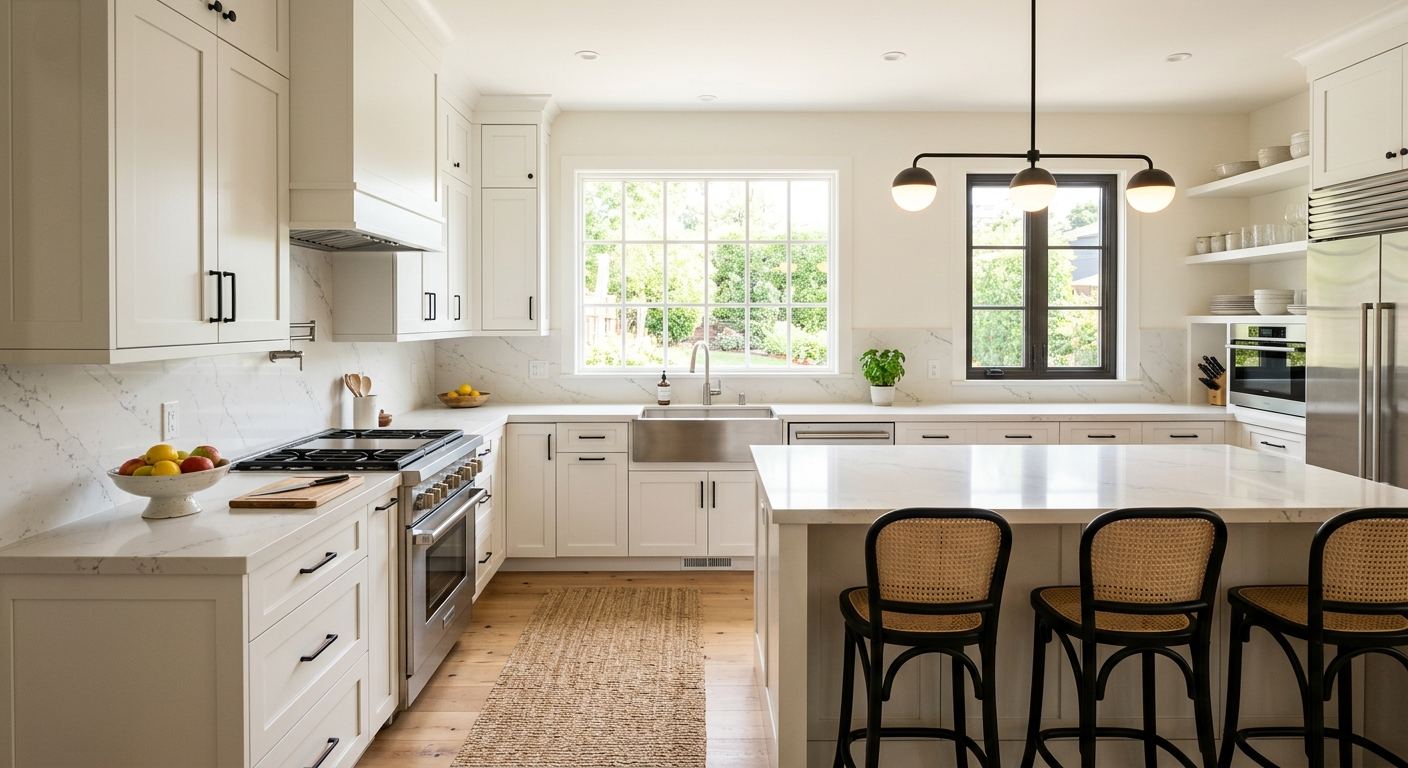
Kitchen renovation options and costs in Thessalon
Thessalon, Ontario homeowners typically plan their kitchen upgrades around what fits their household budget and resale expectations. With a median household income of $58,400 (Statistics Canada, 2021 Census), many families can comfortably move into a “hybrid” scope—fresh cabinets and modern counters—rather than going straight to a full custom rebuild. Also, because the area’s homeowner base leans strongly to owned housing (71.4% of households own, Statistics Canada, 2021 Census), contractors see steady demand for durable, easy-to-maintain finishes that hold up for the long run.
In the Northeast region, kitchen renovation pricing is influenced more by market expectations than by climate alone. Thessalon’s older housing stock matters: 68.8% of homes were built before 1981 (Statistics Canada, 2021 Census), so many projects involve practical removals, electrical catch-ups, and “unknowns” behind older backsplashes and under subflooring. Climate affects scheduling and logistics—winter moisture, road conditions, and drying times can slow countertop and tile work—yet it usually doesn’t force a higher finish tier by itself. What drives the tier is property value and the homeowner’s financing comfort, which is why many mid-range projects land around new cabinetry plus quartz or strong laminate rather than premium-only stone.
In Thessalon, areas around the town core tend to have the most contractor activity because access is easier for deliveries, and there’s frequent turnover of older kitchens in that housing stock. If you’re deciding between a refresh and a true rebuild, the table below compares the most common renovation tiers and realistic cost ranges for this market.
| Renovation Tier |
What's Included |
Typical Duration |
Price Range |
| Cosmetic refresh (paint, hardware, new appliances only) |
Cabinet paint or prep, new hardware, backsplash spot-patch (if needed), appliance replacement (no plumbing/gas moves) |
1–2 weeks |
$3,000–$10,000 |
| Mid-range full renovation (new cabinets, counters, sink, tile) |
Semi-custom or upgraded stock cabinets, quartz or good-quality laminate counters, new sink & taps, backsplash tile, updated lighting (where circuits already exist) |
3–6 weeks |
$30,000–$55,000 |
| High-end full renovation (custom cabinets, stone counters, island) |
Fully custom millwork, premium stone (e.g., granite/stone), island with upgraded electrical/plumbing as required, full-height backsplash or feature stonework, appliance suite |
6–12 weeks |
$60,000–$80,000 |
| Cabinet refacing only (new doors + drawer fronts, same boxes) |
Remove/replace doors & fronts, refinish boxes, new hinges/soft-close hardware, optional new crown and trim, minor caulking/fit adjustments |
1–3 weeks |
$6,000–$18,000 |
| Countertop swap only (laminate to quartz or stone) |
Remove existing top, install new under-mount sink interface as needed, template & cut for cooktop/sink, seam sealing, haul-away |
4–10 days |
$7,500–$15,000 |
| Backsplash tile installation only |
Surface prep, layout, tile installation, grout/sealer, minor outlet cover adjustments (electrical changes not included) |
3–7 days |
$2,500–$8,000 |
Prices are estimates only and vary by project scope, site access and material selection.
What affects the price of kitchen renovation in Thessalon
In Thessalon and across Ontario, the same “kitchen reno” can swing by roughly 30–50% depending on what’s actually being changed and how the trades price risk. The biggest drivers are finish tier and complexity, not just labour. In higher-value Ontario pockets, homeowners often default to quartz or stone counters and semi-custom cabinetry because buyers recognize those upgrades and owners can usually recoup part of the cost at resale. In more modest scopes, laminate counters and stock cabinetry are common because they keep the total ticket within a comfortable band and still modernize the space.
For reference, a mid-range full renovation with new cabinets and counters typically sits around $30,000–$55,000, while a high-end full renovation with custom millwork and an island can climb into $60,000–$80,000. Thessalon’s housing age adds a practical variable: with many homes built before 1981 (68.8%, Statistics Canada, 2021 Census), there’s frequently outdated wiring, slightly out-of-square framing, and older plumbing rough-ins behind the wall, which can force additional labour even when finishes look straightforward.
Concrete examples we see often: (1) A “simple” island usually requires electrical work for task lighting and potentially a new circuit—if the existing panel is tight, trades time increases. (2) When switching from laminate to quartz, the countertop template may reveal cabinet alignment issues; that can add cabinet shims or adjusters before install. (3) Tilebacksplash costs rise if the wall is wavy or if you’re covering older uneven tile and reworking outlets to land properly with the new pattern.
Climate can indirectly impact costs through schedule—colder months can slow drying and curing for some prep compounds and finishes—but it generally doesn’t push homeowners from laminate to stone. In other words, your cabinet and countertop choices, plus whether plumbing/gas/electrical need to move, determine the real variability in your quote.
| Price Factor |
Why It Matters |
Cost Impact |
| Cabinet tier — stock vs. semi-custom vs. fully custom millwork |
Different lead times, build quality, and custom sizing; custom requires more shop work and on-site fit time |
Often the largest swing: roughly $6,000–$30,000+ depending on scope |
| Countertop material — laminate vs. quartz vs. granite vs. stone |
Material cost, edge profiles, and fabrication complexity; stone seams and heavier slabs can require more labour coordination |
Typical countertop installations range $3,500–$15,000 |
| Layout change — wall removal, island add, plumbing/gas move |
Changes add demolition, framing, venting/access, and trade scheduling; permits are more likely |
Can add $5,000–$25,000+ even before finishing upgrades |
| Appliance package tier — builder vs. mid-range vs. pro-grade |
Energy features, fit/finish, and venting needs; pro-grade often requires more precise installs |
Often varies by $2,000–$10,000 within the same cabinetry plan |
| Flooring — refinish existing vs. full replacement |
Matching height, removing old layers, and protecting adjacent finishes affects time |
Commonly $1,500–$8,000 depending on demolition and type |
| Backsplash — ceramic tile vs. marble vs. full-height slab |
Labour and material vary widely; full-height surfaces demand flatter walls and more fabrication |
Backsplash tile installation often $2,500–$12,000 |
| Electrical — new circuits for island, under-cabinet lighting |
Lighting layouts and code-compliant circuit work require licensed electricians and inspection time |
Typically $1,000–$6,000 depending on how many circuits/components |
| Permit fees and licensed trade requirements |
Permits, inspections, and scheduling with licensed trades add coordination cost and timelines |
Often adds $500–$3,500 to the budget when triggered |
Permits & regulations in Ontario
For most Thessalon homeowners, the key is separating “cosmetic swaps” from “system changes.” In Ontario, cabinet and countertop replacements typically do not require a permit because you’re not altering plumbing, electrical, or structural load paths. Swapping countertops (even adding a new undermount sink in the same location) is generally treated as a fixture change. Similarly, replacing cabinet doors, drawer fronts, or repainting cabinetry usually stays permit-free.
However, you should expect permits and licensed trade involvement when you move or add building services. A permit is typically required when you: move plumbing supply/drain lines (new sink location), relocate gas connections (stove/range hood with gas), remove a load-bearing wall or do structural modifications, or add/alter electrical circuits (for example, new outlets for an island, under-cabinet lighting that needs new wiring, or upgrading a panel).
How to verify a contractor in Ontario, step-by-step: (1) Ask for their proof of business registration and liability insurance certificate (COI). (2) For electrical work, confirm they coordinate through a licensed electrician and ask to see the electrician’s licence details on the invoice or permits as applicable. (3) For gas-related changes, confirm a licensed gas fitter is responsible. (4) Verify WSIB/WCB clearance by requesting the clearance letter or a current account status document—don’t accept “we’re covered” as a verbal answer.
Finally, make sure the contract clearly states who pulls permits, who pays inspection-related costs, and what trades are included before any demolition begins.
Cabinets, countertops and layout decisions in Thessalon
When planning a kitchen renovation in Thessalon, three decisions determine most of your long-term satisfaction: cabinet tier, countertop material, and layout changes. (1) Cabinet tier: stock cabinets are usually the fastest and cheapest, semi-custom is the most common mid-range choice, and custom millwork delivers the best fit but adds lead time and cost. (2) Countertops: laminate can be the budget win; quartz is the “safe upgrade” for families who want durability with low maintenance; granite/stone look premium but can involve more fabrication complexity; butcher block adds warmth but needs more attention; marble is beautiful yet more sensitive to etching. (3) Layout: opening an area by removing a wall or adding an island can improve flow and resale appeal, but plumbing/gas relocation and electrical changes are where budgets expand.
Because many Thessalon homes were built before 1981 (68.8% of dwellings, Statistics Canada, 2021 Census), older rough-ins can make a “move everything” layout more expensive than homeowners expect. The Northeast resale market also tends to reward kitchens that feel modern without looking overly delicate—so quartz and robust cabinet finishes are popular at mid-range budgets, while stone and custom islands are more common when the project is closer to a premium full renovation.
Here’s a realistic dollar example: upgrading from laminate to quartz only (keeping cabinets the same) often adds roughly $3,500–$8,000 above a laminate-style budget once you include template, sink/cooktop cut-outs, and installation. That’s usually justified because quartz typically handles daily wear better (heat resistance and staining resistance) and holds appearance longer—especially helpful in a household that cooks often through long winters. By contrast, paying for a full custom cabinet tier is best justified when you’re solving a real size problem (awkward corners, fridge wall depth, or a tight pass-through). If your measurements are straightforward, semi-custom delivers most of the payoff with less risk.
| Option |
Durability |
Maintenance |
Best For |
Price Range |
| Stock cabinets (big-box) |
Good everyday durability; limited sizing options can reduce perfect fit |
Simple cleaning; rely on correct installation and quality hinges/soft-close if available |
Fast turnarounds and tighter budgets |
$6,000–$18,000 |
| Semi-custom cabinets (local dealer) |
Very solid build with better internal organization and more sizing flexibility |
Low; keep hardware adjusted and wipe spills promptly |
Most common Thessalon mid-range renovations seeking a “built-in” look |
$12,000–$30,000 |
| Custom cabinets (local millwork shop) |
Highest fit and finish; stronger for specialized storage and unique layouts |
Low—durability depends on finish system used by the shop |
Island-heavy layouts, unusual wall dimensions, and premium resale upgrades |
$25,000–$45,000+ |
| Laminate countertop |
Resistant to daily scuffs but can chip or degrade around seams if poorly supported |
Wipe clean; avoid prolonged heat exposure and standing water at seams |
Budget refreshes that still modernize the kitchen |
$3,500–$6,500 |
| Quartz engineered countertop |
Highly durable for family cooking; consistent color and pattern |
Low maintenance; reseal usually not required, but use pads for hot items |
Best all-around choice for busy households and resale-friendly kitchens |
$6,500–$12,500 |
| Granite / natural stone countertop |
Excellent durability and heat tolerance; variety in porosity by stone type |
Periodic sealing recommended; wipe spills quickly |
Premium look where homeowners accept slightly higher upkeep |
$9,000–$15,000 |
| Butcher block countertop |
Solid but can scratch and needs attention at seams and edges |
Oil and condition regularly; dry promptly |
Warm, casual kitchen style when the homeowner will maintain it |
$5,000–$9,500 |
| Marble countertop |
Premium visual appeal; more prone to etching/chips than quartz |
Requires careful cleaning and protection; sealing and gentler habits |
Low-abuse aesthetics-focused kitchens |
$10,000–$15,000+ |
How to choose a kitchen renovation contractor in Thessalon
Choosing a contractor in Thessalon isn’t just about the lowest number—it’s about risk control, especially in older homes where you can’t see everything until walls come off. Start by verifying Ontario licensing requirements for the trades involved and confirming the contractor’s liability insurance. Ask for the certificate of insurance (COI) and ensure the coverage is current and includes construction/renovation work. For work coordination, you should also verify WSIB/WCB clearance by requesting the clearance letter or current coverage status documentation. If the GC says “we’ll handle it,” still ask for proof—documents belong in the file, not in a promise.
Next, request 2–3 itemised written quotes. You want a labour + materials breakdown (cabinet supply vs. installation, countertop fabrication vs. install, tile prep vs. tile setting) instead of a lump sum. Review scope exclusions carefully: is drywall patching included, is disposal included, does the quote include permit pulling if plumbing/electrical changes are needed, and what happens if your existing walls are out of square? Warranty matters too—ask for the workmanship warranty term, what it covers, and whether it is transferable if you sell. Product warranties are separate and should be provided for cabinets, counters, and major appliances.
Payment schedule should be conservative. A common rule is never paying more than 10–15% upfront; use a holdback until key milestones complete. Finally, get the start date and completion estimate in writing so you have a clear plan for materials lead times, especially for cabinet orders.
- Ask for COI and confirm the named insured and active dates on the certificate.
- Request WSIB/WCB clearance documentation before work starts.
- Confirm which licensed trades are responsible for electrical or gas-related tasks (where applicable).
- Get 2–3 itemised quotes with line-by-line labour and materials.
- Ensure the scope states whether permits are included or extra.
- Check if demolition, disposal/haul-away, and site protection are included.
- Look for how they handle “unknowns” from pre-1981 wall conditions.
- Verify countertop template timing and who pays for remakes if measurements shift.
- Ask for written start date, weekly schedule, and estimated completion date.
- Confirm warranty length for workmanship and how claims are handled.
- Set payment milestones tied to inspections and completed stages (not vague dates).
- Ask for references for similar kitchens in Northeast Ontario or comparable older homes.
Red flags to watch for in Thessalon: (1) quotes without itemized labour/material breakdowns, (2) refusal to provide COI and WSIB/WCB clearance paperwork, (3) vague answers about who pulls permits when plumbing/electrical changes are involved, (4) pressuring you to pay more than a small deposit up front, and (5) no written timeline or change-order process.
Frequently asked questions — kitchen renovation in Thessalon
Quartz vs granite countertops — which is better?
In Thessalon kitchens, quartz is often the “best practical” choice because it’s durable for daily cooking and usually requires less upkeep than natural stone. Quartz is engineered to be more consistent in pattern and generally resists staining well, which helps in family kitchens through busy winters. Granite is also very durable and can tolerate heat better, but maintenance depends on the specific stone’s porosity—sealing and quicker spill cleanup matter. If you want a resale-friendly look with fewer routines, quartz typically wins. Budget-wise, countertop swaps commonly run between $3,500–$15,000 depending on material and edge/profile complexity; your best comparison comes from quotes that include template, cut-outs, and installation, not just the raw slab.
Should I reface or replace my cabinets?
For many older Thessalon homes, refacing is a smart move when the existing cabinet boxes are solid and level. Cabinet refacing can modernize the look—new doors, drawer fronts, and updated hardware—without the full disruption of removing everything. Typical cabinet refacing-only pricing often lands around $6,000–$18,000, and it can be faster than a full replacement. Replace instead if the boxes are warped, water-damaged, or poorly installed, or if you need major internal changes like relocating plumbing, adding pull-outs, or correcting severe layout issues. The deciding factor is what you’ll find after removal—so ask your contractor how they evaluate box condition early and whether they include a proper inspection step before you commit.
Do I need a permit for a kitchen renovation in Ontario?
In Ontario, a cabinet or countertop swap typically does not require a permit because you’re not changing the building’s core systems. Where permits become necessary in Thessalon is when you alter plumbing supply/drain lines, relocate gas connections (for gas stoves or gas range hoods), remove a load-bearing wall or do structural changes, or add/alter electrical circuits (such as new island outlets or new wiring for lighting). A good contractor will tell you upfront whether your scope triggers permits and who is responsible for pulling them. Before signing, confirm in writing: who pulls the permit, which inspections are expected, and which licensed trades are included. It keeps your renovation smoother and avoids surprises at completion.
What's the ROI on a kitchen renovation?
ROI in Ontario is usually strongest when the renovation improves usability and durability—think clean layout, modern cabinetry, and countertops that look good for years. In practice, not every project “pays back” dollar-for-dollar, but higher-quality, low-maintenance finishes tend to support resale confidence. Thessalon homeowners should consider what buyers expect in your price bracket: for many mid-range upgrades, homeowners aim for new cabinets and quartz or upgraded laminate, often in the $30,000–$55,000 range, because it modernizes without overspending. The best ROI also comes from avoiding unnecessary layout changes—moving plumbing or gas is expensive and unpredictable, even if the finish tier is modest. A contractor should help you choose upgrades that match your home’s value and how long you plan to stay.
How do I budget for a kitchen renovation?
Budgeting starts with deciding your tier and protecting a contingency. For Thessalon, a cosmetic refresh (paint, hardware, appliances only) can be a smaller entry point around $3,000–$10,000, while a mid-range full renovation often sits around $30,000–$55,000 when you include new cabinets and countertops plus tile. If you’re going higher with custom cabinets, premium stone, and an island, plan for roughly $60,000–$80,000. Add a contingency because many kitchens in older homes (a large portion built before 1981) may have hidden issues like wiring updates or out-of-square framing. Request itemised quotes so you know what’s included (demo, disposal, lighting, permits) and what’s excluded before you commit.
Can I move my kitchen sink or stove?
Yes, you can move a kitchen sink or stove, but the feasibility and cost depend on what needs to change behind the walls. Moving a sink usually means rerouting water supply and drain lines, which typically triggers permit requirements and requires licensed plumbing work. Moving a stove can be straightforward if it’s electric and the circuit is nearby, but it becomes more complex—and permit-driven—if gas is involved because licensed gas fitting and inspections are required. In Thessalon’s older housing stock, routing through existing framing and avoiding surprises in old plumbing rough-ins is a common cost driver. If you want to move them, ask your contractor for a plan that includes rough-in approach, estimated labour, and how permits/inspections are handled before demolition begins.