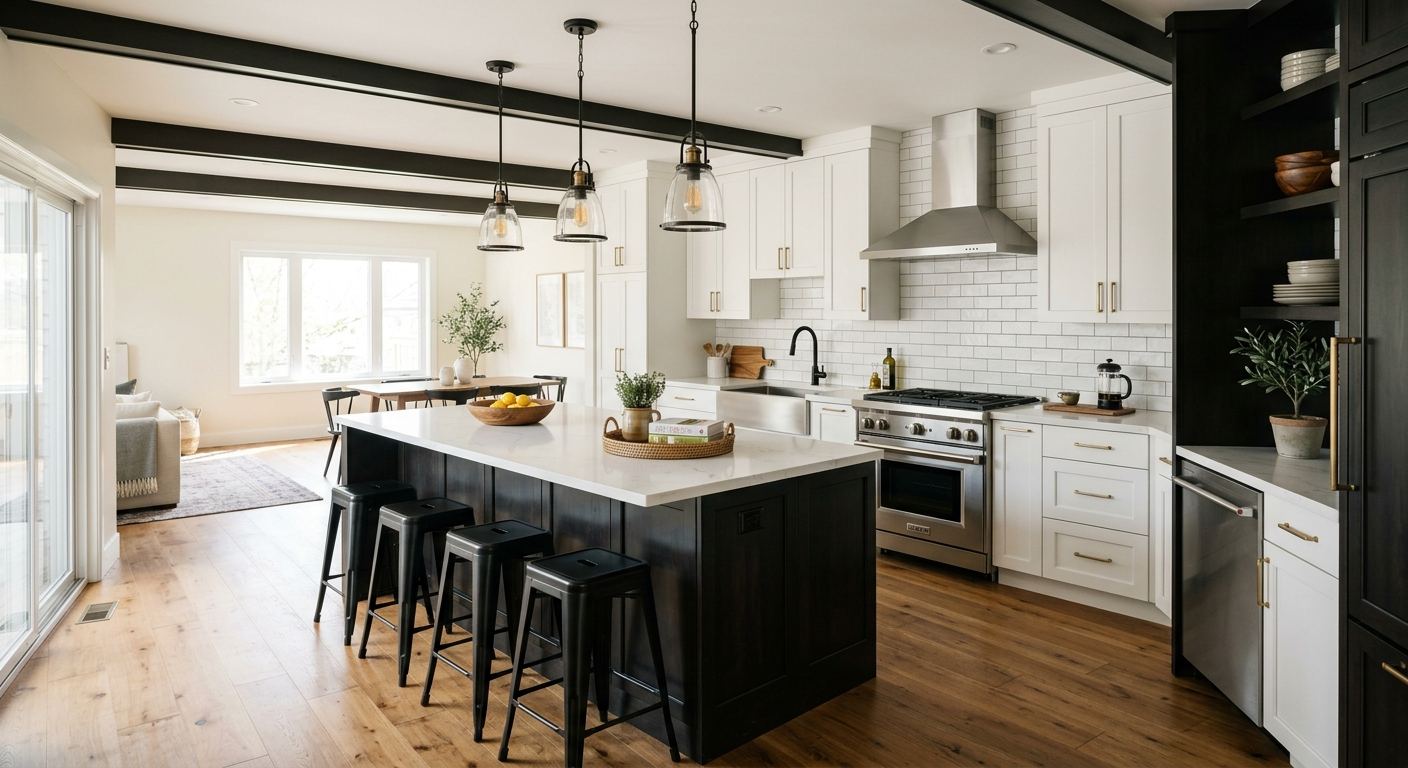
Kitchen renovation options and costs in Almonte
Almonte homeowners usually start kitchen planning with one question: “What can I realistically afford, and what will it look like when the work is done?” With Almonte sitting at a population of 5,039 (Statistics Canada, 2021 Census), you’ll notice a tight pool of trades that stay busy year-round—so lead times can swing when multiple nearby projects stack up. At the same time, the Toronto economic region strongly influences what buyers expect when they tour listings. In higher-value pockets, many owners choose upgrades that align with an “8–15% of home value” renovation mindset, which pushes kitchens toward quartz or natural stone and upgraded appliances. Those expectations don’t depend on how often it rains; they’re tied to resale economics and the types of finishes that photograph well and hold value.
In the GTA market, finish tier is the biggest cost lever. Stock and refaced cabinet approaches typically keep a full renovation closer to the mid-$20k range, while structural changes plus custom cabinetry and premium countertops commonly move the project into the $80k+ band. Climate still plays a supporting role in Almonte: spring humidity and winter drying can stress older sealants and adhesives, so air-tightness, ventilation, and proper substrate prep are worth budgeting for—especially if you’re replacing tile or redoing grout lines. If you’re working near Main Street or in older housing stock around the historic core, accessibility and parking can also affect labour hours.
Because of these factors, contractor demand is especially steady for “do it once” renovations in established residential pockets off Ottawa Street and near the Mississippi area. Next, here are the common renovation tiers and what homeowners typically get in each budget level.
| Renovation Tier |
What's Included |
Typical Duration |
Price Range |
| Cosmetic refresh (paint, hardware, new appliances only) |
New paint, cabinet hardware, appliance swap, minor caulking, and basic cleaning/touch-ups (no cabinet box changes) |
3–7 days |
$8,000–$20,000 |
| Mid-range full renovation (new cabinets, counters, sink, tile) |
Semi-custom or quality stock cabinets, quartz or laminate counters, sink + faucet, backsplash tile, flooring refresh (patch/re-level as needed) |
3–5 weeks |
$25,000–$55,000 |
| High-end full renovation (custom cabinets, stone counters, island) |
Fully custom millwork, stone counters (granite/soapstone/marble), upgraded appliance package, island with electrical/plumbing upgrades, full backsplash |
6–10 weeks |
$70,000–$90,000 |
| Cabinet refacing only (new doors + drawer fronts, same boxes) |
Refaced fronts, new hardware, optional interior organizers, repaint/finish touch-ups, careful sealing and alignment |
1–2 weeks |
$8,000–$35,000 |
| Countertop swap only (laminate to quartz or stone) |
Remove existing counters, template, install new quartz/stone, edge finishing, sink cut-outs (if compatible), basic backsplash adjust |
5–10 business days |
$3,000–$15,000 |
| Backsplash tile installation only |
Surface prep, tile supply + install (typical ceramic/porcelain), grout/seal, caulking at changes of plane |
3–7 days |
$2,000–$10,000 |
Prices are estimates only and vary by project scope, site access and material selection.
What affects the price of kitchen renovation in Almonte
In Almonte—and across the wider Ontario and Toronto economic region—two quotes for what looks like the “same kitchen” can easily differ by 30–50%. The usual reason isn’t labour inefficiency; it’s finish tier, scope definition, and whether the contractor is pricing the unseen work: subfloor corrections, cabinet level-on condition, electrical rework, and plumbing adjustments. Toronto-area projects also tend to be judged against resale expectations, so higher-value buyers often pay for quartz or natural stone and semi-custom cabinetry because that cost is easier to recapture at sale time.
Local home values and household incomes shape the typical finish tier far more than weather. In higher-value parts of the Toronto market, homeowners more often target the $55,000-and-up renovation range using upgraded appliances and upgraded countertops. In more price-sensitive scenarios, many teams steer toward stock or refaced cabinets and laminate tops to keep the project closer to the $25,000–$55,000 band, balancing affordability with good day-to-day performance.
Layout changes add the most unpredictable cost regardless of finish level. For example, adding an island often means rerouting electrical and possibly plumbing, which can quickly move labour and material needs upward. Moving a gas line is also a scope-determining item because it must be done by licensed trade professionals and can affect scheduling.
Concrete Almonte examples: (1) Older homes often have less consistent wall straightness and uneven subfloors, so cabinet installation may require additional shimming, re-leveling, and longer install time. (2) If your winter heating cycles have dried out older caulk lines and grout, backsplash removal and re-tile prep may involve more patching than expected. (3) If you’re upgrading to quartz over existing laminate, the new sink cut-out and edge profiles can require careful templating to avoid costly rework. Now let’s break down the key price factors homeowners see on itemised estimates.
| Price Factor |
Why It Matters |
Cost Impact |
| Cabinet tier — stock vs. semi-custom vs. fully custom millwork |
Differences in material thickness, joinery, door styles, and ability to fit out-of-square walls |
Can shift a full kitchen from mid-range budgets ($25,000–$55,000) toward high-end territory ($70,000–$90,000) |
| Countertop material — laminate vs. quartz vs. granite vs. stone |
Price per square foot, installation complexity, edge options, and sink cut-out compatibility |
Often a swing factor of thousands; quartz typically lands between laminate and natural stone in total installed cost |
| Layout change — wall removal, island add, plumbing/gas move |
Structural work, new framing, venting/ducting access, and trades coordination |
Most unpredictable; commonly adds several thousand to labour and permits, even when finishes are modest |
| Appliance package tier — builder vs. mid-range vs. pro-grade |
Electric/gas requirements, integration (panels/trim), and installation specs |
Can add $2,000–$10,000+ depending on range hood style, built-in vs freestanding, and venting needs |
| Flooring — refinish existing vs. full replacement |
Some flooring survives demolition; other surfaces require full removal for proper leveling |
Refinish/patch keeps costs down; full replacement can add significant labour and material |
| Backsplash — ceramic tile vs. marble vs. full-height slab |
Tile pattern complexity and material weight; full-height increases prep and detailing |
Typically ranges from a couple thousand to several thousand depending on height and material |
| Electrical — new circuits for island, under-cabinet lighting |
Load calculations, new breakers/circuits, and code-compliant receptacle placement |
Can add thousands and also impacts scheduling for licensed inspections |
| Permit fees and licensed trade requirements |
Permits and inspections are tied to plumbing/gas/electrical/structural scope |
Small in isolation, but when a scope triggers them, they can change both cost and timeline |
Permits & regulations in Ontario
In Ontario, swapping cabinets or countertops usually doesn’t require permits, because you’re not changing plumbing/drain routes, gas connections, load-bearing structure, or electrical circuits. That said, homeowners in Almonte often get caught when a “simple refresh” turns into an actual reconfiguration. Moving plumbing supply or drain lines (even a few inches), relocating a gas stove/range, or changing where the hood vents—especially if it connects to gas or requires gas line modification—will require permits and licensed trades. Removing a load-bearing wall is also a permit-triggering scope because it affects the structural system.
For gas work, only a licensed gas fitter can do the work, and it must be inspected. For electrical, a licensed electrician must install new circuits and any required updates for island receptacles, under-cabinet lighting, or new ventilation controls tied to electrical systems. Inspections and sign-offs then become part of the job schedule, so it’s important to plan for those days.
Step-by-step verification (what I tell clients to do before signing in Almonte): (1) Ask the contractor for their licence details and check the online registry for the relevant categories; (2) request a current certificate of liability insurance and confirm the address/project name is covered; (3) verify WSIB/WCB coverage where applicable—ask for clearance documentation; (4) get a written statement clarifying which permits the contractor will pull versus what you’re expected to authorize; and (5) ensure the contract includes inspection responsibility and scheduling. If it isn’t written down, assume it’s not included.
Cabinets, countertops and layout decisions in Almonte
When you’re renovating an Almonte kitchen, three decisions drive most of your cost and most of your satisfaction: (1) cabinet tier, (2) countertop material, and (3) layout changes. For cabinets, stock is fastest and cheapest, semi-custom is the most common sweet spot, and custom millwork is the highest cost—but it can also solve “out-of-square” realities in older homes and deliver more precise storage. For countertops, laminate is budget-friendly, quartz is the popular durability choice, and natural stone (granite/marble) is premium with more maintenance considerations. Layout—open-concept wall removal, island addition, or plumbing/gas relocation—should be judged against space gained and how easily the new flow matches what Toronto-area buyers expect: clear traffic paths, good lighting, and practical storage.
Ontario’s temperature swings don’t usually “break” kitchen materials the way freeze/thaw affects exterior work, but humidity and dryness can reveal installation weaknesses. Proper substrate preparation, correct sealants, and venting matter for long-term performance—especially around backsplashes and sink areas.
A good example: If you’re aiming for a mid-range refresh (often $25,000–$55,000), choosing semi-custom cabinets and quartz can be justified because it delivers both appearance and day-to-day durability without stepping into high-end structural costs. By contrast, upgrading to marble at the same time as adding an island can overshoot value—because marble’s higher care requirements and the extra fabrication/installation complexity stack on top of the biggest layout costs. If you’re planning an island, the cost is most justified when it improves how many people can work at once and where seating/traffic lives—rather than adding square footage that complicates circulation.
Next, use the guide below to compare the most common options people choose in Almonte, keeping resale expectations from the Toronto market in mind.
| Option |
Durability |
Maintenance |
Best For |
Price Range |
| Stock cabinets (big-box) |
Good overall, but limited in-size flexibility; hinges/finishes vary by line |
Low routine maintenance; be mindful of alignment on older, uneven walls |
Budget-first projects and quick turnarounds |
$8,000–$20,000 |
| Semi-custom cabinets (local dealer) |
Very good durability; better options for widths, heights, and storage inserts |
Low to moderate; occasional hardware adjustment as homes settle |
Most Almonte renovations seeking “looks custom, costs reasonable” |
$15,000–$40,000 |
| Custom cabinets (local millwork shop) |
Excellent fit and finishing; best for unusual layouts and cabinetry-to-ceiling detailing |
Low maintenance; quality hinges/finishes typically age well |
High-end builds and spaces needing exact fit |
$30,000–$60,000 |
| Laminate countertop |
Solid for daily use; can scratch or chip and is sensitive to edge damage |
Wipe clean; avoid standing water at seams and protect the edges |
Value-focused kitchens and rental/resale-friendly refreshes |
$3,000–$7,000 |
| Quartz engineered countertop |
Very durable; resists staining and handles daily wear well |
Low—typical cleaning only; avoid harsh abrasives |
Busy households wanting a low-maintenance “upgrade” |
$6,000–$15,000 |
| Granite / natural stone countertop |
High durability; unique patterning and heat resistance |
Often requires periodic sealing depending on the stone |
Homeowners prioritizing premium appearance |
$8,000–$18,000 |
| Butcher block countertop |
Durable for cutting; can dent and needs protection from prolonged moisture |
Regular oiling; wipe dry quickly around sink areas |
Families who want warmth and a “cottage” feel |
$5,000–$12,000 |
| Marble countertop |
Beautiful but softer than quartz/granite; can etch with acidic spills |
Higher care—frequent wipe-up and stain/etch prevention |
Low-to-moderate traffic kitchens or a more design-forward primary home |
$10,000–$22,000 |
How to choose a kitchen renovation contractor in Almonte
Choosing the right contractor is mostly about proof: licensing, insurance, clear scope, and a timeline you can actually rely on in Almonte. In Ontario, you should request proof of the relevant licence category, then verify it through the appropriate online registry for the trade(s) involved. Ask for a certificate of liability insurance and confirm it’s active for the project period. For workplace protection, verify WSIB/WCB coverage (or equivalent clearance documentation) so you’re not exposed if a worker is injured on your site.
Next, ask for 2–3 itemised written quotes rather than lump sums. You want labour and materials broken out (cabinets, counters, tile, electrical/plumbing adjustments, demolition, disposal, and project management). Check whether permits are included, whether the contractor will pull them, and who is responsible for inspection bookings. A good scope will list inclusions clearly—like demolition limits, backer board/tile substrate method, disposal hauling, and what happens if hidden rot or outdated wiring is found.
Warranty matters too: look for a workmanship warranty length stated in the contract and confirm the product/manufacturer warranties for cabinets, countertops, and appliances. Ask whether warranties are transferable if you sell the home before the term ends. Payments should be tied to milestones; never accept more than 10–15% upfront, and hold back a portion until the job is complete and punch-list items are resolved. Finally, require a start date and completion estimate in writing so schedule expectations are clear.
- Verify Ontario licensing for each trade involved (general contractor plus electrician/gas/plumbing where applicable).
- Confirm liability insurance is active and ask for the certificate before work starts.
- Request WSIB/WCB clearance documentation for contractor workers.
- Get 2–3 itemised quotes: labour + materials, with line items for cabinets, counters, and tile.
- Ensure the scope states whether permits are included and who pulls them.
- Confirm demolition limits and whether disposal/dump fees are included.
- Ask about site protection: tarps, dust control, and protection of flooring/doorways.
- Check the backsplash plan: substrate type, waterproofing details, and grout/sealant specs.
- Review electrical scope: outlets for island, under-cabinet lighting, and fixture locations.
- Confirm plumbing/gas tie-ins if moving sink, dishwasher, or range location.
- Ask for a written schedule with lead times for cabinets and countertop fabrication.
- Use a contract that includes warranty terms and a punch-list process at closeout.
Red flags to watch for: quotes that are “too good” with no itemisation, vague scopes that don’t mention permits or disposal, promises to skip licensed trade requirements, pressure for large deposits upfront, and warranties that are only discussed verbally instead of written into the agreement.
Frequently asked questions — kitchen renovation in Almonte
What's the best countertop material for a busy Almonte kitchen?
For a busy kitchen in Almonte, quartz is usually the safest “liveable upgrade.” It handles daily use well, resists staining more than many natural stone choices, and stays looking clean with typical household care. If you’re aiming for a mid-range renovation budget, quartz commonly supports projects in the $25,000–$55,000 band when paired with semi-custom cabinetry and sensible backsplash finishes. Laminate can work if you’re keeping costs tight, but its seams and edges are more vulnerable to damage over time, especially around sinks and high-traffic areas. Marble is gorgeous but needs more careful attention to acidic spills. If you want a clear, low-maintenance decision for Ontario homeowners, quartz is generally the best balance of durability and resale-friendly appearance.
How do I add an island to my Almonte kitchen?
Adding an island is usually less about choosing the island itself and more about planning utilities and traffic flow. First, confirm the room geometry: you’ll want adequate clearance for circulation and door swings. Then we design the island’s electrical needs—often new outlets and under-cabinet lighting—because that will require a licensed electrician and can add scheduling time. If the island includes a sink or dishwasher, plumbing and drainage routes must be planned and may change permit requirements in Ontario. If you’re dealing with a gas range, changing nearby ventilation and gas connections can trigger additional licensed work. In real terms, homeowners should be ready for island additions to push budgets toward the higher end of mid-range projects and often overlap with the $55,000–$80,000 planning zone, depending on finish tier and whether plumbing/gas is moved.
How much does a kitchen renovation cost in Almonte?
Kitchen renovation costs in Almonte typically follow the broader Toronto economic region pattern: finish tier and scope define the range more than local weather. For most homeowners, full renovations are commonly planned within the $25,000–$90,000 range. A cosmetic refresh (paint, hardware, and new appliances only) can be closer to the $8,000–$20,000 level, while a mid-range full renovation with new cabinets, counters, sink, and tile is often budgeted around $25,000–$55,000. If you add an island, upgrade to custom cabinetry, and choose stone counters, many projects move into the $70,000–$90,000 band. For accuracy, request itemised quotes that show labour and materials separately—especially for plumbing/electrical changes—so you can compare apples to apples and avoid surprises.
How long does a kitchen renovation take in Almonte?
Most kitchen renovations in Almonte take anywhere from a couple of weeks for small scopes to several months for full custom builds. A cosmetic refresh with paint and hardware typically fits into 3–7 days. A mid-range full renovation usually lands around 3–5 weeks, assuming cabinet lead times and countertop templating line up. High-end projects with custom millwork and an island often run 6–10 weeks due to fabrication timelines, additional trade coordination, and finishing details. Countertop swap-only jobs can sometimes be done in about 5–10 business days once template measurements are confirmed. Weather isn’t usually the dominant driver inside a kitchen, but Ontario seasonal schedules can affect trade availability, and hidden conditions (like older subfloor irregularities) can add days. The best way to protect your timeline is to get a written schedule with start date, milestones, and countertop/cabinet delivery dates.
Quartz vs granite countertops — which is better?
“Better” depends on how you use your kitchen, but for many Ontario families, quartz is the practical winner. Quartz is engineered to resist staining and is generally lower maintenance than many natural stones; routine cleaning is usually enough. Granite is also durable and heat resistant, but the look is more variable and many granite types require periodic sealing to maintain performance. If you’re choosing between them for a realistic budget, quartz often fits smoothly into mid-range renovation plans—commonly supporting projects in the $25,000–$55,000 band when paired with semi-custom cabinetry—while granite can push the budget higher if you add premium edges and island fabrication. If you love the natural pattern and you’re comfortable with sealing/maintenance, granite is great. If you want the easiest “set it and forget it” countertop in a busy Almonte home, quartz is usually the safer bet.
Should I reface or replace my cabinets?
In Almonte, refacing is often the right choice when your existing cabinet boxes are structurally sound, straight, and level—because you can keep the same cabinet footprint while upgrading doors, drawer fronts, and finishes. This can be especially effective when you want to target cabinet installation/refacing budgets in the $8,000–$35,000 range and spend more on countertops or a backsplash. Replacement is better when boxes are damaged, sagging, poorly sealed, or when you’re planning a layout change that demands different sizes or moving storage configurations. Refacing typically avoids the heavier demolition of replacement, which can reduce timeline disruptions. The fastest decision path is an on-site assessment: we check box condition, wall/level accuracy, and whether the existing layout supports the new door style and hardware locations without awkward reveals.