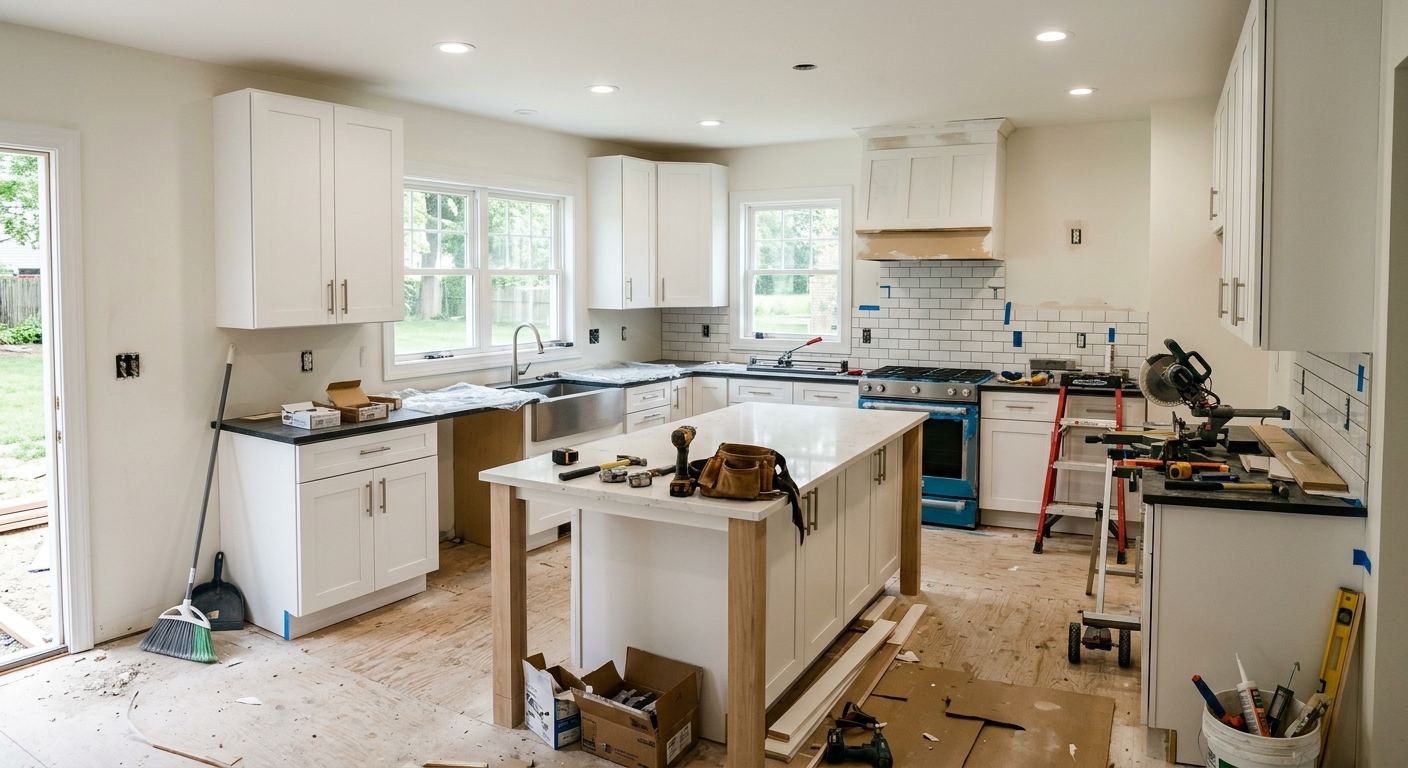
Kitchen renovation options and costs in Simcoe
In Simcoe, Ontario, homeowners usually start their kitchen budget by matching expectations to what the local market will pay for, especially as you look across the Hamilton–Niagara Peninsula. With Simcoe’s population sitting at 13,922 (Statistics Canada, 2021 Census), you’re balancing a tighter pool of contractors against steady demand from family buyers and downsizers in nearby resale pockets. In practice, that means most full renovations trend toward mid-range finishes that feel “move-in ready,” rather than extreme bargain builds. Market-driven finish choices also reflect broader economic strength in the region: higher-income buyers are more likely to prioritize quartz and semi-custom cabinetry because they want a kitchen that photographs well and holds value through resale cycles.
Even though kitchen cost in Southern Ontario is rarely driven by climate alone, local conditions still play a role. Winter freeze–thaw and indoor humidity from cooking can stress older materials and fasteners, and in some homes you’ll also uncover moisture-touched subfloor or worn underlayment behind aging flooring. The good news is that kitchen trades are accessible around the Hamilton–Niagara corridor, so lead times for common finishes are usually predictable—unless you’re scheduling premium stone templates or specialty appliance deliveries. Trade demand is especially strong around the downtown and established residential pockets where older housing stock is typical and homeowners want modern storage and lighting without relocating too many utilities.
Below is a practical tier comparison to help you line up your scope with a realistic budget—then we’ll dig into what moves quotes up or down.
| Renovation Tier |
What's Included |
Typical Duration |
Price Range |
| Cosmetic refresh (paint, hardware, new appliances only) |
Cabinet paint or repaint, new hardware, appliance swap (in-stock), lighting refresh (if existing wiring is reused), minor caulking and touch-ups |
1–2 weeks |
$5,000–$15,000 |
| Mid-range full renovation (new cabinets, counters, sink, tile) |
New cabinets (stock or semi-custom), quartz counters, new sink and faucet, backsplash tile, under-cabinet lighting (where applicable), flooring refresh if in scope, disposal and basic plumbing tweaks |
3–6 weeks |
$30,000–$60,000 |
| High-end full renovation (custom cabinets, stone counters, island) |
Fully custom millwork, stone or premium counter (granite/stone), island build with enhanced storage, upgraded backsplash (feature tile or full-height option), upgraded appliance package, more electrical and lighting, potential ducting/vent upgrades |
6–10 weeks |
$70,000–$90,000 |
| Cabinet refacing only (new doors + drawer fronts, same boxes) |
Door/drawer-front replacement, new hardware, option for re-skinning select areas, basic prep and refinishing of the existing cabinet carcasses (when in good shape), paint touch-ups |
1–3 weeks |
$7,000–$20,000 |
| Countertop swap only (laminate to quartz or stone) |
Remove and install new counters, seam work, sink cut-out (if compatible), reinstall faucet/sink plumbing connections as needed, disposal of old materials |
3–7 days (longer if rework is required) |
$3,000–$10,000 |
| Backsplash tile installation only |
Tile supply and install (ceramic/porcelain), prep of wall surfaces, grout, sealing where required, allow for electrical cover plates and minor trim adjustments |
3–7 days |
$2,000–$10,000 |
Prices are estimates only and vary by project scope, site access and material selection.
What affects the price of kitchen renovation in Simcoe
For the same kitchen job, quotes across the Hamilton–Niagara Peninsula and Ontario can swing by 30–50% because contractors price different risk levels: how much demolition they expect, how many unknowns they anticipate behind old walls, and how complex your utility work becomes. While homeowners sometimes think cost is driven by “the weather,” it’s actually local housing value and income expectations that determine finish tier. In higher-value resale neighbourhoods in the wider region, homeowners tend to budget for quartz or stone counters and semi-custom cabinetry because the improvement is easily recovered on resale. In more modest-value properties, laminate counters and stock cabinets still make sense; the goal becomes an attractive, functional kitchen without paying for premium millwork.
Layout changes are the biggest unpredictable cost driver regardless of finish. For example, removing a wall to open a galley into a larger family space, adding an island that requires new electrical, or moving plumbing/gas lines can add labour, permit work, and restoration trades. In Simcoe homes built in different eras, that unpredictability is common: older supply lines may need rerouting, and floors can be out of level after decades of cooking moisture and freeze–thaw expansion.
Concrete cost examples I see frequently in Simcoe: upgrading from laminate to quartz often lands in the countertop-only range of about $1,500–$8,000, but adding new sink locations can quickly push the “simple swap” into full install scope. Similarly, switching from stock cabinets to semi-custom cabinetry can move a mid-range full renovation from roughly the $30,000–$60,000 band closer to the upper end once you factor in better storage layouts, more toe-kick adjustments, and longer material lead times.
Next, we’ll separate what typically requires permits and licensed trades from what doesn’t—because that’s where quotes can differ dramatically in Ontario.
| Price Factor |
Why It Matters |
Cost Impact |
| Cabinet tier — stock vs. semi-custom vs. fully custom millwork |
Carcass quality, door styles, internal organizers, sizing flexibility and lead times change the labour/material profile |
Often drives the largest swing within the $30,000–$90,000 full-renovation bands |
| Countertop material — laminate vs. quartz vs. granite vs. stone |
Material price, thickness/edge profiles, seam complexity, and template/installation effort vary |
Can move the project by several thousand dollars on its own (e.g., $1,500–$8,000 for countertop installation scope) |
| Layout change — wall removal, island add, plumbing/gas move |
Creates demolition, restoration, and often permit/inspection steps; also increases trade coordination |
Commonly adds the most “unknowns,” especially when utilities must be relocated |
| Appliance package tier — builder vs. mid-range vs. pro-grade |
Pro-grade appliances require more coordination (venting, electrical specs, fit and finish) |
Typically affects total budget in proportion to cabinet and countertop upgrades |
| Flooring — refinish existing vs. full replacement |
Reflooring after demolition can be small or extensive depending on subfloor condition and leveling needs |
Full replacement usually increases cost more than homeowners expect |
| Backsplash — ceramic tile vs. marble vs. full-height slab |
Material density, pattern alignment, and wall prep change installation time and risk |
Backsplash packages commonly fall within $2,000–$10,000 |
| Electrical — new circuits for island, under-cabinet lighting |
Electrical work requires licensed labour and can trigger permit requirements and inspection timing |
Can materially affect both price and schedule if additional circuits are needed |
| Permit fees and licensed trade requirements |
Certain work must be permitted and inspected, changing administrative steps and contractor coordination |
Often adds cost beyond materials—especially for plumbing/gas/electrical scope |
Permits & regulations in Ontario
In Ontario, not every kitchen change needs a permit. In general, cabinet swaps and countertop replacement usually don’t require permits because they’re considered finishing work that doesn’t alter building systems. That said, permits and inspections typically come into play when you’re changing plumbing, gas, electrical distribution, or structural elements. In Simcoe kitchens, the most common “permit-trigger” scenarios are: moving or adding plumbing supply/drain lines (sink relocation, dishwasher line changes), relocating a gas stove or making changes related to gas venting or range hood setup, removing a load-bearing wall, adding electrical circuits (for island outlets, pot lights if you’re expanding circuits, or under-cabinet lighting that requires new wiring), and any work that ties into the building’s service beyond simple like-for-like replacement.
Gas work must be performed by a licensed gas fitter, and electrical work must be performed by a licensed electrician—both with appropriate inspections. Before you sign, confirm in writing who is pulling permits (you vs. the contractor) and who is responsible for scheduling inspections. A strong contractor will include this in the contract scope.
To verify a contractor in Ontario step-by-step: (1) ask for a current certificate of insurance (liability) and WSIB/WCB clearance letter from their insurer or clearance process; (2) check that licensed trades are appropriately licensed for the work (electricians and gas fitters); (3) confirm the certificate covers the kitchen work period and the correct business name; and (4) keep copies of every document with your contract file in case an inspection or claim is needed later.
Cabinets, countertops and layout decisions in Simcoe
The three biggest decisions in a Simcoe kitchen renovation are cabinet tier, countertop material, and whether you’ll change the layout. First, cabinet tier controls fit, storage efficiency, and how quickly your kitchen will feel “built for real life.” Stock cabinets are usually fastest and cheapest, semi-custom is the sweet spot for most homeowners in the Hamilton–Niagara Peninsula, and fully custom millwork is for when you need exact dimensions, special storage, or a unique layout. Second, countertop material affects both daily maintenance and perceived quality: laminate is budget-friendly but more easily damaged by heat and sharp impacts, while quartz and natural stone are more tolerant of real kitchen use and tend to match what buyers expect at mid- and upper price points. Third, layout changes—open-concept wall removal, an island addition, or plumbing/gas relocation—often cost more because they require coordination between trades and can reveal hidden issues in older housing.
In Simcoe’s housing stock, you’ll frequently encounter older floors and cabinetry walls that aren’t perfectly square. That’s one reason semi-custom cabinets remain popular: they can handle small site irregularities without the full premium of custom millwork. For a realistic example, a countertop-only upgrade from laminate to quartz can fit within the $1,500–$8,000 installation band if your sink cut-outs and edges are compatible; however, if you also change sink location and add a waterfall edge or complex island seams, the same decision quickly becomes a larger portion of a full renovation budget (often pushing toward the $30,000–$60,000 range for mid-tier full work).
Now, use the table to compare durability, maintenance, and cost trade-offs before you lock in materials and commit to any layout changes.
| Option |
Durability |
Maintenance |
Best For |
Price Range |
| Stock cabinets (big-box) |
Good for standard sizing; less forgiving for irregular walls or custom storage needs |
Low care; hardware swaps are easy if you stay within common sizes |
Fast timelines, tighter budgets, rental/investor refresh |
$5,000–$20,000 |
| Semi-custom cabinets (local dealer) |
Strong balance of build quality and layout flexibility; better fit and storage options |
Typical cabinet care; organizers reduce wear on drawer pulls and tracks |
Most homeowners aiming for a long-lasting, resale-friendly kitchen |
$15,000–$40,000 |
| Custom cabinets (local millwork shop) |
Highest fit and design control; best for unusual spaces and premium storage |
Premium finish care; hardware and door alignment matter more |
Architectural layouts, high-end renovations, specialty pantry/island storage |
$30,000–$70,000 |
| Laminate countertop |
Moderate; can chip or scorch if exposed to heat or heavy impacts |
Wipe clean; avoid hot pans directly on the surface |
Budget-first renovations and properties where ROI matters more than longevity |
$1,500–$4,000 |
| Quartz engineered countertop |
High; resistant to staining and everyday wear, consistent look |
Low maintenance; clean with standard non-abrasive products |
Mid-range to premium renos in the Hamilton–Niagara Peninsula resale market |
$3,000–$8,000 |
| Granite / natural stone countertop |
High; durable with unique veining and premium appearance |
May require periodic sealing depending on stone; avoid harsh cleaners |
Higher-value homes and buyers looking for natural variation |
$5,000–$12,000 |
| Butcher block countertop |
Medium to high; can be nicked but can be sanded/refinished |
Requires regular oiling and gentle cleaning |
Casual family kitchens where you want warmth and repairability |
$3,000–$7,000 |
| Marble countertop |
Premium look; can be more susceptible to etching/staining than quartz |
Needs more careful cleaning and sealing maintenance |
Luxury kitchens where the aesthetic is the priority |
$6,000–$15,000 |
How to choose a kitchen renovation contractor in Simcoe
Choosing the right kitchen contractor in Simcoe is mostly about verification and clarity. First, confirm Ontario coverage and compliance: ask for their liability insurance certificate (showing the correct business name and coverage limits) and their WSIB/WCB clearance documentation. Then, if the scope includes electrical or gas-related changes, verify that the trades assigned to your project are properly licensed for that work. Where to look: request the certificate of insurance and clearance letter directly from the contractor; for licensing, ask for the licence details of the specific licensed electrician and licensed gas fitter involved.
Next, get 2–3 itemised written quotes instead of one lump sum. You want a breakdown that separates labour, demolition, cabinetry supply, countertop templating/installation, tile/backsplash install, electrical work, plumbing work, disposal, and any allowance items. Read the scope line-by-line: what’s excluded (appliance cost, floor levelling, drywall repairs beyond a stated amount)? Is permit pulling included, and who pays permit fees? Is waste disposal included, and does it cover drywall, old cabinets, and packaging?
For warranties, insist on clear terms: a workmanship warranty length, product/manufacturer coverage specifics, and whether warranties are transferable if you sell your home. Payment schedules should also be controlled: never pay more than about 10–15% upfront, and hold back a portion until substantial completion and punch-list items are finished. Finally, require a written start date and completion estimate; kitchen timelines depend heavily on cabinet and countertop lead times, so vague dates are a risk.
- Request WSIB/WCB clearance letter and liability insurance certificate before any work starts.
- Confirm who pulls permits and who pays permit fees in the contract.
- Ensure the quote is itemised: labour vs materials vs allowances.
- Ask for line items for demolition, drywall repairs, and disposal of old materials.
- Check whether cabinet installation includes shimming/leveling for out-of-square walls.
- Verify countertop templating responsibility and who handles remake costs if templates change.
- Confirm backsplash scope: surface prep, crack repair allowance, grout type and sealing.
- Get appliance fit notes (fridge opening size, range venting, electrical requirements).
- Ask about electrical scope: new circuits for island outlets and under-cabinet lighting.
- Require a clear warranty: workmanship duration and product warranty terms.
- Use a payment schedule with a holdback tied to completion and punch-list signoff.
- Get a written schedule that includes cabinet and countertop lead times.
Red flags I commonly see with kitchen renovation contractors in Simcoe: refusal to provide WSIB/WCB clearance or insurance documentation; quoting without a detailed demolition/disposal plan; “allowances” that are too low for counters or tile but treated like fixed prices; and a contract that doesn’t specify who is responsible for permits, inspections, or any required licensed trade work.
Frequently asked questions — kitchen renovation in Simcoe
Custom vs stock cabinets — is custom worth it?
In Simcoe and the broader Hamilton–Niagara Peninsula, “worth it” usually depends on fit and storage, not just style. Stock cabinets are fastest and can be a good choice when your walls are fairly straight and your layout is simple—especially if you’re targeting a cosmetic refresh or a mid-range full renovation. Semi-custom tends to be the most balanced option because it offers better storage (pantry depth, organizer drawers, nicer door options) while still keeping costs manageable. Fully custom can be worth it when you need exact dimensions for an awkward nook, a unique island footprint, or specialty features buyers notice at resale. If you’re already in the $30,000–$60,000 mid-tier range for a full renovation, moving to fully custom can push you toward the upper end quickly, unless you reduce another area (like upgrading appliances or expanding tile coverage).
How do I choose a kitchen contractor in Simcoe?
Start by verifying Ontario-specific coverage and competence. Ask for liability insurance and WSIB/WCB clearance before work begins, and ensure licensed trades (like electricians and gas fitters when applicable) are assigned to the parts of your scope that require permits and inspections. Then compare quotes using the same scope: request 2–3 itemised written estimates with labour and material breakdowns, including demolition, disposal, and permit responsibility. Read exclusions carefully—many budget surprises come from under-scoped drywall repairs, missing electrical line items, or countertop templating/remake assumptions. Finally, check the payment schedule: never agree to large upfront deposits. In Simcoe, a contractor who provides a clear schedule that aligns cabinet and countertop lead times is usually the safer bet for avoiding months of uncertainty.
What order do kitchen renovation steps happen in?
A typical order in Simcoe starts with site prep and demolition, because you can’t accurately measure or rough-in utilities until old cabinets and finishes are removed. Next comes rough work: plumbing/gas changes (if any) and electrical preparations, then inspections where required by permit. After that, walls are repaired and prepared, cabinets are installed (leveling/shimming comes early), and then countertops are templated and installed. Flooring work usually fits around this stage depending on your existing layout—some projects finish flooring after cabinets, others before. Backsplash tile usually goes after countertops are in place so the tile line aligns cleanly at the counter. Finish tasks—painting, caulking, hardware installation, trim, and final appliance connections—complete the job.
Can I live at home during a kitchen renovation in Simcoe?
Often yes, but it depends on how disruptive your scope is. If you’re doing a cabinet refresh or backsplash-only work, you can typically stay home with minimal interruption. For a full renovation—especially one that includes layout changes, electrical rewiring, or moving plumbing—living at home is still sometimes possible, but you should plan for limited access to the kitchen and a temporary cooking setup. In Simcoe’s older housing stock, demolition can uncover surprises (out-of-level floors, damaged subfloor, outdated wiring), which can extend the timeline and make daily routines harder. If you’re targeting the mid-range full renovation band around $30,000–$60,000, expect a longer phase of dust control and partial utility downtime. Ask your contractor for a plan for dust containment, safe access routes, and a staged workflow so you’re not without usable essentials for the entire project.
Should I renovate my kitchen before selling in Simcoe?
Usually, yes—if the kitchen is visibly dated or functionally limiting—because buyers in Simcoe and the Hamilton–Niagara Peninsula respond to kitchens that look modern and work smoothly. The most cost-effective upgrades are often those that concentrate on cabinets, counters, and lighting rather than high-structural changes. For example, moving from worn surfaces to quartz and updated cabinetry is more likely to match what buyers expect in a move-up home, especially when the renovation aligns with resale timelines. If your budget is roughly in the $30,000–$60,000 mid-tier full renovation range, this is typically where you’ll see the strongest “sellability” without going so luxury that the return becomes uncertain. However, if you’re planning to sell soon, avoid heavy layout changes unless the space gain is obvious—because permits, trade coordination, and unforeseen issues can delay listing. Your realtor’s input on target finishes for your neighbourhood is invaluable.
What's the most popular kitchen style in Simcoe right now?
Right now in Simcoe, the most popular look is a clean, modern traditional style: flat-panel or softly detailed shaker doors, warm neutrals, and durable counters that read premium in daylight. Quartz remains the default for many full renovations because it gives a consistent finish with low day-to-day maintenance, and it aligns with what Hamilton–Niagara Peninsula buyers expect at mid-range pricing. In layouts, homeowners increasingly want practical storage—pantries with better zoning, deeper drawers for utensils, and islands that include seating or prep space. Stainless or matte black hardware and lighting are common accents, paired with backsplash tile that’s simple enough to look timeless but interesting enough to photograph well. If you’re deciding between renovation tiers, many projects that land around the mid-$30k to $60k range deliver the “current” look without requiring fully custom millwork.