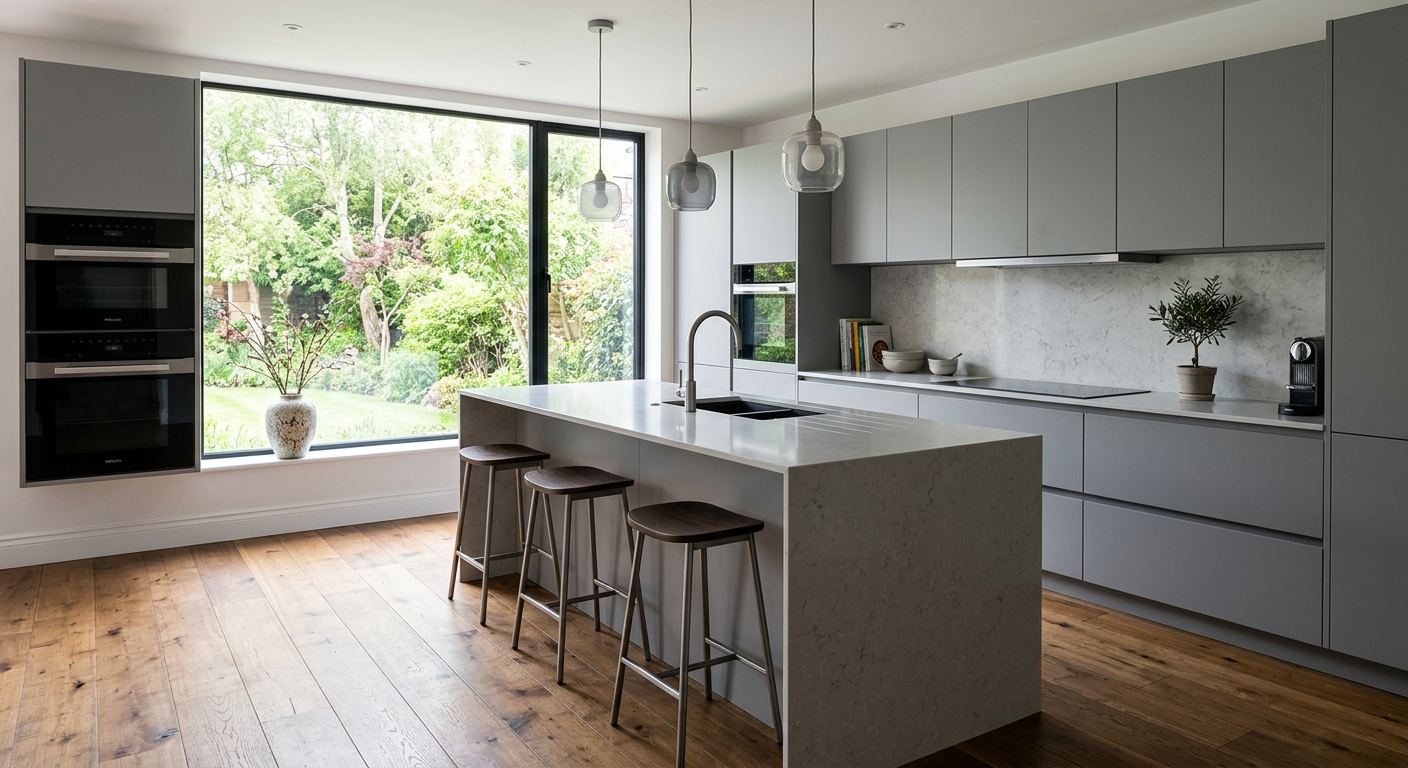
Kitchen renovation options and costs in Caledon
Caledon homeowners typically start their kitchen planning by choosing how far they want to go—because in a market that includes 76,581 residents and about 21,180 owner households, most projects are tied to long-term comfort as much as resale. With a median household income of $133,000, it’s common to see Caledon renos sit mid-range for finishes, then “step up” when homeowners want better storage, a cleaner layout, or more durable surfaces.
In the broader Toronto economic region, kitchen budgets often track close to local home values and what buyers expect to see when they walk through. That’s why many Caledon clients end up selecting quartz or natural stone, even when their layout doesn’t change dramatically—buyers tend to pay attention to countertops and cabinet presentation first. Toronto-area contractor availability and lead times also matter: the spring-to-fall reno season is busy, and custom cabinet manufacturing can add weeks, so timing can move your total budget even when scope stays the same.
Demand is especially strong around the Bolton and Caledon East corridor, where older housing stock meets growing family relocation. With 30.0% of homes built before 1981, you also see more “hidden work” opportunities—older plumbing runs, dated electrical, and floors that need a better base for tile. From there, you can compare options by tier and pick a realistic band before you request quotes.
Use the table below as a starting point for a Caledon kitchen plan, then fine-tune based on layout changes and material selection.
| Renovation Tier |
What's Included |
Typical Duration |
Price Range |
| Cosmetic refresh (paint, hardware, new appliances only) |
Cabinet paint or stain refresh, new hardware, new appliance package (e.g., fridge/range/dishwasher), minor caulking and touch-ups |
1–3 weeks |
$8,000–$18,000 |
| Mid-range full renovation (new cabinets, counters, sink, tile) |
Semi-custom or upgraded stock cabinets, quartz or quality laminate counters, sink and faucet, backsplash tile, updated lighting and trim |
3–6 weeks |
$25,000–$55,000 |
| High-end full renovation (custom cabinets, stone counters, island) |
Custom millwork, premium quartz or stone counters, island with seating, expanded backsplash, upgraded appliance package, deeper electrical and lighting updates |
6–10 weeks |
$60,000–$90,000 |
| Cabinet refacing only (new doors + drawer fronts, same boxes) |
Door and drawer replacement, re-surfacing or new cabinet panels, hardware change, optional lighting upgrades |
2–4 weeks |
$8,000–$28,000 |
| Countertop swap only (laminate to quartz or stone) |
Remove old surface, new countertop installation, seam planning, backsplash caulking transition, sink cutout |
3–10 days |
$6,000–$16,000 |
| Backsplash tile installation only |
Tile supply and installation, surface prep, grout/seal, trim and caulk detailing |
3–7 days |
$2,000–$9,500 |
Prices are estimates only and vary by project scope, site access and material selection.
What affects the price of kitchen renovation in Caledon
In Caledon and across the Toronto economic region, quotes for the “same” kitchen can swing by 30–50% because the scope isn’t always identical. One homeowner may be doing a refresh (paint and appliances only), while another is factoring in new cabinets, countertop, tile, plus electrical and plumbing updates. Even when both are “mid-range,” finish tier is usually the biggest driver—cabinet build quality and countertop material change labour and material costs quickly.
Market expectations also steer how homeowners spend. In higher-value pockets, many buyers focus on visible upgrades—quartz or stone countertops and semi-custom cabinetry—because owners want a renovation that’s easy to justify at resale (often 8–15% of home value in the higher-priced areas of the region). In more price-sensitive areas, laminate and stock cabinets tend to be chosen to keep the project within mid-range bands—while still giving a cleaner look.
Layout changes create the most unpredictable costs regardless of finish. Removing a wall to open the kitchen, adding an island, or moving a gas line can turn a predictable install into a buildout with framing, electrical redesign, and longer material lead times.
Concrete Caledon examples: (1) older homes built before 1981 often have plumbing runs that don’t line up with modern cabinet positioning, increasing countertop and sink change orders; (2) if your kitchen has dated electrical capacity, island lighting and under-cabinet LEDs may require new circuits, pushing electrical work into the higher end of the typical range; (3) if you upgrade from laminate to quartz or natural stone, budgeting should include seam planning and sink cutout accuracy, not just the slab price. The result is that a kitchen can land anywhere from roughly $25,000–$55,000 for a mid-range full renovation to $60,000–$90,000 when the project includes an island, premium stone, and deeper changes.
| Price Factor |
Why It Matters |
Cost Impact |
| Cabinet tier — stock vs. semi-custom vs. fully custom millwork |
Higher tiers cost more for fabrication time, materials, and finishing; custom also affects installation complexity |
Small to very large—can be the difference between a low–mid range and an $80k+ project |
| Countertop material — laminate vs. quartz vs. granite vs. stone |
Material choice changes supply cost, cutting/seaming, and installer time; stone is heavier and needs careful templating |
Moderate to large—often one of the top two line items after cabinets |
| Layout change — wall removal, island add, plumbing/gas move |
Structural and service relocations drive permits, trade coordination, and rebuild time |
Can add the most unpredictability, commonly pushing budgets upward by tens of thousands |
| Appliance package tier — builder vs. mid-range vs. pro-grade |
Electrical and ventilation needs (especially with gas) plus cost of fixtures and brands |
Moderate—often a noticeable swing even when cabinetry stays the same |
| Flooring — refinish existing vs. full replacement |
Flooring affects subfloor prep, tile bonding, and transition detailing; cabinets may be set over existing conditions |
Low to moderate; rises if floors require repairs before cabinet install |
| Backsplash — ceramic tile vs. marble vs. full-height slab |
Complex patterns, specialty stone handling, and wall coverage depth add time and material |
Moderate—full-height features can move a “small add-on” into a larger scope |
| Electrical — new circuits for island, under-cabinet lighting |
Modern kitchens often need more receptacles plus dedicated lighting circuits |
Moderate; can become large if panel upgrades are needed |
| Permit fees and licensed trade requirements |
Work involving plumbing drains/supplies, gas, structural changes, or new circuits requires regulated trades and inspections |
Low to moderate for minor work; can be significant when multiple service trades are involved |
Permits & regulations in Ontario
In Ontario, a straightforward cabinet and countertop swap usually doesn’t require permits. If you’re replacing doors, drawer fronts, counters, and you’re keeping plumbing and gas exactly where they are, it typically stays in the category of non-permitted renovations. However, once you change how services run—moving water supply or drain lines, relocating a gas stove, installing or altering a gas range hood venting setup, removing a load-bearing wall, or adding new electrical circuits—you’re in permit territory and you’ll need licensed trades.
For Caledon homeowners verifying compliance, the safest approach is to confirm responsibility in writing before work starts. In your contract, ask who is pulling permits (often the contractor pulls permits for the scope they’re performing), who is completing inspections, and what’s included for disposal and protection. Gas work must be done by a licensed gas fitter, and electrical work must be completed by a licensed electrician; both require proper inspection sign-offs.
Here’s a practical step-by-step check:
- Ask for the contractor’s Ontario business details and request licence documentation where applicable.
- Request a current certificate of insurance (liability) and confirm the contractor carries coverage for your project size and risk.
- Verify WSIB/WCB clearance: ask for proof of coverage/clearance letter for their workers (and any subcontractors).
- Before signing, review whether permits apply to your planned work—plumbing drain/supply moves, gas relocation, structural wall changes, and new electrical circuits.
- Confirm inspections and who schedules them so you’re not left coordinating compliance at the end.
Cabinets, countertops and layout decisions in Caledon
For a Caledon kitchen renovation, three decisions usually determine 80% of your satisfaction: cabinet tier, countertop material, and layout changes. Cabinet tier affects storage, door alignment, and how “custom” your kitchen feels day-to-day. If you want the fastest, cheapest path, stock cabinets are usually quickest to install and are easiest to schedule around a busy reno season. Semi-custom cabinets are the most popular mid-range choice because they balance modern storage options with predictable lead times. Custom cabinets cost the most, but they’re ideal when you have an awkward wall run, unusual ceiling height, or you want an island layout that fits perfectly.
Countertop material is where durability meets maintenance. Quartz is a strong “set it and forget it” option for family kitchens and is commonly chosen in GTA renovations in the $25,000–$55,000 range because it delivers a polished look without the upkeep demands of natural stone. Granite and other natural stones are also durable but can be higher maintenance (sealing routines and care). Laminate remains the budget-friendly option and can be appropriate if you’re staying resale-focused and want to keep the project closer to entry pricing.
Finally, layout changes are where space gains can justify cost. Removing a wall or adding an island often pays off when your current kitchen doesn’t work for modern traffic patterns—especially in older homes where room dimensions were designed for smaller appliances and fewer outlets. A typical “justified” example: upgrading to quartz and moving from basic cabinet options to semi-custom shelves can feel worth it, whereas adding a structural change with expensive stone but keeping the same cramped layout is often the least efficient spend.
Caledon’s seasonal temperature swings and humidity shifts also make airtight detailing and solid substrate prep important—especially for tile and backsplash adhesion—so your cabinet placement and wall prep aren’t areas to cut corners on.
| Option |
Durability |
Maintenance |
Best For |
Price Range |
| Stock cabinets (big-box) |
Good for standard layouts; less flexibility for awkward spaces |
Low—wipe clean; hinges and adjustments depend on model quality |
Fast timelines and tighter budgets |
$8,000–$22,000 |
| Semi-custom cabinets (local dealer) |
Very good; improved finishes, better internal storage options |
Low—generally easy to maintain with proper care |
Most Caledon renovations aiming for value + modern storage |
$18,000–$40,000 |
| Custom cabinets (local millwork shop) |
Excellent; tailored fit and higher build control |
Low to moderate—quality hardware and finish matter |
Unique layouts, ceiling/space constraints, high-end styling |
$35,000–$65,000 |
| Laminate countertop |
Good for everyday use; can be less resistant to severe heat/impacts |
Low—avoid standing water at seams; use heat protection |
Budget-conscious refreshes and rental-like practicality |
$3,000–$6,000 |
| Quartz engineered countertop |
Very high; resists stains and everyday wear well |
Low—routine cleaning; avoid excessive heat exposure near seams |
Family kitchens wanting a “premium look” without natural stone upkeep |
$6,500–$12,000 |
| Granite / natural stone countertop |
High; durable and distinctive |
Moderate—may require periodic sealing depending on stone |
Homeowners prioritizing natural variation and premium appearance |
$8,000–$15,000 |
| Butcher block countertop |
Good with proper care; can show wear over time |
Moderate—regular oiling/maintenance to protect the surface |
Warm, classic looks and homeowners comfortable with upkeep |
$4,500–$10,000 |
| Marble countertop |
Beautiful but more sensitive to etching and staining than quartz |
Higher—requires careful cleaning and sealing strategy |
Lower-traffic “showpiece” kitchens or buyers who value luxury appearance |
$10,000–$18,000 |
How to choose a kitchen renovation contractor in Caledon
Choosing the right contractor in Caledon comes down to verification, clarity, and control of risk. First, verify Ontario licensing where applicable and confirm the contractor carries liability insurance that matches your project scope. For worker coverage, request proof of WSIB/WCB clearance (for the contractor and their trades). If anything is unclear, ask directly—reputable contractors can provide documents promptly.
Next, get 2–3 itemised written quotes, not lump sums. You want a breakdown that separates labour and materials: cabinet supply, countertop supply, demolition, tile install, electrical/plumbing allowances, and disposal. In kitchens, the biggest budget surprises usually come from what was excluded—like permit pulls, drywall patching, subfloor repairs, appliance installation, or disposal and landfill fees.
Read the scope line-by-line. Does the quote include protection of floors and doorways? Is there an allowance for mismatched flooring underneath old cabinets? Are permits and inspections included if your scope needs them? Then review warranties: ask for the workmanship warranty length, and understand product/manufacturer warranties for cabinets and countertops. Clarify whether warranties transfer if you sell the home.
For payments, use a schedule with conservative upfront deposits—typically no more than 10–15%—and a holdback until key milestones (or final completion) are confirmed. Finally, timeline matters: ensure your start date and estimated completion date are in writing, along with lead-time assumptions for cabinets and stone templating.
- Request current liability insurance certificate and confirm coverage limits.
- Provide WSIB/WCB clearance letter for trades or confirm subcontractor coverage.
- Confirm who pulls permits (if required) and who pays the permit fees.
- Insist on itemised quotes (labour + materials) with realistic allowances.
- Check exclusions: disposal, appliance hookup, drywall patching, and flooring repairs.
- Ask about site protection (tarps, dust control) and cleanup standards.
- Confirm countertop templating and install date windows (stone lead times vary).
- Review warranty terms for workmanship and ask if it’s in writing.
- Clarify change-order process and how pricing is documented mid-project.
- Confirm payment schedule: limit upfront to 10–15% and keep a holdback.
- Ask for a detailed schedule including inspection days for regulated trades.
- Verify subcontractor list (electrician/gas fitter/plumber) and their credentials.
Red flags to watch for in Caledon kitchens: vague “one price covers everything” quotes with no exclusions; refusal to provide WSIB/WCB clearance or insurance proof; quotes that don’t list countertop templating and seam planning; high upfront deposits with no holdback; and contractors who won’t put start/completion dates and permit responsibility in the written contract.
Frequently asked questions — kitchen renovation in Caledon
How much does a kitchen renovation cost in Caledon?
In Caledon, most full kitchen renovations land in the mid-range to high-range bands depending on cabinet tier and whether you change the layout. As a practical baseline, modest refreshes can start around $25,000–$55,000 when you’re doing a mid-range full renovation with updated cabinets, counters, a sink, and tile. If you choose fully custom millwork, premium quartz/stone, and an island plus deeper electrical/plumbing updates, budgets commonly move into $60,000–$90,000. Caledon’s housing mix matters too: with a meaningful share of homes built before 1981, some projects uncover older plumbing/electrical alignment issues that add labour and coordination. In the Toronto region, finish expectations also reflect the resale market, so owners often budget more for countertops and cabinetry than for cosmetic-only upgrades. (Statistics Canada, 2021 Census)
How long does a kitchen renovation take in Caledon?
Timeline depends on scope and lead times. A cosmetic refresh (paint, hardware, appliance-only) is often 1–3 weeks. A mid-range full renovation typically takes about 3–6 weeks once demolition is done, assuming cabinets and countertops are ready and your plumbing/electrical updates aren’t extensive. If you’re going high-end with custom cabinets and stone counters, plan for roughly 6–10 weeks, especially because countertop templating and stone fabrication can add scheduling time. Caledon projects also follow the GTA’s busy reno season, so waiting on cabinet manufacturing and delivery can stretch timelines even when labour is steady. If you’re relocating plumbing/gas or adding an island, you should expect extra time for trade coordination and inspections under Ontario requirements. (Statistics Canada, 2021 Census)
Quartz vs granite countertops — which is better?
For most Caledon homeowners renovating for everyday use, quartz is the “best all-around” option. It’s engineered, holds up well to everyday staining, and typically requires less day-to-day care than many natural stone choices. Granite and other natural stones are also durable and look stunning with natural variation, but they often require more careful maintenance routines (including sealing strategy depending on the stone). In Ontario’s seasonal temperature swings, good installation and seam planning matter for both materials, but quartz tends to be more forgiving for busy kitchens. If you’re budgeting within a mid-range renovation, quartz often fits more predictably—commonly within the $6,500–$12,000 countertop band depending on area and edge details—while granite can push higher depending on slab selection. The “better” choice is the one that matches your lifestyle: low-maintenance tends to win for families.
Should I reface or replace my cabinets?
Refacing is usually best when your existing cabinet boxes are solid, level, and structurally sound, and you want a refreshed look without the time and disruption of full replacement. It’s also often a good fit for homeowners staying in a tighter budget band, since cabinet refacing commonly falls around $8,000–$28,000. Replacement is the better choice if you need major layout changes, new internal storage (pull-out pantry systems, revised drawer configurations), or if your boxes show water damage, are out of square, or won’t align with new countertops and backsplash runs. In Caledon, older homes (including many built before 1981) sometimes have cabinet bases that were installed over uneven floors—refacing can still work, but you should expect more prep to make doors line up. If you’re planning an island or moving services, replacement usually makes the most sense because it aligns with the bigger structural updates.
Do I need a permit for a kitchen renovation in Ontario?
Many kitchen renovations don’t require permits, especially when you’re doing countertop and cabinet swaps without changing plumbing, gas, electrical, or structural walls. In Ontario, permits typically become necessary when you move plumbing supply or drain lines, relocate gas appliances or venting, remove or alter a load-bearing wall, or add new electrical circuits (for example, new island receptacles or dedicated lighting circuits). Gas work must be performed by a licensed gas fitter, and electrical work by a licensed electrician, with inspections as required. A good Caledon contractor will explain in the contract whether permits are needed and who is responsible for pulling them. Before you sign, confirm the scope in writing—don’t assume that “renovation” always means “no permits,” because layout/service changes are what trigger the regulated steps.
What's the ROI on a kitchen renovation?
ROI in Caledon is strongly tied to what you improve and how it aligns with local resale expectations. While there isn’t a single guaranteed ROI number, kitchens typically recoup value through buyer appeal—especially when countertops and cabinetry look modern and cohesive. In higher-value parts of the GTA, homeowners often invest a larger share of property value (commonly around 8–15%) because finishes like quartz/stone and semi-custom cabinetry are what buyers notice first. If your project is a mid-range renovation (often $25,000–$55,000), a “value-first” approach usually performs better than chasing the highest-end finishes on a kitchen that doesn’t meaningfully change function. The biggest ROI drivers are practical: better storage, a smarter layout, and durable, low-maintenance surfaces. Make sure your upgrades match your home’s baseline condition—especially since many Caledon homes include older plumbing/electrical considerations that affect how smooth and complete the final renovation looks.