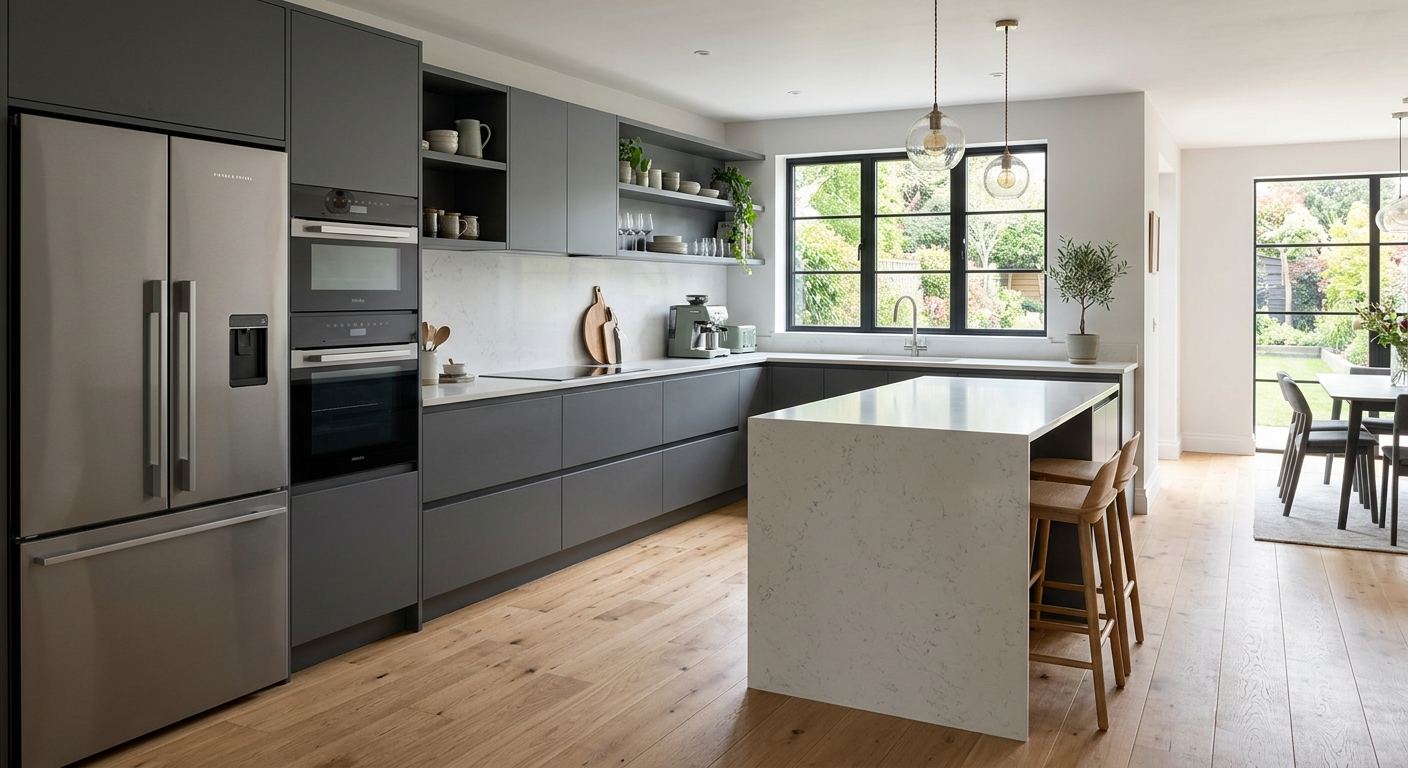
Kitchen renovation options and costs in Church-Yonge Corridor
Kitchen renovation in Church-Yonge Corridor is tightly linked to what homeowners around the Toronto economic region are willing to invest in finishes—more than to weather. With a population of 31,340 in the area (Statistics Canada, 2021 Census), the market is dense enough that contractor availability and scheduling are generally strong, particularly for cosmetic and mid-range projects. At the same time, Church-Yonge Corridor sits inside Toronto’s broader high-demand housing economy, where many owners target a kitchen that “shows” well for resale—so upgrades often skew toward durable surfaces and more built-in storage.
Ontario’s costs also behave more like a market cycle than a climate-driven problem. We do see seasonal labour scheduling pressure in winter and early spring, but the real budget swings come from finish tier choices and how much of the kitchen you change: stock cabinetry and laminate typically keep a project closer to the low–mid range, while custom millwork, quartz or natural stone, and island builds push budgets upward. In neighbourhoods with older homes and post-war layouts—common in parts of the Church-Yonge Corridor—there’s often a need to rework electrical and ventilation when you modernize the space.
In high-traffic areas such as around Yonge Street and the Eaton Centre catchment, this trade stays especially in demand because many renovations are done in occupied homes with short timelines and a strong emphasis on resale-ready finishes. If you’re deciding between a refresh and a full re-build, start with the options and price ranges below.
| Renovation Tier |
What's Included |
Typical Duration |
Price Range |
| Cosmetic refresh (paint, hardware, new appliances only) |
Cabinet paint or refinishing, new hardware, appliance swap (no plumbing/gas moves), minor touch-ups |
3–7 days |
$8,000–$22,000 |
| Mid-range full renovation (new cabinets, counters, sink, tile) |
New semi-custom cabinets, quartz or laminate counters, sink, faucet, backsplash tile, new flooring/underlay or refinishing (as required) |
4–6 weeks |
$25,000–$55,000 |
| High-end full renovation (custom cabinets, stone counters, island) |
Fully custom cabinetry, natural stone or premium quartz, island (electrical + ventilation planning), higher-tier tile, upgraded lighting and trim |
7–12 weeks |
$65,000–$90,000 |
| Cabinet refacing only (new doors + drawer fronts, same boxes) |
Door/drawer front replacement, new hardware, new toe-kicks/trim where possible; keep existing cabinet boxes |
2–4 weeks |
$8,000–$35,000 |
| Countertop swap only (laminate to quartz or stone) |
Remove old tops, new engineered/quartz or stone install, reconnect sink and basic cut-outs |
3–7 days |
$3,000–$15,000 |
| Backsplash tile installation only |
Tile selection and installation (including prep, layout, grout/seal where needed) |
5–10 days |
$2,000–$10,000 |
Prices are estimates only and vary by project scope, site access and material selection.
What affects the price of kitchen renovation in Church-Yonge Corridor
In Church-Yonge Corridor, two quotes for what looks like the same kitchen job can vary by 30–50% because contractors price the “risk” differently: hidden damage behind old cabinets, how much relocation work you add, the cabinet and countertop lead times, and whether electrical/plumbing changes are already accounted for. Finish selection also matters most—Toronto-area buyers often prioritize a modern, resale-friendly look, so projects in higher-value pockets tend to move quickly toward quartz or stone and semi-custom cabinetry. Where budgets are more price-sensitive, owners often choose stock or refacing plus laminate or good quartz to keep the project closer to the mid-range.
Importantly, in the Toronto economic region, local home values and household income shape the typical finish tier far more than climate. Even though Ontario winters are hard on materials, kitchen renovation costs don’t swing like they do in truly weather-dependent regions; rather, cost differences are driven by what you choose and how much demolition you do. Layout changes—removing a wall, adding an island, or moving a gas line—add unpredictable costs regardless of whether your counters are laminate or stone. A kitchen that starts as a “$25,000–$55,000” mid-range renovation can jump toward the “$65,000–$90,000” range if you open up the room for an island and upgrade ventilation and wiring.
Here are a few concrete local examples I see in Church-Yonge Corridor: (1) older condo or townhouse kitchens with constrained service chases can make sink moves more labour-intensive—often adding several thousand dollars even when the cabinet plan looks simple; (2) homes with dated 60-amp or poorly organized panels may require new circuits for under-cabinet lighting or a new island receptacle—raising electrical scope; and (3) projects in busy streetscapes around Yonge can face scheduling and access constraints, which can increase labour hours if deliveries must be coordinated precisely.
| Price Factor |
Why It Matters |
Cost Impact |
| Cabinet tier — stock vs. semi-custom vs. fully custom millwork |
Different build methods, hardware, door styles, and interior organizers; custom often requires more shop time and approvals |
Typically shifts the project by thousands; can push full renovations toward the high-end band |
| Countertop material — laminate vs. quartz vs. granite vs. stone |
Materials vary in price, installation complexity (seams/cuts), and tolerance to daily use |
Laminate keeps budgets lower; stone premiums commonly add significant cost to the total |
| Layout change — wall removal, island add, plumbing/gas move |
Demolition, structural coordination, rough-in changes, and inspection hold points drive uncertainty |
Often the biggest swing factor in the quote, even with mid-tier finishes |
| Appliance package tier — builder vs. mid-range vs. pro-grade |
Higher tiers add ventilation, electrical draw, and more exact cabinetry clearances |
Can move you several thousand up or down depending on whether you “upgrade everything” |
| Flooring — refinish existing vs. full replacement |
Cabinet removal can damage flooring; matching existing materials can be difficult |
Refinishing is usually cheaper; full replacement often increases cost |
| Backsplash — ceramic tile vs. marble vs. full-height slab |
Material density, weight, and detailing (full-height transitions) change labour and risk |
Simple ceramic is mid-range; premium slab or stone can quickly increase totals |
| Electrical — new circuits for island, under-cabinet lighting |
New circuits require licensed work and sometimes panel upgrades |
Can add noticeable cost even if cabinets and counters are modest |
| Permit fees and licensed trade requirements |
Work that triggers permits adds administration, timelines, and inspections |
Usually modest individually, but can increase overall project time and coordination cost |
Permits & regulations in Ontario
In Ontario, simple cabinet and countertop swaps typically don’t require permits—if you’re not moving major services and you’re not altering the structure. That means replacing existing countertops, swapping cabinet fronts/doors where the boxes remain, or installing new cabinets in the same footprint is usually straightforward from a permitting perspective. However, the moment you move plumbing supply or drain lines, relocate a gas stove or range hood that involves gas, remove a load-bearing wall, or add new electrical circuits, you’re in permit territory and you’ll need licensed trades for the work.
For Church-Yonge Corridor homeowners, the practical way to verify this is to ask the contractor (before signing) who is pulling the permits and which permit(s) apply. Then confirm that gas work is done by a licensed gas fitter and that electrical work is performed by a licensed electrician, with inspections completed at the required stages. Load-bearing changes and significant structural alterations should be handled with appropriate engineering/structural review and permitting through the renovation process.
Step-by-step checks you can do yourself:
- Ask for the contractor’s Ontario business details and confirm the licence/registration status where applicable.
- Request a current certificate of insurance (liability) naming you as an additional insured where feasible.
- Confirm WSIB/WCB clearance letter or equivalent proof that they’re in good standing.
- For electrical and gas, request the licensed trade numbers and proof of their insurance and permitting responsibility.
- Ensure the contract states permit responsibility and inspection scheduling.
- Verify that any gas/venting changes include documentation for the final inspection.
Cabinets, countertops and layout decisions in Church-Yonge Corridor
The three most consequential decisions in a Church-Yonge Corridor kitchen renovation are cabinet tier, countertop material, and whether you change the layout. (1) Cabinet tier—stock, semi-custom, or custom—mainly affects fit and storage efficiency. Stock is fastest and cheapest, but options for interior organizers and exact dimensions can be limited. Semi-custom is the popular mid-range choice because it balances lead time with better storage layouts. Custom cabinets cost the most but can be ideal for uneven walls, unusual appliance dimensions, and maximizing every inch.
(2) Countertop material affects both daily usability and perceived quality in resale marketing. Laminate is the budget-friendly option, easy to replace, but it can be more prone to wear at seams if you get heavy water exposure. Quartz is a strong “default” for many GTA buyers: it’s durable, low-maintenance, and typically looks consistent. Granite/natural stone adds premium appearance and heat tolerance, while butcher block suits homeowners who want a warmer, lived-in look (with more maintenance). Marble looks upscale but requires more care to protect from etching and staining.
(3) Layout changes—open-concept wall removal, island addition, or plumbing/gas relocation—are justified when they improve flow, storage, and usable work space. In many Toronto homes, small layout moves can be enough; a full island build is usually where the spend jumps. For example, if you’re deciding between laminate and quartz on a mid-range renovation, upgrading counters may move your budget within the “$25,000–$55,000” band, but adding an island plus electrical and ventilation planning is often what pushes the project toward the “$65,000–$90,000” range.
Ontario’s climate doesn’t change countertop performance as much as day-to-day use (wetness, cleaning habits, and impact), but Toronto’s housing stock—often older or compact—means layout and service-routing decisions are the real cost drivers.
| Option |
Durability |
Maintenance |
Best For |
Price Range |
| Stock cabinets (big-box) |
Good for everyday use; durability depends on box construction and hardware |
Low to moderate—keep hinges and slides maintained |
Fast timelines and budget-first renovations |
$8,000–$18,000 |
| Semi-custom cabinets (local dealer) |
Very solid with better options for organizers and door styles |
Low—routine cleaning and standard hardware upkeep |
Most homeowners targeting mid-range resale appeal |
$15,000–$35,000 |
| Custom cabinets (local millwork shop) |
Highest fit and build quality; best for irregular spaces |
Low—still needs care for moving parts and finishes |
Custom layouts, built-ins, and premium kitchen styling |
$30,000–$55,000 |
| Laminate countertop |
Moderate; seams and edges need care |
Easy daily care; avoid prolonged standing water at seams |
Cost-controlled upgrades and quick turnarounds |
$3,000–$7,000 |
| Quartz engineered countertop |
High—resists staining and everyday wear well |
Very low; wipe clean, minimal special treatment |
Busy households and resale-focused kitchens |
$6,000–$12,000 |
| Granite / natural stone countertop |
High—excellent heat tolerance and long service life |
Low to moderate; sealing needs periodic attention |
Premium look with natural variation |
$8,000–$15,000 |
| Butcher block countertop |
High if properly maintained; sensitive to moisture without upkeep |
Moderate to high—oil and sanding as recommended |
Home cooks who want warm aesthetics |
$4,500–$10,000 |
| Marble countertop |
Beautiful but more susceptible to etching and staining |
Moderate—more careful cleaning and protection |
Luxury styling where homeowners will maintain carefully |
$10,000–$18,000 |
How to choose a kitchen renovation contractor in Church-Yonge Corridor
Choosing a contractor in Church-Yonge Corridor comes down to verifying three things: Ontario licensing/credentials where applicable, proof of liability coverage, and WSIB/WCB status for the trades working on your site. Start by requesting their insurance certificate and a WSIB/WCB clearance letter (or confirmation of coverage). Then ask for licensing documentation for any specialty work—electrical by a licensed electrician and gas-related work by a licensed gas fitter—so you know who is responsible for permits, inspections, and compliance.
Next, get 2–3 itemised written quotes rather than a lump sum. A good quote breaks labour and materials line-by-line: demolition, cabinet installation, countertop template and install, electrical/plumbing allowances, tile prep, disposal, and finish details. Scope clarity protects you from budget surprises. Confirm whether permits are included, whether you’re getting dumpster/disposal handling, and what exactly is excluded (for example, drywall patching beyond a set allowance, custom backsplash detailing, or flooring removal/replacement).
Warranty should be in writing. Ask about workmanship warranty length and whether the product manufacturer warranty transfers if you sell. Also agree on payment scheduling: never pay more than 10–15% upfront, and use a holdback until the job is fully completed and cleaned.
Finally, timeline matters in Toronto schedules. Get a start date and completion estimate in writing, including lead times for cabinets and countertops so you aren’t stuck waiting on a back-ordered island or sink cut-out.
- Ask for itemised quotes (labour + materials) with clear inclusions.
- Confirm who pulls permits and who pays permit fees.
- Verify liability insurance certificate is current and covers your address.
- Confirm WSIB/WCB clearance letter for the company and subcontractors.
- For electrical and gas, confirm licensed trade credentials and responsibilities.
- Check that disposal/dumpster and site protection are included.
- Ensure lead times for cabinets/counters are stated in the contract.
- Demand a written demolition and rough-in schedule, not just a start date.
- Clarify what happens if materials arrive late (no-schedule protections).
- Use a payment schedule with a 10–15% max deposit and a holdback.
- Confirm warranty terms: workmanship duration and manufacturer coverage.
- Ask for 2–3 recent kitchen references in the Toronto area.
Red flags: contractors who won’t provide written scope, itemised quotes, or permit/inspection responsibility; vague warranties or “verbal-only” product assurances; refusal to show insurance and WSIB/WCB clearance; demanding large deposits (beyond 10–15%); and quoting without measuring for cabinetry/countertop template requirements.
Frequently asked questions — kitchen renovation in Church-Yonge Corridor
What's the ROI on a kitchen renovation?
In Church-Yonge Corridor and across Ontario, kitchen ROI depends less on “getting the highest-end look” and more on recouping what buyers expect for your local price tier and layout. In the Toronto economic region, many homeowners aim to invest a meaningful share of the home’s value—often around 8–15% in higher-value pockets—because the kitchen is a major decision area for resale. A refresh (paint, hardware, appliances) can offer strong perceived value, but a fully functional upgrade with updated cabinets and countertops usually performs better. As a reality check, if your full renovation lands in the mid-range (for example, within the $25,000–$55,000 band), it’s easier to align with resale expectations than jumping straight to the top-end $65,000–$90,000 build unless you’re truly matching the rest of the home’s quality.
How do I budget for a kitchen renovation?
Start by choosing your renovation tier, then add a contingency. For a modest update, cosmetic refresh projects often sit around the $8,000–$22,000 range, but that only covers superficial changes. If you want new cabinets and counters plus tile and a sink refresh, mid-range full renovations commonly fall within $25,000–$55,000. If you’re adding an island, upgrading ventilation/electrical, and moving services, budgets often move toward the $65,000–$90,000 range. In Church-Yonge Corridor, older housing stock sometimes adds hidden costs (subfloor condition, outdated wiring/piping), so I recommend planning contingency and ensuring your quote includes demo, disposal, and a clear line for electrical/plumbing allowances.
Can I move my kitchen sink or stove?
Yes, you can move a kitchen sink or stove in Ontario, but whether it’s affordable depends on the distance and what services need re-routing. Moving a sink typically involves plumbing supply and drain changes, which usually trigger permits and require licensed plumbing work. Moving a gas stove or adjusting gas-related ventilation is also permit-dependent and must be done by a licensed gas fitter, followed by inspections. Even if cabinets and counters stay mid-range (for example within the $25,000–$55,000 band), service relocation can be one of the biggest cost swings because it affects rough-in labour, wall openings, drywall repair, and sometimes panel capacity for new electrical loads.
What's the most cost-effective kitchen upgrade?
For most Church-Yonge Corridor homes, the best “bang for the buck” is usually an upgrade that modernizes the visible surfaces without heavy demolition. That often means either a countertop swap (for example laminate to quartz or stone, commonly $3,000–$15,000 depending on size and material) or cabinet refacing if your existing cabinet boxes are still solid (often $8,000–$35,000). If you want to go bigger but keep risk lower, a mid-range full renovation that focuses on new semi-custom cabinetry, quartz counters, and a refreshed backsplash usually delivers the biggest visual payoff while staying controlled. Purely cosmetic refreshes (paint, hardware, new appliances only) can look great, but they don’t always address dated storage layouts and may not satisfy every resale buyer.
Custom vs stock cabinets — is custom worth it?
Custom cabinets can be worth it when you need a kitchen that fits an awkward space, maximizes storage, or includes built-ins that stock options can’t replicate. In a compact Toronto layout, custom can also reduce problems like filler gaps and awkward drawer sizes, improving usability. However, if your goal is value and speed, semi-custom is often the sweet spot—strong quality with more flexibility than stock, and typically easier lead-time management. Stock cabinets are the lowest-cost route and can keep you closer to the budget, especially if you pair them with quartz counters. As a general benchmark: cabinetry costs can shift the project’s direction quickly, and it’s the combination of custom millwork plus premium stone that pushes renovations toward the higher band ($65,000–$90,000).
How do I choose a kitchen contractor in Church-Yonge Corridor?
Choose a contractor by verifying proof and clarity, not by price alone. In Ontario, confirm the contractor’s liability insurance certificate and WSIB/WCB clearance (or equivalent proof) and make sure licensed trades are used for electrical and gas-related work. Then request 2–3 itemised written quotes with a labour/materials breakdown, clear inclusions, and explicit permit/disposal responsibilities. Read the scope carefully: what’s excluded, what’s included (permit pull, disposal, protection, patching), and what the timeline looks like given material lead times. Ask about warranties—workmanship length and whether product warranties are transferable. Finally, avoid contracts that demand more than 10–15% upfront or won’t provide written start/completion dates.