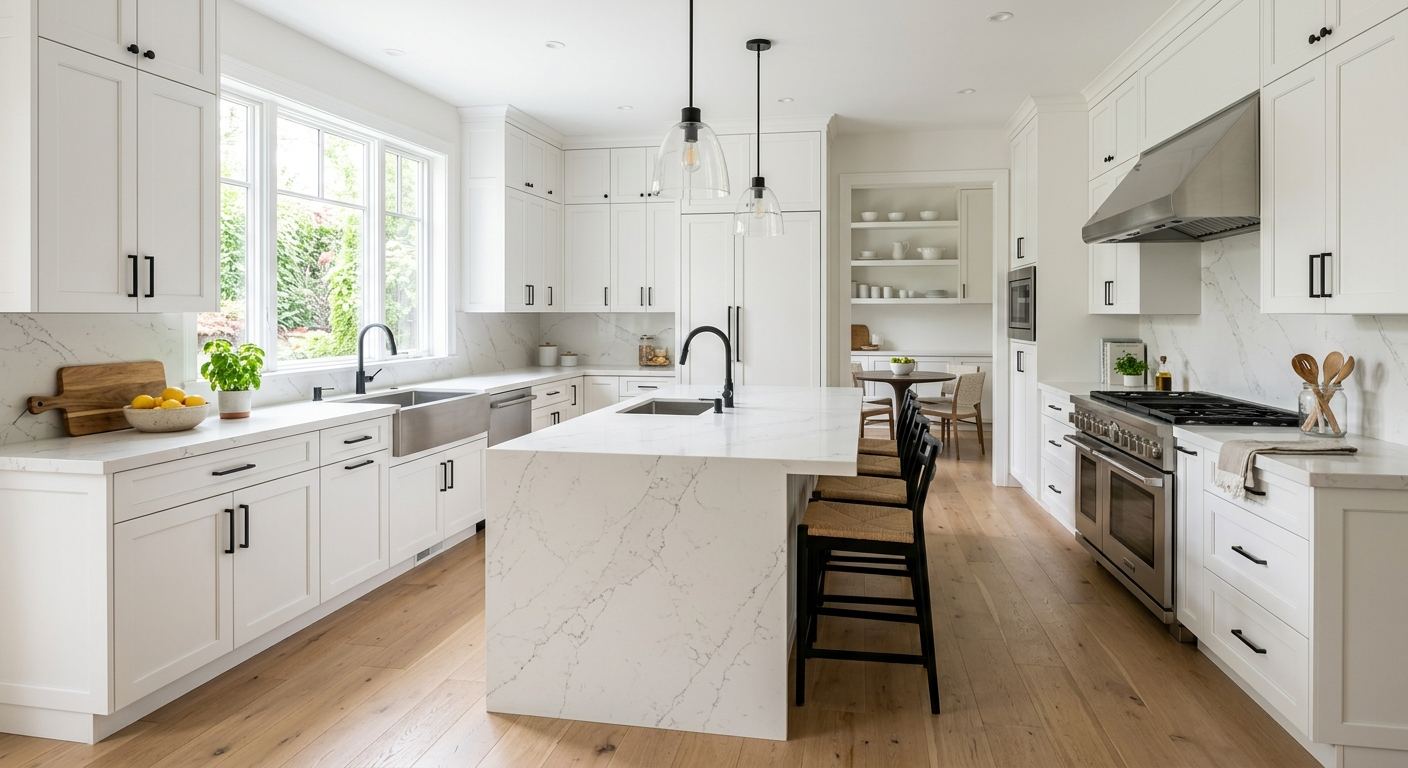
Kitchen renovation options and costs in Junction Area
Kitchen renovations in Junction Area, Ontario tend to fall into predictable budget bands, but the “right” option depends on how much you want to change and how much your finishes need to impress. Homeowners here make decisions with resale in mind—Junction Area’s population was 14,366 in 2021 (Statistics Canada, 2021 Census)—and that small-but-established community often prioritizes practical updates that look current. In the Toronto economic region, higher-value pockets commonly justify a larger kitchen spend because owners want kitchens that align with what buyers expect for the local price points and household incomes. In practice, finish choices and millwork quality track more closely to that market pressure than to actual weather.
Toronto’s winters and spring freeze–thaw cycles can indirectly affect costs by increasing the need for careful sealing, durable water-resistant underlayments, and proper ventilation around sinks and dishwashers. That said, contractor availability and supply pricing are the bigger swing factors: during peak renovation months, labour demand rises and can push schedule-driven costs upward. In areas like the Junction Triangle and around Bloor St. West, trade demand is especially strong because many homes are older (often needing electrical, ventilation, or plumbing refreshes) while owners still want modern, brighter layouts that work for everyday life.
Use the table below as a budgeting starting point; once you pick your cabinet tier, countertop material, and whether you’re changing the layout, the total becomes much easier to compare across quotes.
| Renovation Tier |
What's Included |
Typical Duration |
Price Range |
| Cosmetic refresh (paint, hardware, new appliances only) |
Cabinet hardware replacement, paint/refinish of existing cabinet boxes (no structural changes), new refrigerator/range/dishwasher (labour + basic hookup), touch-up lighting/trim, minor caulking and re-sealing where needed |
1–3 weeks |
$25,000–$35,000 |
| Mid-range full renovation (new cabinets, counters, sink, tile) |
New semi-custom or quality stock cabinets, quartz or good laminate counters, sink + faucet, backsplash tile, basic plumbing refresh (no major line relocation), flooring refresh or targeted replacement, labour for installation and finishing |
3–7 weeks |
$45,000–$70,000 |
| High-end full renovation (custom cabinets, stone counters, island) |
Fully custom millwork, premium quartz or natural stone, island build (including electrical planning), higher-tier appliance package, full-height or upgraded backsplash, potential ventilation/hood upgrade, more finish carpentry and upgraded hardware/trim |
6–12 weeks |
$70,000–$90,000 |
| Cabinet refacing only (new doors + drawer fronts, same boxes) |
Door/drawer front replacement, new trim and moulding, hardware installation, labour for refacing, professional measurement and alignment; counters typically unchanged unless you add a separate countertop scope |
1–3 weeks |
$12,000–$35,000 |
| Countertop swap only (laminate to quartz or stone) |
Removal of existing counters, template and install new quartz/stone/laminate, new sink cut-out where applicable, basic countertop sealing; backsplash usually handled separately |
3–10 days |
$3,000–$15,000 |
| Backsplash tile installation only |
Surface prep, tile installation, grouting/sealing, caulking at countertop edges; includes edge banding and typical L-shaped transitions |
3–7 days |
$2,000–$10,000 |
Prices are estimates only and vary by project scope, site access and material selection.
What affects the price of kitchen renovation in Junction Area
In Junction Area, Ontario, it’s common to see surprisingly different quotes for the same “kitchen refresh.” Across Toronto and Ontario, identical layouts can land 30–50% apart because contractors price the hidden work differently—electrical capacity, subfloor condition, venting, and how much labour is required to make older walls and cabinets truly straight and plumb. Local home values and household incomes also steer what finish tier people choose: in higher-value Toronto pockets, homeowners frequently default to quartz or natural stone and semi-custom cabinetry because the cost is easier to recover on resale. Where budget pressure is stronger, laminate tops and stock cabinetry often dominate, keeping projects in a lower range like the mid-$20k zone for modest refreshes or the broader $25,000–$90,000 band for full renovations.
Layout changes are the biggest unpredictable cost driver no matter your finish level. Removing a wall to open the kitchen, adding an island, or moving a gas line can shift the scope from “install and finish” to real trades scheduling and permitting, which is where budgets swing. For an older Junction Area home, common condition surprises include dated electrical runs, moisture-affected drywall near exterior walls, and mismatched subfloor thickness—any of these can add rework and labour.
Two concrete cost examples that often show up here: (1) upgrading to an island with under-cabinet outlets and lighting usually increases electrical labour and may trigger permit work; (2) switching from laminate to quartz is typically less disruptive than moving plumbing—so you can upgrade surfaces while controlling labour risk. In short, in this market, the “what” (finish tier and layout) matters more than the weather, but winter-driven moisture management and ventilation still influence what’s needed to make the kitchen last.
| Price Factor |
Why It Matters |
Cost Impact |
| Cabinet tier — stock vs. semi-custom vs. fully custom millwork |
Custom millwork changes sizing, door styles, internal options (soft-close, pull-outs), and shop labour |
Typically moves a full kitchen from the mid-range toward the $80k+ end |
| Countertop material — laminate vs. quartz vs. granite vs. stone |
Material price and cutting/template complexity affect both material and install time |
Often shifts countertop scopes within the $3,000–$15,000 band |
| Layout change — wall removal, island add, plumbing/gas move |
Trigger permitting, structural review, new framing and trades coordination |
Can add the most variance (often the difference between mid-range and high-end totals) |
| Appliance package tier — builder vs. mid-range vs. pro-grade |
Pro-grade models may require different clearances, power/venting, and premium installation accessories |
Can push a “refresh” from low–mid budgets into higher totals |
| Flooring — refinish existing vs. full replacement |
Older kitchens may have uneven subfloors; removal can uncover rot or moisture issues |
Partial replacement usually less; full replacement can add meaningful labour and waste |
| Backsplash — ceramic tile vs. marble vs. full-height slab |
Material weight, panel planning, and waterproof detailing change installation complexity |
Usually lands within the $2,000–$10,000 band depending on finish and coverage |
| Electrical — new circuits for island, under-cabinet lighting |
New circuits must be planned for load and must be done by a licensed electrician |
Often one of the cost multipliers when moving to an island layout |
| Permit fees and licensed trade requirements |
Permits, inspections, and trade scheduling add administrative and compliance time |
Commonly increases totals most when plumbing/gas/electrical is altered |
Permits & regulations in Ontario
For homeowners in Junction Area, Ontario, cabinet and countertop swaps typically do not require permits. If you’re only replacing cabinets (like-for-like), changing counters, updating hardware, or installing a backsplash, you can usually proceed without a permit—assuming you’re not altering structural elements or moving services.
Permits and licensed trade work are commonly required when you change plumbing supply/drain lines, relocate gas appliances (including the stove/range), remove a load-bearing wall, add an island that requires new electrical, or add new dedicated circuits (for example, additional outlets or under-cabinet lighting tied into a new circuit). Gas work must be performed by a licensed gas fitter, and electrical alterations must be done by a licensed electrician, with inspections performed as required.
Step-by-step, here’s how you verify a contractor before signing:
- Ask for their Ontario licensing details and confirm the relevant trade category applies to the scope (gas fitting vs. electrical vs. general contracting).
- Request a current certificate of insurance: general liability plus proof they’re covered for the duration of your job.
- Ask whether they carry WSIB/WCB coverage (as applicable) and request the documentation—don’t rely on verbal assurance.
- For licensed trades, ask for the inspector/permit responsibility to be spelled out in writing: who pulls permits, who schedules inspections, and what’s included in the contract.
- Look for a clearance letter where applicable and confirm coverage is active (not expired).
- Confirm the permit timeline in advance so your work doesn’t stall mid-renovation when inspectors are booked.
Finally, always confirm permit responsibility in the written contract—this is one of the easiest ways to prevent surprises late in the project.
Cabinets, countertops and layout decisions in Junction Area
In Junction Area, the three most consequential decisions for your kitchen renovation are cabinet tier, countertop material, and whether you’re changing the layout. Cabinet tier determines how quickly you can start and how well the kitchen fits your walls and ceiling lines—stock cabinets are fastest and cheapest, semi-custom is the sweet spot for most GTA homes, and fully custom millwork is the best fit when you need tailored dimensions or unique storage. For countertops, laminate is the budget-friendly path; quartz and granite/natural stone are higher upfront costs but generally deliver a better look and durability profile for busy households.
Layout choices drive cost because they change how many trades and how much structural work is required. Open-concept wall removal and island additions can be justified when they improve the flow of a narrower, older plan—common in many Junction Area homes—but they also increase unpredictability if your existing framing or subfloor conditions are out of level. Toronto resale expectations also matter: at the mid-range price point (often around the $45,000–$70,000 range for full renovations), buyers expect a clean, modern look—typically shaker-style cabinetry, quartz counters, and a coordinated backsplash. At the higher end (often $70,000–$90,000), they more often see custom details and stone counters with integrated island electrical.
Climate plays a role mainly through maintenance habits and ventilation. Ontario’s winter indoor humidity swings mean you want good sealing around sinks and proper range hood venting to reduce cabinet and countertop edge wear. Here’s a practical dollar example: upgrading from laminate to quartz is often less disruptive than moving plumbing. If quartz adds a few thousand within the $3,000–$15,000 countertop band, it’s usually a more “bang-for-buck” improvement than changing drain or supply locations—because the latter can push you into higher permitting and rework costs.
| Option |
Durability |
Maintenance |
Best For |
Price Range |
| Stock cabinets (big-box) |
Good durability with standard construction; relies on measured fit to avoid gaps |
Low day-to-day maintenance; hardware upgrades help longevity |
Fast turnarounds and tighter renovation budgets |
$8,000–$20,000 |
| Semi-custom cabinets (local dealer) |
Durable with better sizing options and more storage configurations |
Low maintenance; choose quality hinges and soft-close hardware |
Most Junction Area homeowners aiming for a modern look and resale readiness |
$18,000–$40,000 |
| Custom cabinets (local millwork shop) |
Highest fit and finish; tailored to irregular walls and unique storage needs |
Low maintenance; craftsmanship supports long-term use |
Unique layouts, island builds, and homeowners who want maximum design control |
$35,000–$70,000 |
| Laminate countertop |
Moderate durability; can chip at edges if abused; seams require care |
Wipe clean; avoid standing water near seams and corners |
Budget-sensitive upgrades with a clean aesthetic |
$3,000–$7,000 |
| Quartz engineered countertop |
High durability; resistant to staining and daily wear with proper installation |
Easy cleaning; seal is generally not required |
Busy family kitchens and resale-focused upgrades |
$6,000–$12,000 |
| Granite / natural stone countertop |
Very durable and heat resistant; variation is part of the appeal |
Periodic sealing recommended depending on stone type |
Premium look buyers who want natural character |
$8,000–$15,000 |
| Butcher block countertop |
Durable if maintained; can scratch and needs protection from prolonged moisture |
Oil and condition regularly; wipe and dry promptly |
Casual or warm designs where homeowners commit to maintenance |
$4,500–$10,000 |
| Marble countertop |
Beautiful and durable structurally; more vulnerable to etching/staining than quartz |
Higher maintenance (gentle cleaners, prompt cleanup, sealing routine) |
High-end visual impact and kitchens with lighter wear patterns |
$10,000–$18,000 |
How to choose a kitchen renovation contractor in Junction Area
Choosing the right kitchen renovation contractor in Junction Area, Ontario is mostly about verification and clarity. Start with licensing and coverage. For general and trade work, ask for their Ontario registration details and confirm they carry liability insurance and WSIB/WCB coverage (as applicable). You can verify documentation by requesting certificates directly and checking dates and coverage terms; for licensed trades, also confirm their trade-specific credentials match your scope (electrical for circuits, gas fitting for gas appliance changes). If they can’t provide insurance/WSIB/WCB paperwork promptly, that’s a major warning sign.
Next, get 2–3 itemised written quotes that break labour and materials into line items—cabinet supply and install, countertop template/install, tile labour, electrical allowance, plumbing allowance, disposal, and any permit-related costs. Avoid quotes that only show a lump sum without describing inclusions and exclusions. Read the scope carefully for what’s left out: is disposal included? Is drywall patching included? Does the quote include permit pulling (when required), protection of floors and adjacent rooms, and countertop removal/care? Warranty matters too: confirm workmanship warranty length, the product/manufacturer warranty coverage, and whether warranties are transferable if you sell your home.
Finally, structure the payment schedule responsibly: never pay more than 10–15% upfront, and hold back a portion until final walkthrough completion. Request a start date and a written completion estimate, and ask how they handle delays from material lead times, which can be more common in GTA peak season.
- Confirm Ontario trade coverage: electrical and gas work must be done by licensed professionals for those scopes.
- Request certificates of insurance (general liability) and confirm they’re active.
- Ask for WSIB/WCB coverage documentation (as applicable) before work begins.
- Use itemised quotes with labour + materials breakdown, not only one total number.
- Ensure the scope lists exclusions (e.g., plumbing relocation, structural work, drywall replacement).
- Ask whether permits are pulled by the contractor and who pays permit fees.
- Confirm disposal and waste removal is included (dump fees and hauling).
- Verify protection measures: floor coverings, dust control, and door/window protection.
- Request a project schedule: demolition day, cabinet delivery, countertop templating, install dates.
- Confirm how variances are handled if site conditions change (written change-order process).
- Check warranty details in writing: workmanship and product/manufacturer terms.
- Use a payment plan with limited upfront deposit (10–15%) and a holdback until walkthrough.
Red flags in Junction Area include: contractors who won’t provide insurance/WSIB/WCB paperwork, quotes that are not itemised, promises of “exact” timing without acknowledging material lead times, vague scope language about permits/disposal, and pressure to pay a large deposit upfront.
Frequently asked questions — kitchen renovation in Junction Area
Can I live at home during a kitchen renovation in Junction Area?
Yes, most homeowners can live at home during a kitchen renovation in Junction Area, especially if you choose a cosmetic refresh or a phased approach. For example, a cabinet refacing plus hardware and a backsplash often happens faster than a full teardown, which helps you keep daily routines going. Even with a full renovation, you can often arrange a temporary food setup (microwave, kettle, and mini-fridge) while the main work is underway. The main factor isn’t “weather” so much as noise and dust control—Ontario homes from different eras may have more gaps or less insulated ducting, so you’ll want strong dust containment and a plan for ventilation during countertop and tile installation. Confirm whether your contractor includes dust barriers, floor protection, and daily cleanup in the scope.
Should I renovate my kitchen before selling in Junction Area?
In Ontario, many homeowners renovate before selling when the kitchen is clearly outdated or inconvenient, because the kitchen is a high-attention area for buyers. In Junction Area, the decision is usually about balancing the upgrade cost against expected buyer response in the Toronto market. If you’re considering a full renovation, realistic budgets for this region commonly span from about $25,000 into the $80k+ range depending on cabinetry and countertops; focusing on high-impact items like quartz counters, modern hardware, and a clean backsplash can provide better perceived value than cosmetic tweaks alone. If your layout is functional and only finishes are tired, a mid-range full renovation (often $45,000–$70,000) can be a sensible target. If major plumbing or electrical changes are required, get clear scope and costs first so you don’t overspend relative to resale expectations.
What's the most popular kitchen style in Junction Area right now?
Across Junction Area and the wider Toronto market, homeowners most often choose a clean, contemporary look with shaker-style cabinetry, matte or semi-matte finishes, and bright countertops that pair well with modern lighting. In practice, that usually means semi-custom or quality stock cabinets, quartz countertops, and a coordinated backsplash rather than heavy, ornate detailing. The reason is simple: these choices photograph well for listings and appeal to a broad range of buyers. At the mid-range end, many projects stay within the $45,000–$70,000 band for full renovations by combining semi-custom cabinetry with quartz and selective layout upgrades. When budgets rise toward $70,000–$90,000, islands, upgraded appliance packages, and more custom millwork details become more common. Your contractor should be able to show finished work that matches this style and fits older Toronto-era home dimensions.
How do I know if I need to update my kitchen plumbing in Junction Area?
You may need a plumbing update in Junction Area if you notice slow drains, leaks under the sink, water stains, inconsistent hot-water pressure, or corrosion signs at shutoff valves. Plumbing updates become even more likely in older homes where drain lines and shutoffs may be near end-of-life or not properly sized for newer fixtures. The key is discovery before you commit: ask your contractor to inspect the shutoffs, supply lines, and drain connections during the demolition phase. If you plan to move the sink, dishwasher, or add an island, assume you’ll need at least some plumbing rework, even if your counters and cabinets are staying in place. Permits can be required when you move supply/drain lines, and that’s part of why detailed, itemised quotes matter. When you get quotes, confirm whether plumbing allowances include line checks and any required licensed trade work.
What is the difference between a galley and open-concept kitchen?
A galley kitchen is typically a narrow, linear or two-parallel-counter layout, often with traffic flowing along the corridor—common in older homes. An open-concept kitchen removes barriers so the kitchen blends into living space, usually improving sightlines and perceived space. In Toronto homes, the “best” option often depends on how your walls and services are arranged. If you have a galley layout but the footprint feels cramped, a thoughtful change—like adding storage, improving lighting, or carefully widening circulation—can help without triggering major structural work. An open-concept approach, however, may involve load-bearing wall removal (permitting and licensed trade scheduling), plus electrical and ventilation planning. That’s where costs can shift dramatically even with the same cabinet style. If you’re comparing quotes, ask specifically what’s changing structurally and what’s staying the same so you can compare apples to apples.
How do I get accurate kitchen renovation quotes in Junction Area?
To get accurate quotes in Junction Area, start by choosing your scope and finishes clearly, then provide consistent details to every contractor. Ask for 2–3 itemised quotes that separate labour and materials (cabinets supply/install, countertop template/install, tile labour, electrical allowance, plumbing allowance, disposal, and any permit-related items). Ensure each contractor is bidding the same inclusions: dust control, floor protection, drywall patching, demolition, and whether disposal is included. Also confirm what requires permits in Ontario—cabinets and countertop swaps typically don’t, but moving plumbing supply/drain lines, relocating gas appliances, load-bearing wall removal, or adding electrical circuits often does. Finally, verify credentials: ask for evidence of liability insurance and WSIB/WCB coverage where applicable, plus licensed trade documentation for gas/electrical work. A good quote will also list lead times and a written start/completion schedule, not just a single total.