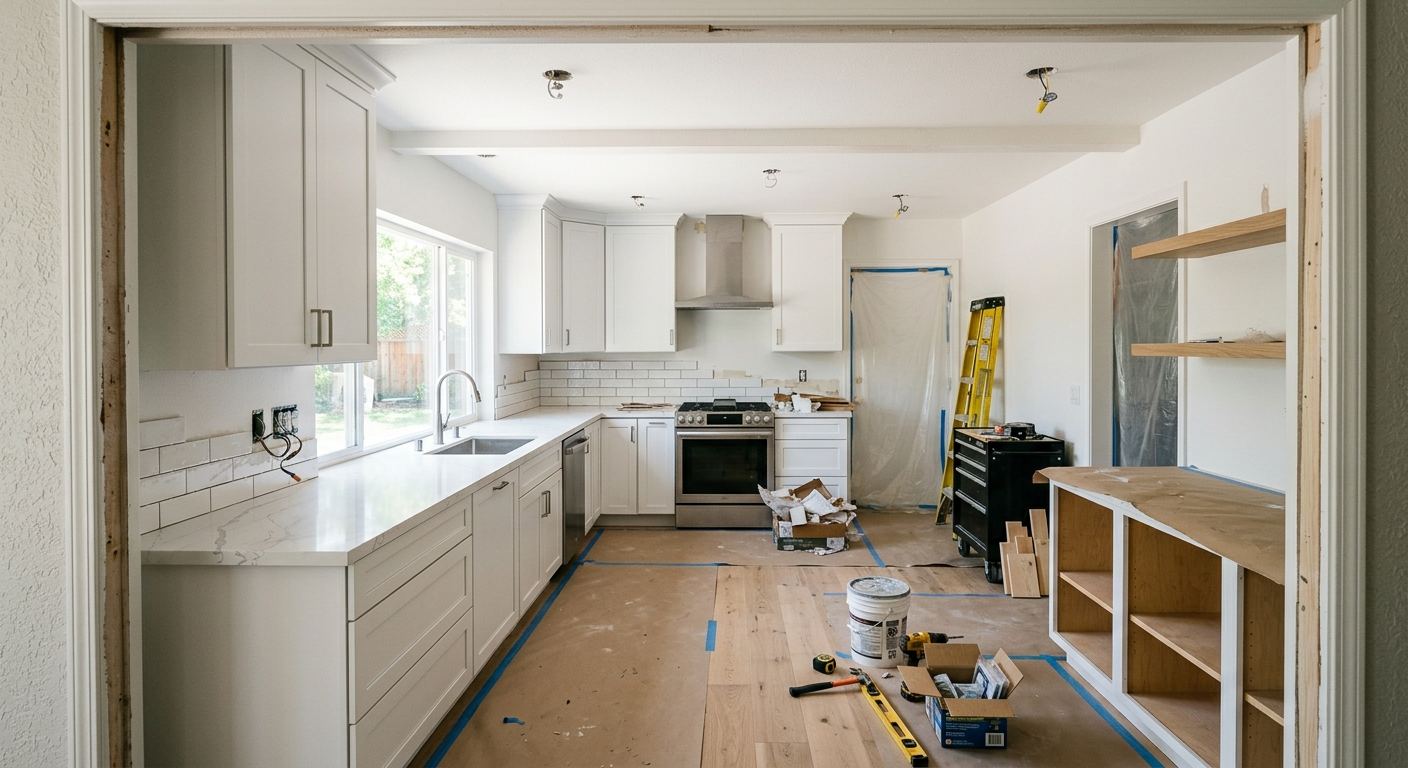
Kitchen renovation options and costs in Deep River
Deep River homeowners typically start their kitchen conversations by deciding how much change they want to see—cosmetic only, a mid-range refresh, or a full redesign. With a median household income of about $95,000 (Statistics Canada, 2021 Census), many households in the Kingston–Pembroke economic region plan upgrades that balance resale appeal with predictable budgeting. That matters here because the vast majority of homes are older: 84.5% were built before 1981 (Statistics Canada, 2021 Census), and those layouts often have dated electrical runs, smaller appliance clearances, and different cabinet depths than today’s standards.
In Deep River, pricing is shaped more by the market’s finish expectations and buyer demand than by climate swings. The cost jump between a $25,000–$55,000 mid-range renovation and a $60,000+ premium project is driven mostly by cabinetry tier and countertop selection, not season. Contractors also schedule work around peak construction windows, so availability can tighten in spring and early summer, which can add labour premium if your timeline is urgent—especially in high-demand areas like Victoria Street and the broader downtown core where older housing stock clusters and kitchen projects come up frequently.
Below is a practical price guide using the common scope ranges contractors see in Deep River. Use it to compare quotes apples-to-apples before you sign.
| Renovation Tier |
What's Included |
Typical Duration |
Price Range |
| Cosmetic refresh (paint, hardware, new appliances only) |
Cabinet paint or touch-ups (no new boxes), new hardware, matching trim/caulk, appliance swap only |
1–2 weeks |
$7,000–$18,000 |
| Mid-range full renovation (new cabinets, counters, sink, tile) |
New semi-custom or quality stock cabinets, new countertop, sink and faucet, backsplash tile, basic labour carpentry |
3–6 weeks |
$25,000–$55,000 |
| High-end full renovation (custom cabinets, stone counters, island) |
Fully custom cabinetry, premium stone (or equivalent), island build, upgraded backsplash detailing, enhanced lighting and detailing |
6–10 weeks |
$55,000–$65,000 |
| Cabinet refacing only (new doors + drawer fronts, same boxes) |
Refacing materials, new doors/drawers, hardware, adjustment/alignments where needed |
2–4 weeks |
$6,000–$25,000 |
| Countertop swap only (laminate to quartz or stone) |
Removal and install of new countertop, sink cut-out transfers as needed, edge profile changes |
3–7 days |
$2,500–$12,000 |
| Backsplash tile installation only |
Tile supply/installation for standard backsplash height, prep, grout, finishing |
3–10 days |
$1,500–$8,000 |
Prices are estimates only and vary by project scope, site access and material selection.
What affects the price of kitchen renovation in Deep River
In the Kingston–Pembroke economic region, it’s common to see quotes for the “same” kitchen end up 30–50% apart once you account for labour allowances, cabinet tier, and how trades handle older rough-ins. The reason is that homeowners choose different finish tiers based on what they expect to recoup on resale, and local buying patterns influence that more than weather does. Deep River has a lot of older housing stock—84.5% built before 1981—so the baseline can start higher if wiring, plumbing supply angles, or cabinet openings don’t match today’s standard product lines.
Across Ontario, contractors often counsel that a full renovation lands roughly in the $25,000–$55,000 mid-range band for many standard upgrades, while premium finishes and custom millwork commonly move projects toward $60,000+ if you add an island or upgrade stone. In high-value pockets within the Kingston–Pembroke orbit, homeowners default to quartz or stone counters and semi-custom cabinetry because upgrades are easier to justify at resale. In more modest pockets, laminate and stock cabinets dominate because they deliver better ROI with a lower initial price point.
In Deep River specifically, cost can rise quickly for three practical reasons. First, older homes may need electrical rework for under-cabinet lighting or additional outlets for an island—adding new circuits can increase labour even if the layout stays similar. Second, plumbing locations may not line up with a modern sink/faucet rough-in, so changing sink placement can add both carpentry and supply/drain work. Third, when you replace dated finishes (old tile, mismatched wall surfaces, or out-of-square walls), the “level and prep” time can quietly add dollars even before cabinetry and countertops arrive.
| Price Factor |
Why It Matters |
Cost Impact |
| Cabinet tier — stock vs. semi-custom vs. fully custom millwork |
Cabinet construction, door styles, fit/finish tolerance, and whether modifications are included |
Typically shifts most of the project budget; can move you from mid-range to high-end quickly |
| Countertop material — laminate vs. quartz vs. granite vs. stone |
Material cost, fabrication complexity, and edge/profile options |
Commonly adds several thousand dollars; premium stone can push a $25,000–$55,000 job toward upper bands |
| Layout change — wall removal, island add, plumbing/gas move |
More demolition, structural planning, and trade coordination; the surprises live here |
Often the biggest unpredictable swing regardless of finish tier |
| Appliance package tier — builder vs. mid-range vs. pro-grade |
Price differences + required electrical/venting considerations |
Can add or reduce several thousand dollars depending on brand and features |
| Flooring — refinish existing vs. full replacement |
Removal/disposal, subfloor prep, and whether transitions need redesign |
May be minor if refinishing; can become a sizable add-on with full replacement |
| Backsplash — ceramic tile vs. marble vs. full-height slab |
Labour intensity, material weight, and layout complexity |
Ranges from a few thousand dollars for standard tile to higher for specialty stone and full-height work |
| Electrical — new circuits for island, under-cabinet lighting |
New receptacles, lighting circuits, and code-compliant wiring runs |
Often increases labour and materials; can be a hidden driver on older homes |
| Permit fees and licensed trade requirements |
Work involving gas, certain plumbing changes, structural modifications, and electrical upgrades |
Small compared to cabinets, but it affects scheduling and total project cost |
Permits & regulations in Ontario
In Ontario, swapping cabinets, countertops, and backsplashes typically does not require a permit—because you’re not changing the building systems. However, as soon as your kitchen project touches plumbing supply or drains, moves or adds gas connections (stove/range hood with gas), removes a load-bearing wall, or adds new electrical circuits, permits and licensed trades are usually required. Gas work must be done by a licensed gas fitter, and electrical work must be done by a licensed electrician; both involve inspections where applicable. Because permit responsibility can vary by contractor, always confirm in writing who pulls the permit, pays the fees, and schedules inspections.
For a homeowner in Deep River, a simple verification process helps you avoid unpleasant surprises:
- Ask your contractor for their Ontario licence details and quote references for all affected trades (gas and electrical).
- Request a certificate of insurance (liability) naming you as the certificate holder where appropriate.
- Confirm workers’ compensation coverage (WSIB/WCB) for the crews doing the work.
- Before work starts, ask whether permits will be pulled for plumbing/drain relocation, gas relocation, electrical circuit additions, or any load-bearing structural changes.
- Check the contractor’s written scope for “permit included” vs “permit by homeowner,” and ensure demolition/disposal responsibilities are listed too.
If a contractor can’t clearly tell you what does or doesn’t require a permit, that’s often the first sign to slow down and get clarification before signing.
Cabinets, countertops and layout decisions in Deep River
Three decisions drive most Deep River kitchen renovation outcomes: (1) cabinet tier, (2) countertop material, and (3) whether you change layout. Start with cabinet tier because it determines how “tight” the kitchen will feel for years—door alignment, drawer quality, and whether you can easily match existing openings in older homes built before 1981. In the Kingston–Pembroke resale context, buyers commonly expect clean, modern door styles and durable, easy-to-maintain surfaces; that typically means semi-custom is the sweet spot for many homeowners targeting the mid-range band, while fully custom and premium stone show up more often in high-end renovations.
Countertop choice is the second big lever. Laminate can be the lowest-cost route, but it’s less forgiving with heat exposure and cuts over time. Quartz engineered countertops offer a strong balance of durability and low maintenance, often fitting the $25,000–$55,000 renovation target without getting into the most expensive stone tiers. Granite/natural stone looks upscale but can require more ongoing care depending on the finish. Layout changes are where justification matters: removing a wall or adding an island can be worth it for storage and flow, but moving plumbing/gas lines is usually where cost balloons unpredictably.
Here’s a realistic dollar example: many homeowners spend less on cabinets by staying semi-custom, then invest in quartz. If your plan is a mid-range full renovation, you might hold cabinet spend steady at the semi-custom level and reallocate a few thousand dollars toward quartz edges and a better backsplash—often giving a bigger “wow” per dollar than small cabinet upgrades alone. Conversely, if you’re adding an island and need electrical and plumbing relocation, it’s usually smarter to plan finishes around that structural budget first.
| Option |
Durability |
Maintenance |
Best For |
Price Range |
| Stock cabinets (big-box) |
Solid for basic use; best when your existing space is standard-sized |
Low; wipe-clean surfaces, occasional hardware tightening |
Fast timelines and budget-conscious refreshes with minimal modifications |
$12,000–$25,000 |
| Semi-custom cabinets (local dealer) |
Good build quality with more sizing options for older rough openings |
Low; regular cleaning, adjust drawers/hinges as needed after settling |
Most common choice for Deep River homeowners aiming for mid-range ROI |
$18,000–$40,000 |
| Custom cabinets (local millwork shop) |
Highest fit, custom storage, and the most resilient detailing |
Low to moderate; premium materials benefit from routine care |
Unusual layouts, ceiling heights, and homeowners who want a “built-in” look |
$30,000–$55,000 |
| Laminate countertop |
Moderate; edges can be vulnerable to chips if the kitchen is high-traffic |
Easy daily cleaning; avoid heat and prolonged standing water at seams |
Budget renovations and rental-style durability expectations |
$2,500–$5,500 |
| Quartz engineered countertop |
High; excellent stain resistance and consistent surface |
Low; wipe-clean, no sealing in typical applications |
Mid-range full renovations that need a durable, modern look |
$5,500–$10,000 |
| Granite / natural stone countertop |
High; durable but more sensitive to certain seal/finish choices |
Moderate; periodic sealing may be recommended |
Premium look seekers who value natural variation |
$7,000–$12,000 |
| Butcher block countertop |
Moderate to high with proper care; can dent and scratch |
Moderate; oiling/maintenance needed to prevent drying and staining |
Families who want a warm, traditional prep surface |
$4,000–$8,000 |
| Marble countertop |
Moderate; beautiful but prone to etching from acidic spills |
Higher; sealing and careful use required |
Low-wear showpiece kitchens or homeowners who want luxury aesthetics |
$8,000–$15,000 |
How to choose a kitchen renovation contractor in Deep River
Choosing the right contractor in Deep River comes down to proof: proof of licensing, proof of insurance, and proof that their quote matches your scope. For Ontario, confirm that the trades they subcontract—especially electricians and gas fitters—are properly licensed. For the general contractor, ask for liability insurance documents (certificate of insurance), and confirm workers’ compensation coverage (WSIB/WCB) so you’re not exposed if someone is injured on site. If they can’t provide current paperwork, keep looking.
Next, get 2–3 itemised written quotes. You want a breakdown that separates labour vs materials (including specific allowances for cabinets, countertops, tile, and disposal). A lump sum can look competitive but often hides missing scope like drywall repair, underlayment prep, or electrical line extension—those omissions can cost you later. Carefully check whether permits are included, who is responsible for pulling them, and whether waste removal is part of the job.
Warranty matters in kitchens because wear happens quickly: ask for the workmanship warranty length and what it covers, plus the manufacturer warranty for cabinets and countertops. If a warranty is transferable, ask for it in writing; if not, confirm what happens if you sell the home soon after renovation.
- Never pay more than 10–15% upfront; use staged payments tied to milestones.
- Hold back a portion until punch list items are complete.
- Require a start date and completion estimate in the contract.
- Ask who pulls permits and who schedules inspections (in writing).
- Confirm demolition and disposal are included (and what’s included in “site prep”).
- Verify countertop template/scheduling dates so you don’t lose weeks waiting.
- Check that plumbing/electrical rough-ins are included when layout changes.
- Request the cabinet specs: door style, finish, hardware, and warranty terms.
- Make sure backsplash and flooring transition details are part of scope.
- Clarify what happens if materials arrive late (timelines and costs).
- Ask for daily jobsite cleanup expectations and dust control methods.
- Get everything in writing: scope, allowances, inclusions, exclusions, and change-order rules.
Red flags in Deep River I’ve seen over the years: (1) quotes that don’t list a disposal/demolition line, (2) vague “allowance” language for countertops/cabinets without material specs, (3) no clear permit responsibility, (4) pushing for large upfront deposits, and (5) reluctance to show insurance/WSIB/WCB paperwork.
Frequently asked questions — kitchen renovation in Deep River
How do I choose a kitchen contractor in Deep River?
Start with paperwork and a clean scope. In Ontario, confirm the contractor’s liability insurance and that their workers are covered under WSIB/WCB; ask for certificates before work begins. Then verify any subtrades that require licences—especially gas fitting and electrical—are correctly covered for the specific tasks in your plan. Get 2–3 itemised quotes with labour + materials breakdowns (not just a single total). Compare cabinets and countertops spec sheets, not just brand names. Finally, align your budget with realistic bands: for many Deep River kitchens, a mid-range full renovation commonly lands in the $25,000–$55,000 range, while premium custom projects can push toward the upper band.
What order do kitchen renovation steps happen in?
Typically, demolition comes first, then rough-ins, then cabinetry and countertops, then finishing trades. After you decide layout changes, the order usually looks like: remove old cabinets/counters, protect the surrounding finishes, and confirm subfloor and wall conditions. If plumbing/drain locations or electrical circuits are changing, those trades rough-in early so the walls can close up cleanly. Next is base cabinet install (and leveling/shimming), then countertop templating and fabrication. After counters go in, sinks/faucets and backsplash are installed, followed by final electrical fixtures, trim/casing, paint, and a full punch list. In older Deep River homes (built before 1981), expect some extra time for correcting out-of-square walls before cabinets lock in.
Can I live at home during a kitchen renovation in Deep River?
Often yes, but it depends on how extensive the work is and how many days your kitchen becomes non-functional. Cosmetic refreshes are the easiest to live through. For a mid-range full renovation in the $25,000–$55,000 band, many homeowners remain in the home by setting up a temporary “clean” cooking area (microwave, kettle, small prep station) while the main kitchen is offline. If you’re doing layout changes—like adding an island, moving plumbing, or relocating appliances—expect longer disruption because walls may open and dust control is more intense. A contractor should help you plan staging: protected entry paths, dust barriers, and clear timelines for when appliances and sink areas are usable again.
Should I renovate my kitchen before selling in Deep River?
In many Ontario markets, kitchens are one of the highest-impact rooms for buyer perception, especially when the home is older and visually dated. With 84.5% of Deep River dwellings built before 1981, many properties benefit from visible upgrades like updated cabinet fronts, refreshed finishes, and durable counters. If your goal is to sell, focus on value-for-money: semi-custom cabinets plus quartz in the mid-range band ($25,000–$55,000) often feels more current than a purely cosmetic paint-and-hardware approach. Avoid overbuilding if the rest of the home isn’t keeping up. A good contractor will also suggest which items to prioritize based on what local buyers tend to notice first—storage layout, counter cleanliness, and modern lighting.
What's the most popular kitchen style in Deep River right now?
In Deep River and the wider Kingston–Pembroke region, homeowners are commonly choosing clean-lined modern and transitional looks: simple shaker-style doors, matte or low-sheen finishes, and warm neutrals paired with quartz. Quartz selections have become especially popular because they offer a durable, low-maintenance surface that fits daily life and still photographs well. Many projects are built toward the mid-range $25,000–$55,000 band, where semi-custom cabinetry plus a quality backsplash gives the biggest visual payoff. Extremely elaborate styles do still happen, but they’re more often tied to high-end renovations approaching the upper band, especially when there’s an island and premium stone detailing.
How do I know if I need to update my kitchen plumbing in Deep River?
A plumbing update is usually needed when the existing rough-in doesn’t match the new sink location, when supply/drain lines are failing, or when you’re changing appliances that require different connections. In older homes common in Deep River (most built before 1981), it’s also smart to inspect shutoff valves, trap conditions, and the routing of drains before you close walls. If you’re staying in the same general sink position and simply swapping countertop/cabinets, you may only need minor adjustments. But if you’re moving plumbing or adding a dishwasher where one didn’t exist, you should plan for licensed plumbing work and a permit pathway when required. A reputable contractor will camera-check where appropriate and include plumbing allowances explicitly in the quote.