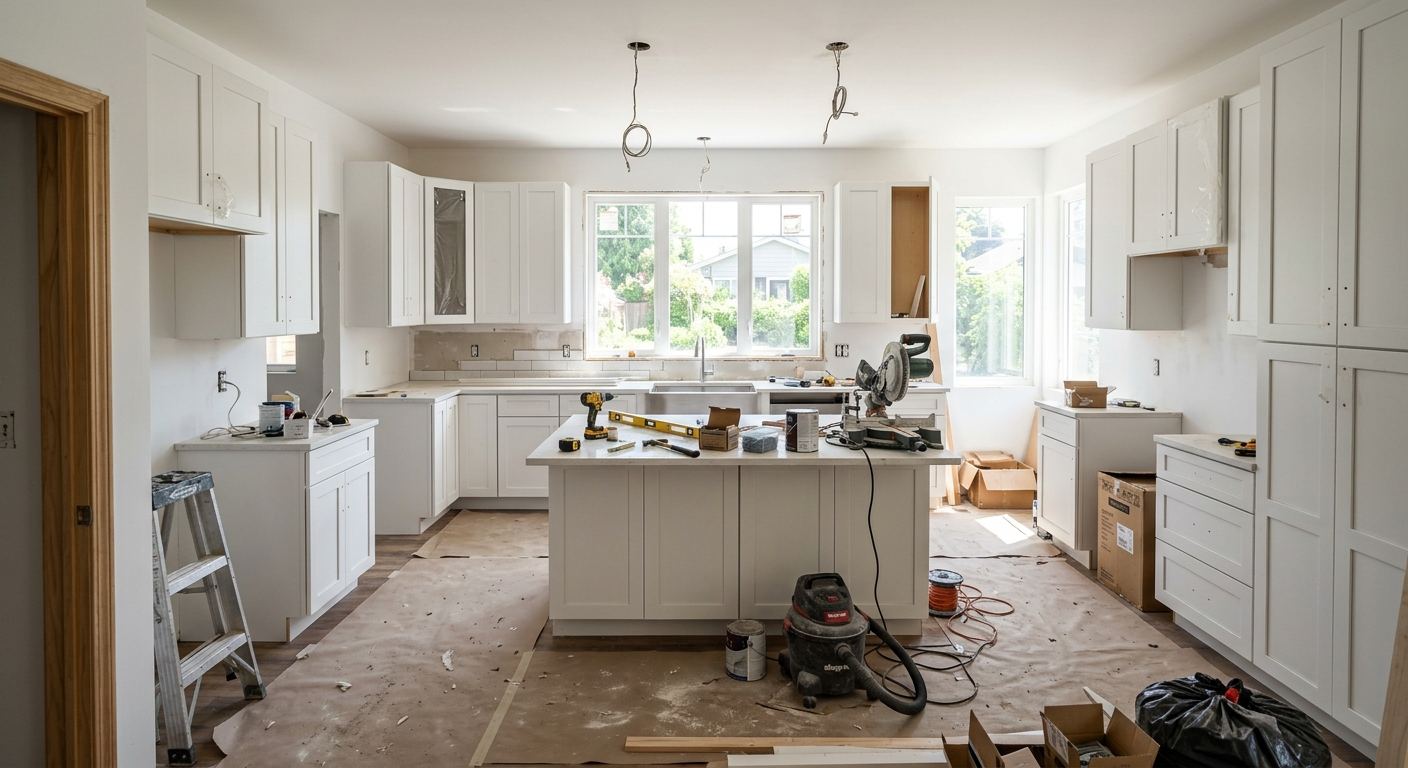
Kitchen renovation options and costs in Greenwood-Coxwell
Greenwood-Coxwell is a neighbourhood where kitchen makeovers often feel like part of the home’s “main renovation,” because buyers watch the kitchen when they tour. With a 2021 population of 14,417 residents in the broader area (Statistics Canada, 2021 Census), there’s steady demand for contractors who can move quickly between projects. Local household purchasing power also matters: in the Toronto economic region, higher household incomes and stronger home values push many owners toward upgrade-ready finishes—often treating the kitchen as a resale investment. In practice, Toronto projects commonly target finish tiers tied more to buyers’ expectations than to weather.
Importantly, kitchen renovation costs in the Toronto economic region don’t rise primarily because of climate. Instead, pricing tracks local housing turnover, material availability, and how quickly trades can book schedules. During busy periods, labour and scheduling can add cost because crews are booked out; however, the “big number” is usually finishes and scope. For example, a cosmetic refresh (paint, hardware, new appliances only) can stay well under a full replacement, while a mid-range or high-end full renovation climbs quickly into the $25,000–$90,000 range depending on cabinet tier and countertop choice. Contractors are especially in demand around the Greenwood Avenue / Danforth corridor, where many homes have practical galley layouts that owners rework for brighter, more open circulation. Use the tiers below to compare apples-to-apples before you request quotes.
| Renovation Tier |
What's Included |
Typical Duration |
Price Range |
| Cosmetic refresh (paint, hardware, new appliances only) |
Cabinet paint or re-stain (if applicable), new hardware/hinges, backsplash touch-up or light refresh, appliance swap (no plumbing/gas moves), countertop protection or minor repairs only |
3–7 days |
$10,000–$22,000 |
| Mid-range full renovation (new cabinets, counters, sink, tile) |
Semi-custom or quality stock cabinets, new quartz or laminate countertops, sink and faucet change, backsplash tile, new or refreshed flooring sub-scope, basic electrical updates for lighting |
3–5 weeks |
$35,000–$65,000 |
| High-end full renovation (custom cabinets, stone counters, island) |
Fully custom millwork, premium stone (quartz/stone/engineered options), island (new base/casework), upgraded appliance package, full-height or designer backsplash, structural and layout changes as needed |
6–10 weeks |
$70,000–$90,000 |
| Cabinet refacing only (new doors + drawer fronts, same boxes) |
Refaced cabinet doors/drawers, new pulls/trim, interior hardware, optional matching panel/soffit adjustments, limited countertop/backsplash work if requested |
1–3 weeks |
$8,000–$25,000 |
| Countertop swap only (laminate to quartz or stone) |
Removal and disposal of old countertop, templating and install of new quartz or stone, new undermount sink cut-out (if applicable), basic caulking/sealing |
3–10 days |
$6,000–$15,000 |
| Backsplash tile installation only |
Demo (if needed), substrate prep, tile supply and installation, grout/seal, trim at outlets (no major electrical rewiring) |
2–5 days |
$2,000–$10,000 |
Prices are estimates only and vary by project scope, site access and material selection.
What affects the price of kitchen renovation in Greenwood-Coxwell
In the Toronto economic region, two homeowners can receive quotes for the “same kitchen” that differ by 30–50% because the scope rarely matches. One contractor may include rough-in electrical, appliance venting updates, and proper subfloor prep; the other may price a faster cosmetic approach with limited demo and assumptions. Even when finish selections look similar, cabinet type, countertop thickness, backsplash style, and whether the contractor is pricing based on actual site conditions (not a guess from photos) can swing labour hours and material waste.
Across Ontario, local home values and median incomes shape the typical finish tier far more than climate. In higher-value Toronto pockets, owners more often choose quartz or natural stone countertops and semi-custom cabinetry because the upgrade is easier to recover on resale. In more price-sensitive projects, laminate and stock cabinets stay common to protect ROI while still modernizing the look. Layout changes are the wild card regardless of finish: removing a wall, adding an island, or moving a gas line or plumbing supply creates unknowns like structural bracing, venting changes, and rework of subfloor and cabinetry base alignment.
Concrete Greenwood-Coxwell examples: (1) older homes often have uneven floors or dated plumbing runs, so a “simple sink swap” can become a higher-cost scope to re-level the cabinet bases and rework supply/drain connections; (2) if your kitchen currently has a narrow galley and you’re aiming for an open feel, bringing in an island may require electrical for under-cabinet lighting and possibly a new circuit for outlets; and (3) if your backsplash plan is going full-height behind the range, expect more tile cuts and longer installation time than a standard 18–24 inch run. That’s why costs that start in the low–mid range can climb toward $65,000+ when layout and trades overlap.
| Price Factor |
Why It Matters |
Cost Impact |
| Cabinet tier — stock vs. semi-custom vs. fully custom millwork |
Different lead times, fit/finish tolerances, hardware options, and internal storage features change both material and install time. |
Can move a project roughly $10,000–$25,000+ (depending on full replacement vs. partial scope) |
| Countertop material — laminate vs. quartz vs. granite vs. stone |
Material cost and fabrication complexity vary; stone also drives thickness/edge treatments and install labour. |
Typically adds $3,000–$12,000+ over laminate for many full-kitchen scopes |
| Layout change — wall removal, island add, plumbing/gas move |
Structural and utility rework creates permitting needs, scheduling risk, and extra demo/construction hours. |
Often the biggest swing: $5,000–$30,000+ |
| Appliance package tier — builder vs. mid-range vs. pro-grade |
Pro-grade models may require specific clearances, ventilation setups, and sometimes different electrical/venting requirements. |
Usually adds $2,000–$15,000+ |
| Flooring — refinish existing vs. full replacement |
If floors are flat and in good condition, you save on demo, subfloor repair, and finishing time. |
Can be $2,000–$12,000+ depending on what’s underneath |
| Backsplash — ceramic tile vs. marble vs. full-height slab |
Hard-to-match stone, full-height coverage, and outlet detailing increase cut time and labour. |
Often $2,000–$10,000+ with full-height upgrades |
| Electrical — new circuits for island, under-cabinet lighting |
Additional circuits for outlets/lighting increase electrical scope and inspection scheduling. |
Commonly $800–$5,000+ depending on circuit count |
| Permit fees and licensed trade requirements |
Work that triggers permits adds administration and inspection coordination. |
Can add several hundred to a few thousand dollars, plus schedule time |
Permits & regulations in Ontario
In Ontario, many straightforward kitchen upgrades are permit-light, but the moment you touch plumbing, gas, electrical circuits, or structure, permitting and licensed trades often come into play. A cabinet swap, cabinet refacing, and countertop replacements typically do not require permits by themselves. Similarly, replacing finishes like tile backsplashes and flooring usually stays permit-free unless electrical work or structural changes are involved.
Work that typically does require a permit includes: moving plumbing supply or drain lines (even to a new sink location), relocating a gas stove/range, adjusting a gas range hood setup tied to gas, removing a load-bearing wall, and adding new electrical circuits (for an island, added outlets, or relocating heavy loads). Gas work must be performed by a licensed gas fitter, and electrical work must be performed by a licensed electrician, with inspections where required.
Step-by-step, here’s how a Greenwood-Coxwell homeowner can verify a contractor’s Ontario compliance before you sign: (1) request their Ontario licence numbers and trade credentials; (2) verify the licensed trades directly through the appropriate Ontario online registry pathways (your contractor should tell you which licence applies to gas or electrical); (3) ask for an up-to-date certificate of insurance (liability coverage) and a WSIB/WCB clearance letter or coverage proof; and (4) confirm who pulls permits in the written contract. Permit responsibility should never be “assumed”—it should be clearly stated in your scope of work.
Cabinets, countertops and layout decisions in Greenwood-Coxwell
When you’re planning a Greenwood-Coxwell kitchen renovation, three decisions drive the outcome more than almost anything else: (1) cabinet tier, (2) countertop material, and (3) layout changes. Cabinet tier determines how the kitchen will look today and in five to ten years—stock is fastest and cheapest, semi-custom is the most common value choice, and fully custom millwork offers the best fit for irregular spaces common in older Toronto homes. For countertops, laminate is budget-friendly but more sensitive to impact and heat; quartz is a popular middle ground; granite/natural stone looks premium and ages well with correct sealing; butcher block adds warmth and character but needs maintenance; marble is beautiful but demands more care.
Layout changes are where Toronto resale logic gets practical. Many Greenwood-Coxwell homes are older and have galley or tight L-shaped designs. If you’re adding an island or opening up circulation, that can justify higher budgets because it improves day-to-day flow and photo appeal for buyers. But it also increases unpredictability: moving plumbing/gas and adding electrical circuits is typically more expensive than simply keeping the sink footprint. A concrete example: if you start with a mid-range plan in the $35,000–$65,000 band, switching from laminate to quartz can be a manageable upgrade; however, adding an island and moving plumbing can push you toward the higher end of the $70,000–$90,000 range due to the trade overlap and rough-in work.
Toronto buyers at different price points tend to expect quartz or quality laminate for most mid-range listings, and stone or upgraded finishes for higher-end renovations. The “right” choice is the one that matches your layout scope—because it’s easier to recover a finish upgrade than to undo a complicated rework.
| Option |
Durability |
Maintenance |
Best For |
Price Range |
| Stock cabinets (big-box) |
Good everyday durability; limited customization for awkward corners |
Low—typical cleaning; hinges/hardware may need periodic adjustment |
Fast turnarounds and budget-forward renovations |
$8,000–$20,000 |
| Semi-custom cabinets (local dealer) |
Very good durability with better storage options and fit |
Low—keep hardware tightened and wipe spills promptly |
Most Greenwood-Coxwell remodels aiming for resale appeal |
$18,000–$35,000 |
| Custom cabinets (local millwork shop) |
Excellent durability; tailored to irregular layouts and premium hardware |
Low to moderate depending on finish type; handle with care near edges |
Maximizing fit, storage, and premium styling |
$30,000–$55,000 |
| Laminate countertop |
Moderate; can chip or scratch, especially at edges |
Low day-to-day care; avoid heat directly on surface |
Budget projects that still want a clean, updated look |
$3,000–$7,000 |
| Quartz engineered countertop |
High durability; resistant to staining and everyday wear |
Low—no sealing required; wipe clean and avoid harsh abrasives |
Best blend of look, durability, and predictable maintenance |
$7,000–$12,000 |
| Granite / natural stone countertop |
High; very durable with proper support and installation |
Moderate—often requires sealing schedule and careful cleaning products |
Premium look for owners who want stone character |
$9,000–$15,000 |
| Butcher block countertop |
Good but vulnerable to deep cuts and water sitting in seams |
Moderate to high—needs periodic oiling and careful drying |
Warm, casual style and households that cook frequently |
$6,000–$11,000 |
| Marble countertop |
Moderate; can etch or stain because it’s more porous |
Higher—requires sealing and quick cleanup of acidic spills |
Luxury aesthetic where you’re willing to maintain it |
$10,000–$18,000 |
How to choose a kitchen renovation contractor in Greenwood-Coxwell
Choosing the right kitchen contractor in Greenwood-Coxwell is mostly about proof and process, not just price. In Ontario, verify licensing and coverage before any work starts: ask for their liability insurance certificate (so you’re protected if something is damaged), and request WSIB/WCB clearance or coverage proof where applicable. If the scope includes gas appliances or gas line changes, confirm the gas fitter is licensed; for any electrical circuit changes, confirm work is done by a licensed electrician. A reputable contractor will hand you documents without hesitation and will explain what they subcontract versus what they self-perform.
Next, get 2–3 itemised written quotes. You want a breakdown that separates labour and materials (cabinet supply, countertop fabrication, backsplash tile, plumbing/electrical allowances, demolition and disposal), not one lump-sum number with vague line items. Read the scope carefully: is permit pulling included, who pays permit fees, and is disposal included? Make sure timelines include product lead times (cabinet and countertop fabrication) and provide a start date and completion estimate in writing.
On warranty, insist on clarity: workmanship warranty length, product/manufacturer warranty terms, and whether warranties are transferable if you sell. For payments, never pay more than 10–15% upfront; use a holdback until the job is complete and key inspections are satisfied. If a contractor pressures you for large upfront payments or won’t put details into the contract, treat it as a serious warning.
- Confirm licence/coverage documents before signing (liability insurance + WSIB/WCB proof).
- Request an itemised quote with labour and materials listed separately.
- Ensure permits and licensed trade responsibilities are stated in writing.
- Ask what’s included in demolition and disposal (and what isn’t).
- Verify countertop template dates and who is responsible for fabrication changes.
- Check cabinet lead times and the contingency plan if materials run late.
- Confirm backsplash scope: tile supply, substrate prep, and caulking details.
- Review electrical scope: number of circuits/outlet moves and fixture allowances.
- Agree on a payment schedule (≤10–15% upfront; holdback near completion).
- Get a written start date, milestones, and a completion estimate.
- Ask for sample warranty terms and whether they transfer to a new owner.
- Request references for similar Toronto-area kitchens (especially older-home retrofits).
Red flags we see often in Greenwood-Coxwell: contractors who won’t provide insurance/coverage proof, vague “allowances” with no numbers for tile or electrical, quotes that omit disposal and demo details, pressured payment schedules that front-load most costs, and timelines that ignore cabinet/countertop lead times (leaving you stuck waiting).
Frequently asked questions — kitchen renovation in Greenwood-Coxwell
What order do kitchen renovation steps happen in?
In Greenwood-Coxwell and across Ontario, the typical flow is: (1) measure and finalize the plan (cabinet layout, countertop template schedule, backsplash dimensions); (2) demolition and site protection; (3) rough-ins—plumbing supply/drain adjustments, gas line work (if any), and electrical work like new circuits or under-cabinet lighting wiring; (4) inspection steps for any permitted work; (5) installation of cabinets (leveling over the subfloor); (6) countertop fabrication and install once templates are ready; (7) backsplash tile installation and final trim; (8) appliance hook-ups and finishing touches; and (9) punch list and cleaning. A common reason for delays is countertop templating being done too early or rough-in trades not finishing first.
Can I live at home during a kitchen renovation in Greenwood-Coxwell?
Often yes, especially for cosmetic refreshes or cabinet refacing. For a mid-range full renovation, many homeowners continue living at home by setting up a temporary kitchen in another room and using a limited pathway to manage dust. If you’re in the $35,000–$65,000 range for a full cabinet-and-counter project, plan for at least part of the work to feel disruptive: demolition dust, loud cutting, and limited access to sinks. If your renovation includes plumbing moves, electrical updates, or any gas-related changes, expect more “offline” time for water or cooking until hook-ups are complete and inspected. A reliable contractor will provide a dust-control plan, protect floors and doorways, and communicate daily what areas are safe to use.
Should I renovate my kitchen before selling in Greenwood-Coxwell?
Usually, you should renovate before selling if your kitchen is holding back showings—think dated finishes, poor layout flow, or cabinets that look tired rather than functional. In the Toronto housing market, buyers often expect modern, durable countertops and clean cabinetry lines, so a thoughtful upgrade can help. That said, timing matters: you don’t want to start a project that runs into peak listing season if product lead times are uncertain. If you’re trying to balance cost and resale, a mid-range renovation (commonly $35,000–$65,000) often provides the most predictable ROI when changes are focused on cabinets, counters, and a tasteful backsplash. If you’re considering a high-end build (toward $70,000–$90,000), make sure your neighbourhood’s pricing supports those finishes, or the resale payback can be uneven.
What's the most popular kitchen style in Greenwood-Coxwell right now?
Across Greenwood-Coxwell and the broader Toronto area, the most requested look is a clean, contemporary “warm modern” style: flat-panel or simple shaker cabinets, neutral palettes (white, warm greige, or light wood tones), and quartz countertops that read as natural stone. Layouts are also trending more functional—owners often keep the kitchen’s core footprint but make it feel brighter by improving lighting and adding storage or a small island where possible. If you’re staying in the mid-range tier, semi-custom cabinetry and quartz are common because they photograph well and wear nicely under daily use. For homeowners doing a more premium renovation, custom millwork and a stone statement backsplash or island landing are popular. Your contractor can guide you based on what’s selling in your immediate Danforth/Greenwood corridor.
How do I know if I need to update my kitchen plumbing in Greenwood-Coxwell?
You may need updates if you’ve noticed slow drains, frequent leaks under the sink, rusty supply lines, or inconsistent water pressure at the faucet. Older Toronto homes can also have plumbing that doesn’t align cleanly with today’s cabinet base heights or undermount sink requirements. If your plan includes moving the sink location, adding a dishwasher, or changing the tap style, plumbing updates become more likely because drain/supply rerouting is part of the work. From a permitting standpoint, moving plumbing supply or drain lines typically triggers permit and licensed-trade requirements in Ontario. The best practical approach is to have your contractor evaluate existing shutoffs, inspect connections during demo, and then confirm what’s required in the written scope before you order countertops.
What is the difference between a galley and open-concept kitchen?
A galley kitchen is a corridor-like layout with cabinets and work surfaces on two opposite walls, often with limited sightlines and a tighter traffic flow. An open-concept kitchen blends the kitchen into adjacent living or dining space, usually by removing or not using a separating wall, and by choosing layouts that support movement and visibility. In Greenwood-Coxwell, galley kitchens are common in older homes; renovating them often focuses on storage upgrades, lighting, and occasionally reworking the footprint. Open-concept designs can offer better entertaining flow, but they’re usually more expensive when they require structure changes, new electrical circuits, and sometimes plumbing/gas coordination. If you’re aiming for open-concept, confirm which parts are staying put versus what utilities will be moved before you lock your budget.