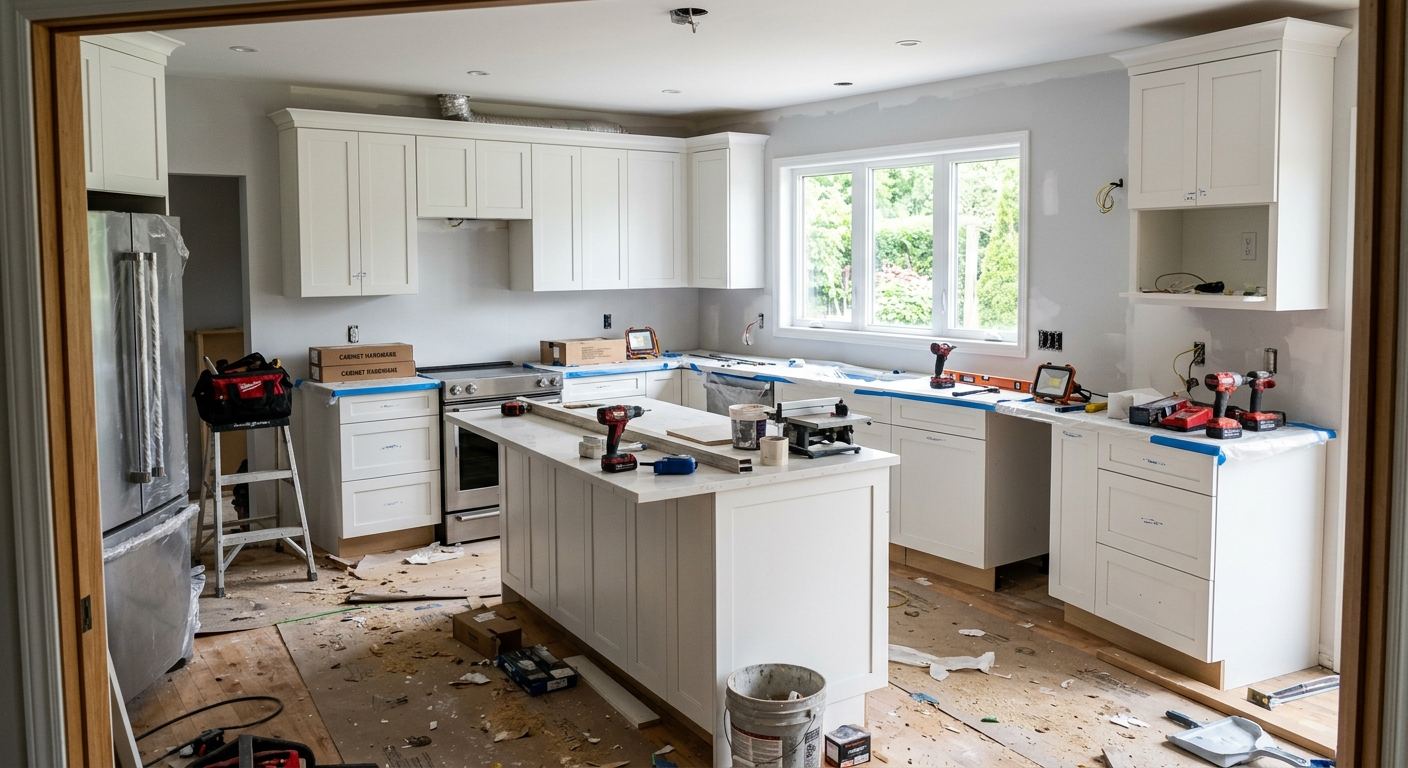
Kitchen renovation options and costs in Penetanguishene
Penetanguishene kitchen renovations run the gamut from quick refreshes to full tear-outs, but the most common reason homeowners change their budgets is what they choose for cabinets and stone. With a median household income of $74,000 (Statistics Canada, 2021 Census) and a housing stock where 51.7% of homes were built before 1981, many projects start with “upgrade the look and function,” then grow once homeowners see the condition of old plumbing runs, subflooring, and ventilation. That’s also why finish tier tends to follow value expectations that align with the broader Kitchener–Waterloo–Barrie market—even here on the shores of Lake Huron.
In the Kitchener–Waterloo–Barrie economic region, contractor pricing is influenced more by demand and resale psychology than by temperature swings. Trades and lead times cluster around higher-value pockets of the region, and that can tighten availability and raise labour rates during busy seasons. Still, the climate does have a practical impact: winter humidity and freeze-thaw cycles can make older caulking, under-sink areas, and exterior venting less forgiving, which is why we often recommend checking ventilation and sealing details during a renovation. You’ll see especially strong renovation demand around Penetanguishene’s core residential areas and near the waterfront where older homes are being updated for year-round comfort.
To help you budget, the table below shows realistic options and typical timelines for Penetanguishene homeowners, from a cosmetic refresh to a full high-end install—so you can compare like-for-like when reviewing quotes.
| Renovation Tier |
What's Included |
Typical Duration |
Price Range |
| Cosmetic refresh (paint, hardware, new appliances only) |
Cabinet paint or stain refresh (no box changes), new hardware, new appliances, basic countertop clean/repair if needed |
3–7 days |
$6,000–$18,000 |
| Mid-range full renovation (new cabinets, counters, sink, tile) |
Stock to semi-custom cabinets, quartz or entry-level stone counters, new sink + faucet, backsplash tile, lighting upgrades, standard plumbing tie-ins |
3–5 weeks |
$30,000–$65,000 |
| High-end full renovation (custom cabinets, stone counters, island) |
Fully custom cabinetry, premium stone (quartz/stone), island with upgraded hardware, full-height backsplash option, flooring refresh coordination, enhanced electrical/lighting |
5–9 weeks |
$65,000–$90,000 |
| Cabinet refacing only (new doors + drawer fronts, same boxes) |
Refaced cabinet fronts, new hardware, interior touch-ups, countertop remains (unless specified) |
1–3 weeks |
$10,000–$28,000 |
| Countertop swap only (laminate to quartz or stone) |
Remove existing counters, install new quartz/stone, new sink cut-out coordination, seam/edge finishing, backsplash touch-up as needed |
3–10 days |
$4,000–$12,000 |
| Backsplash tile installation only |
Tile removal (if needed), mortar/setting, grout, sealing, finish trim to cabinets/countertops |
3–7 days |
$1,800–$6,500 |
Prices are estimates only and vary by project scope, site access and material selection.
What affects the price of kitchen renovation in Penetanguishene
In the Kitchener–Waterloo–Barrie region, two kitchens that look identical at first glance can come in 30–50% apart once you get into the details of layout work and finish tier. The reason is straightforward: local home values and household income levels steer homeowners toward quartz/stone and semi-custom cabinetry, while more modest budgets tend to use stock cabinets and laminate. Even in Penetanguishene, where many homes are older (51.7% built before 1981), the “upgrade path” is usually driven by resale expectations in the broader regional market, not by winter weather alone. Buyers commonly expect a clean, modern cabinet face, durable counters, and lighting that makes the kitchen feel brighter year-round.
Across Ontario, layout changes are where uncertainty lives. Removing a wall, adding an island, or moving a gas line for a cooktop (or a vent hood path) can quickly shift the scope. Those moves can require new rough-in plumbing or electrical, subfloor reinforcement, and updated venting—work that’s hard to price accurately before opening walls and confirming what’s behind them.
Here are a few Penetanguishene-specific examples that can raise or lower cost: an older home with dated shut-off valves may force a plumbing refresh during a sink swap, pushing a “countertop-only” idea toward a mid-range renovation; homes with previous water exposure under sinks can add subfloor replacement before new cabinets arrive; and when kitchens rely on an older venting route, adding an upgraded hood fan can mean extra ducting work. Budget-wise, it’s common to see projects start near the $25,000–$90,000 full-renovation band, then land higher if cabinets and stone move from a basic tier to mid- or high-end packages—especially when electrical upgrades add new circuits for island lighting. With cabinetry typically the largest component (often 30–35% of the budget), that tier choice can swing the quote as much as countertop material does.
| Price Factor |
Why It Matters |
Cost Impact |
| Cabinet tier — stock vs. semi-custom vs. fully custom millwork |
Box quality, door styles, internal storage, and how well the system fits out-of-square walls in older homes |
$8,000–$45,000 |
| Countertop material — laminate vs. quartz vs. granite vs. stone |
Material cost, edge/seam complexity, and long-term stain/heat resistance |
$1,500–$18,000 |
| Layout change — wall removal, island add, plumbing/gas move |
Structural considerations, rough-in work, and additional labour and inspections |
$4,000–$25,000 |
| Appliance package tier — builder vs. mid-range vs. pro-grade |
Cutouts, ventilation needs, and install complexity (especially for built-in fridges and ranges) |
$2,000–$15,000 |
| Flooring — refinish existing vs. full replacement |
Subfloor condition and how far cabinets extend (floor prep can become unavoidable) |
$1,200–$8,000 |
| Backsplash — ceramic tile vs. marble vs. full-height slab |
Material handling, grout/seam labour, and reach/height detailing |
$1,500–$8,000 |
| Electrical — new circuits for island, under-cabinet lighting |
Outlet repositions, lighting transformer locations, and code-compliant wiring runs |
$1,000–$6,500 |
| Permit fees and licensed trade requirements |
Work that involves gas, major electrical changes, or structural alterations triggers extra administration and inspection |
$300–$3,500 |
Permits & regulations in Ontario
In Ontario, swapping cabinets and replacing countertops typically do not require permits—so if you’re staying with the same footprint and not changing rough-in services, the project is usually straightforward from a compliance standpoint. However, Penetanguishene renovations often go beyond surfaces: moving plumbing supply/drain lines, relocating a gas stove/cooktop, removing a load-bearing wall (or altering structural supports), and adding electrical circuits for things like island outlets or under-cabinet lighting commonly require permits and licensed trades, along with inspections.
Gas work is the clearest example: if you’re changing where the stove sits or changing venting that ties to gas appliances, the work must be performed by a licensed gas fitter, and inspections are part of the process. Electrical changes follow a similar path—new circuits, significant panel work, or outlet/lighting rewiring must be done by a licensed electrician, again with inspection after the rough-in and before closure where applicable.
Before you sign in Penetanguishene, make sure the contractor clearly states who pulls permits and schedules inspections in the written contract. Then verify the contractor’s credentials: (1) licence information through the appropriate Ontario online registry for the trades involved, (2) liability insurance certificate of insurance (COI) naming you as the certificate holder where applicable, and (3) evidence of WSIB/WCB coverage for employees (or the contractor’s acceptable exemption documentation). Ask for clearance letters where available and confirm they match the business name on the quote.
Cabinets, countertops and layout decisions in Penetanguishene
The three most consequential decisions in a Penetanguishene kitchen renovation are your cabinet tier, countertop material, and whether you change the layout. In Ontario homes—especially older stock where walls may be slightly out of square—cabinet system choice affects how clean the final fit looks and how quickly the job goes. Stock cabinets (big-box) are usually fastest and cheapest, and they suit homeowners who want a modern look with minimal change. Semi-custom cabinets (often the most popular mid-range) balance options—storage upgrades, better door styles, and improved sizing—without jumping to full custom pricing. Fully custom cabinets offer the best fit and niche solutions, but they cost more and require more time and a tighter design process.
For countertops, durability and maintenance matter in real daily use. Laminate is the budget-friendly option, but it’s less forgiving with chips and heat. Quartz is popular because it resists staining and is relatively low-maintenance, making it a solid choice for family kitchens and year-round use. Granite/natural stone and marble look high-end, but they typically need more care—sealing schedules and extra caution with acids and harsh cleaners. In Penetanguishene, where older kitchens sometimes have uneven surfaces and seasonal moisture variability near exterior walls, choosing a countertop that installs cleanly and seals well at the perimeter is important.
Layout changes are where you should spend only if you truly gain space. For example, adding an island can justify cost because it improves workflow and storage, but moving plumbing or gas lines can turn a mid-range project into a higher band quickly. A practical illustration: if your plan starts in the $30,000–$65,000 mid-range renovation band, upgrading from stock cabinets to semi-custom plus quartz may be a reasonable bump; trying to add an island and relocate services often pushes toward the upper end of the $65,000–$90,000 high-end range once cabinetry, electrical, and rough-in labour stack up.
| Option |
Durability |
Maintenance |
Best For |
Price Range |
| Stock cabinets (big-box) |
Good for everyday use; fit can be less forgiving in older/off-square spaces |
Low; wipe-clean finishes; hardware service as needed |
Budget-conscious refresh with minimal layout changes |
$6,000–$18,000 |
| Semi-custom cabinets (local dealer) |
Very strong; better sizing options and storage upgrades |
Low; durable door finishes and easier reconfiguration |
Most Penetanguishene homeowners who want a modern look and better function |
$12,000–$30,000 |
| Custom cabinets (local millwork shop) |
Highest fit and build quality; tailored storage and details |
Low to moderate; depend on finish type, but generally easy care |
Challenging layouts, unique storage needs, or top-tier finishes |
$25,000–$50,000 |
| Laminate countertop |
Moderate; can chip if impacted and can scorch with heat |
Low; avoid abrasives and use trivets for hot items |
Quick upgrades that stay budget-friendly |
$1,500–$4,500 |
| Quartz engineered countertop |
High; resists staining and daily wear well |
Low; regular soap-and-water cleaning |
Durability-first kitchens targeting a strong resale look |
$4,000–$10,500 |
| Granite / natural stone countertop |
High; very durable but depends on the specific stone |
Moderate; typically requires periodic sealing |
Homeowners who want natural variation and premium styling |
$5,500–$14,000 |
| Butcher block countertop |
Moderate to high; sensitive to standing water and needs oiling |
Moderate; periodic sanding/oiling to protect the surface |
Families who want a warm, lived-in prep surface |
$3,000–$9,000 |
| Marble countertop |
Moderate; softer than quartz and can etch/stain |
Higher; sealing and careful cleaning required |
Statement kitchens where aesthetics matter most and daily care is maintained |
$7,500–$18,000 |
How to choose a kitchen renovation contractor in Penetanguishene
Choosing the right contractor in Penetanguishene comes down to proof, clarity, and job control. Start by verifying Ontario licensing for any trades involved (gas and electrical must be licensed for the work they perform). Ask for a current certificate of insurance (liability COI) and confirm WSIB/WCB coverage for employees. How to check: request the WSIB/WCB clearance details directly from the contractor, review the COI for policy dates and limits, and verify trade licences through the appropriate Ontario online licence registry for the specific business name you’re contracting with.
Next, get 2–3 itemised written quotes. You want line items that separate labour vs. materials (cabinet supply, installation labour, countertop fabrication/installation, plumbing/electrical allowances, tile labour, disposal). Avoid any quote that only lists a single lump sum without showing what’s excluded. Reading the scope carefully matters: confirm whether demolition, debris hauling, cabinet removal/reinstallation, permit pulling (where required), and patch/paint are included. Also ask who is responsible if hidden damage is discovered behind old cabinets—especially in homes built before 1981, where dated plumbing and subfloor conditions can be unpredictable.
For warranty and payments: insist on a workmanship warranty (length and what it covers) and understand product/manufacturer warranties for cabinets, countertops and appliances. Make sure it’s transferable if you sell. Payment schedule should be conservative—never more than 10–15% upfront, and hold back a meaningful portion until the job is complete and deficiencies are corrected. Finally, get a written start date and a completion estimate, including lead times for cabinets and stone fabrication.
- Licence verification for the specific trades that will be on site (gas/electrical in particular).
- Liability COI with valid policy dates and appropriate coverage limits.
- WSIB/WCB coverage proof (or acceptable documented exemption).
- Itemised quote with labour and materials separated, not a single lump sum.
- Clear inclusions for demolition, disposal/hauling, and site protection.
- Confirm whether permits are pulled by the contractor (when required) and who pays fees.
- Written warranty details: workmanship length, exclusions, and response timeline.
- Manufacturer warranty documents for cabinets/counters/appliances.
- Payment schedule with 10–15% max upfront and a holdback until completion.
- Schedule that reflects realistic lead times for cabinets and countertop fabrication.
- Change-order process in writing (how changes are priced and approved).
- Ask for past Penetanguishene or nearby project references with similar cabinet tier.
Red flags to watch for in Penetanguishene: they refuse to provide an itemised scope; they won’t discuss permits when you’re moving plumbing/gas or adding circuits; they request a large deposit upfront; their warranty terms are vague or only verbal; or they won’t show WSIB/WCB coverage and a current liability COI.
Frequently asked questions — kitchen renovation in Penetanguishene
Can I live at home during a kitchen renovation in Penetanguishene?
Yes, many Penetanguishene homeowners live in their home during renovation, but it depends on how disruptive the work is. If you’re staying within a cosmetic refresh or focusing on cabinetry/counters without moving major services, you can usually set up a temporary cooking station and keep access to at least one functional sink. Full renovations (often in the $25,000–$90,000 band) may require a few weeks of limited kitchen use—especially during demolition, countertop template/fabrication, and tile/electrical close-in. Plan for dust control, protected floors, and a clear path to the laundry/bathrooms. Contractors should provide a phased schedule so you aren’t without essentials longer than necessary.
Should I renovate my kitchen before selling in Penetanguishene?
Usually, a renovation before selling makes sense when you can improve “visual cleanliness” and key durability without over-improving beyond local expectations. In Penetanguishene, where 51.7% of homes were built before 1981, buyers often scrutinize dated cabinetry, worn flooring, and under-sink plumbing condition. A mid-range update—commonly around the $30,000–$65,000 range—can help deliver modern finishes like quartz counters and updated lighting. But if your budget is tight, a targeted approach (refacing or a countertop swap) can be more cost-effective than a full layout change. Avoid expensive layout moves unless the space gain is undeniable, because moving plumbing/gas can inflate costs and timeline.
What's the most popular kitchen style in Penetanguishene right now?
Most Penetanguishene homeowners are leaning toward clean, modern styles with timeless colours: shaker-style cabinets, warm neutrals (cream/greige), and consistent hardware finishes. Quartz counters remain a top choice because they look premium and handle everyday use with low maintenance. We also see a lot of “bright kitchen” planning—under-cabinet lighting and improved ceiling lighting—because winters in Ontario make kitchens feel darker during part of the year. In terms of budget alignment, homeowners who spend in the mid-range often choose semi-custom cabinetry and quartz, while higher-end projects move into fully custom millwork and more statement stone selections. Your contractor should be able to show a few local recent palettes that sell well in your price tier.
How do I know if I need to update my kitchen plumbing in Penetanguishene?
You should consider plumbing updates if you see ongoing leaks, slow draining, corrosion/discolouration under the sink, or if your shut-off valves are old and unreliable. In older Penetanguishene homes (many pre-1981), dated supply lines and questionable drain routing can become obvious once walls are opened for cabinet installation. Plumbing changes are also a practical trigger: when you move a sink location, change the dishwasher route, or add a new feature like a filtered water line, it’s wise to replace problematic sections rather than patch. Note that moving plumbing supply/drain lines typically brings permit and inspection requirements in Ontario, so build that into the plan and confirm responsibility in your written contract.
What is the difference between a galley and open-concept kitchen?
A galley kitchen is a narrow, corridor-style layout with counters on two parallel walls, which usually limits where you can add an island or seating. An open-concept kitchen connects the cooking area to adjacent living space, typically improving sightlines and how the home feels—especially for entertaining. In Penetanguishene renovation planning, the big driver is whether you can change walls without major structural or service work. If you’re considering removing a wall to open things up, that’s where permits and inspections often come into play due to structural and electrical/plumbing considerations. Costs also rise because you may need new wiring routes, updated venting, and reworked plumbing tie-ins. If you want the feel of open-concept without full wall removal, sometimes a smarter approach is improved lighting, cabinet height alignment, and appliance placement.
How do I get accurate kitchen renovation quotes in Penetanguishene?
To get accurate quotes in Penetanguishene, start with itemised proposals and a detailed scope review. Ask for 2–3 written quotes that separate labour and materials (cabinet supply/installation, countertop fabrication and install, tile labour, electrical allowances, disposal). Provide clear decisions on cabinet tier and countertop material so contractors can price confidently—because cabinet packages are often one of the largest budget components. Make sure the quote states inclusions/exclusions: permit pulling (when required), demolition, disposal, patch/paint, and whether any plumbing/electrical changes are included or only allowed for. Finally, request a written timeline with assumed lead times. A “cheap” lump sum that doesn’t specify the work often creates surprises later and can push a project beyond the $30,000–$65,000 mid-range expectations.