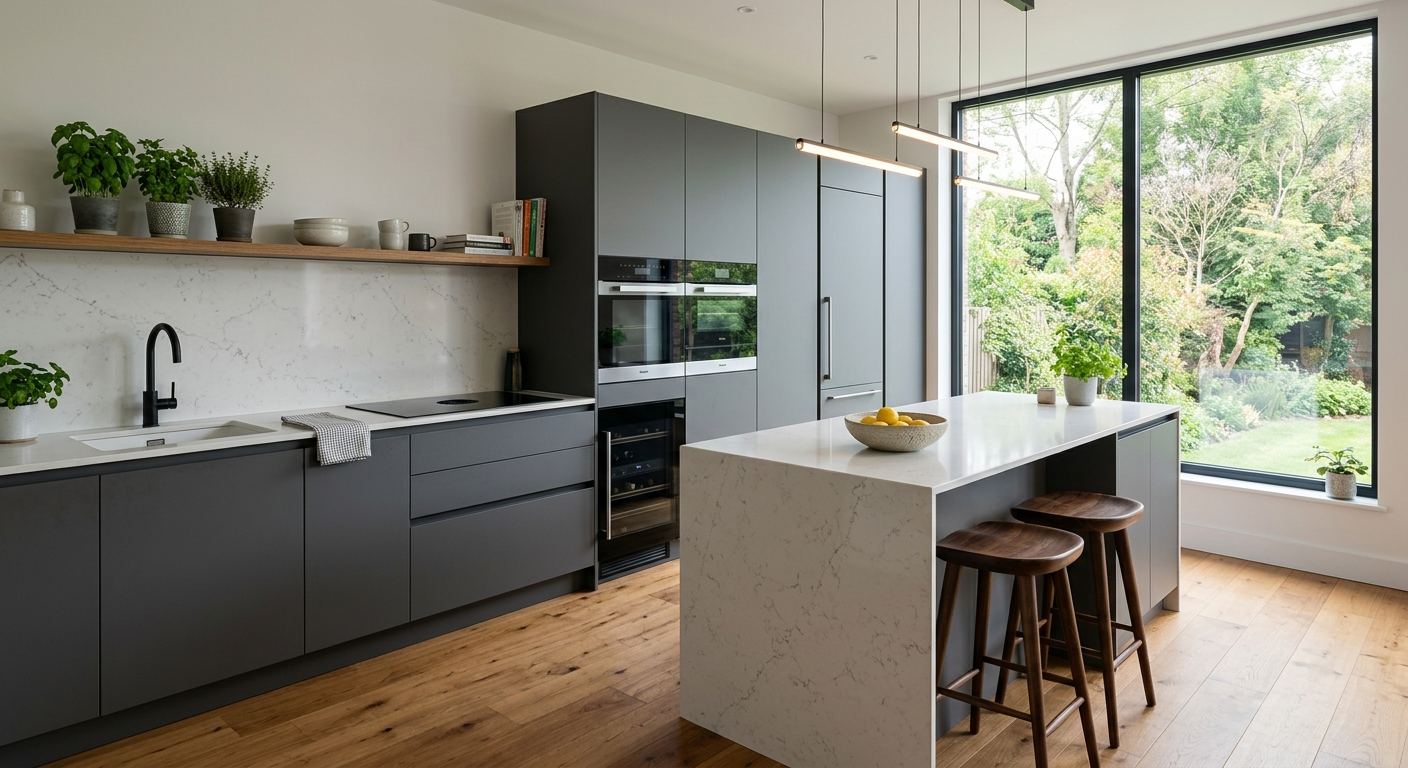
Kitchen renovation options and costs in Omemee
Kitchen renovation in Omemee is usually less about the weather and more about what homeowners want to achieve for resale value in the broader Toronto economic region. With a local population of 1,323 (Statistics Canada, 2021 Census), contractors tend to focus on practical schedules and materials that are easy to source and install quickly. In higher-value pockets across the Toronto market, it’s common to see owners allocate roughly 8–15% of home value toward the kitchen, which is why premium choices like quartz counters and semi-custom cabinetry come up frequently. At the same time, Omemee homes often experience the same renovation economics as the region: labour and material pricing are fairly consistent, but finish tier drives the total.
Climate still matters indirectly. Ontario’s freeze–thaw cycles and seasonal humidity swings can stress caulking, grout, and cabinet shims, so a “cheap now, fix later” approach can cost more over time—especially around sinks and exterior-facing walls. Also, Toronto-area contractor demand peaks in spring and early summer, so you may pay a scheduling premium for short-notice starts. For projects around the most active local service area—commonly the residential corridors in and near Omemee’s core—renovations that include plumbing or electrical coordination tend to book first.
If you’re comparing options, use the bands below to sanity-check any quote before you choose a scope, then we’ll break down what’s driving price in the next section.
| Renovation Tier |
What's Included |
Typical Duration |
Price Range |
| Cosmetic refresh (paint, hardware, new appliances only) |
Painting, cabinet hardware swap, backsplash refresh only if existing tile is reused, new appliances (like-for-like sizes), minor caulking/touch-ups |
3–7 days |
$25,000–$35,000 |
| Mid-range full renovation (new cabinets, counters, sink, tile) |
New cabinets (stock or semi-custom), new countertops (laminate or quartz), sink and faucet, backsplash tile, labour to level/prepare base for cabinets, disposal |
3–6 weeks |
$40,000–$65,000 |
| High-end full renovation (custom cabinets, stone counters, island) |
Custom millwork, quartz or granite/stone countertops, island base and countertop, upgraded backsplash (stone/tall slab option), premium appliance package, electrical coordination for island lighting |
6–12 weeks |
$70,000–$90,000 |
| Cabinet refacing only (new doors + drawer fronts, same boxes) |
Door/drawer-front replacement, new pulls/knobs, new trim, patch-and-paint as needed, cabinet hinge adjustments, optional interior upgrades (organizers) |
1–3 weeks |
$8,000–$25,000 |
| Countertop swap only (laminate to quartz or stone) |
Removal of existing counters, new quartz/stone install, sink cut-out and resealing as required, silicone/caulk upgrades |
2–5 days |
$10,000–$15,000 |
| Backsplash tile installation only |
Tile layout and install, edge finishing, new caulk lines at adjacent surfaces, grout and cleanup; assumes existing countertops/cabinetry are staying |
2–4 days |
$2,000–$10,000 |
Prices are estimates only and vary by project scope, site access and material selection.
What affects the price of kitchen renovation in Omemee
Even when two homeowners request the “same” kitchen renovation in the Toronto economic region, quotes can swing by 30–50%. The biggest reason is that local home values and household income patterns strongly influence finish tier: in higher-value areas, buyers more often choose quartz or stone and semi-custom cabinetry because the upgrade cost is easier to recoup on resale. In more price-sensitive areas of the region, many projects stay in the mid-range using stock or refaced cabinets and good laminate or cost-controlled quartz, which helps balance resale value with affordability. In short: climate rarely changes the contract price; finish choices, labour scheduling, and scope changes do.
In Omemee, two practical realities can raise costs quickly. First, layout changes—like adding an island, removing a wall, or moving plumbing—create the most unpredictable expense regardless of whether you’re doing $40,000–$65,000 mid-range or aiming at $70,000–$90,000 high-end. Second, Ontario’s seasonal humidity and freeze–thaw can make older caulking and floor levels less forgiving, so cabinet leveling, subfloor repairs, and re-sealing around the sink frequently add time.
Concrete examples: if your kitchen is on an older slab or has uneven flooring, cabinet shimming and reworking toe-kicks can add several days. If you’re swapping from laminate to quartz in a tight kitchen, the extra weight and cut accuracy can require careful sink/faucet reseating and additional trim work. If you’re adding under-cabinet lighting, you may need new circuits and wall opening repairs—small line items that add up fast.
Use the factors below to interpret your estimate line-by-line before you sign.
| Price Factor |
Why It Matters |
Cost Impact |
| Cabinet tier — stock vs. semi-custom vs. fully custom millwork |
Higher tiers change lead times, material/finish options, internal features, and fit tolerances |
Often the largest swing within cabinet line items; moving up a tier can add thousands |
| Countertop material — laminate vs. quartz vs. granite vs. stone |
Material density affects fabrication time and install complexity; stone also changes edge and sealing expectations |
Laminate is typically lowest; quartz/stone are mid-to-high; full natural stone tends to push toward upper bands |
| Layout change — wall removal, island add, plumbing/gas move |
Triggers trades coordination, sometimes structural considerations, and more demolition/rebuild |
Can quickly add significant cost regardless of finish level |
| Appliance package tier — builder vs. mid-range vs. pro-grade |
Pro-grade units can require different electrical specs, ventilation planning, and installation clearances |
Moderate to large swing; also impacts delivery timing |
| Flooring — refinish existing vs. full replacement |
Older floors may have damage hidden under toe-kicks or existing backsplash edges |
Refinishing saves money when substrate is sound; replacement adds labour and disposal |
| Backsplash — ceramic tile vs. marble vs. full-height slab |
Higher-end materials increase cutting complexity and waste; full-height may require more detail finishing |
Can move a project from mid-range to high-end quickly |
| Electrical — new circuits for island, under-cabinet lighting |
Electrical scope must be done by licensed professionals and inspected where required |
Labour and materials can add noticeable cost, especially with wall openings |
| Permit fees and licensed trade requirements |
Permits, inspections, and trade scheduling affect both cost and timeline |
Typically a predictable add-on when the scope requires it |
Permits & regulations in Ontario
In Ontario, many “like-for-like” kitchen updates do not require a building permit. Typically, cabinet and countertop swaps (for example, replacing existing cabinets with new units at the same locations, or changing counters while keeping the sink in the same plumbing configuration) are commonly handled without a permit. However, permits and licensed trades become part of the job when you change systems or structure.
Work that typically does require permits and inspections includes: moving plumbing supply or drain lines, relocating a sink, moving or adding a gas line or changing a gas stove/range setup, removing a load-bearing wall, and adding new electrical circuits (such as powering an island outlet and under-cabinet lighting) or significantly modifying the electrical panel. Gas work must be done by a licensed gas fitter, and electrical work must be performed by a licensed electrician—both require proper sign-offs after inspections.
Step-by-step, a homeowner in Omemee should verify before work starts:
- Ask for the contractor’s Ontario business details and written scope, including which items require permits.
- Request proof of liability insurance and confirm it covers renovation work at your address.
- For electrical or gas scope, ask the specific licensed trade for their licence details and inspection plan.
- Confirm WSIB/WCB coverage for the company doing the labour (and request a clearance letter or equivalent proof).
- Look at the certificates of insurance and licence documents provided, and ensure the trade names match the paperwork.
In practice, the biggest problem I see is scope confusion—someone assumes “no permit” and then the estimate misses licensed trade time. Always confirm permit responsibility in writing with your contractor before signing.
Cabinets, countertops and layout decisions in Omemee
The three most consequential decisions in an Omemee kitchen renovation are cabinet tier, countertop material, and whether you change the layout. Start with cabinets: stock units are usually the fastest and cheapest; semi-custom is the sweet spot most homeowners choose in the Toronto resale market; custom millwork maximizes fit and storage but carries the highest cost and longer lead times. Next is countertops. Laminate is a budget-friendly option, while quartz and natural stone deliver a more premium look that buyers commonly expect when the kitchen is positioned as a “main selling feature.” Finally, layout. Open-concept wall removal and island additions can improve day-to-day function, but plumbing and gas relocation can turn a straightforward project into a coordination-heavy job.
Ontario’s seasonal temperature swings don’t automatically dictate material choice, but they can expose gaps and movement at the sink and along exterior-facing walls. That’s why strong installation practices—shimming, proper sealing, and careful caulk lines—matter regardless of whether you choose laminate or stone.
A realistic dollar example: if you’re deciding between laminate and quartz in a mid-range renovation, the countertop upgrade is often the difference between staying around $40,000–$65,000 versus pushing into the upper end of that band after you account for sink cut-outs, edges, and install coordination. But if you’re already planning an island and new electrical, the incremental cost of quartz can be more justified because the kitchen’s “look and function” are both being upgraded for resale buyers who scan kitchens first.
Use the options below to match your budget to the outcome you want, then we’ll talk about contractor selection and how to avoid costly surprises.
| Option |
Durability |
Maintenance |
Best For |
Price Range |
| Stock cabinets (big-box) |
Good everyday durability with limited custom adjustment |
Wipe clean; check hinges periodically; manage moisture near sink |
Speed, straightforward builds, and tighter budgets |
$8,000–$20,000 |
| Semi-custom cabinets (local dealer) |
Very durable with more size options and better interior flexibility |
Similar upkeep to stock; more options for organizers reduce wear on soft-close hardware |
Most resale-minded renovations in the GTA mid-range |
$20,000–$35,000 |
| Custom cabinets (local millwork shop) |
Excellent durability with precise fit and premium hardware compatibility |
Wipe clean; protect finish at seam lines; best installed with careful shimming |
Unusual layouts, full-height storage, and premium resale positioning |
$35,000–$60,000 |
| Laminate countertop |
Moderate durability; seams require good protection and sealing |
Simple cleaning; avoid prolonged standing water at edges |
Cost-effective refreshes where cabinets are the main focus |
$3,000–$6,000 |
| Quartz engineered countertop |
High durability and consistent appearance; resists staining well |
Low maintenance; treat it like stone—wipe and reseal only if manufacturer specifies |
Toronto-area buyer expectations and dependable day-to-day use |
$6,000–$10,000 |
| Granite / natural stone countertop |
Very durable surface with unique pattern variation |
May require periodic sealing depending on the stone |
Premium look and “feature kitchen” upgrades |
$8,000–$15,000 |
| Butcher block countertop |
Durable but more sensitive to water absorption and heat |
Regular oiling and careful drying around the sink |
Warm aesthetic and kitchens used for cooking |
$5,000–$9,000 |
| Marble countertop |
Beautiful but softer; can etch and scratch more easily |
Requires diligent care; sealing and careful cleaning for acidic spills |
High-end, design-forward kitchens where maintenance is acceptable |
$10,000–$15,000 |
How to choose a kitchen renovation contractor in Omemee
Choosing the right contractor is where kitchen renovations get won or lost in Omemee. First, verify Ontario licensing for any trade components. Ask for proof of liability insurance and confirm the contractor has coverage that matches renovation work at your address. For workforce protection, ensure WSIB/WCB coverage is in place—request documentation such as a clearance letter or proof of coverage before materials are ordered.
Next, get 2–3 itemised written quotes, not a single lump sum. A solid quote separates labour and materials (cabinets, counters, tile, demolition, disposal) and clearly lists what triggers permits. Read the scope carefully: is permit pulling included? Are there allowance ranges for fixtures (sink, faucet, appliances) or are you committing to specific models? Disposal matters too—ask if old cabinets and countertops haul-away are included, because that’s often where “low bid” estimates quietly move costs into change orders.
Warranty is another differentiator. Look for a workmanship warranty (how many months) and confirm product/manufacturer warranties on cabinets, countertops, and hardware. Also ask whether warranties are transferable if you sell the home—this matters in the resale-focused Toronto market. Payment scheduling should be controlled: never pay more than 10–15% upfront, and use a holdback until the job is substantially complete.
Finally, insist on a written start date and realistic completion estimate. In Ontario’s spring-to-summer contractor season, timelines can slip, but a good builder will communicate milestones like cabinet delivery, countertop templating, and fixture rough-ins.
- Confirm insured coverage: liability certificate matches the business name on the contract.
- Check WSIB/WCB clearance proof before signing (not after the first invoice).
- Verify licensed trades for electrical and gas scope (licence details and inspection plan).
- Request itemised labour + material breakdown with clear allowances.
- Ask whether permits are included or billed separately, and who is responsible.
- Confirm demolition scope: what gets removed, and what stays.
- Confirm disposal/hauling is included for cabinets, tile, and debris.
- Verify cabinet installation includes shimming/levelling and proper fastening to substrate.
- Ask about countertop templating and lead-time buffer before demo.
- Get a written schedule with key dates (demo, rough-ins, cabinet install, templating, install).
- Review warranty terms in writing: workmanship duration and product coverage.
- Use milestone-based payments; keep a holdback until punch list is complete.
Concrete red flags I see around kitchen renos in Omemee: quotes that are not itemised, vague scopes (“permit as required” with no responsibility stated), no written warranty details, asking for heavy upfront payment beyond 10–15%, and contractors who won’t explain who pulls permits or who’s doing electrical/gas work.
Frequently asked questions — kitchen renovation in Omemee
Do I need a permit for a kitchen renovation in Ontario?
In Ontario, many straightforward updates (like replacing cabinets in the same positions and swapping countertops while keeping the sink plumbing configuration the same) often do not require a permit. Permits are typically triggered when you move plumbing supply/drain lines, relocate a sink, move or alter gas equipment/lines, remove a load-bearing wall, or add new electrical circuits (for example, new island outlets or under-cabinet lighting that requires new wiring). In Omemee, where renovations frequently pair cabinetry changes with electrical coordination, it’s common for homeowners to assume “no permit” and then discover the scope includes new circuits or relocated fixtures. The safest approach is to confirm permit responsibility in the written contract and ensure licensed gas fitter/electrician sign off where required. If you’re aiming for a mid-range full renovation around $40,000–$65,000, make sure the quote clearly lists what is staying put versus what’s being relocated.
What's the ROI on a kitchen renovation?
ROI is strongest when your renovation matches buyer expectations for the Toronto region: clean layout, good lighting, durable finishes, and a cabinet/counter combination that looks current. That said, ROI is not guaranteed and varies by how much you spend relative to the home’s overall condition. Kitchens are a “visible value” upgrade, so improvements like quartz counters, better cabinet storage, and updated tile often help resale appeal more than purely cosmetic tweaks. In higher-value markets around the Toronto economic region, homeowners often invest about 8–15% of home value into the kitchen, which typically supports better recovery at resale compared with very budget-only refreshes. If you’re working within $25,000–$35,000, think of it as buyer-attracting refresh rather than full ROI maximization; a larger renovation tends to show more impact when the layout and finishes are upgraded together.
How do I budget for a kitchen renovation?
Start by choosing your renovation tier, then budget for the “hidden movers”: layout changes, electrical/gas coordination, and substrate repairs. In the Toronto economic region, finish tier usually drives cost more than climate, but older housing stock can add labour when floors aren’t level or sealing has failed near the sink. A practical budget approach in Omemee is to anchor to realistic bands: a mid-range full renovation typically lands around $40,000–$65,000, while high-end full renovations commonly move into $70,000–$90,000 when custom cabinetry, stone counters, and island work are included. Build in a contingency of at least 10% for demolition surprises. Also ask your contractor to itemise labour vs materials so you can control upgrades (like switching laminate to quartz) without accidentally blowing the budget.
Can I move my kitchen sink or stove?
Yes, you can move a sink or stove in Ontario, but it’s usually more expensive and more schedule-sensitive than most homeowners expect. Moving a sink typically means adjusting plumbing supply and drain lines, which commonly requires permits and licensed plumbing work (and sometimes additional framing/subfloor repairs). Relocating a gas stove or changing gas configuration requires a licensed gas fitter and inspections—this is not a DIY item. The cost can also be unpredictable if the existing plumbing run is difficult to access. In practical Omemee renovations, I often see homeowners get better value by keeping the sink in the same general location and focusing changes on cabinets, countertops, and lighting, unless they truly need the layout shift. If you’re planning a higher-value kitchen approach around $70,000–$90,000, layout work can be justified because it improves function and resale presentation at the same time.
What's the most cost-effective kitchen upgrade?
The most cost-effective upgrade depends on what’s currently failing visually and functionally. If your cabinet boxes are sound, refacing (new doors and drawer fronts) is often one of the best value moves because it updates the look without full demolition. If cabinets are dated but structurally fine, backsplash and hardware upgrades can also deliver a noticeable “fresh kitchen” effect at lower cost. If you want a higher perceived-value jump, countertop upgrades to quartz (instead of staying with laminate) can make the kitchen look much more modern, especially when paired with improved lighting. For many homeowners, a refacing-to-counters path is more efficient than a full demolition reroute of plumbing. As a reference point, cabinet refacing commonly sits around $8,000–$25,000 while a backsplash-only installation can fall in the $2,000–$10,000 range, so these upgrades are easier to control within a budget. Always ensure sealing and caulking around the sink are done well—Ontario’s moisture swings can show weak installs over time.
Custom vs stock cabinets — is custom worth it?
Custom cabinets are “worth it” when your kitchen layout is unusual, you need specific storage solutions, or you want a premium, seamless look that matches your home’s style. Stock cabinets are usually faster and cheaper, and they work well when your dimensions are standard and you’re comfortable with fewer layout options. Semi-custom is often the practical compromise in the Toronto market: it offers better sizing flexibility and storage features while keeping lead times reasonable. In Omemee, the decision also ties to how much time you can spend living with disruption—custom builds can extend timelines due to design and manufacturing. If your goal is to stay within a mid-range renovation around $40,000–$65,000, semi-custom or refacing tends to deliver the best value for money. If you’re targeting the higher-end band around $70,000–$90,000, custom millwork can be justified, especially when you’re also upgrading layout, adding an island, and installing premium stone countertops.