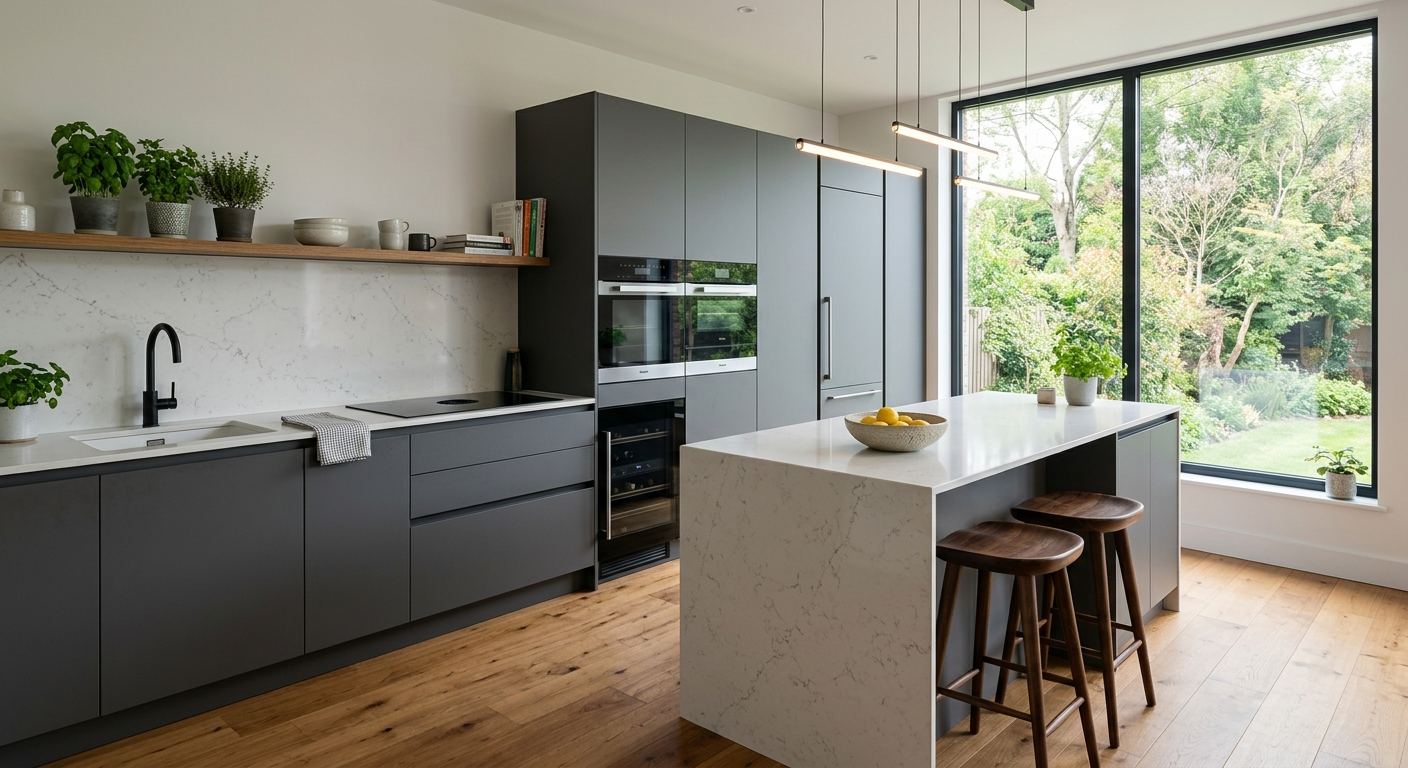
Kitchen renovation options and costs in Christopher-Champlain
In Christopher-Champlain, kitchen renovations tend to follow the same pattern as the rest of the Toronto economic region: homeowners balance resale expectations with how long they plan to stay. With a population of 15,372 (Statistics Canada, 2021 Census), the local housing stock is mostly established neighbourhoods where buyers often expect a clean, modern look rather than a full architectural redesign. At the same time, the Toronto market’s strong household purchasing power is why many projects move beyond “cosmetic refresh” into semi-custom upgrades—finish choices commonly track with what buyers are willing to pay for updated kitchens in the GTA. In practical terms, that means more owners selecting quartz or stone counters and higher-grade hardware, especially for kitchens that are visible from the dining/living area.
Ontario costs are also shaped by market demand and labour availability across the Toronto region. Cabinet makers, countertop installers, and tile crews are booked around similar windows—so schedule pressure can affect labour rates and lead times, even when pricing looks comparable on paper. Weather doesn’t usually drive the core cost the way it does in extreme climates, but it does impact site logistics (drying time for patching/paint, delivery timing, and indoor work planning) when homes are winter-closed and ventilation is limited.
If you’re in high-demand pockets like the older, denser parts of the community near major commuter corridors, contractors often see the fastest turnarounds for mid-range full renovations because they deliver noticeable ROI without the complexity of full structural work. From there, it’s a matter of what tier you choose—our comparison table breaks down typical inclusions, timelines, and realistic price bands so you can compare quotes apples-to-apples.
| Renovation Tier |
What's Included |
Typical Duration |
Price Range |
| Cosmetic refresh (paint, hardware, new appliances only) |
Cabinet paint or refinishing (no box changes), new hardware, new appliances, caulking & minor trim touch-ups |
1–2 weeks |
$12,000–$25,000 |
| Mid-range full renovation (new cabinets, counters, sink, tile) |
New semi-custom cabinets, countertop install, sink + faucet, backsplash tile, disposal connection, updated trim/finishing |
4–7 weeks |
$35,000–$65,000 |
| High-end full renovation (custom cabinets, stone counters, island) |
Custom millwork, premium stone/quartz, island cabinetry, upgraded appliance package, full backsplash (often to ceiling), lighting upgrades |
8–14 weeks |
$70,000–$90,000 |
| Cabinet refacing only (new doors + drawer fronts, same boxes) |
Replace doors/drawers, new hardware, veneer overlay where applicable, basic sealing + alignment adjustments |
2–4 weeks |
$10,000–$30,000 |
| Countertop swap only (laminate to quartz or stone) |
Remove existing top, new countertop install, cut-outs for sink/cooktop, edge detail, sealing and re-install |
3–7 days |
$3,500–$15,000 |
| Backsplash tile installation only |
Prep, tile supply & install (ceramic/subway/upgrade material), grout + sealant, trim and finishing at edges |
2–5 days |
$2,000–$10,000 |
Prices are estimates only and vary by project scope, site access and material selection.
What affects the price of kitchen renovation in Christopher-Champlain
Even when you’re comparing the same “new kitchen” scope, quotes in Christopher-Champlain (and across the Toronto economic region) can swing by roughly 30–50%. The biggest reason is that homeowners often describe a goal (“modernize the kitchen”) while contractors price the real variables underneath—cabinet tier, countertop material, layout complexity, and how many trades are triggered. Toronto-area home values and typical household incomes tend to influence finish tier more than weather does. In higher-value pockets, homeowners more often choose quartz or stone counters and semi-custom cabinetry because the renovation cost is easier to recover on resale. In more price-sensitive areas, laminate tops and stock or refaced cabinets keep the project closer to the mid-range—while still improving the look.
Layout changes are the cost wildcard regardless of finish: removing a wall, adding an island, moving plumbing, or relocating a gas line forces extra framing, rough-in work, and rework of adjacent finishes. For example, a simple refresh may sit near the low–mid range, but a full renovation that includes cabinets, countertops, sink, and tile can quickly move into the $35,000–$65,000 territory. If you add custom millwork and a stone island, the same footprint can push toward $70,000–$90,000.
Two local examples we see often in Christopher-Champlain: (1) older kitchens with original plumbing runs can require more opening of walls than expected to achieve clean under-sink and dishwasher connections, adding labour and patching; and (2) winter-closed homes can require more careful drying/ventilation planning for paint and skim-coat patching so cabinetry and trim aren’t installed over moisture. The result is that scheduling constraints and site prep can add real cost even when materials stay the same.
| Price Factor |
Why It Matters |
Cost Impact |
| Cabinet tier — stock vs. semi-custom vs. fully custom millwork |
Materials, fit/finish tolerances, hardware quality, interior accessories and lead times |
Can swing most of the budget: roughly +$10,000 to +$30,000 from stock to custom |
| Countertop material — laminate vs. quartz vs. granite vs. stone |
Material price, installation methods, edge profiles and weight/handling requirements |
Often +$3,000 to +$15,000 depending on slab and sink/cooktop complexity |
| Layout change — wall removal, island add, plumbing/gas move |
Triggers framing, rough-in plumbing/gas work, electrical changes and additional inspections |
Typically +$5,000 to +$25,000; unpredictability is highest here |
| Appliance package tier — builder vs. mid-range vs. pro-grade |
Brand tier affects warranties, finish details, power requirements and installation needs |
Common swing of +$2,000 to +$12,000 |
| Flooring — refinish existing vs. full replacement |
Underlay, subfloor condition, and how much floor area must be replaced for clean transitions |
Usually +$1,500 to +$8,000 depending on damage and scope |
| Backsplash — ceramic tile vs. marble vs. full-height slab |
Tile complexity, pattern alignment, stone handling and sealing requirements |
Roughly +$1,000 to +$7,000 |
| Electrical — new circuits for island, under-cabinet lighting |
Requires licensed work, load calculations, and proper box placement |
Often +$800 to +$4,000 |
| Permit fees and licensed trade requirements |
Some work needs permits/inspections, and you’ll pay additional coordination and compliance time |
Commonly +$500 to +$3,000+ depending on scope |
Permits & regulations in Ontario
In Ontario, a lot of straightforward kitchen upgrading does not require permits—for example, replacing cabinets with like-for-like units, swapping countertops, and installing a new backsplash generally fall into the category of finishing work. Many homeowners in Christopher-Champlain choose a countertop replacement within the typical $3,500–$15,000 band without needing permit approvals for the swap itself.
Where permits and licensed trades do come into play is when you alter a system: moving plumbing supply or drain lines, relocating gas (such as changing where the stove/range hood exhaust or gas connection sits), removing a load-bearing wall, or adding new electrical circuits (for example, power to an island or upgraded under-cabinet lighting that requires new wiring). Gas work must be completed by a licensed gas fitter and electrical work by a licensed electrician, with inspections as required.
To verify a contractor in Christopher-Champlain before signing, follow this practical process:
- Ask for the contractor’s liability insurance certificate (COI) and confirm coverage limits.
- Request WSIB/WCB coverage proof for workers, not just subcontractors’ statements.
- Verify licences for any triggered trade work (gas and electrical) through the appropriate Ontario online registry or licence verification tools, and ensure the licence matches the company doing the work.
- Confirm who is pulling permits and whether permit fees are included in the quote.
- Ask for clearance letters or inspection documentation where applicable (especially after rough-in and final inspections).
Always confirm permit responsibility in the written contract—who pulls, who pays, and who schedules—so there are no surprises mid-project.
Cabinets, countertops and layout decisions in Christopher-Champlain
In a Christopher-Champlain kitchen renovation, three decisions usually determine about 80% of your outcome: (1) cabinet tier, (2) countertop material, and (3) whether you change the layout. For cabinets, stock units are the fastest and least expensive, semi-custom is the most popular mid-range option, and custom millwork delivers the best fit at a higher cost. In Toronto’s resale-focused market, buyers often respond strongly to clean lines, better storage (drawers, pull-outs) and contemporary finishes—so even when budgets are mid-range, choosing a cabinet tier that improves functionality matters.
For countertops, laminate can be budget-friendly and durable for everyday use, but it won’t match quartz or stone for scratch and stain resistance over the long run. Quartz engineered counters are a common “sweet spot” because they look upscale, require minimal maintenance, and install cleanly in most homes. Natural stone (granite/other stone) adds character and a premium feel, while marble is elegant but more maintenance-sensitive for acidic spills.
Layout changes—open-concept wall removal, island addition, or plumbing/gas relocation—are justified when they create measurable flow improvements: clearer sightlines, better circulation to dining space, and improved work triangle. But if your layout already works, putting the budget into cabinetry and counters can deliver a bigger visual payoff for the dollar. For example, upgrading from laminate to quartz may move you within the broader countertop bands (often a few thousand dollars more), while adding an island with plumbing relocation can jump you into full-renovation pricing closer to the $35,000–$65,000 or even $70,000–$90,000 range depending on cabinet tier and finish package.
With Ontario’s seasonal temperature swings and humidity cycles, proper ventilation during and after installation helps finishes cure correctly and reduces long-term cabinet/stain issues. That’s another reason to plan layout and materials early and to coordinate sequencing with your trades.
| Option |
Durability |
Maintenance |
Best For |
Price Range |
| Stock cabinets (big-box) |
Good daily-use durability; fit can be less precise |
Low; clean and tighten hardware as needed |
Fast timelines and tighter budgets |
$8,000–$18,000 |
| Semi-custom cabinets (local dealer) |
Strong build quality; better internal organization |
Low; wipe clean, check soft-close hardware |
Most Toronto-area resale-targeted renovations |
$18,000–$35,000 |
| Custom cabinets (local millwork shop) |
Highest fit and finish; tailored storage solutions |
Low; depends on finish type, but designed for longevity |
Unique layouts, premium aesthetics, and long stays |
$35,000–$60,000 |
| Laminate countertop |
Resistant to normal wear; seams require care |
Wipe clean; avoid prolonged standing water at joints |
Budget refreshes and rental-friendly upgrades |
$3,000–$6,000 |
| Quartz engineered countertop |
Very durable; consistent finish and fewer concerns with sealing |
Minimal—regular cleaner and no special sealing schedule |
High-demand resale looks without heavy upkeep |
$7,000–$12,000 |
| Granite / natural stone countertop |
Excellent hardness and heat tolerance |
Periodic sealing recommended; protect against staining |
Premium, natural movement and high-end character |
$9,000–$15,000 |
| Butcher block countertop |
Durable for prep use; can be vulnerable to moisture if neglected |
Regular oiling; use cutting boards and manage spills |
Warm, traditional kitchens and cooking-focused households |
$5,000–$10,000 |
| Marble countertop |
Stunning appearance; softer than quartz/stone |
Higher maintenance—avoid acidic spills, sealing usually required |
Statement kitchens where homeowners maintain the surface |
$12,000–$18,000 |
How to choose a kitchen renovation contractor in Christopher-Champlain
Choosing the right contractor in Christopher-Champlain is mostly about verifying the basics and forcing clarity into the quote. Start with Ontario licensing and insurance: ask for the contractor’s liability insurance certificate (COI), verify WSIB/WCB coverage for their workers, and ensure any subcontracted trade work (gas and electrical) is performed under the correct licensed companies. How to check: request the COI and confirm the policy is active and the contractor is listed as the insured; ask for WSIB/WCB clearance documentation; and for gas/electrical, confirm licence details against the online licence verification tools available in Ontario before the first rough-in.
Next, get 2–3 itemised written quotes, not a single lump sum. You want line items showing labour versus materials (demolition, framing, cabinet install, countertop install, tile labour, electrical/plumbing allowances). Also read the scope carefully: what’s excluded (stairs/dust control, specialty disposal, specialty mouldings), whether permits are included, and whether disposal and dump fees are part of the estimate.
Warranty and payment structure matter in the GTA market where schedules can be tight. Ask for a workmanship warranty length (commonly 1 year minimum, but confirm what it covers) and clarify whether the product/manufacturer warranty transfers to you. Payment should be staged—never pay more than 10–15% upfront for mobilization—and use a holdback until the job is complete and deficiencies are corrected. Finally, demand a written start date and an estimated completion window that includes cabinet/counter lead times.
- COI: confirm active liability insurance and coverage limits, and that the contractor name matches the COI.
- WSIB/WCB proof: request clearance documentation for workers assigned to your project.
- Licence verification: confirm gas fitter and electrician licences for any work that triggers permits.
- 2–3 itemised quotes: labour and materials separated, with allowances stated clearly.
- Permit responsibility: who pulls, who pays, and whether permit fees are included.
- Disposal included? Confirm appliance removal, drywall waste, and tile/demolition debris handling.
- Site protection: ask about dust control, floor protection, and how they prevent cross-contamination.
- Scheduling: get a lead-time plan for cabinets, countertops, and tile (not just a start date).
- Change orders: ensure material substitutions and scope changes require written approval and pricing.
- Warranty: get workmanship warranty terms in writing and confirm product warranty transfer.
- Payment schedule: keep upfront payment at 10–15% and plan a holdback for completion.
- Final inspection plan: confirm walk-through/deficiency correction before final payment.
Red flags we see in Christopher-Champlain include: (1) contractors who quote without itemizing labour/materials, (2) vague answers on whether permits are required for plumbing/gas/electrical changes, (3) missing or expired COIs/WSIB documentation, (4) pressure to pay large upfront deposits, and (5) no written timeline that accounts for cabinet and countertop lead times.
Frequently asked questions — kitchen renovation in Christopher-Champlain
What order do kitchen renovation steps happen in?
In Ontario (and in Christopher-Champlain), the typical order is: demolition and site protection first, then rough-in work (plumbing/drain supply adjustments, gas line relocations if applicable, and electrical rough-in for outlets/island lighting). After rough-in, inspection happens where required, then framing/patching and subfloor/wall prep follow. Cabinets go in next, then countertops/templates, and finally the finishing steps: backsplash installation, paint/trim, appliance hook-ups, and final caulking/cleanup. If you’re staying within a cosmetic refresh, the sequence is simpler—paint/hardware and appliance swaps—with less disruption to plumbing/electrical. For a full renovation, timelines often align with cabinet lead times, which is why the written plan and allowances matter.
Can I live at home during a kitchen renovation in Christopher-Champlain?
Often yes, but it depends on how invasive the scope is. In Christopher-Champlain, many homeowners stay home during a mid-range renovation if there’s a workable fallback space (a functional microwave/coffee setup and access to a sink). For projects in the $35,000–$65,000 band that include cabinet and countertop swaps, you can usually live in the home if demolition and dust control are managed well, and if your contractor sequences work to restore key functions quickly. If you’re doing structural changes (wall removal, gas line moves) or a full island with plumbing relocation, living at home becomes harder because rough-in and inspection stages create longer downtime for kitchen access. We usually recommend planning for at least a couple of weeks where the kitchen is effectively “off” while countertops and backsplash are being installed and finished.
Should I renovate my kitchen before selling in Christopher-Champlain?
It depends on your goals and your timeline, but in the Toronto market the kitchen is one of the highest-visibility areas buyers compare. If your cabinets and counters are dated or worn, a renovation can help you compete—especially if you keep choices aligned with what buyers expect: clean cabinet lines, durable countertops, and a backsplash that looks current. Budget realistically: a modest refresh can modernize presentation, but a buyer-focused mid-range renovation ($35,000–$65,000) typically makes a bigger difference when storage and layout are still workable. If you’re considering high-end changes ($70,000–$90,000), aim to match the home’s value tier—because premium millwork and stone pay off best when the rest of the finishes and layout justify it. If you’re unsure, focus on the “largest visual impact per dollar”: cabinets + counters + lighting.
What's the most popular kitchen style in Christopher-Champlain right now?
In Christopher-Champlain and the wider GTA, the most requested look right now is a bright, modern transitional style: flat or shaker-style cabinetry, warm white to greige tones, and quartz counters that read clean and consistent (often with subtle veining). Hardware is typically brushed nickel or matte black depending on appliance finishes. Open, connected sightlines are also popular when the home layout allows it—though any wall removal or mechanical relocation adds permitting and trade coordination. Many homeowners choose this style because it photographs well for listing photos and tends to appeal to buyers across income bands. If you’re tailoring to a specific price tier, the key is to avoid “one-off” materials that look dated quickly; durable, easy-to-maintain surfaces are a safer bet in a resale-oriented market.
How do I know if I need to update my kitchen plumbing in Christopher-Champlain?
Look for telltale signs: slow drains, recurring under-sink leaks, water pressure issues at the faucet, corrosion around shutoff valves, and outdated supply lines (especially if you see visible cracking or staining). If you’re moving the sink, adding a dishwasher, or changing the dishwasher connection location as part of a layout update, you’ll likely need plumbing adjustments even if the current system “works.” In Ontario, moving plumbing supply or drain lines generally triggers permits and requires licensed trade work, so it’s not just a cost question—it’s a compliance and inspection question too. For older homes, we often find that the “hidden” cost is wall opening and re-patching to achieve a proper alignment. A contractor should assess the current rough-in before locking the design.
What is the difference between a galley and open-concept kitchen?
A galley kitchen is a long, two-sided layout where the work surfaces run along parallel walls, typically with a corridor down the middle. It’s efficient for cooking and can be great in smaller footprints, but it limits conversation space because the kitchen is visually enclosed. An open-concept kitchen removes barriers (often a partial or full wall) to connect the kitchen to living/dining areas, improving sightlines and how the space feels—something many buyers like in the Toronto region. The trade-off is complexity: removing a wall can involve structural considerations and, depending on what’s behind the wall, electrical/plumbing/gas changes that may require permits and licensed trades in Ontario. If you’re moving mechanicals (like plumbing or gas), you should expect timing impacts and a wider budget range than purely cosmetic upgrades.