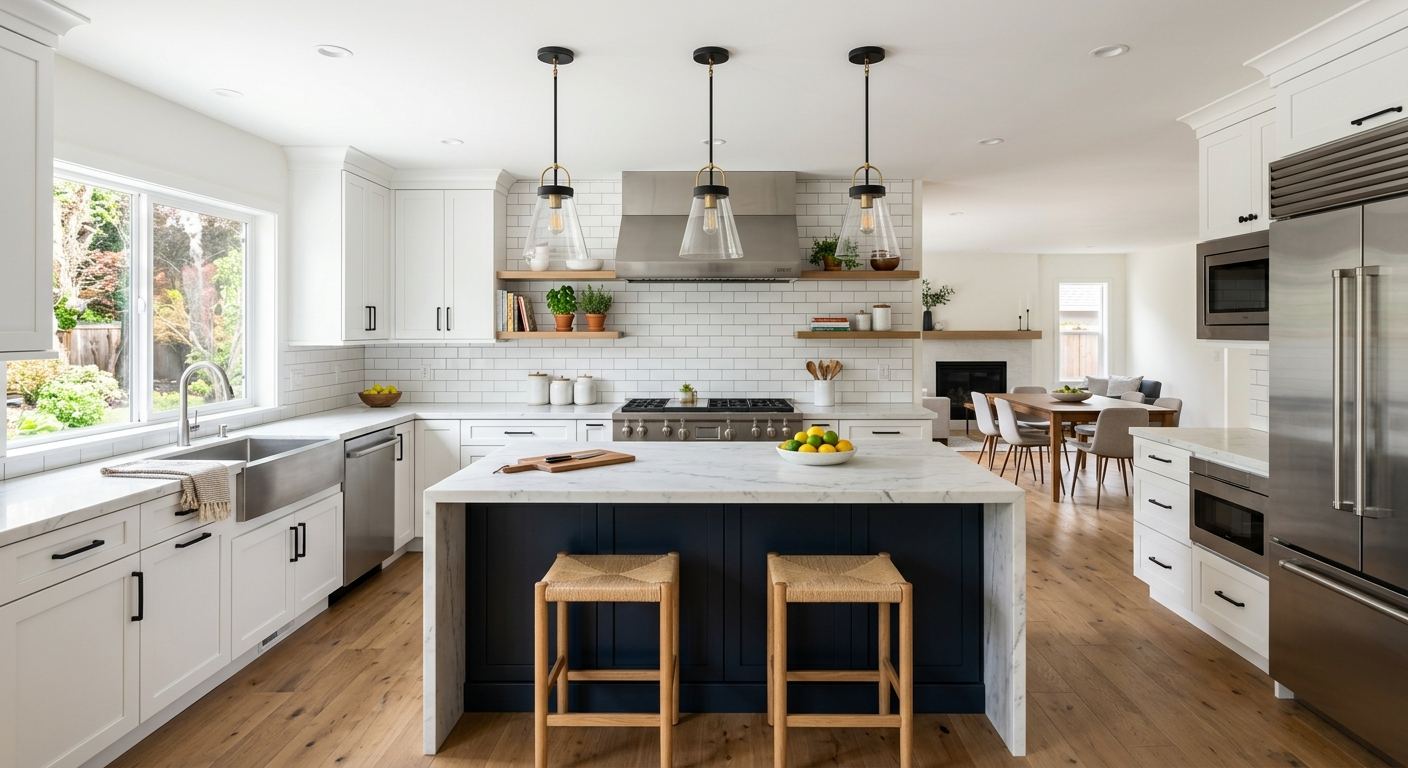
Kitchen renovation options and costs in Belleville
Belleville homeowners typically choose kitchen projects that fit both their homes and their resale expectations—especially with a median household income of about $73,000 (Statistics Canada, 2021 Census). In neighbourhoods with more owner-occupied housing (14,720 homeowner households, 62.5% of households owning), projects often land in the mid-range finishes first: semi-custom cabinetry, practical layouts, and durable surfaces that look “updated” without fully custom pricing. In the broader Kingston–Pembroke economic region, contractors also see finish levels rise as local buyers place value on modern kitchens during resale; market demand in higher-value pockets can shift choices toward quartz or premium stone, which pushes budgets toward the upper end of Ontario norms.
Climate affects some details—humidity swings can influence caulking, grout performance, and how quickly materials acclimatize before installation—but it doesn’t usually drive the big-ticket cost difference. Instead, cost is mainly shaped by labour availability, material lead times, and scope unpredictability (like old plumbing runs in pre-1981 homes, since 63.6% of homes were built before 1981). If you’re in an area like West End Belleville near the highway corridors, kitchen contractors are especially busy because homeowners often renovate at the same time as home maintenance cycles, which can tighten schedules and affect quote timing.
To help you compare apples-to-apples, here are realistic renovation tiers you can use when reviewing bids.
| Renovation Tier |
What's Included |
Typical Duration |
Price Range |
| Cosmetic refresh (paint, hardware, new appliances only) |
Cabinet paint or refinishing, new hardware/pulls, backsplash touch-ups, appliance swap (no major plumbing/electrical changes) |
3–7 days |
$6,000–$18,000 |
| Mid-range full renovation (new cabinets, counters, sink, tile) |
Semi-custom or quality stock cabinets, new countertop, sink/faucet, backsplash tile, new flooring prep as needed, basic lighting refresh (no major layout move) |
2–4 weeks |
$25,000–$55,000 |
| High-end full renovation (custom cabinets, stone counters, island) |
Fully custom cabinetry, premium stone (granite or higher-end quartz), island build-out, upgraded tile/backsplash, upgraded electrical/lighting, allowance for more complex plumbing/electrical |
4–8 weeks |
$55,000–$65,000 |
| Cabinet refacing only (new doors + drawer fronts, same boxes) |
Refacing veneer/finishing, new doors and drawer fronts, re-install hardware, optional new crown/base trims |
1–2 weeks |
$6,000–$25,000 |
| Countertop swap only (laminate to quartz or stone) |
Remove/replace countertop, new sink cut-out as needed, silicone/trim details, basic backsplash edge refresh (not full tile) |
2–6 days |
$2,500–$12,000 |
| Backsplash tile installation only |
Tile removal (if applicable), tile installation, grout/seal, clean finish at outlets |
3–7 days |
$1,500–$8,000 |
Prices are estimates only and vary by project scope, site access and material selection.
What affects the price of kitchen renovation in Belleville
In Belleville and across the Kingston–Pembroke region, quotes for the “same” kitchen can swing by 30–50% because contractors price risk differently: older framing and plumbing, how much demo must be redone, and how trades coordinate on site. Ontario pricing also changes with material tier and lead times—quicker supply kitchens can compress labour, while premium stone and custom doors can add weeks. The largest drivers are local expectations for finishes, not climate.
Home value and median income influence the finish tier far more than temperature. When buyers expect a more “appliance-and-stone ready” kitchen, homeowners often default to quartz or stone counters and semi-custom cabinetry because those upgrades are easy to market at resale. In more modest segments, laminate and stock cabinets dominate because they deliver a cleaner look with better ROI—especially when the layout stays intact. In both cases, layout changes are the most unpredictable cost regardless of finish level: removing a wall, adding an island, or moving a gas line or plumbing can turn a straightforward install into a coordination-heavy rebuild.
Concrete local examples: (1) In many pre-1981 Belleville homes, you may find outdated drain routing under existing cabinets, which can add countertop height adjustments and extra subfloor/box work during a $25,000–$55,000 renovation. (2) If you’re upgrading from laminate to quartz, the countertop-only range of $2,500–$12,000 can climb quickly when the sink cut-out or edge profile is more complex than the original. (3) If you’re adding an island that requires new circuits and possibly a venting change for the hood, electrical and rough-in time often becomes a schedule driver, even before finishes begin.
Bottom line: climate affects installation sequencing, but cabinetry tier, countertop choice, and layout scope decide the real number.
| Price Factor |
Why It Matters |
Cost Impact |
| Cabinet tier — stock vs. semi-custom vs. fully custom millwork |
Determines material quality, door styles, internal organization, and how precisely boxes fit your walls |
Often the single biggest swing: roughly 10–30% of total project cost |
| Countertop material — laminate vs. quartz vs. granite vs. stone |
Material price, edge profiles, and fabrication complexity |
Can change the budget by several thousand dollars; premiums commonly add 5–20%+ |
| Layout change — wall removal, island add, plumbing/gas move |
Adds framing, rough-ins, inspection coordination, and contingency time |
Typically adds the most unpredictability; often 10–25%+ depending on scope |
| Appliance package tier — builder vs. mid-range vs. pro-grade |
Power requirements, venting needs, and installation tolerances |
May add 2–15% depending on finish and whether specs force cabinet/vent changes |
| Flooring — refinish existing vs. full replacement |
Demo and subfloor prep plus transitions around cabinets |
Commonly 0–10%+, with full replacement usually toward the higher end |
| Backsplash — ceramic tile vs. marble vs. full-height slab |
Labour intensity and material weight/handling |
Often 1–8%+; full-height premium surfaces can be a major add-on |
| Electrical — new circuits for island, under-cabinet lighting |
New circuits require licensed work and sometimes panel upgrades |
Can add several thousand dollars if new circuits or panel work is needed |
| Permit fees and licensed trade requirements |
When required, permits and inspections add admin time plus coordinated scheduling |
Varies; not usually the largest line item, but it affects timelines and labour planning |
Permits & regulations in Ontario
In Ontario, many surface-level kitchen updates do not require permits—for example, cabinet and countertop swaps that don’t alter plumbing, gas, or the electrical system. Typically, you can replace cabinets, update hardware, swap countertops, and install a new backsplash without pulling permits, as long as you’re not changing concealed rough-ins.
However, permits and licensed trades are commonly required when you change the “systems,” not just the finishes. That means you’ll usually need permits (and inspections) for moving or altering plumbing supply/drain lines, relocating a gas stove/range, installing or relocating a venting system tied to gas or combustion requirements, removing a load-bearing wall, and adding new electrical circuits—such as extra outlets for an island, under-cabinet lighting tied into new wiring, or upgrading electrical capacity. Gas work must be performed by a licensed gas fitter, and electrical work by a licensed electrician; both are subject to inspection once work is complete.
For your Belleville project, verify in this order: (1) ask the contractor for their Ontario licence details and the relevant certificate of insurance; (2) request proof of coverage for WSIB/WCB—confirm the coverage is active for the trades assigned; and (3) obtain a written statement of which party pulls permits (and when). Then, before you sign, match the contractor’s paper with the scope: if the quote includes moving plumbing/gas/electrical, it should also include permits and inspections responsibility in the contract.
Cabinets, countertops and layout decisions in Belleville
When homeowners in Belleville plan a renovation, three decisions make the biggest difference: (1) cabinet tier, (2) countertop material, and (3) whether you change the layout. If you keep the footprint, you can usually protect your budget; if you expand the footprint—opening up a wall, adding an island, or relocating plumbing/gas—your costs rise regardless of finish level.
Cabinet tier is primarily about fit and longevity. Stock cabinets are the fastest and usually the lowest cost, but the “look” may be less tailored if your walls aren’t perfectly square (common in older homes, since 63.6% were built before 1981). Semi-custom cabinets are the most popular mid-range option for Kingston–Pembroke resale expectations: they offer better door style selection and storage planning at a cost that still makes sense against typical buyer priorities. Custom cabinets are best when you need unusual dimensions or want a fully integrated island and ceiling details; they’re the highest cost, often pushing projects toward the upper band (e.g., the $55,000–$65,000 zone) especially if stone and electrical upgrades follow.
Countertops follow buyer preferences, not climate. Ontario humidity and temperature swings can affect how materials acclimate, but the long-term differences are more about care and wear. For example, laminate can look great after install but is more vulnerable to impact around sink edges; quartz is a strong “set it and forget it” option, while granite/natural stone can deliver a premium, unique pattern at higher maintenance expectations (sealing, depending on the stone).
Layout changes are justified when the space gain is obvious. If you’re adding seating at an island or improving the work triangle, it can be worth the complexity. But if the only goal is a different cabinet style, you’ll usually get more value by upgrading cabinets and counters within a $25,000–$55,000 renovation rather than moving plumbing.
Local dollar example: Upgrading laminate to quartz might increase countertop budget within the countertop range (rather than transforming the entire plan). But moving a sink to support an island often triggers plumbing changes plus electrical coordination for nearby outlets—those layout-driven trades can cost far more than simply selecting a better edge or finish.
| Option |
Durability |
Maintenance |
Best For |
Price Range |
| Stock cabinets (big-box) |
Good for typical wear; limited custom fit options |
Low; keep hinges adjusted and clean regularly |
Budget-conscious renos with minimal wall/plumbing changes |
$10,000–$25,000 |
| Semi-custom cabinets (local dealer) |
High everyday durability; better organization options |
Low to moderate; solid hardware and proper sealing at joints |
Most Belleville homeowners targeting a refreshed, modern look |
$18,000–$40,000 |
| Custom cabinets (local millwork shop) |
Excellent durability with tailored build and precise fit |
Low; quality hinges/drawers reduce long-term adjustments |
Unusual wall dimensions, full-height storage, statement islands |
$30,000–$55,000 |
| Laminate countertop |
Moderate; sensitive to heat and edge impacts |
Low; avoid standing water at seams and use heat protection |
Quick upgrades where you want the look without premium pricing |
$2,500–$6,000 |
| Quartz engineered countertop |
High durability; resistant to staining and everyday wear |
Very low; wipe clean and keep seals intact at sink edges |
Busy families, resale-friendly finishes, easy daily maintenance |
$4,500–$10,000 |
| Granite / natural stone countertop |
Very high; strong against impacts (varies by stone) |
Moderate; may require periodic sealing |
Premium look with unique natural patterns |
$6,000–$12,000 |
| Butcher block countertop |
Good with proper care; can scratch and dent |
Moderate; regular oiling and careful water management |
Warm, farmhouse or traditional styles |
$4,000–$9,000 |
| Marble countertop |
High aesthetic value; softer surface than quartz |
Higher; prone to etching/staining without disciplined care |
Statement kitchens where appearance is prioritized over heavy wear |
$8,000–$14,000 |
How to choose a kitchen renovation contractor in Belleville
Choosing the right contractor in Belleville is mainly about verification and clarity. Start by confirming Ontario licensing where applicable, and always ask for proof of liability insurance and WSIB/WCB coverage. To check: (1) request the contractor’s insurance certificate and verify the policy is current and covers the contractor’s work at your address; (2) ask for WSIB/WCB clearance documentation (or the appropriate evidence for the trades involved); and (3) verify any relevant trade licences through the correct Ontario online listings when your scope includes gas fitting or electrical work—those trades must be licensed for the work performed.
Next, get 2–3 itemised written quotes. You want a breakdown that distinguishes labour vs materials (cabinet supply, countertop fabrication, tile labour, demo/disposal, plumbing/electrical allowances). Avoid lump sums with vague language—ask whether permits are included, whether disposal is included, and what’s excluded (for example, drywall repair beyond a certain allowance, hidden damage, or subfloor replacement). In Ontario renovations, electrical and gas-related scope should never be “assumed.”
For warranties, ask for both workmanship and product terms. How long is the workmanship warranty, is it transferable, and what does it cover? For payments, never allow more than 10–15% upfront, and negotiate a holdback until the job is complete and deficiencies are corrected. Finally, insist on a written start date and completion estimate, including lead-time assumptions for cabinets and stone.
- Confirm insurance certificate validity and coverage limits.
- Verify WSIB/WCB clearance for the contractor and trades.
- Ask who pulls permits and who pays permit/inspection fees.
- Get licences for gas and electrical trades if your scope changes systems.
- Demand itemised quotes: labour, materials, and allowances.
- Check for a line item for demo and disposal.
- Clarify flooring scope: who repairs subfloor/drywall to what level?
- Ask whether countertop includes sink cut-out, edge finishing, and sealing needs.
- Confirm backsplash scope (tile only vs tile + substrate prep and waterproofing).
- Review warranty length for workmanship and products (and transferability).
- Set payment milestones tied to measurable milestones, with a holdback.
- Require a written timeline that accounts for material lead times.
Red flags I commonly see with kitchen contractors in Belleville: (1) no itemised quote and vague exclusions; (2) refusal to provide insurance or WSIB/WCB documentation; (3) promising “no permits needed” even when moving plumbing/gas/electrical; (4) asking for large deposits beyond 10–15% upfront; and (5) no written timeline or change-order process in the contract.
Frequently asked questions — kitchen renovation in Belleville
Should I reface or replace my cabinets?
In Belleville, refacing is often worth considering when your cabinet boxes are solid and well-squared (especially in many older homes where upgrading the exterior look can be more economical than rebuilding). If the boxes are bowed, have water damage, or don’t align properly, replacement usually gives a better long-term result. Refacing can also be a smart way to manage budget if you’re planning a countertop move at the same time. As a reference point, cabinet refacing typically sits in the $6,000–$25,000 range, while full mid-range cabinet replacement plus counters can land around $25,000–$55,000. Ask your contractor to assess box condition, interior rails, and hinge wear before deciding—photos during demo matter.
Do I need a permit for a kitchen renovation in Ontario?
Often, you don’t need a permit for straightforward cosmetic work in Ontario—cabinet swaps, countertop installation, backsplash tile, and hardware upgrades generally fall into “finish-only” scope. You do need permits and licensed trades when you change the systems: moving plumbing supply/drain lines, relocating a gas stove/range or making changes that involve gas work, removing a load-bearing wall, and adding new electrical circuits (common when adding island outlets or new under-cabinet lighting). In Belleville, the fastest way to avoid surprises is to confirm permit responsibility in writing before signing. Your contractor should specify which tasks require permits and provide proof that licensed trades will complete the required inspections. Gas and electrical work should never be handled by unlicensed labour.
What's the ROI on a kitchen renovation?
ROI depends less on climate and more on buyer expectations in the Kingston–Pembroke market and the finish tier you choose. In many mid-market Belleville homes, buyers reward functional layouts, clean cabinetry, durable countertops, and modern lighting—so a project that lands in the $25,000–$55,000 range with quartz (or durable laminate where budget is tighter) tends to be more resale-aligned than a purely aesthetic refresh. Full high-end builds can perform well when they match the home’s value and neighbourhood expectations, but they aren’t always a direct dollar-for-dollar return. Also remember: significant ROI comes from “recoverable” upgrades buyers can immediately see. Layout changes and system moves can boost livability, but they must be done carefully to avoid cost overruns that reduce net return.
How do I budget for a kitchen renovation?
For Belleville homeowners, start by matching your finish tier to your scope and resale goals. A full renovation typically lands in Ontario’s mid-range band of about $25,000–$65,000 depending on cabinet tier and countertop choice. Budget planning should also include allowances for unpredictables common in older housing stock: hidden plumbing issues, subfloor repairs, and electrical corrections. If you’re only changing surfaces, you can stay much lower—countertop swaps often fall around $2,500–$12,000, and backsplash tile installation around $1,500–$8,000 (depending on tile type and coverage). I recommend setting a contingency line for surprises, then insisting on an itemised quote so you can control what’s included (demo, disposal, drywall repairs, permits and licensed trade work).
Can I move my kitchen sink or stove?
Yes, but it’s not just a “cabinet move.” Moving a sink usually means relocating plumbing supply and drain lines, and that can trigger permits and licensed work in Ontario. Moving a stove depends on whether it’s gas or electric: relocating a gas range is a higher-scope job because gas work must be performed by a licensed gas fitter and inspected. In practice for Belleville homes—many built before 1981—relocating fixtures can also uncover dated rough-ins behind walls and under cabinets, which affects subfloor and framing repairs. If you want to change the sink or stove position, build the plan around a realistic pathway for plumbing/gas and electrical. Ask your contractor to include rough-in drawings and clearly state inspection responsibilities in the contract.
What's the most cost-effective kitchen upgrade?
For many Belleville kitchens, the most cost-effective upgrade is the one that delivers the biggest “visible refresh” without major demolition. In practical terms, that often means (1) refacing or updating cabinet fronts if the boxes are sound, or (2) upgrading countertops from laminate to quartz for a noticeable improvement with relatively contained labour. If your budget is tight, a backsplash tile upgrade can also make the room feel significantly newer—especially when paired with fresh paint and new hardware. As a guideline, countertop work often starts in the $2,500–$12,000 range, while cabinet refacing commonly falls in the $6,000–$25,000 range. The “best” option depends on whether your current cabinet boxes, plumbing conditions, and wall alignment are already good—have a contractor assess before you spend.