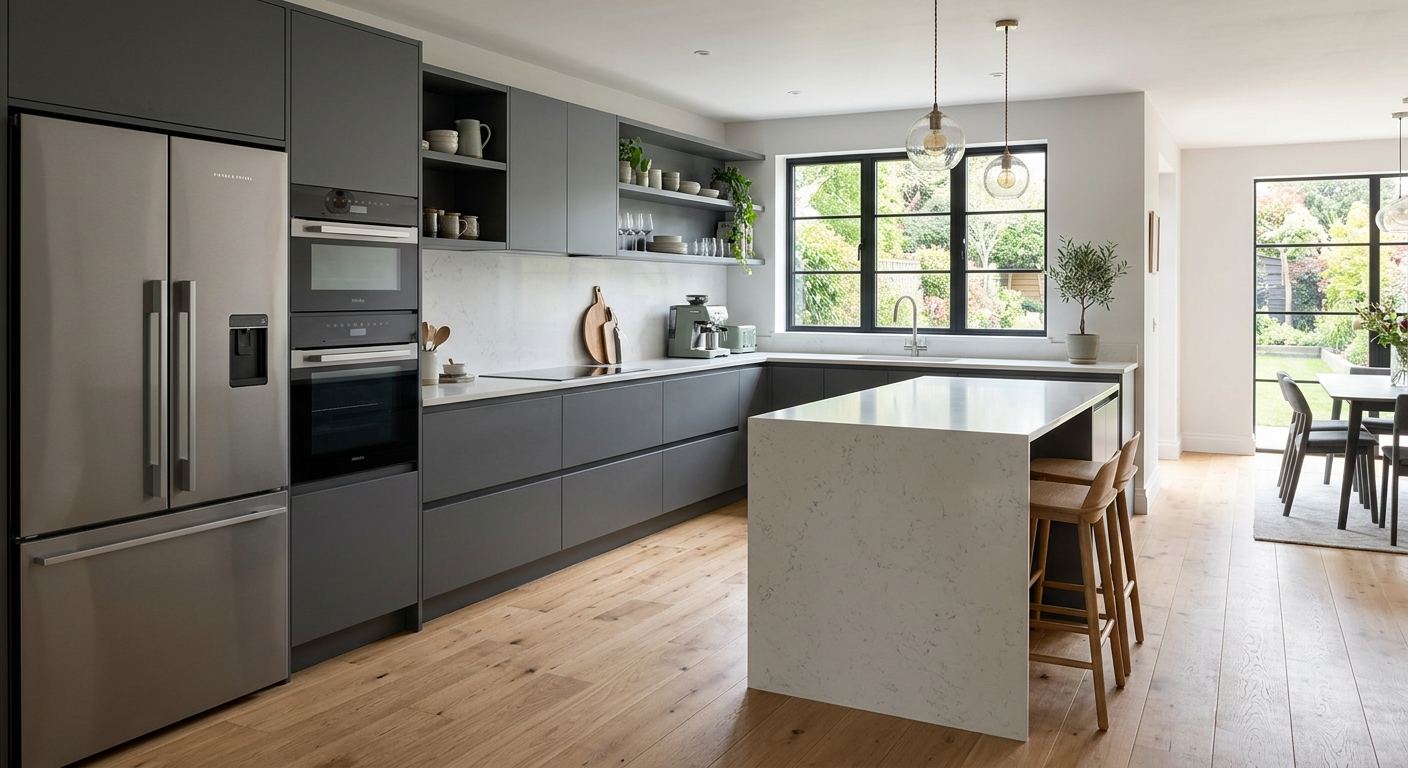
Kitchen renovation options and costs in Downtown Cambridge
Downtown Cambridge kitchen renovations typically start with how your home is positioned in the local market. With a 2021 population of 3,117 (Statistics Canada, 2021 Census), the downtown trade is concentrated and competitive—so scheduling can tighten quickly when multiple homeowners in the same blocks want to renovate at once. Budget expectations also track the broader Kitchener–Waterloo–Barrie economic region: when household incomes and home values support higher-end finishes, homeowners more often choose semi-custom or custom cabinetry and quartz rather than lowest-cost upgrades. In that scenario, cabinetry becomes the anchor line item, and you’ll see projects land well above basic refreshes.
In this region, the “climate” piece is less about temperature swings ruining materials (today’s cabinet finishes and countertops perform well), and more about how wet winters, spring thaw, and indoor humidity drive installation quality and ventilation choices. Contractors in and around Hespeler Road and the downtown core often get more demand from older housing stock where floors and subfloors need careful prep before tile and cabinet base sealing. Labour availability can also shift cost because licensed trades are booked earlier in busier months, especially for electrical add-ons like under-cabinet lighting and island circuits.
To compare options side by side for your quote, use the tiers below as a budgeting baseline—then we’ll fine-tune scope based on layout, cabinet tier, countertop selection, and what trades are required.
| Renovation Tier |
What's Included |
Typical Duration |
Price Range |
| Cosmetic refresh (paint, hardware, new appliances only) |
Cabinet paint or restain, new pulls/knobs, new range/dishwasher (no plumbing/drain moves), touch-up lighting, basic caulking and trim work |
1–3 days on site (plus 1–2 weeks for paint cure) |
$5,000–$15,000 |
| Mid-range full renovation (new cabinets, counters, sink, tile) |
Stock or semi-custom cabinets, countertop (quartz or entry-level stone), sink + faucet, backsplash tile, tile flooring or partial replacement, new under-cabinet lighting (if included) |
2–4 weeks |
$30,000–$65,000 |
| High-end full renovation (custom cabinets, stone counters, island) |
Fully custom millwork, premium stone (granite/stone or higher-end quartz), larger island (often with power), upgraded lighting package, upgraded backsplash (tile or slab), layout tweaks |
4–7 weeks |
$65,000–$120,000 |
| Cabinet refacing only (new doors + drawer fronts, same boxes) |
Reface with new doors/drawers/trim, hardware upgrade, new toe-kick and refinishing of existing boxes as needed (doors and drawer fronts only if boxes are sound) |
1–2 weeks |
$6,000–$20,000 |
| Countertop swap only (laminate to quartz or stone) |
Template and fabrication for new counters, install on existing cabinets, sink cut-out adjustments, sealing, basic backsplash transition (no full backsplash rebuild unless specified) |
3–7 days (plus lead time for fabrication) |
$7,500–$18,000 |
| Backsplash tile installation only |
Remove existing backsplash (as required), tile supply and install, waterproofing prep, new trim at edges |
3–7 days |
$1,500–$8,000 |
Prices are estimates only and vary by project scope, site access and material selection.
What affects the price of kitchen renovation in Downtown Cambridge
In Downtown Cambridge and across the Kitchener–Waterloo–Barrie economic region, two quotes for the “same” kitchen can still differ by 30–50% because the finish tier, trade scope, and hidden conditions rarely line up perfectly from one home to the next. While Ontario winters don’t usually “break” cabinets or quartz on their own, they affect how installers prep subfloors, manage moisture, and seal around backsplashes and cabinet bases—small omissions can force redo work later.
Local home values and median-income-driven expectations matter more than climate for what you choose. In higher-value areas of Cambridge and the wider region, homeowners often default to quartz or premium stone and semi-custom cabinetry because the cost is easier to recover when the kitchen is marketed with buyer-friendly finishes. In more modest budgets, laminate countertops and stock cabinetry dominate because they deliver a visible refresh without pushing the project toward the upper bands—still supporting ROI, especially when layout stays mostly unchanged. Meanwhile, layout changes are the most unpredictable cost regardless of finish level: removing a wall, adding an island, or moving a gas line or plumbing supply can trigger multiple trades and new rough-in work.
Concrete examples from downtown jobs: if your existing floor is out of level from an older installation, plan on extra subfloor leveling and longer tile timelines; that can shift a mid-range plan toward the top end of the $25,000–$90,000 full-renovation band. If you want an island with power and upgraded lighting, electrical work and added conduit often push labour higher even if cabinets stay in the same tier. If your kitchen is in good shape and you limit work to counters and hardware, you may stay closer to the lower portion of the cabinet installation/refacing range—whereas premium stone and custom millwork move you quickly into higher-value pricing.
| Price Factor |
Why It Matters |
Cost Impact |
| Cabinet tier — stock vs. semi-custom vs. fully custom millwork |
More custom components mean higher material cost, longer lead times, and more precise fitting |
Typically shifts cabinetry from the lower end (stock) to the upper end (custom), often covering the biggest single jump in the budget |
| Countertop material — laminate vs. quartz vs. granite vs. stone |
Material plus fabrication complexity changes both price and install time; stone also needs heavier handling and careful edge detailing |
Can move the countertop installation cost within the $1,500–$12,000 band and add extra for sink/cooktop cut-outs |
| Layout change — wall removal, island add, plumbing/gas move |
Repositioning drains, supplies, venting, or gas increases rough-in labour and inspection steps |
Often adds the most uncertainty; commonly pushes projects upward even if finishes stay mid-range |
| Appliance package tier — builder vs. mid-range vs. pro-grade |
Pro-grade appliances can require specific electrical/gas requirements and premium trim/finishing |
Can add meaningful cost through appliance purchase and extra installation labour |
| Flooring — refinish existing vs. full replacement |
If joists/subfloors need remediation, replacement cost rises quickly; refinish works only if the base is stable |
May be a small add-on for cosmetic upgrades, but becomes significant when subfloor corrections are required |
| Backsplash — ceramic tile vs. marble vs. full-height slab |
Material weight and cutting complexity affect labour; full-height work needs more waterproofing and careful transitions |
Usually stays within the $1,500–$8,000 range, but premium formats trend higher |
| Electrical — new circuits for island, under-cabinet lighting |
New loads require licensed work, panel updates (if needed), and added receptacles/switches |
Can add cost even on otherwise “standard” renovations, especially with island power |
| Permit fees and licensed trade requirements |
Certain changes trigger permits and inspections; licensed trades increase scheduling and documentation |
Varies by scope; layout/utility changes can add both time and administrative cost |
Permits & regulations in Ontario
In Ontario, cabinet and countertop swaps usually do not require a permit when you’re keeping the plumbing, gas, and electrical systems in the same locations. That means replacing cabinets in-place, swapping laminate to quartz, or installing a new backsplash typically falls under renovation work that doesn’t trigger permit-led inspections.
However, a permit is typically required when you change the built services or structure—most commonly: moving plumbing supply or drain lines (sink location changes), relocating gas (stove/range), work tied to a gas range or gas-related range hood, removing a load-bearing wall, or adding electrical circuits (like new island receptacles or relocating heavy appliance circuits). Gas work must be done by a licensed gas fitter, and electrical work by a licensed electrician; both typically require inspections as part of the regulated process.
For Downtown Cambridge homeowners, verify contractor credentials before signing. Step-by-step: (1) ask for the contractor’s business registration and licence details and check it via the appropriate Ontario online resources (trade-specific where applicable); (2) request a current certificate of insurance (liability) naming you as certificate holder if the contractor agrees; (3) confirm WSIB/WCB coverage for workers (where applicable for the contractor and subcontractors). Also ask for a clearance letter or proof of account status, not just a promise—then keep copies with your contract. Finally, confirm in writing who pulls permits and pays any permit/inspection fees; responsibility should be clearly stated in your contract.
Cabinets, countertops and layout decisions in Downtown Cambridge
Your three biggest decision points in a Downtown Cambridge kitchen renovation are cabinet tier, countertop material, and whether you change the layout (especially islands and service locations). In the Kitchener–Waterloo–Barrie resale market, buyers often expect kitchens that look current: clean cabinet faces, durable counters, and lighting that supports task use. That expectation is strongest at the upper end of the $30,000–$80,000 “mid-range to higher” renovation territory, where semi-custom or custom cabinetry and quartz/premium stone are common. At the lower end, stock cabinets plus smart refacing and a countertop upgrade can deliver a modern look without overextending the budget.
Cabinet tier choice drives speed and fit. Stock cabinets are usually the fastest and cheapest, but they can mean fewer sizing options and more compromises on cut-ins. Semi-custom is the “most popular” mid-range choice because you can tune storage—pantries, drawer count, and toe-kick details—without fully custom millwork timelines. Custom cabinets are best when you’re tailoring to a unique footprint, old framing irregularities, or a layout that needs exact clearance.
Countertops should match how you live and how you’ll maintain them. In this region, homeowners often choose quartz for consistency and low maintenance; granite/stone bring natural patterning but can require more attention to sealing. Here’s a realistic dollar example: if you’re budgeting a mid-range renovation around $30,000–$65,000, upgrading from laminate to quartz might be one of the highest “visual payoff per dollar” moves. But upgrading every detail to full-height stone and a large custom island can quickly push you into the upper full-renovation band of $65,000–$90,000 depending on layout changes and electrical/plumbing scope.
Layout changes are justified when the space gain is real—like a better work triangle, improved seating flow, or storage where the current plan is awkward. But moving plumbing or relocating gas to support an island can be worth it only if you’re also upgrading lighting and storage so the new plan feels complete, not patched together.
| Option |
Durability |
Maintenance |
Best For |
Price Range |
| Stock cabinets (big-box) |
Good everyday durability with standard hardware and materials |
Low; wipe-clean surfaces, tighten hardware as needed |
Fast timelines and cost-controlled refreshes with in-place layouts |
$6,000–$15,000 |
| Semi-custom cabinets (local dealer) |
Very solid build quality with more options for sizing and storage |
Low; typical care for painted/laminate or thermofoil finishes |
Most Downtown Cambridge mid-range renovations aiming for a tailored look |
$15,000–$28,000 |
| Custom cabinets (local millwork shop) |
Excellent durability when custom-fitted to your exact opening and traffic flow |
Low; similar care to quality painted/finished cabinet surfaces |
Unique layouts, older homes with framing irregularities, and premium storage design |
$28,000–$50,000 |
| Laminate countertop |
Durable for light use; edges and seams are the most vulnerable areas |
Low; avoid standing water at seams and protect from burns |
Budget-focused upgrades where you want a fresh surface quickly |
$3,000–$6,500 |
| Quartz engineered countertop |
High durability and resistance to staining and everyday wear |
Very low; wipe-clean and routine household care |
Balanced “looks + performance” choice for resale in the region |
$6,000–$12,000 |
| Granite / natural stone countertop |
Very durable and heat-tolerant |
Moderate; periodic sealing and stain management recommended |
Premium look with unique veining and a classic finish |
$8,000–$16,000 |
| Butcher block countertop |
Durable but susceptible to water absorption and knife wear |
Higher; regular oiling and protection from soaking/sustained wet spots |
Warm, casual kitchens where homeowners maintain wood surfaces |
$4,500–$10,000 |
| Marble countertop |
Beautiful but softer; can etch or mark under acidic exposure |
Higher; sealing and careful cleaning habits needed |
Style-forward kitchens where appearance is prioritized over heavy daily wear |
$10,000–$20,000 |
How to choose a kitchen renovation contractor in Downtown Cambridge
Choosing the right contractor in Downtown Cambridge starts with verifying Ontario licensing, insurance, and workers’ coverage—and then matching their paper to your kitchen scope. First, ask for proof of liability insurance (certificate of insurance) and ensure the coverage is current for the project timeline. Next, confirm WSIB/WCB coverage for workers (where applicable) and request documentation such as clearance letters or proof of account status rather than verbal assurances.
Then focus on your quotes. Get 2–3 itemised written quotes with a clear labour and materials breakdown—cabinet supply, cabinet installation/refacing labour, countertop template/fabrication, plumbing/electrical allowance, tile/backsplash prep, and disposal. Avoid vague “lump sum” estimates that make it hard to compare apples to apples. Read the scope line-by-line: what’s excluded (old material disposal, drywall patching, subfloor leveling, permit pulling, dust protection)? Is permit responsibility included or assumed by you? Confirm whether disposal and demolition are part of the base scope.
Warranty matters. Ask for the workmanship warranty length and what it covers (for example, cabinet alignment, caulking and sealant failures, tile grout cracking due to prep issues). Also ask about manufacturer warranties for cabinets and countertops and whether coverage is transferable if you sell the home.
Finally, protect your cash flow: never pay more than about 10–15% upfront, and keep a holdback until key milestones are complete (cabinets installed, counters set, and the final walkthrough is done). Request an exact start date and a completion estimate in writing, including a note on lead times for cabinets and countertops.
- Confirm licence/credentials for each regulated trade involved (gas fitters for gas, electricians for electrical).
- Ask for a current certificate of insurance and keep it with your contract.
- Verify WSIB/WCB coverage documentation (clearance letter or proof) before demolition starts.
- Request 2–3 itemised quotes with labour and materials separated (no “one number” only).
- Ensure the quote lists what permits are included and who pulls them.
- Clarify disposal: demolition haul-away, recycling/landfill fees, and protection of sidewalks/driveways.
- Check whether subfloor leveling, drywall patching, and paint/stain are included.
- Confirm countertop timeline and who templates; ask how fabrication delays affect your start date.
- Ask for backsplash waterproofing details and prep scope (behind tile and at transitions).
- Get cabinet installation details: shimming/leveling plan, fastener method, and sealing at cabinet bases.
- Review warranty terms in writing for workmanship and confirm manufacturer warranty specifics.
- Use a payment schedule with milestones and retain a holdback until final sign-off.
Red flags to watch in Downtown Cambridge: contractors who won’t provide insurance/WSIB documentation up front; quotes that don’t specify what’s included for permits, disposal, and drywall/tile prep; unrealistic start dates that ignore cabinet/counter lead times; vague warranty terms (“we stand behind it” without length and scope); and payment requests exceeding 10–15% upfront with no milestone-based plan.
Frequently asked questions — kitchen renovation in Downtown Cambridge
How do I add an island to my Downtown Cambridge kitchen?
Adding an island in Downtown Cambridge usually triggers a few coordinated scopes: cabinet layout redesign, floor and base preparation, and likely electrical work for island lighting and receptacles. If your island requires a sink or cooktop, plan for plumbing/gas rough-ins too—those changes are typically where permits and licensed trades become necessary in Ontario. Practically, most homeowners keep it simpler at first: a “seating island” with power can still give you a big usability upgrade without moving gas or drains. Budget-wise, a full kitchen renovation often ranges $25,000–$90,000, and island electrical/plumbing scope can push labour and scheduling. Your contractor should map routes in writing so you understand whether you’re only adding a box-and-drawer base or reworking services.
How much does a kitchen renovation cost in Downtown Cambridge?
Kitchen renovation costs in Downtown Cambridge commonly fall within the regional bands of about $25,000–$90,000 for a full project, depending on cabinet tier, countertop choice, and whether you change the layout. If you’re doing a mid-range plan—new cabinets, counters, sink, and tile—you’ll often see budgets land in the middle of that full-renovation range. Cabinet work tends to be the largest line item (roughly 30–35%), and countertops are commonly another 10–15%, with labour rising once plumbing, electrical, and finishing trades are included. If your scope stays closer to cabinetry installation/refacing or countertop swaps only, pricing drops into the narrower ranges for those sub-projects rather than full renos. Always compare quotes using an itemised breakdown so you’re not comparing different cabinet tiers or different levels of electrical and tile prep.
How long does a kitchen renovation take in Downtown Cambridge?
Timeline depends on whether you’re doing a cosmetic refresh, a full renovation, or a countertop-only change. Cosmetic refreshes are often the quickest, with paint cure time extending the overall schedule. Mid-range full renovations typically run around 2–4 weeks, while high-end projects with custom cabinetry and island builds often take 4–7 weeks due to fabrication lead times and additional finishing work. Countertop swaps can be fast once templating is done, but lead time for fabrication still applies. Downtown Cambridge projects also need coordination for licensed electrical or gas work when required, which can affect scheduling. If your kitchen is in older housing stock, subfloor or drywall prep can add days. A good contractor will give you a written start date, a completion estimate, and a plan for how they handle cabinet/counter delays.
Quartz vs granite countertops — which is better?
Quartz and granite are both premium options, but “better” depends on your daily use and maintenance comfort. Quartz engineered countertops are popular in Ontario because they’re low-maintenance and consistent in appearance; they’re also a strong resale-friendly choice across the Kitchener–Waterloo–Barrie region. Granite is very durable and heat-tolerant, with natural variation and unique patterning, but it usually requires periodic sealing and more careful stain management. In many Downtown Cambridge projects, the realistic difference shows up in budget and performance trade-offs: quartz often lands in the countertop installation range (commonly around the $1,500–$12,000 band depending on scope), while granite and natural stone can push higher once fabrication and special edges are included. If you want a “set it and forget it” feel, quartz is usually the easier recommendation for busy households.
Should I reface or replace my cabinets?
Refacing vs replacing hinges on box condition, layout needs, and how modern you want the storage to feel. If your cabinet boxes are solid, aligned, and not water-damaged, refacing (new doors and drawer fronts with updated trim) is often the most cost-effective way to refresh the look. If your boxes are sagging, have inconsistent gaps, or your layout doesn’t work anymore, replacement is the better long-term solution because you can correct sizing, drawer count, and storage organization. In Downtown Cambridge, many homeowners consider refacing when they want visible upgrades without the full project disruption of a full demo. Budget-wise, cabinet refacing alone commonly runs within $6,000–$30,000, while new cabinet packages can quickly move you toward the broader full renovation bands when you add counters, sink, and tile. A contractor should assess box integrity before recommending refacing so you don’t pay for a facelift on problems underneath.
Do I need a permit for a kitchen renovation in Ontario?
In Ontario, you usually do not need permits for cabinet and countertop swaps when the plumbing, gas, and electrical locations stay the same. That means replacing cabinets in-place, changing countertop surfaces, and installing a backsplash typically doesn’t trigger permit-led inspections. Permits are commonly required when you change the systems: moving plumbing supply or drain lines, relocating gas for a stove/range situation, removing a load-bearing wall, or adding new electrical circuits (for example, island power or additional receptacles/lighting). Gas work must be done by a licensed gas fitter, and electrical work by a licensed electrician, with inspections as applicable. For Downtown Cambridge homeowners, confirm in your contract who pulls permits and who pays fees. Also verify that the contractor provides proof of licensing, liability insurance, and WSIB/WCB coverage before work starts.