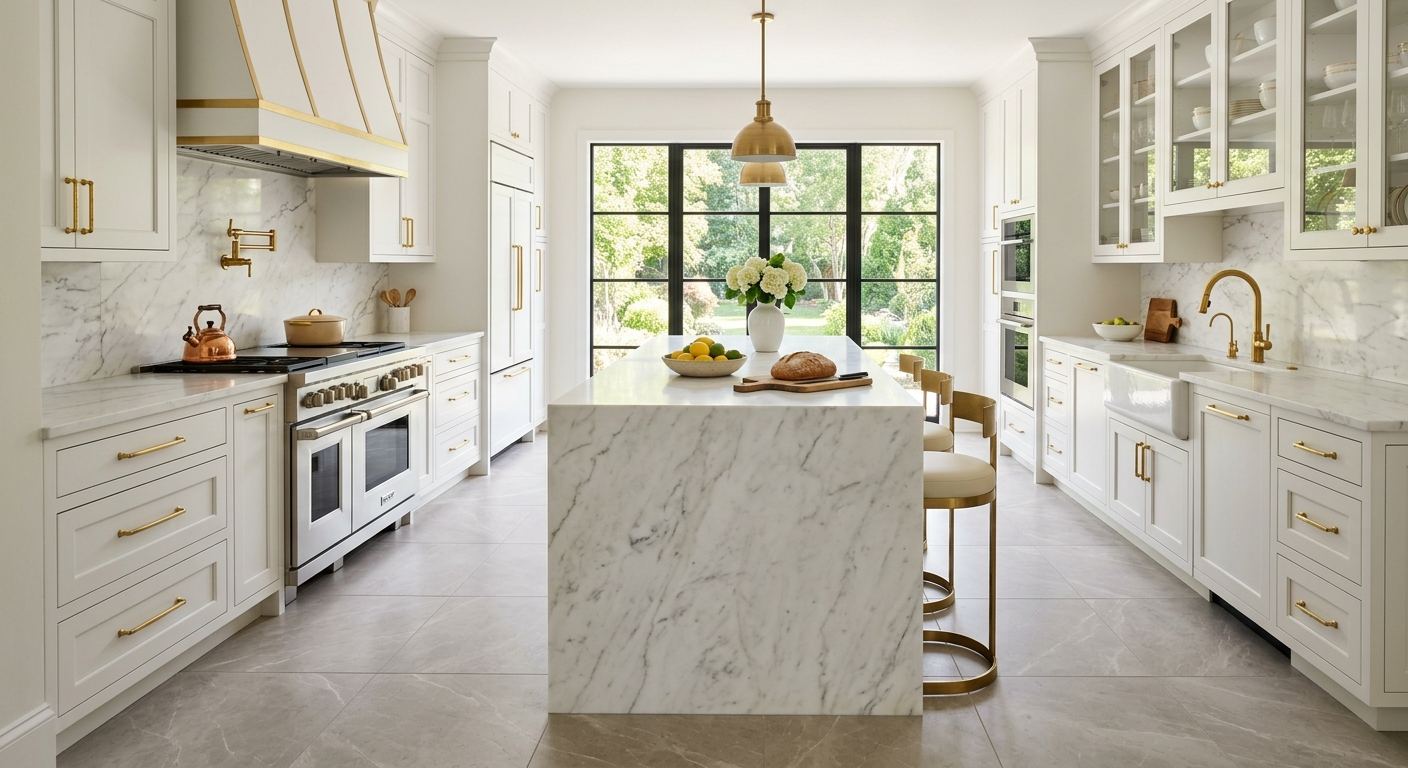
Kitchen renovation options and costs in Columbia Hills
Kitchen renovations in Columbia Hills typically start with a budget conversation, because the “right” finish level changes with the local housing market. Columbia Hills has a population of 7,125 (Statistics Canada, 2021 Census), and many homeowners are balancing day-to-day livability with resale value in the Toronto economic region. While Ontario’s kitchen-catalog budgets can look similar on paper, the finish tier chosen in higher-value pockets of the GTA often pushes projects toward custom cabinetry, quartz, and upgraded appliances—because owners can more easily recover that spend on resale. In practice, that means a kitchen that feels “modestly refreshed” in a more price-sensitive area may be specified as a mid-range full renovation in Columbia Hills, where homeowners expect buyers to see updated counters, modern lighting, and cleaner hardware lines.
Toronto-area costs are also shaped more by market demand and contractor availability than by weather. Unlike regions where winter delays trades, the GTA has relatively steady renovation activity, so labour pricing stays more consistent throughout the year. That said, kitchen work still costs more when it involves scheduling longer lead-time items (cabinetry, stone slabs) and when older homes need additional prep (straightening cabinets, updating wiring, or correcting subfloor variations). Demand is especially strong around residential pockets where families frequently remodel for better storage and circulation—often the areas near the local service corridors where “function first” upgrades are in high demand.
Below are realistic renovation tiers you can use to compare quotes and plan a scope that fits your goals—whether you’re aiming for a clean refresh or a full kitchen transformation.
| Renovation Tier |
What's Included |
Typical Duration |
Price Range |
| Cosmetic refresh (paint, hardware, new appliances only) |
Paint, cabinet hardware change, re-caulking, appliance swap (no plumbing/gas moves), basic cleaning/trim touch-ups |
3–7 days |
$8,000–$22,000 |
| Mid-range full renovation (new cabinets, counters, sink, tile) |
Semi-custom or quality stock cabinets, new countertop, sink + faucet, backsplash tile, new vanity-style lighting, standard flooring refresh, minor electrical updates |
2–4 weeks |
$35,000–$65,000 |
| High-end full renovation (custom cabinets, stone counters, island) |
Fully custom millwork, natural stone or upgraded quartz, island (including electrical + countertop templating), upgraded appliance package, higher-end tile/finish details |
4–8 weeks |
$70,000–$90,000 |
| Cabinet refacing only (new doors + drawer fronts, same boxes) |
New doors/drawer fronts, refinish the remaining cabinet surfaces, hardware, adjust hinges/rollers, optional new crown/base trim |
1–2 weeks |
$12,000–$28,000 |
| Countertop swap only (laminate to quartz or stone) |
Remove and dispose old counters, install new quartz/stone, sink cut-out, standard edge and seam layout |
3–7 days |
$7,000–$15,000 |
| Backsplash tile installation only |
Tile selection and install, surface prep, waterproofing where needed, grout/seal (as applicable), finish trim details |
3–5 days |
$2,000–$10,000 |
Prices are estimates only and vary by project scope, site access and material selection.
What affects the price of kitchen renovation in Columbia Hills
For the same kitchen scope, quotes in Toronto and across Ontario can vary by 30–50% because contractors price risk differently: removals, hidden damage, lead times, and how much trades coordination the job requires. Even if you request “new cabinets and counters,” the quote swings based on cabinet tier, countertop material, and whether the contractor must address plumbing, electrical, or structural changes. In high-value Toronto-area markets, homeowners often default to quartz or stone counters and semi-custom cabinetry because the renovation cost is more likely to be recovered on resale. In more price-sensitive areas, laminate and stock cabinets dominate because the return on investment is prioritized.
In Columbia Hills specifically, two practical drivers move the needle: (1) layout constraints common in many older GTA housing types (narrow halls, smaller kitchens that limit accessibility for trades), and (2) the way finish choices reflect today’s buyer expectations. When homeowners push beyond a mid-range full renovation into a higher-end finish tier—especially with island builds—costs usually rise quickly, even if cabinet footprints are similar. Conversely, staying in a more controlled range like a cabinet refacing plus countertop swap can deliver a noticeable update without triggering major plumbing or electrical changes.
Concrete examples from Columbia Hills renovation sites: moving a sink from an exterior wall to an island can add labour and rough-in costs, plus delays for inspection scheduling; upgrading from laminate to quartz is often straightforward, but adding stone edging or extra seams changes fabrication time; and bringing electrical for under-cabinet lighting or a new island circuit typically costs more on older homes where panel capacity is limited. When you’re budgeting from mid-$20k into the $80k+ zone, the decision that most unpredictably affects price isn’t the finish—it’s whether the work stays “surface-level” or crosses into plumbing, gas, or electrical.
| Price Factor |
Why It Matters |
Cost Impact |
| Cabinet tier — stock vs. semi-custom vs. fully custom millwork |
Different lead times, materials, build quality, and fit/finish standards |
$8,000–$50,000 |
| Countertop material — laminate vs. quartz vs. granite vs. stone |
Material price, fabrication complexity, edge/seam options, and waste |
$3,000–$15,000 |
| Layout change — wall removal, island add, plumbing/gas move |
Structural coordination plus potential permit requirements and rework risk |
$10,000–$30,000 |
| Appliance package tier — builder vs. mid-range vs. pro-grade |
Electrical, ventilation fit, trim kits, and install time |
$2,000–$12,000 |
| Flooring — refinish existing vs. full replacement |
Subfloor condition, moisture protection needs, and match-to-existing labour |
$2,000–$12,000 |
| Backsplash — ceramic tile vs. marble vs. full-height slab |
Tile layout complexity, stone sealing, and labour intensity |
$2,000–$10,000 |
| Electrical — new circuits for island, under-cabinet lighting |
Licensed work, panel capacity checks, and inspector scheduling |
$1,500–$8,000 |
| Permit fees and licensed trade requirements |
Plan/permit admin, inspections, and additional coordination on site |
$500–$3,500 |
Permits & regulations in Ontario
In Ontario, many “swap” jobs don’t require permits, but changes to plumbing, gas, electrical, or structure usually do. For example, cabinet and countertop swaps typically do not require a permit when you’re keeping existing connections where they are (same footprint, no new drains/supplies, and no load-bearing changes). Likewise, a backsplash replacement is usually treated as a finish upgrade, not a building alteration—unless it triggers electrical work for new outlets or lighting.
Permits and licensed trade involvement are commonly required for: moving plumbing supply or drain lines; relocating a gas stove; working on a range hood with gas connections; removing a load-bearing wall (or doing structural modifications); and adding new electrical circuits (such as dedicated island circuits or upgrading under-cabinet lighting that ties into new wiring). Gas work must be done by a licensed gas fitter, and electrical work by a licensed electrician—both require appropriate inspections. Always confirm permit responsibility with the contractor in writing, including who pays for what and what you’re expected to sign.
To verify a contractor in Columbia Hills, ask for (1) licence details and proof of registration where applicable, (2) liability insurance and (3) WSIB/WCB coverage. You can check licences through Ontario’s online registries, review the contractor’s certificate of insurance for current coverage, and confirm clearance letters or account status for WSIB/WCB (as applicable) before work begins. If a contractor can’t provide documents promptly, treat that as a red flag and move on.
Cabinets, countertops and layout decisions in Columbia Hills
The three biggest decisions in a Columbia Hills kitchen renovation are cabinet tier, countertop material, and whether you change the layout. First, cabinet tier drives both cost and how “future-proof” the kitchen feels. Stock cabinets are fastest and cheapest, semi-custom is the most popular balance for GTA resale expectations, and custom cabinetry costs more but can match odd wall angles, ceiling height, and storage goals.
Second, countertop material affects durability, daily maintenance, and buyer perception. Laminate is budget-friendly, quartz is a strong all-around option for busy kitchens, granite/natural stone offers premium character, butcher block adds warmth but needs more care, and marble is elegant but more sensitive to etching and staining. In Toronto-area homes, where many kitchens are used heavily and cleaned frequently, choosing quartz often hits the sweet spot between “looks updated” and “stays low-maintenance” without the extra upkeep of softer natural stones.
Third, layout changes are where budgets can jump unpredictably. Removing a wall for open-concept flow or adding an island can be justified when it creates real circulation and improves functionality—especially for resale buyers who expect a modern, usable kitchen. But plumbing/gas relocation and electrical rework add the most cost, and the value depends on whether the new design truly fits the home. For a concrete example: if laminate-to-quartz is the only upgrade, you can often keep costs in the countertop swap band (roughly $3,000–$15,000) while still achieving a “new kitchen” visual. If you pair that with a full island build and service moves, you’re more likely to move into mid-range full renovation or higher-end full renovation territory.
In Ontario’s housing stock around the Toronto economic region, many kitchens are in older layouts, so the best plan is usually: upgrade finishes first (cabinets + quartz), and only change plumbing/gas if the design improves storage and traffic enough to matter.
| Option |
Durability |
Maintenance |
Best For |
Price Range |
| Stock cabinets (big-box) |
Good for standard measurements; less forgiving with odd spaces |
Low—typical wipe-down; hardware upgrades help longevity |
Fast refreshes and tighter budgets |
$8,000–$20,000 |
| Semi-custom cabinets (local dealer) |
Very solid construction; better options for fit and storage |
Low—routine cleaning and occasional hinge/track adjustment |
Most Columbia Hills renovations aiming for resale appeal |
$18,000–$35,000 |
| Custom cabinets (local millwork shop) |
Highest fit and finish; handles irregular rooms and specialty storage |
Low to moderate—excellent build quality, still benefits from proper care |
Design-forward kitchens, islands, and challenging layouts |
$30,000–$60,000 |
| Laminate countertop |
Resists daily wear well, but can be less impact- and heat-tolerant than stone |
Easy—avoid standing water at seams; use trivets |
Budget-conscious updates |
$3,000–$7,000 |
| Quartz engineered countertop |
Very durable and consistent; resistant to stains and scratches for everyday use |
Low—routine cleaning; minimal sealing needs |
Busy households that want “stone look” with practical upkeep |
$7,000–$12,000 |
| Granite / natural stone countertop |
High durability; unique patterns and character |
Moderate—periodic sealing and care to manage porous surfaces |
Premium look and long-term durability |
$10,000–$15,000 |
| Butcher block countertop |
Durable with proper care; can show knife marks |
Moderate—oil/condition regularly; protect from moisture |
Warm, casual styles and cooks who maintain surfaces |
$6,000–$10,000 |
| Marble countertop |
Beautiful but more prone to etching/staining than quartz |
Higher—requires careful cleaning habits and protective products |
Statement kitchens with lighter-duty use |
$12,000–$18,000 |
How to choose a kitchen renovation contractor in Columbia Hills
Choosing the right contractor in Columbia Hills is mostly about proof and process. Start by verifying Ontario licensing for the trades involved in your scope, and request liability insurance plus WSIB/WCB coverage. How to check: (1) ask for the licence number and trade category for any licensed work, (2) review the certificate of insurance for current dates and sufficient limits, and (3) confirm WSIB/WCB coverage via clearance letters or account status documentation. A reputable contractor will provide these without pressure and well before the work starts.
Next, get 2–3 itemised written quotes—not lump sums. The estimate should separate labour and materials, show allowances for cabinets/stone/appliances, list electrical/plumbing line items if applicable, and specify waste disposal and protection of floors/fixtures. Read the scope carefully: ask what’s excluded (demo, patching, drywall finishing, trim, permits, cabinet modifications), whether permit pull is included, and whether disposal is part of the price. Warranty terms also matter: confirm workmanship warranty length, product/manufacturer warranty coverage, and whether warranties are transferable if you sell your home.
On payments, never pay more than 10–15% upfront. Use staged payments tied to milestones, and keep a holdback until completion and punch-list sign-off. Finally, insist on a written start date and completion estimate. Kitchen projects stall when lead times change; strong contractors document assumptions and update timelines promptly.
- Ask for licence numbers and confirmation for gas/electrical/structural scope
- Verify liability insurance is current and request the certificate before signing
- Confirm WSIB/WCB clearance or equivalent coverage documentation
- Use itemised quotes (labour vs materials) with clear allowances
- Check what demo includes: countertops, cabinets, backsplash, flooring protection
- Confirm permit responsibility (who pulls it, who pays, who schedules inspections)
- Confirm disposal/recycling is included (dump fees can be expensive)
- Get a written warranty for workmanship and understand coverage limits
- Ask whether the warranty is transferable to the next homeowner
- Review the payment schedule and keep a completion holdback
- Require a timeline with key milestones (template, cabinet delivery, install)
- Ask for examples/photos of similar GTA kitchens and references
Common red flags I see with less-prepared contractors in the Columbia Hills area: they won’t provide insurance/coverage documents, they refuse itemised quotes, they hide permit responsibilities, they ask for large upfront deposits (beyond 10–15%), or they use vague “allowances” without specifying brands/grades—making your final cost jump after selections are already locked in.
Frequently asked questions — kitchen renovation in Columbia Hills
Should I renovate my kitchen before selling in Columbia Hills?
If you’re selling in Columbia Hills or nearby in Ontario, the goal is to refresh what buyers immediately notice—cabinets, counters, lighting, and overall cleanliness. A full kitchen at the higher end (for example, budgets in the $70,000–$90,000 range) doesn’t always guarantee a dollar-for-dollar return; it’s best when your kitchen layout is workable and you’re upgrading finishes buyers expect. If your kitchen is dated but structurally sound, consider a mid-range full renovation (roughly $35,000–$65,000) with a strong focus on cabinets, countertops, and tile—those changes photograph well and read “move-in ready.”
Before renovating, get one estimate that’s clearly scoped for resale value and ask your contractor to list what’s “must-do” versus “nice-to-have.” Also consider your housing-stock reality: older GTA homes sometimes need electrical or subfloor prep, which should be included in your budget to avoid surprises on closing timelines.
What's the most popular kitchen style in Columbia Hills right now?
In Columbia Hills, the most common trend I see is a clean, modern look with warm neutrals—think simple slab or shaker cabinet fronts, matte or satin finishes, and quartz countertops that mimic stone veining. Many homeowners pair semi-custom cabinetry with an updated backsplash and a more layered lighting plan (under-cabinet lighting plus better ambient fixtures). This style balances “current” with practical upkeep, which matters for families and also for resale when buyers tour multiple homes.
Price tier influences the look: in the $25,000–$90,000 full renovation band, mid-range projects often land on semi-custom cabinets and quartz, while higher-end projects add custom millwork details and stone or natural stone statement surfaces. If you want the popular look without overspending, ask your contractor to keep the layout simple and spend on the surfaces that buyers touch and notice—cabinets, counters, and hardware.
How do I know if I need to update my kitchen plumbing in Columbia Hills?
You usually don’t need to replace everything when doing a cosmetic refresh, but you do need to check for serviceability—especially in older Toronto-area homes where shutoffs, supply lines, or drain lines may be nearing end-of-life. Signs include slow drains, recurring leaks under the sink, frequent drain clogs, water pressure changes near the kitchen, or stains/corrosion around fixtures. If you’re moving the sink or adding a dishwasher line, plan for at least some rework of supply/drain connections.
In a renovation scope that keeps plumbing in the same locations, the work may stay within countertop/cabinet swaps that typically avoid permits. But if you’re changing supply or drain lines, you can be pulled into permit and licensed trade coordination in Ontario. During quoting, ask the contractor to confirm what gets inspected, what gets replaced proactively, and whether they will include testing and leak checks before closing walls.
What is the difference between a galley and open-concept kitchen?
A galley kitchen is a narrow, corridor-style layout where cabinetry runs along two parallel walls, often with limited space for an island. It’s efficient for workflow but can feel enclosed, especially in smaller footprints. An open-concept kitchen typically blends into adjacent living or dining space, usually achieved by removing or not having load-bearing wall sections that separate rooms (when permitted) and by placing an island or peninsula to define the zone.
In Columbia Hills, whether you can go open-concept depends heavily on your home’s structure and how changes affect plumbing and electrical pathways. An open-concept redesign can be justified if you gain usable circulation and better social flow, but it’s also where costs can rise quickly because wall removal and service moves require careful coordination. If budget is the priority, you can sometimes improve a galley kitchen through smart storage, better lighting, and a small peninsula without triggering major structural or utility changes.
How do I get accurate kitchen renovation quotes in Columbia Hills?
Accurate quotes come from clear scope and comparable selections. In Columbia Hills, ask for 2–3 itemised written quotes that separate labour and materials, and include allowances that match your actual choices (cabinet grade, countertop material, backsplash type, appliance tier). Avoid quotes that lump everything together without detailing demo, disposal, drywall patching, electrical/plumbing scope, and installation sequencing. The kitchen is a trade coordination project, so the quote should show who is doing what and when.
To keep pricing realistic, provide measurements, photos, and notes about what you want changed—especially if you plan to move the sink, add an island, or update under-cabinet lighting. Then tie it to your budget bands: a modest refresh might land in the $25,000–$90,000 full renovation band only if it includes more than appliances, while a countertop swap alone is often in the $3,000–$15,000 range. Finally, confirm whether permits and licensed-trade work are included where required.
What's the best countertop material for a busy Columbia Hills kitchen?
For a busy Columbia Hills kitchen, quartz is usually the best balance of durability, appearance, and low daily maintenance. It’s resistant to stains and scratches compared with many other options, and it holds up well to frequent cleaning. It also aligns with the look many GTA buyers expect—clean surfaces and modern stone-like patterns—so it’s a popular choice whether you’re targeting a mid-range full renovation or a higher-end finish tier.
If you want maximum durability with natural character, granite/natural stone is excellent but may require periodic sealing and more mindful care. Laminate can work for budget refreshes, but it may not deliver the same “premium” feel or longevity at the seam and edge areas over time. Butcher block is great for warmth and cooking-friendly vibes, provided you’re willing to maintain it. In Ontario homes, where daily use and seasonal cooking are constant, quartz is often the safest practical bet for a kitchen that stays beautiful under real-life wear.