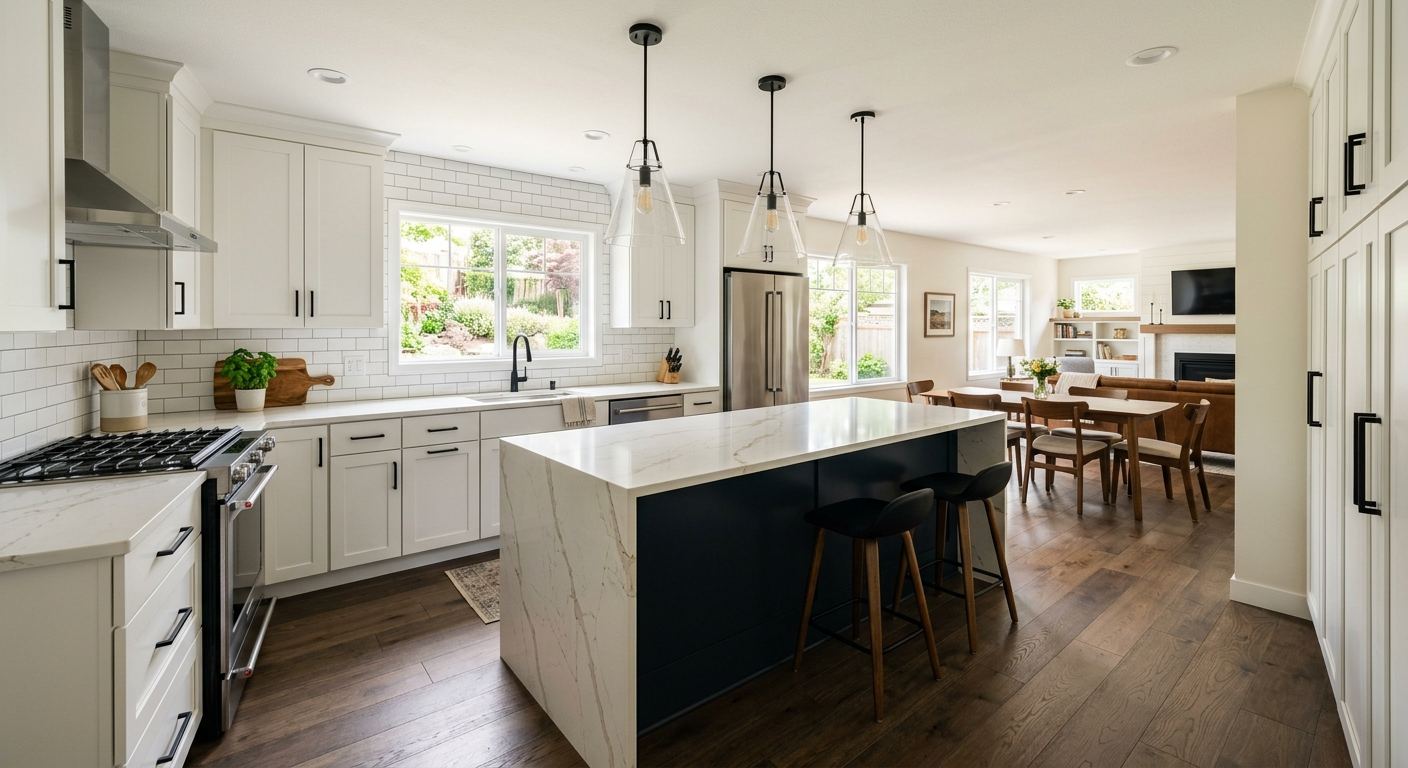
Kitchen renovation options and costs in Keswick
Keswick homeowners typically start their kitchen plan by choosing how far they want to go: a quick refresh, a mid-range update, or a full high-end rebuild. With a population of about 21,000 (Statistics Canada, 2021 Census), Keswick has plenty of contractors serving the broader Toronto economic region, but scheduling can still get tight in spring and early summer. In this part of Ontario, pricing is influenced more by the resale expectations in the Toronto market than by the local climate itself—especially because finish tiers often track how homeowners position their home for sale. In higher-value pockets around the Toronto economic region, many owners budget closer to 8%–15% of their home value for a kitchen, which pushes projects toward quartz or natural stone and more custom cabinetry; in more price-sensitive areas, many projects stay in a mid-range band with refacing or semi-custom cabinets and good quartz or laminate tops.
Toronto-area kitchen work is also shaped by housing stock. Many Keswick homes are older than new builds and have layout constraints—like where venting, older wiring, or original plumbing runs sit—which can change labour and material costs. Day-to-day, contractor availability and material pricing are relatively consistent across the GTA, so the biggest cost swings usually come from finish tier and layout changes (not whether it’s winter or summer).
If you’re comparing options for your project, start with the tiers below and then match a scope to your finish level, layout goals, and timelines—then you’ll be ready to tighten your budget in the next sections.
| Renovation Tier |
What's Included |
Typical Duration |
Price Range |
| Cosmetic refresh (paint, hardware, new appliances only) |
Paint (walls/ceiling), new cabinet hardware/pulls, caulking/touch-ups, installation of selected appliances only |
3–7 days |
$5,000–$15,000 |
| Mid-range full renovation (new cabinets, counters, sink, tile) |
New or semi-custom cabinets, quartz or good laminate counters, new undermount sink and faucet, backsplash tile, basic lighting refresh, disposal plumbing hookup |
3–5 weeks |
$25,000–$55,000 |
| High-end full renovation (custom cabinets, stone counters, island) |
Fully custom millwork, natural stone or premium quartz counters, island build with seating, upgraded appliance package, tile/stone backsplash, upgraded trim/lighting, deeper electrical scope |
6–10 weeks |
$65,000–$90,000 |
| Cabinet refacing only (new doors + drawer fronts, same boxes) |
Door/drawer replacement, new veneer faces, new pulls, hinge/soft-close upgrades, surface prep and repaint/stain as needed |
1–2 weeks |
$8,000–$25,000 |
| Countertop swap only (laminate to quartz or stone) |
Remove existing tops (and disconnect/replace sink cut-outs as required), install new quartz/stone, silicone and countertop sealing where applicable, edge profile upgrade |
2–5 days |
$3,000–$15,000 |
| Backsplash tile installation only |
Tile supply and install on existing surface, waterproofing/board prep where needed, grout sealing, cleanup |
2–7 days |
$2,000–$10,000 |
Prices are estimates only and vary by project scope, site access and material selection.
What affects the price of kitchen renovation in Keswick
Even when two homeowners describe the “same” kitchen renovation, quotes in the Toronto economic region can diverge by 30%–50% because each contractor prices risk, access, and unknowns differently. In practice, the biggest driver isn’t climate—it’s finish tier choices shaped by Keswick’s broader Toronto resale market. When local home values are higher and buyers expect a more polished look, homeowners often default to quartz or stone counters and semi-custom cabinetry because the spend is easier to justify on resale. In more price-sensitive areas across the region, laminate counters and stock cabinetry dominate because they deliver the functional upgrade without pushing the budget into the $80k+ territory.
Layout changes are where costs become most unpredictable, regardless of finish. Moving a gas line, relocating a sink’s supply/drain, or removing a wall (especially if it’s load-bearing) can add materials, trades, inspections, and demolition complexity. A wall removal and structural work package can cost dramatically more than a like-for-like facelift, and it can also affect the schedule if permits or inspections are delayed.
In Keswick specifically, a few conditions commonly raise or lower price:
- Older plumbing runs: kitchens in older homes can require additional line length and tie-ins, pushing countertop swap projects toward the upper end of the $3,000–$15,000 band.
- Winter moisture and curing: in cold months, curing times for adhesives, underlay, and some coatings can extend timelines, especially if work is delayed by temperature swings during installation.
- Small-space layouts: if your room is tight, adding an island may require deeper cabinetry changes and electrical moves—often nudging mid-range projects (around $25,000–$55,000) upward.
For budgeting, treat finish and layout as separate decisions: choose your cabinet and countertop tier first, then decide whether the layout improvements are worth the uncertainty and trade coordination costs.
| Price Factor |
Why It Matters |
Cost Impact |
| Cabinet tier — stock vs. semi-custom vs. fully custom millwork |
Determines build quality, fit, hardware/soft-close options, and how precisely cabinets match your walls |
Largest predictable range shift within cabinet spending |
| Countertop material — laminate vs. quartz vs. granite vs. stone |
Material cost and fabrication/installation complexity (seams, edges, sink cut-outs) |
Can swing total budget by several thousand dollars |
| Layout change — wall removal, island add, plumbing/gas move |
Triggers demolition, structural considerations, and trade coordination (plus permit requirements when applicable) |
Often the biggest unpredictable cost increase |
| Appliance package tier — builder vs. mid-range vs. pro-grade |
Differences in capacity, ventilation requirements, power/gas needs, and finish compatibility |
Can move the project up or down by a noticeable margin |
| Flooring — refinish existing vs. full replacement |
Subfloor condition, underlayment needs, and how much gets removed during cabinet install |
Full replacement adds material + extra labour |
| Backsplash — ceramic tile vs. marble vs. full-height slab |
Varies by tile thickness, pattern matching, waterproofing prep, and weight/setting materials |
Highest for slab or specialty stone applications |
| Electrical — new circuits for island, under-cabinet lighting |
More lighting points, pot lights, and upgraded outlets require planning and labour |
Adds cost even when finishes stay mid-range |
| Permit fees and licensed trade requirements |
Permits, inspections, and licensed trade scheduling can affect both cost and timing |
Increases total outlay when work crosses into regulated scope |
Permits & regulations in Ontario
In Ontario, many straightforward kitchen swaps do not require permits. Cabinet and countertop replacements typically fall into the “no permit” category because they’re considered finish work when you keep the plumbing, gas, and electrical locations unchanged. However, permits and licensed trades usually come into play when you change services or the building structure—such as moving plumbing supply or drain lines, relocating a gas appliance (like a stove), removing a load-bearing wall, or adding electrical circuits for things like an island outlet bank or a new lighting layout.
Gas work must be performed by a licensed gas fitter, and electrical work must be done by a licensed electrician. Both require proper inspections as applicable to the scope. Even when the work is “small,” if it touches the regulated parts of the system, treat it as permit-relevant.
For a Keswick homeowner, the verification process should be methodical:
- Ask for the contractor’s Ontario licence details (as applicable), and confirm the trade licensing for gas and electrical work in writing.
- Request a current certificate of insurance (liability) and confirm it matches the project period.
- Confirm WSIB/WCB coverage status (and request documentation) before work starts.
- Ask who is responsible for pulling permits, and ensure that responsibility is clearly written into the contract.
- Verify that the contractor includes inspections (where required) as part of the scope.
- Keep copies of all permits/inspection notes provided for your records.
Bottom line: confirm permit responsibility before you sign—ideally in the contract, not just in an email.
Cabinets, countertops and layout decisions in Keswick
In most Keswick kitchen renovations, three decisions determine both your satisfaction and your resale value: cabinet tier, countertop material, and whether to change the layout. (1) Cabinets: stock is the fastest path and usually the lowest price; semi-custom is the most popular mid-range choice because it balances options like soft-close, door styles, and better fit; custom cabinets cost the most but can be engineered to fit ceilings, irregular walls, and tricky storage needs. (2) Countertops: laminate is budget-friendly and durable for everyday use, but quartz and natural stone typically deliver a more premium look that aligns with what Toronto-area buyers expect at higher price points. (3) Layout: removing a wall for an open-concept feel or adding an island can be worth it when it improves traffic flow, storage, and entertaining—especially in families who want a functional “hub.” If you’re also relocating a sink or gas line, the cost justification should be tied to actual space gains and daily use, not just aesthetics.
Toronto resale dynamics matter here because kitchens are visible “proof of quality.” In a modest budget, focusing on semi-custom cabinets and quartz can land you solidly in the $25,000–$55,000 band while still giving buyers that clean, modern finish. For higher-tier projects, fully custom millwork plus stone counters and an island pushes you into the $65,000–$90,000 range—where the spend tends to be easier to recover if the layout upgrade is meaningful.
Climate plays a supporting role: temperature swings and winter indoor humidity affect curing times for coatings and adhesives during installs. That usually changes schedule more than the final price, but it’s still a reason to plan well and ensure your contractor can manage installation conditions. If you want one clear money example: upgrading from laminate to quartz on a mid-range kitchen often costs more up front, but it can be a smarter “value per visible surface” than paying for a minor layout change that doesn’t improve storage or flow.
| Option |
Durability |
Maintenance |
Best For |
| Stock cabinets (big-box) |
Good everyday durability; limited custom fit near ceilings and corners |
Wipe clean; hinges and hardware depend on the model’s tier |
Fast upgrades, tight timelines, and budget-first renovations |
$8,000–$25,000 |
| Semi-custom cabinets (local dealer) |
Very durable; better variety of sizes, storage options, and finishes |
Easy cleaning; select hardware for smooth daily use |
Most Keswick homeowners aiming for a resale-friendly look |
$15,000–$45,000 |
| Custom cabinets (local millwork shop) |
Highest durability and best fit; engineered to your exact room |
Wipe clean; premium hardware is typically easier to maintain |
Unusual layouts, ceiling heights, maximum storage planning |
$35,000–$65,000+ |
| Laminate countertop |
Resists staining; edges and seams are the main wear points |
Simple cleaning; avoid prolonged standing water at seams |
Value-focused renovations and rental-to-resale upgrades |
$3,000–$7,000 |
| Quartz engineered countertop |
Very durable and impact-resistant; consistent colouring |
Low maintenance; minimal sealing (vs. many natural stones) |
Balanced premium look with practical daily use |
$7,000–$12,000 |
| Granite / natural stone countertop |
Natural hardness and long lifespan; variation in slabs is part of the appeal |
May require periodic sealing depending on the stone and finish |
Homeowners wanting a distinctive high-end countertop look |
$10,000–$15,000 |
| Butcher block countertop |
Great for cutting prep; surface needs care to stay looking sharp |
Conditioning/oiling schedule is important; wipe dry after wet use |
Warm, traditional designs and households who actively cook |
$4,500–$10,000 |
| Marble countertop |
Premium look; more susceptible to etching/staining than quartz or granite |
Requires careful cleaning and protective habits |
High-end aesthetics where daily wear is managed |
$12,000–$20,000+ |
How to choose a kitchen renovation contractor in Keswick
Choosing the right contractor in Keswick comes down to proof: licensing/coverage, clarity in the scope, and the ability to deliver the schedule they promise. First, verify Ontario trade licensing where relevant and confirm liability insurance—ask for a certificate of insurance and check the coverage limits align with the job size. For worker protection, request documentation showing WSIB/WCB coverage status so you’re not left dealing with the fallout if an issue occurs on-site. If the project includes gas or electrical work, make sure those trades are specifically covered and that the contractor coordinates inspections properly.
Next, request 2–3 itemised written quotes instead of a single lump sum. A good quote breaks out labour and materials line-by-line—cabinets, countertop supply and fabrication, installation labour, tile labour, electrical/gas allowance, disposal, and any moulding/trim work. Read the scope carefully for what’s excluded: tile underlay, drywall repair, removal and haul-away, permit pulling, and whether patching/painting is included after cabinet install. Make sure any permit costs and inspection fees are stated, not implied.
Finally, evaluate warranty and payment structure. Workmanship warranties should be clearly stated (and ideally in writing), and product/manufacturer warranties should specify whether they transfer to you. Payment schedules should protect you: never pay more than 10%–15% upfront, and use a holdback until completion and punch-list signoff. Get a start date and completion estimate in writing so you can plan around the disruption.
- Ask for proof of WSIB/WCB coverage and liability insurance before demolition.
- Confirm gas fitter and electrician coverage for any regulated scope.
- Require an itemised quote (labour vs. materials) with allowances identified.
- Ensure the quote names exactly what’s included for disposal/haul-away.
- Confirm drywall repair and patching/painting responsibilities.
- Check whether permits are included and who pulls them.
- Verify electrical scope (circuits, outlets, lighting) is included where needed.
- Get cabinet installation details: shimming, backer plates, and sealing plan.
- Confirm countertop measurement and template process for your counters and sink cut-out.
- Clarify tile prep: backer board/waterproofing and grout type.
- Ask how the schedule will pause or adjust for countertop fabrication lead times.
- Review warranty terms for workmanship and product coverage in plain language.
Red flags to watch for in Keswick: (1) a quote that’s mostly verbal or missing itemised breakdowns, (2) refusal to provide insurance/WSIB documentation, (3) “we’ll handle permits” with no written responsibility, (4) too-low pricing that doesn’t include required trades, and (5) payment requests beyond 10%–15% upfront or no holdback at completion.
Frequently asked questions — kitchen renovation in Keswick
Do I need a permit for a kitchen renovation in Ontario?
In Ontario, a straight cabinet and countertop replacement typically does not require a permit as long as you’re not changing plumbing, gas, or electrical locations. However, permits are commonly required when you move plumbing supply or drain lines, relocate a gas stove or adjust gas connections, remove a load-bearing wall, or add electrical circuits (for example, new island outlets or a new lighting layout). For Keswick homeowners, the practical approach is to treat “finishes-only” as non-permit, and “service changes or structure changes” as permit-relevant. Before you sign, confirm in writing who pulls permits and who attends inspections. Also confirm that gas work is done by a licensed gas fitter and that electrical work is done by a licensed electrician, with proper documentation provided after the work is complete.
What's the ROI on a kitchen renovation?
ROI depends on how closely the final kitchen matches what local buyers expect, not just how much money you spend. In the Toronto economic region, homeowners often invest a larger share of their home value for a kitchen in higher-priced pockets—frequently in the 8%–15% range—because quartz/stone, stronger cabinetry, and a functional layout are easier to justify on resale. For a typical Keswick project, a modest refresh may improve day-to-day enjoyment and presentation, but resale lift usually comes more reliably from cabinets, countertops, and a layout that supports family use. If your budget lands around the mid-range full renovation band ($25,000–$55,000), focusing on a balanced finish tier can offer strong relative value. For larger custom renovations ($65,000–$90,000), ROI is most predictable when the layout change meaningfully improves flow and storage, not just “more expensive materials.” (Statistics Canada, 2021 Census)
How do I budget for a kitchen renovation?
Start by deciding your renovation tier, then allocate funds to cabinets, counters, and any layout/service changes. In Keswick, a common budgeting strategy is to pick a mid-range plan first (often $25,000–$55,000) if you want new cabinets, new countertops, and tile without a major structural overhaul. Then decide whether an island or moving plumbing/gas is truly needed—because those upgrades can raise the project beyond the finish-tier costs. Add a contingency line for unknowns in older kitchens (hidden plumbing issues, wiring condition, subfloor repairs). If you’re doing a targeted upgrade like a countertop swap, budget within the countertop band ($3,000–$15,000) and make sure sink cut-outs, edge profiles, and any disconnect/reconnect requirements are covered. A contractor who supplies itemised quotes makes it much easier to budget accurately and avoid “surprise” line items.
Can I move my kitchen sink or stove?
Yes, you can move a kitchen sink or stove, but the cost and permit requirements can change quickly. Moving a sink typically involves relocating water supply and the drain line, and it can also require structural adjustments depending on your basement/joist situation. Relocating a stove can involve gas work; gas connections must be handled by a licensed gas fitter, and in many cases you’ll need permits and inspections. In Keswick, homeowners sometimes assume “it’s just moving a fixture,” but the real drivers are access to plumbing/gas routes, whether you can reuse existing chases, and how much electrical rewiring or venting is needed. The safest way to plan is to ask your contractor for a service-route review and include a clear allowance for plumbing/gas/electrical work in your quote—especially if you’re aiming for a full renovation budget like $25,000–$55,000 or higher.
What's the most cost-effective kitchen upgrade?
The most cost-effective upgrade is usually the one that gives the biggest visual and functional impact without triggering heavy demolition. For many Keswick homeowners, a cabinet-focused refresh or refacing is a strong value—especially if your cabinet boxes are still solid. Cabinet refacing projects commonly fall in the $8,000–$25,000 range, and it can dramatically update the look while keeping the workflow simpler than a full gut. Another high-impact option is a countertop swap: moving from laminate to quartz or stone can refresh the entire kitchen while staying within the $3,000–$15,000 countertop band. If you want an even more “bang for your buck” finish, pairing new countertops with upgraded hardware and a well-installed backsplash can make the space feel brand new without the structural costs that come with layout changes. The “best” choice still depends on whether your existing cabinets are structurally sound and whether your layout is already working.
Custom vs stock cabinets — is custom worth it?
Custom cabinets can be worth it when your kitchen has tight tolerances, unusual wall angles/ceilings, or you want specific internal storage solutions that standard sizes can’t match. Stock cabinets are usually the most budget-friendly and fastest to install, while custom millwork costs more because it’s built to your exact measurements and design details. In Keswick, most homeowners who want resale-friendly quality and better fit land in the semi-custom tier rather than fully custom. If you’re aiming for a mid-range kitchen (often $25,000–$55,000), semi-custom cabinets plus quartz frequently hits the sweet spot of appearance, durability, and cost control. If you’re planning an island and higher-tier finishes, custom can justify the higher spend—especially in layouts where wasted space would otherwise reduce storage. If your goal is mainly a cosmetic refresh, refacing or stock replacement is often the smarter value.