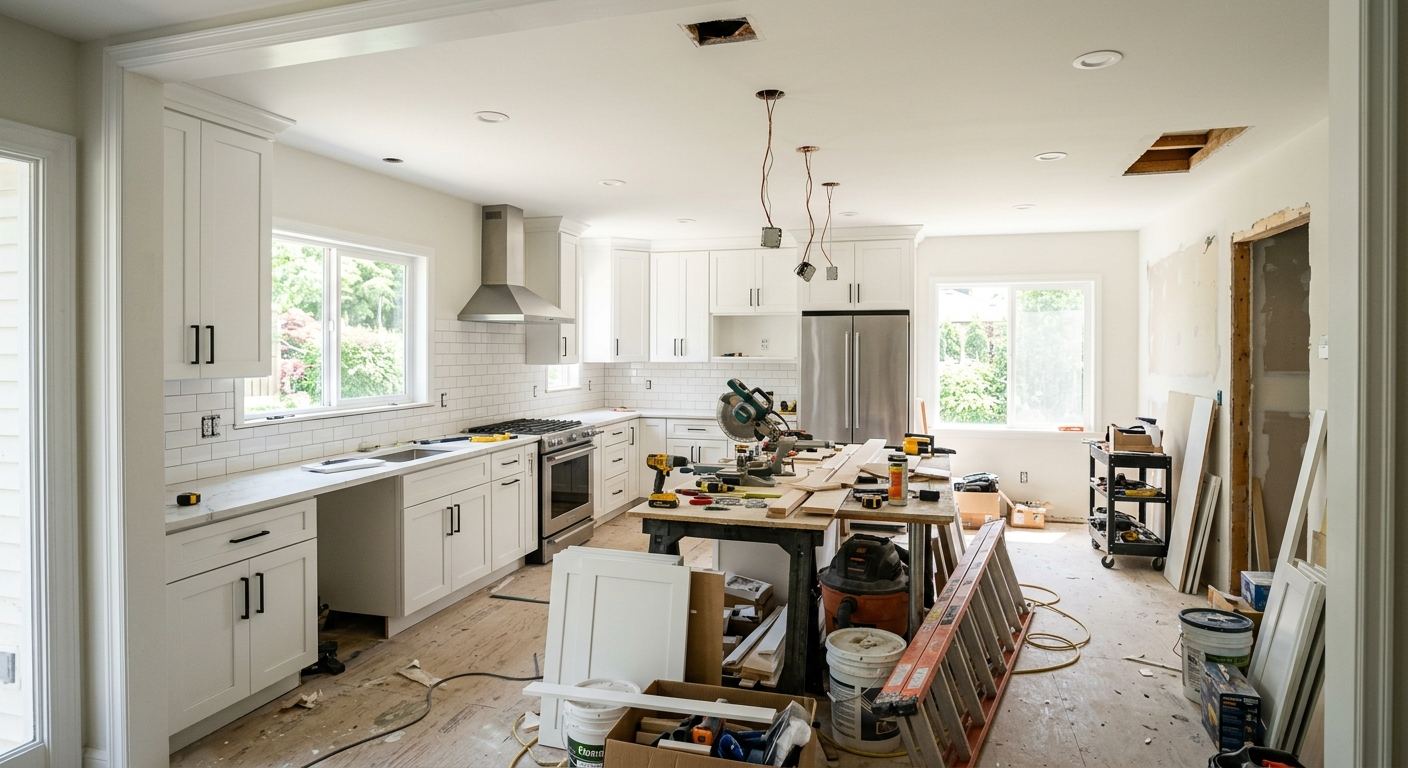
Kitchen renovation options and costs in Current River
Kitchen renovation options in Current River range from quick cosmetic upgrades to full, structural remodels, and the right choice usually comes down to how “move-ready” you want the space to feel and how long you plan to stay in the home. With a small local population of 4,744 (Statistics Canada, 2021 Census), cabinetry suppliers and countertop installers in the broader Toronto economic region may consolidate schedules, so lead times for premium materials can be a key budgeting factor. Market expectations also matter: in many GTA-style communities, higher household incomes support higher-finish kitchens that buyers recognize quickly at resale (Statistics Canada, 2021 Census). That reality affects how contractors price labour and how often homeowners step up to quartz or natural stone.
While Ontario’s weather doesn’t “create” kitchen costs, it does influence renovation scheduling. In the Toronto economic region, winter conditions can slow trade availability and delivery logistics, so projects that start in spring often price more steadily than those forced to compress timelines. Also, the Toronto market’s strong resale pull means design choices that improve perceived value—clean lines, durable surfaces, and modern hardware—are prioritized, even for mid-range renovations.
In Current River, trade demand is especially noticeable for kitchens tied to older, bungalow-style housing stock near the town’s residential core, where homeowners often renovate to modernize layouts without changing the footprint. From there, the decision typically becomes which tier fits your goals—leading directly into the comparison table below.
| Renovation Tier |
What's Included |
Typical Duration |
Price Range |
| Cosmetic refresh (paint, hardware, new appliances only) |
Paint, new cabinet hardware, appliance swap (fridge/range/dishwasher or similar), basic cleanup and minor caulking |
3–7 days |
$10,000–$25,000 |
| Mid-range full renovation (new cabinets, counters, sink, tile) |
New cabinets (stock or semi-custom), new countertops, new sink and faucet, backsplash tile, flooring repair/partial replace, disposal (if needed), plumbing refresh to match layout |
3–5 weeks |
$25,000–$65,000 |
| High-end full renovation (custom cabinets, stone counters, island) |
Custom cabinetry, premium quartz or natural stone, island with added electrical/plumbing as required, full backsplash upgrade, upgraded lighting, coordinated appliance package |
5–10 weeks |
$70,000–$90,000 |
| Cabinet refacing only (new doors + drawer fronts, same boxes) |
Remove and reface doors/drawer fronts, new trim, refinish/clean existing box, new hardware, quick backsplash refresh (optional add-on) |
1–3 weeks |
$8,000–$35,000 |
| Countertop swap only (laminate to quartz or stone) |
Remove existing tops, install new countertop material, new sink cut-out (as applicable), reseal and reinstall trim/backsplash edge details (backsplash may be separate) |
3–7 days (plus material lead time) |
$3,000–$15,000 |
| Backsplash tile installation only |
Surface prep, tile installation, grout/seal where required, caulk details at countertop and corners |
2–5 days |
$2,000–$10,000 |
Prices are estimates only and vary by project scope, site access and material selection.
What affects the price of kitchen renovation in Current River
In the Toronto economic region, two homeowners can receive quotes that differ by 30–50% for what sounds like the same kitchen—same square footage, same “new cabinets and counters”—because the quoted scope, finish tier, and how much trade coordination is included can vary widely. Local home values and household income levels shape the typical finish tier far more than climate. In higher-value pockets of the GTA, many owners default to quartz or natural stone countertops and semi-custom cabinetry because they can recoup part of the investment at resale. In more price-sensitive areas, laminate and stock cabinetry stay common, and layout tweaks are often limited to reduce risk.
In Current River specifically, a few conditions often move the needle. First, older homes can have out-of-square walls and older subfloors; that typically adds time for cabinet leveling and can push backsplash preparation costs up. Second, supply timing matters: if you choose premium stone, schedule pressure can change labour allocation and increase costs when installers must work around delivery windows. Third, homes with existing knob-and-tube or aging panels may require additional electrical coordination for modern lighting, under-cabinet LEDs, or new circuits—especially if you add an island.
Layout changes are the most unpredictable cost regardless of finish. Removing a wall, adding an island, or moving plumbing supply/drain can trigger additional framing, patching, and rework—often a bigger jump than moving from laminate to quartz. That’s why many budgets start in the mid-range (for example, $25,000–$65,000 for a full renovation) and then climb into the high tier ($70,000–$90,000) once plumbing/gas/electrical work and premium materials stack together.
| Price Factor |
Why It Matters |
Cost Impact |
| Cabinet tier — stock vs. semi-custom vs. fully custom millwork |
Higher tiers offer better fit, finishing, door quality, and internal organization, but require more shop time and on-site adjustments |
$8,000–$45,000 difference across project scopes |
| Countertop material — laminate vs. quartz vs. granite vs. stone |
Material cost and fabrication complexity drive totals; thick slabs and specialty edges increase labour and install time |
$3,000–$15,000 for swaps, higher when paired with custom islands |
| Layout change — wall removal, island add, plumbing/gas move |
Structural/framing work plus licensed trade coordination creates the largest variability between quotes |
$5,000–$30,000 depending on scope and rework |
| Appliance package tier — builder vs. mid-range vs. pro-grade |
Brand and feature levels affect price and sometimes require electrical or ventilation upgrades |
$2,000–$12,000 swing typical |
| Flooring — refinish existing vs. full replacement |
Refinishing can limit demo, while full replacement increases waste hauling, subfloor prep, and installation labour |
$1,500–$10,000 |
| Backsplash — ceramic tile vs. marble vs. full-height slab |
Complex patterns, higher-end materials, and larger coverage area increase prep, cutting and labour |
$2,000–$10,000 |
| Electrical — new circuits for island, under-cabinet lighting |
Additional circuits, switches, and lighting runs often require panel updates and more inspection time |
$1,000–$8,000 depending on panel capacity |
| Permit fees and licensed trade requirements |
Permits and inspections don’t just add cost—they also add scheduling steps and trade coordination |
$500–$4,000+ for typical regulated items |
Permits & regulations in Ontario
In Ontario, not every kitchen change needs a permit, but the changes that do require permits are the ones that most affect budget and scheduling. Generally, cabinet and countertop swaps (like replacing laminate with quartz or swapping cabinet doors for a refacing) typically do not require permits. By contrast, moving plumbing supply or drain lines, relocating gas for a stove/cooktop or venting, removing a load-bearing wall, or adding new electrical circuits for an island or additional lighting usually require permits and work by licensed trades.
Gas work must be done by a licensed gas fitter and electrical work must be done by a licensed electrician, with inspections after the work is completed. The key homeowner step is to confirm, in writing, who is responsible for permits and inspections before you sign—because the responsibility affects both cost and timeline.
To verify a contractor in Current River, start with licensing and coverage documentation:
First, ask for their Ontario licence details (where applicable) and confirm trades are licensed for their scope. Second, request a certificate of insurance (liability) showing it’s active for your project dates. Third, verify WSIB/WCB clearance or registration for the contractor and the trades they use—most reputable contractors can provide proof or clearance letters. Finally, keep copies of permit filings and inspection results if regulated work is planned.
Cabinets, countertops and layout decisions in Current River
Your three biggest decision points in a Current River kitchen renovation are cabinet tier, countertop material, and whether you change the layout. Cabinet tier is the “frame” of the kitchen: stock cabinets are the fastest and cheapest, semi-custom is usually the sweet spot for fit and cost, and custom millwork is best when you need exact dimensions, specialty storage, or a distinctive design. Countertop material drives both day-to-day durability and long-term maintenance: laminate is budget-friendly, quartz is low-maintenance and consistent, natural stone like granite adds prestige and heat tolerance, and butcher block brings warmth but needs more care.
Layout choices are where the Toronto resale mindset matters most. Buyers in this market tend to look for functional work triangles, clear sightlines, and practical storage. Removing a wall to open the space can justify the higher labour and framing costs if it meaningfully improves flow—especially in older homes where the existing layout feels closed off. Adding an island can also help, but only when clearances work; otherwise, you can end up paying for square footage you can’t use comfortably.
Climate doesn’t “ruin” kitchens in a direct sense, but Toronto-area freeze-thaw cycles and seasonal humidity swings can expose installation gaps in older buildings—so a good installer accounts for subfloor and wall variance. For a concrete example: if you’re aiming at a mid-range full renovation in the $25,000–$65,000 band, switching from laminate to quartz may be a practical step-up without blowing the budget, while adding an island plus plumbing/gas/electrical adjustments can be what pushes you closer to the $70,000–$90,000 tier.
| Option |
Durability |
Maintenance |
Best For |
Price Range |
| Stock cabinets (big-box) |
Good for light-to-moderate use; limited customization can show in fit if walls are uneven |
Low—typically wipe-clean surfaces and straightforward hardware replacements |
Fast timelines, tight budgets, straightforward layouts |
$8,000–$25,000 |
| Semi-custom cabinets (local dealer) |
Very solid; improved sizing and options for drawers and shelving |
Low—standard cabinet care; more options for organization reduce wear on doors |
Most “best value” renovations in the Toronto market |
$20,000–$45,000 |
| Custom cabinets (local millwork shop) |
Highest build quality and best alignment for older, irregular spaces |
Low—expect longer service life and replacement parts availability |
Unique layouts, specialty storage, premium buyer appeal |
$35,000–$60,000 |
| Laminate countertop |
Good daily durability; can chip at edges if impacts occur |
Easy—no sealing; avoid prolonged standing water at seams |
Cost control and quick updates for resale |
$3,000–$7,000 |
| Quartz engineered countertop |
Very durable and consistent; resistant to staining from most household foods |
Low—no sealing; wipe clean and address spills quickly at seams |
Busy households wanting a “set it and forget it” surface |
$7,000–$13,000 |
| Granite / natural stone countertop |
Excellent heat tolerance and toughness; variation in veining and finishes |
Moderate—may require periodic sealing depending on product |
Premium look where buyers expect natural materials |
$10,000–$15,000 |
| Butcher block countertop |
Strong and repairable; surface dents are possible but can be refinished |
Higher—regular oiling and drying practices are recommended |
Homeowners who want a warm, traditional feel |
$6,000–$12,000 |
| Marble countertop |
Beautiful but softer than many stones; can etch or stain with acidic foods |
Higher—requires careful cleaning and protective measures |
Low-impact, design-forward kitchens |
$12,000–$20,000 |
How to choose a kitchen renovation contractor in Current River
Choosing the right contractor in Current River is mostly about proof: proof they’re licensed for the regulated parts of the job, proof their insurance is current, and proof they can deliver an itemised scope that matches your budget. Start by verifying Ontario licensing for the trades involved (gas fitter/electrician where needed) and request liability insurance documentation for the contractor and key subcontractors. Then confirm WSIB/WCB coverage—ask for clearance letters or equivalent proof, not verbal assurances. A kitchen is one of the highest-risk renovation projects because it combines cabinetry, electrical, plumbing, and potential gas work.
Next, get 2–3 written quotes that are itemised by labour and materials (cabinet supply, countertop fabrication, demo, electrical scope, plumbing scope, tile/backsplash install, and disposal). Avoid lump sums where the exclusions are unclear. Read the scope line-by-line: what’s included for permits, what’s included for protection/dust control, and whether disposal/hauling is part of the price.
For warranties, ask for the workmanship warranty length and what it covers (and for how long). Also confirm the product/manufacturer warranties for cabinetry and countertops, and whether warranties transfer to a new owner if you sell. Finally, manage payments: never pay more than 10–15% upfront, and use a holdback until key milestones are complete—especially after countertops and tile are finished and inspected.
- Request proof of liability insurance (active policy dates) before work starts.
- Confirm WSIB/WCB clearance for the contractor and any subcontractors.
- Verify that gas work (if applicable) is done by a licensed gas fitter.
- Verify that electrical additions/changes (like island circuits) are done by a licensed electrician.
- Ensure quotes are itemised: materials, labour, and allowance amounts are separated.
- Ask whether permit fees and inspections are included when required.
- Confirm demolition and disposal/hauling are included (not “by you” later).
- Check the scope for restoration details (drywall patching, caulking, trim finishing).
- Get start date and realistic completion estimate in writing.
- Require a written warranty statement for workmanship and products.
- Use milestone-based payments; keep a holdback until punch-list is complete.
- Ask about protection: floor covering, cabinet wrapping, and dust control during demo.
Red flags: (1) quotes that are “all-in” without line items for regulated work; (2) skipping written scope on permits, disposal, or electrical/plumbing responsibilities; (3) asking for large upfront deposits (well beyond 10–15%); (4) no proof of WSIB/WCB clearance or current insurance; (5) vague timelines with no start date or phased completion plan.
Frequently asked questions — kitchen renovation in Current River
Quartz vs granite countertops — which is better?
In Current River kitchens, the “better” choice usually depends on your lifestyle and maintenance preferences. Quartz is engineered, so it’s consistent in colour and pattern, very resistant to everyday staining, and doesn’t require sealing in the way many natural stones do. Granite is natural, heat-tolerant, and can offer a premium look with unique veining, but it often benefits from periodic sealing and more careful cleaning of acidic spills. If you’re budgeting inside the mid-range renovation band, moving to quartz can fit well—countertop swaps commonly land around $3,000–$15,000 depending on size and edge profile. If you want a distinctive, natural-material statement and don’t mind maintenance, granite is a strong choice.
Should I reface or replace my cabinets?
Refacing is often the best option when your existing cabinet boxes are structurally sound—solid frames, straight sides, and no sagging or chronic moisture damage. Replacing cabinets makes more sense if boxes are warped, if you need major storage changes (like converting wide drawers to specialty pull-outs), or if you want to reconfigure the layout. In Ontario homes around Current River, refacing can also reduce demo impacts and speed up the timeline. Budget-wise, cabinet refacing typically falls around $8,000–$35,000, while a full kitchen replacement (cabinets plus counters, sink, and finishes) is usually much higher—often $25,000–$65,000 for a mid-range full renovation. The best way to decide is a contractor assessment of box condition and wall squareness.
Do I need a permit for a kitchen renovation in Ontario?
Often, simple swaps don’t require permits in Ontario: replacing cabinets and countertops typically doesn’t trigger permits. Where permits and licensed trade work come in is with regulated changes—moving plumbing supply or drain lines, relocating gas for a stove/cooktop, removing a load-bearing wall, or adding new electrical circuits (for example, island power and lighting). For Current River homeowners, the practical approach is to plan the permit-relevant work early so quotes reflect real sequencing and inspection steps. Always confirm permit responsibility in your contract. Gas work must be done by a licensed gas fitter and electrical by a licensed electrician, with inspections after completion. If you’re unsure, ask your contractor to list which items in the scope are permit-required before you sign.
What's the ROI on a kitchen renovation?
Kitchen renovations can improve resale value, but ROI varies widely by finish tier, layout quality, and how closely the design matches what local buyers expect. In the Toronto market, owners often invest in kitchens that feel durable and “move-in ready,” because perceived value matters at listing time. That’s why quartz or natural stone and semi-custom cabinetry are common choices when budgets stretch beyond a basic refresh. For budgeting, it helps to think in terms of where you’re landing: a cosmetic update can keep you closer to the lower end, while a full renovation often ranges from $25,000–$90,000 depending on tier and scope. If you add significant structural changes or premium materials without a layout improvement that buyers value, ROI can soften. The most consistent return usually comes from good workflow, modern finishes, and durable surfaces rather than overbuilding.
How do I budget for a kitchen renovation?
Start by choosing your renovation tier and locking in priorities: cabinets, countertops, and whether you’re changing the layout. A smart budgeting approach is to separate “must-haves” from “nice-to-haves” and assign ranges to each. In Current River and the broader Toronto region, full kitchen renovation budgets commonly sit in $25,000–$90,000, while cabinet refacing often sits around $8,000–$35,000 and countertop swaps around $3,000–$15,000. Build a contingency for hidden conditions—especially in older homes where walls and subfloors may not be perfectly square—because leveling and patching time can quietly add up. Finally, make sure quotes include disposal/hauling, dust protection, and any permit/licensed trade scope so your “budget” doesn’t get surprises halfway through.
Can I move my kitchen sink or stove?
Yes, you can move a sink or stove, but it’s one of the highest-cost and most permit-sensitive changes in a Toronto-area renovation. Moving a sink usually means rerouting plumbing supply and drain lines; relocating a stove (especially if it’s gas) can require gas line changes and appropriate ventilation adjustments. In Ontario, those regulated trades—plumbing/gas/electrical as applicable—typically require permits and licensed professionals. From a budgeting standpoint, layout shifts are often what push a project up a tier faster than changing finishes. If you’re considering moving either appliance, ask your contractor for a detailed plan: new line routes, connection points, venting requirements, and whether you’ll need electrical updates for fans or ignition systems. A well-designed new location can be worth it, but the scope must be clear before you sign.