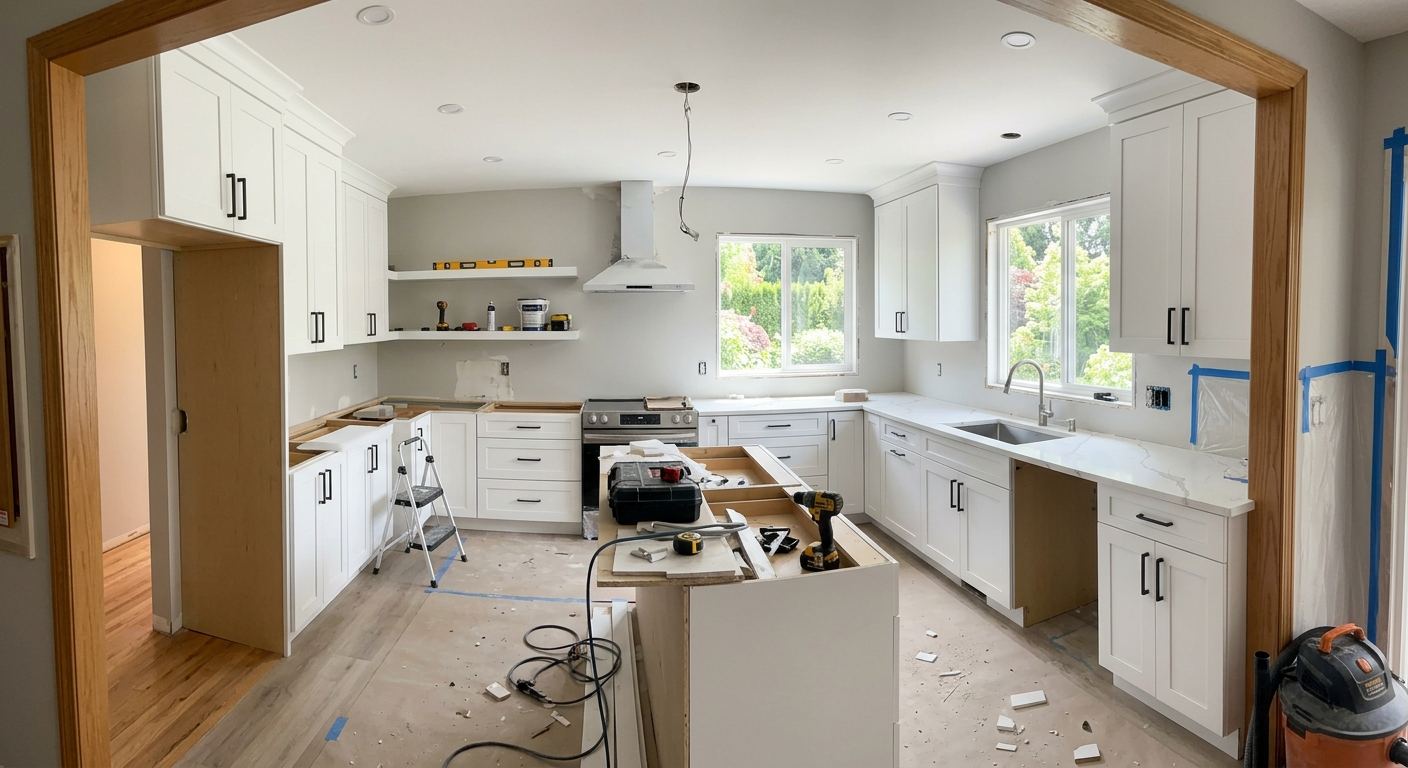
Kitchen renovation options and costs in Queenswood Heights
Queenswood Heights homeowners often start kitchen planning with a budget, then quickly realize pricing is tied to the value of the home and what buyers expect in the GTA. With a population of about 12,000 (Statistics Canada, 2021 Census), the neighbourhood has plenty of steady demand for contractors—especially around the established pockets of family homes where renovations are common. In the Toronto market, higher home values tend to pull projects toward upgraded finishes, because many owners treat the kitchen as both a day-to-day improvement and a resale asset. In practice, that means budgeting more often for quartz or natural stone and semi-custom cabinetry than for basic laminate and stock boxes.
In this region, “climate” affects kitchens indirectly—moisture control, ventilation, and freeze-thaw impacts on exterior walls and how quickly crews can access plumbing—but it doesn’t usually swing labour pricing the way finish tier does. GTA availability is also a factor: popular spring and early-summer lead times can add scheduling costs, particularly for trades that must coordinate electrical, plumbing, and cabinet installs.
Where it’s especially in demand in Queenswood Heights is the broader east-end and adjacent North York–area commute corridor, where many kitchens share similar layouts and older plumbing runs. If your goal is a fast refresh, a cosmetic package typically stays on the lower end of the local bands; if you’re moving to a full high-end build with an island and stone counters, expect to land higher within the Toronto range. Use the table below to compare realistic tiers for your project.
| Renovation Tier |
What's Included |
Typical Duration |
Price Range |
| Cosmetic refresh (paint, hardware, new appliances only) |
Paint (walls/ceilings), new cabinet hardware, lighting refresh, swap appliances (fridge, range/hood, dishwasher), basic caulking/touch-ups; no cabinet/counter rebuild |
1–3 weeks |
$25,000–$35,000 |
| Mid-range full renovation (new cabinets, counters, sink, tile) |
Install semi-custom or quality stock cabinets, new countertop (often quartz), sink + faucet, backsplash/tile, flooring touch-ups as needed, electrical allowances for task lighting |
4–8 weeks |
$35,000–$65,000 |
| High-end full renovation (custom cabinets, stone counters, island) |
Fully custom cabinetry, premium quartz/stone, island with upgraded electrical (and often new plumbing), tile to full-height areas, upgraded appliance package and refined finishing details |
8–14 weeks |
$65,000–$90,000 |
| Cabinet refacing only (new doors + drawer fronts, same boxes) |
Remove/replace doors/drawer fronts, new hinges/soft-close hardware, re-veneering, new trim where needed; counters typically not changed |
2–5 weeks |
$8,000–$25,000 |
| Countertop swap only (laminate to quartz or stone) |
Remove existing countertop, install new quartz or stone, new undermount sink/caulking allowances, minor edge/backsplash adjustments if required |
1–2 weeks |
$10,000–$15,000 |
| Backsplash tile installation only |
Tile supply and install (ceramic or similar), surface prep, grout/seal where needed, caulking at perimeter |
3–7 days |
$2,000–$10,000 |
Prices are estimates only and vary by project scope, site access and material selection.
What affects the price of kitchen renovation in Queenswood Heights
In Queenswood Heights and across the Toronto economic region, it’s common to see quotes for the “same” kitchen come in 30–50% apart. The biggest reason isn’t workmanship—it’s finish tier and how much of the job turns into coordinated work between trades. Even when total square footage is similar, homeowners in higher-value parts of the GTA often default to upgraded countertops (quartz or natural stone) and semi-custom cabinetry, which pushes projects upward. Meanwhile, price-sensitive areas may favour stock or refacing and laminate-based tops to keep the renovation closer to the lower-mid bands.
Layout changes are the most unpredictable cost driver in any Ontario kitchen. Removing a wall, adding an island, or moving plumbing/gas can trigger structural work, new rough-in, drywall patching, electrical detailing, and longer scheduling. Those items can quickly move your project from a more controlled mid-range renovation toward high-end pricing even if finishes stay similar.
Concrete examples in Queenswood Heights: (1) older homes may have supply lines and shutoffs that don’t align neatly with new sink or dishwasher locations, adding plumbing labour and parts; (2) if your backsplash must be rebuilt because cabinets are being swapped out, tile labour and prep time rise; (3) if your existing electrical panel has limited capacity for an island circuit and under-cabinet lighting, adding electrical work can increase the quoted range. As a planning baseline, a countertop-only swap may sit in the lower band around $10,000–$15,000, while a full mid-range renovation with cabinetry and tile commonly lands around $35,000–$65,000—and high-end builds with custom millwork can reach $65,000–$90,000.
| Price Factor |
Why It Matters |
Cost Impact |
| Cabinet tier — stock vs. semi-custom vs. fully custom millwork |
Pricing changes with door construction, internal hardware, sizing flexibility, and how much is made-to-fit for your walls |
Can shift a full kitchen by roughly $10,000–$35,000 depending on scope |
| Countertop material — laminate vs. quartz vs. granite vs. stone |
Material price and fabrication complexity vary; stone also has heavier finishing and template requirements |
Common swing of $3,000–$15,000 across comparable layouts |
| Layout change — wall removal, island add, plumbing/gas move |
These actions trigger rough-in work, structural considerations, and longer coordination across trades |
Often adds $8,000–$25,000 on top of finishes |
| Appliance package tier — builder vs. mid-range vs. pro-grade |
Higher tiers add ventilation performance, features, and sometimes required electrical/venting adjustments |
Can vary by $2,000–$12,000 |
| Flooring — refinish existing vs. full replacement |
Subfloor condition and height changes affect cabinet install and transitions |
Usually $1,500–$8,000 depending on replacement extent |
| Backsplash — ceramic tile vs. marble vs. full-height slab |
Premium materials need careful substrate prep and more time for layout, cuts and finishing |
Typical range shift: $2,000–$10,000 for backsplash-only scopes |
| Electrical — new circuits for island, under-cabinet lighting |
Task lighting and island outlets are labour-heavy and may require panel adjustments |
Often $1,200–$6,000+ |
| Permit fees and licensed trade requirements |
Work that touches plumbing/gas or electrical circuits needs permits and inspections, adding admin and trade scheduling |
Often $500–$3,000+ depending on the permit scope |
Permits & regulations in Ontario
In Ontario, a cabinet and countertop swap usually doesn’t require permits. That includes replacing existing cabinets in place (or refacing) and installing new countertops on the same footprint—assuming you’re not moving plumbing, gas, or structural elements. However, permits become necessary when you change the systems under the sink or behind walls.
Work that typically DOES require permits and licensed trades includes: relocating or adding plumbing supply/drain lines (sink, dishwasher, or fridge water lines when the route changes), moving a gas range or making changes to gas supply, relocating a range hood when it involves gas or new ducting that changes existing venting, removing a load-bearing wall, and adding new electrical circuits (for example, an island outlet circuit or rewiring to accommodate new appliances and under-cabinet lighting). Gas work must be done by a licensed gas fitter, and electrical work by a licensed electrician; both require inspections after completion.
For a homeowner in Queenswood Heights, verification should happen in writing before you sign: (1) ask for the contractor’s Ontario licence details and the licence numbers for the licensed plumber/electrician/gas fitter they’ll sub; (2) request a certificate of insurance (liability) and confirm coverage amount; (3) ask whether they carry WSIB/WCB coverage where applicable and obtain proof; and (4) confirm who pulls permits—many delays happen when that responsibility isn’t clearly assigned. A good contract clearly spells out permit responsibility, inspection scheduling, and disposal.
Cabinets, countertops and layout decisions in Queenswood Heights
The three most consequential decisions in a Queenswood Heights kitchen renovation are cabinet tier, countertop material, and layout. These choices drive not only cost but also how quickly your kitchen updates feel “complete” once the dust settles. Start with cabinet tier: stock is the fastest and usually the lowest-cost option, semi-custom is the most popular mid-range because it balances fit and pricing, and custom cabinetry delivers the tightest fit and best storage planning. Next, pick the countertop material. Laminate can look great with the right edge and backsplash combination, but it’s more sensitive to heat and impacts. Quartz and natural stone offer a higher-end appearance and better long-term durability in a busy Toronto household.
Finally, decide whether to change the layout. Open-concept wall removal or island additions can be justified when they create usable work zones—especially in kitchens where the current plan feels narrow. But plumbing and gas relocation adds complexity. In Queenswood Heights, where many older homes have dated rough-ins, moving sink drains or gas connections can add labour and scheduling time regardless of finish tier. If your budget is closer to the mid-range—around $35,000–$65,000—consider keeping the plumbing footprint and putting the money into semi-custom cabinetry and quartz. If you’re targeting a high-end result—$65,000–$90,000—that’s where a stone countertop upgrade and island electrical/plumbing changes usually feel most worth it because the overall kitchen becomes a coordinated “showpiece.”
Bottom line example: choosing quartz instead of laminate often adds several thousand dollars in a typical full renovation, but it can prevent replacement and refinishing headaches sooner—making it a better value than spending the same amount on a major layout move you don’t truly need for resale appeal.
| Option |
Durability |
Maintenance |
Best For |
Price Range |
| Stock cabinets (big-box) |
Good for standardized dimensions; less forgiving if walls aren’t square |
Easy parts support; limited custom adjustment |
Fast timelines and straightforward layouts |
$8,000–$25,000 |
| Semi-custom cabinets (local dealer) |
Strong construction; better fit options for typical Toronto wall variations |
Wipe-clean finishes and reliable hardware upgrades |
Most Queenswood Heights mid-range renovations |
$15,000–$45,000 |
| Custom cabinets (local millwork shop) |
Best fit, best storage planning, and higher-end hardware options |
Usually easy to maintain, but requires careful specification |
Complex layouts, islands, and “forever home” kitchens |
$35,000–$70,000 |
| Laminate countertop |
Solid for everyday use; heat and deep cuts can show wear |
Wipe clean; avoid excessive heat and harsh abrasives |
Budget-focused refreshes with updated cabinets |
$3,000–$8,000 |
| Quartz engineered countertop |
Very durable; resistant to staining and daily wear |
Low-maintenance, typically no sealing |
Resale-friendly, low-hassle Toronto kitchens |
$8,000–$15,000 |
| Granite / natural stone countertop |
Hardwearing; unique variation and natural character |
May require periodic sealing; protects against etching depending on stone |
Premium look where you want natural variation |
$10,000–$20,000 |
| Butcher block countertop |
Durable with proper care; can mark if abused |
Needs regular oiling and careful spill discipline |
Warm “country-modern” kitchens and lighter-use worktops |
$6,000–$15,000 |
| Marble countertop |
Beautiful but more prone to staining/etching |
Higher maintenance; requires sealing and gentle cleaning |
Showpiece kitchens with strong care routines |
$15,000–$25,000 |
How to choose a kitchen renovation contractor in Queenswood Heights
When you’re selecting a kitchen renovation contractor in Queenswood Heights, start by verifying Ontario licensing and coverage—then only after that, compare pricing. Ask who will be doing plumbing, electrical and any gas work, and request evidence for each licensed trade. For liability insurance, get a certificate of insurance and confirm it matches the scope and coverage amount. For WSIB/WCB coverage, ask how the contractor handles compliance for their crews and obtain proof. If a contractor can’t provide documentation quickly, treat that as a red flag.
Next, get 2–3 itemised written quotes instead of one lump-sum. You want a labour + materials breakdown so you can see what’s included for demolition, cabinet install, countertop templates, electrical allowances, plumbing allowances, disposal, and any tile/moulding finishing. Make sure the quote addresses what’s excluded (for example, subfloor repairs, moving the fridge water line, or hidden water damage behind base cabinets). Permit pull responsibility should also be explicit: included or not included, and who schedules inspections.
Finally, protect your cash flow. A typical payment schedule should not exceed 10–15% upfront, with a holdback until key milestones are completed. Require a start date and a completion estimate in writing.
- Request licence details for the main contractor and each licensed trade involved.
- Obtain a current certificate of liability insurance before work begins.
- Ask for proof of WSIB/WCB coverage and confirm it covers the crews on your job.
- Get 2–3 quotes with itemised line items (labour and materials separate).
- Confirm disposal is included (dump fees and haul-away).
- Check whether countertop fabrication and template time are included in the timeline.
- Verify backsplash/tile underlayment prep and waterproofing scope where applicable.
- Ask who is responsible for permits and inspections for plumbing/electrical/gas changes.
- Clarify warranty length for workmanship (and whether the product warranties are transferable).
- Confirm change-order process: written approval required before additional cost.
- Set payment milestones tied to specific deliverables—not vague “progress.”
- Require start date, subsequence dates (demo, rough-in, install), and completion estimate in writing.
In Queenswood Heights, watch for these red flags: (1) only one lump-sum price with no breakdown; (2) unwillingness to provide insurance/WSIB/WCB proof; (3) vague warranty terms or no stated workmanship warranty period; (4) missing permit responsibility details; and (5) demanding large upfront payments (well beyond 10–15%) without clear milestones.
Frequently asked questions — kitchen renovation in Queenswood Heights
What order do kitchen renovation steps happen in?
In Queenswood Heights, the most common renovation flow is demolition first, then rough-ins, then cabinetry/countertops, then finishes. Typically, we start with layout confirmation and measurements, followed by demolition of the existing cabinets, backsplash, and any flooring needed for proper installation. Next comes rough-in work: electrical outlets and under-cabinet lighting runs, plus any plumbing or gas adjustments if you’re changing the sink location or range connection. After inspections, we install cabinets, then template and fabricate countertops, and finish with trim, backsplash, caulking, and final hardware/appliance hookups. If you’re doing a mid-range full renovation (often $35,000–$65,000), this sequencing helps avoid delays, especially around countertop templating and trade scheduling in the Toronto market.
Can I live at home during a kitchen renovation in Queenswood Heights?
Many Queenswood Heights homeowners can live at home, but it depends on the duration of rough-in work and whether your kitchen becomes fully inoperable. During a cosmetic refresh, you can often keep a functional cooking area with minimal disruption. During a full renovation, especially where cabinets and countertops are removed, most households set up a temporary kitchen in another room (microwave, kettle, small fridge) while keeping a clear path for deliveries and waste. Dust control is key—use containment and daily cleanup to reduce settlement in HVAC returns. If your project includes plumbing/electrical changes, expect longer “no-sink” or “no-cook” windows. A mid-range renovation typically moves through phases that can still be lived with, but high-end projects with islands and stone counters (often $65,000–$90,000) usually mean more weeks of partial kitchen access.
Should I renovate my kitchen before selling in Queenswood Heights?
If you’re selling in Queenswood Heights soon, the best strategy is usually to prioritize improvements that buyers notice immediately—clean lines, modern finishes, and good lighting—without overbuilding for the home’s current value. Toronto buyers often expect updated countertops, functioning layout, and a cohesive look (cabinet hardware, backsplash, and appliance finishes that match). If your budget can support it, a mid-range full renovation (commonly $35,000–$65,000) can refresh both appearance and perceived functionality. But if your plan requires major layout changes or expensive custom millwork, consider timing and resale risk—those costs don’t always translate 1:1 in every purchase price bracket. In older homes, fixing underlying issues—water damage under cabinets, outdated electrical outlets, or poor ventilation—can improve both sale readiness and future stability.
What's the most popular kitchen style in Queenswood Heights right now?
Queenswood Heights kitchens right now typically lean modern-transitional: simple cabinet lines, soft-close hardware, and warm neutral palettes. White, greige, and light wood tones are common for cabinetry, with quartz as the go-to countertop because it’s low maintenance for busy households. Many renovations also include an island with seating, plus a practical backsplash that ties the countertop and flooring together. The style preference also reflects the resale mindset across the Toronto market—buyers tend to respond well to clean, durable finishes rather than highly niche materials. If you’re doing a smaller refresh, hardware and appliance upgrades can modernize the look quickly. If you’re aiming for a full update, most owners choose semi-custom cabinets and quartz to land in the mid-range band of $35,000–$65,000.
How do I know if I need to update my kitchen plumbing in Queenswood Heights?
You may need plumbing updates if you’re moving the sink/dishwasher, encountering slow drains, frequent leaks under the sink, or noticing aging shutoffs that don’t fully shut. In older Queenswood Heights homes, supply lines can be misaligned with new layouts, and drain piping may need rework when cabinets are replaced. Another common trigger is appliance upgrades—dishwasher installation sometimes changes water feed requirements, and fridge water lines need proper connection and routing. If you’re keeping the same plumbing footprint, you might only need valve replacements and proper sealing during installation. If you are relocating plumbing, expect additional labour and likely permit/inspection requirements for the altered supply/drain lines. A good contractor will inspect shutoffs, trace connections, and confirm what’s required before finalizing your quote, especially if your budget is around $25,000–$90,000 for full projects.
What is the difference between a galley and open-concept kitchen?
A galley kitchen is typically a narrow, corridor-style layout with counters on two opposing walls and a smaller open area in between. It’s efficient for workflow but can feel closed off, especially in family homes where cooking and entertaining overlap. An open-concept kitchen removes or reduces barriers between the kitchen and adjoining living/dining space, allowing sightlines and easier hosting. In Ontario, an open-concept change often involves more than just removing cabinets—if you remove a load-bearing wall, that’s a structural change and can require permitting and licensed oversight. In Queenswood Heights, many renovations keep the plumbing footprint and renovate within the existing envelope to control costs, but if your goal is a true open-concept experience, it’s usually where budgeting for a high-end full renovation becomes more realistic (often $65,000–$90,000), because electrical, venting, and finishes coordinate at a higher level.