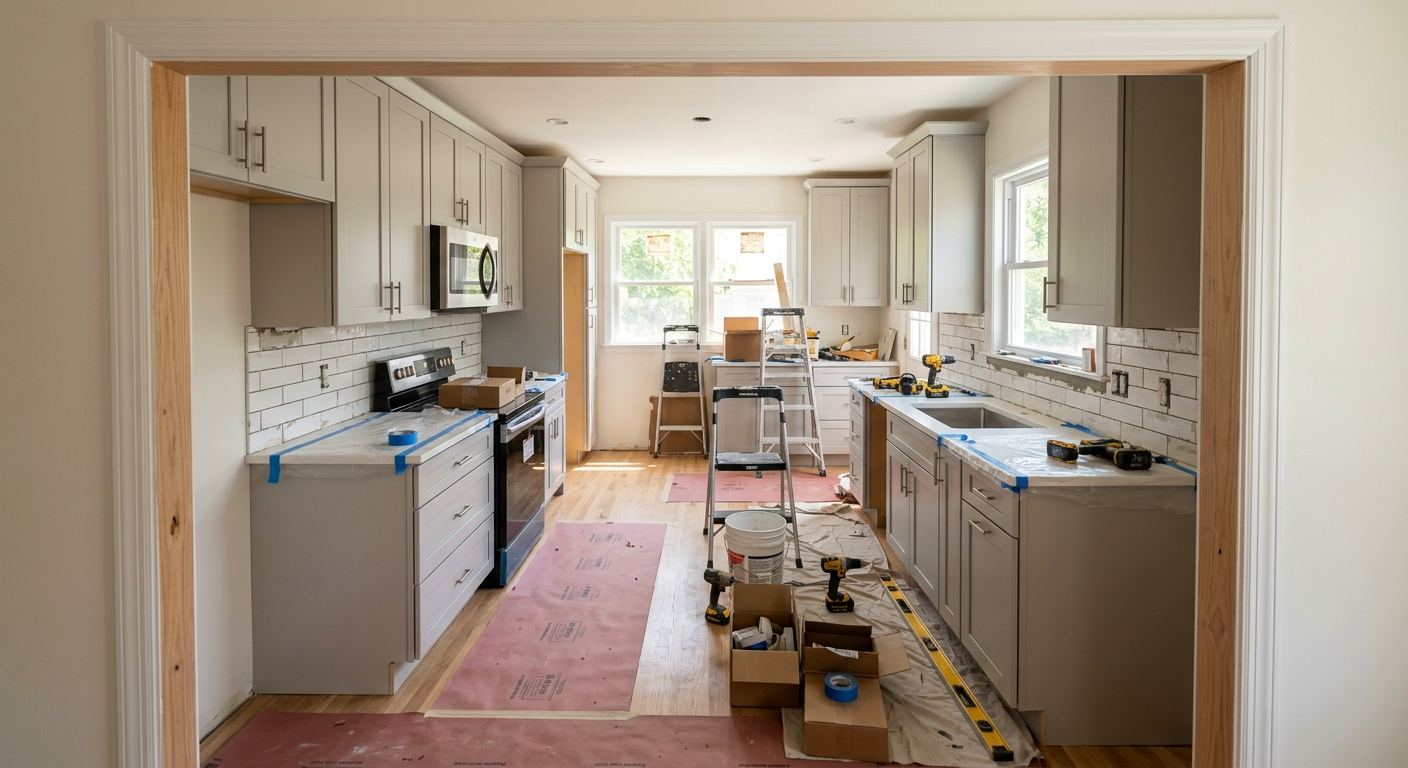
Kitchen renovation options and costs in Conservation
Conservation homeowners typically start their kitchen plans by comparing options that fit both their home’s value and their daily needs. With only 3,095 residents in the 2021 Census profile (Statistics Canada, 2021 Census), many renovations are concentrated in owner-occupied homes where kitchens are a high-visibility part of the property. In Conservation’s broader Toronto economic orbit, finish choices often reflect local market expectations: households frequently favour upgrades that look “new” and photograph well for resale, even when the structural work is modest. While individual incomes vary, Toronto-area demand tends to push buyers toward durable, low-maintenance materials, especially quartz and upgraded appliance packages. In this region, projects commonly align with the broader GTA pattern where homeowners invest a meaningful share of home value into the kitchen—often in the 8–15% range in higher-priced pockets of the Toronto market—because the perceived value carryover matters at listing time.
Cost pressure in the Toronto economic region is less about weather and more about what contractors can schedule and what materials are prioritized. Contractors can usually support typical install windows across Ontario, but kitchen timelines are still influenced by supply lead times (cabinet manufacturing and stone fabrication) and the sequencing of trades when electrical, plumbing, or gas work is required. In Conservation and nearby demand pockets such as the downtown/older-housing areas (where layout changes are common in legacy homes), the most frequent budget swing is finish tier plus whether the job is purely cosmetic or a full functional refresh. Use the table below to compare renovation tiers and realistic ranges for projects that match the regional market.
| Renovation Tier |
What's Included |
Typical Duration |
Price Range |
| Cosmetic refresh (paint, hardware, new appliances only) |
Cabinet paint (or touch-up), new hardware, wall paint, new appliances (like-for-like), basic cleaning/caulking; no cabinet box changes |
3–7 days |
$8,000–$20,000 |
| Mid-range full renovation (new cabinets, counters, sink, tile) |
Semi-custom or stock cabinets, quartz or laminate counters, sink & tap, backsplash tile, updated lighting (where no major rewiring), labour for demo and install |
2–4 weeks |
$25,000–$60,000 |
| High-end full renovation (custom cabinets, stone counters, island) |
Custom millwork, premium stone (granite/stone or high-end quartz), island base with seating, upgraded appliances package, full backsplash, upgraded electrical for island lighting |
4–8 weeks |
$65,000–$90,000 |
| Cabinet refacing only (new doors + drawer fronts, same boxes) |
New door/drawer fronts, refinishing/laminate or veneer update to visible cabinet faces, hardware changes; counters unchanged unless bundled |
1–2 weeks |
$8,000–$35,000 |
| Countertop swap only (laminate to quartz or stone) |
Remove old laminate, prep surfaces, install new quartz/stone, basic edge finishing; assumes no major under-mount sink move |
2–5 days |
$3,000–$15,000 |
| Backsplash tile installation only |
Tile supply and install, new trim/caulking, grout sealing where applicable; assumes walls are ready and flat enough |
2–4 days |
$2,000–$10,000 |
Prices are estimates only and vary by project scope, site access and material selection.
What affects the price of kitchen renovation in Conservation
In Conservation, it’s common to see quotes for what sounds like the “same” kitchen land 30–50% apart once you compare the details. The biggest driver isn’t usually climate; it’s that Toronto-area pricing is tied to local home values and homeowner expectations. When a kitchen renovation is positioned for resale, higher-value neighbourhoods in the Toronto economic region tend to default to quartz or natural stone counters and semi-custom cabinetry because those materials look premium and hold up under daily use. In more price-sensitive outer markets around Brampton and parts of Mississauga, many homeowners aim for mid-range refreshes—stock or refaced cabinets with laminate or mid-tier quartz—to balance resale value with affordability. That finish-tier difference alone can swing a project from the lower-mid bands (for example, mid-range full renovations in the $25,000–$60,000 range) into higher-end territory where budgets stretch toward $65,000–$90,000 with islands and stone.
Local conditions that raise costs in Conservation often include older housing stock with out-of-date electrical or plumbing runs. For example, adding under-cabinet lighting and new circuiting for an island can add labour that isn’t obvious until the electricians open up walls. Similarly, changing the layout—removing a wall, adding an island, or moving a gas line or drain—introduces the most unpredictable costs regardless of cabinet tier. A practical example: swapping laminate to quartz may land in the $3,000–$15,000 range, but moving the sink to a new location can push the same countertop project into a larger renovation band because plumbing rough-ins and patching are required. In Conservation’s freeze-thaw seasons, good ventilation and water management matter more than “weatherproofing”: sealed caulking at tile edges, proper under-sink protection, and well-installed backsplashes reduce callbacks. Finally, supply timing can affect labour scheduling—if stone templating and cabinet lead times stretch, crews may spend more hours on site coordination, especially on renovation projects with staggered inspections.
| Price Factor |
Why It Matters |
Cost Impact |
| Cabinet tier — stock vs. semi-custom vs. fully custom millwork |
Speeds up install and defines how closely the kitchen fits your space (and how many modifications are needed) |
Typically swings the project by about $8,000–$35,000 when comparing refit tiers and full cabinet replacement levels |
| Countertop material — laminate vs. quartz vs. granite vs. stone |
Material pricing, edge complexity, and fabrication time change both cost and schedule |
Can add roughly $3,000–$15,000 versus basic laminate, depending on size and cut-outs |
| Layout change — wall removal, island add, plumbing/gas move |
Creates extra trades work and inspection steps beyond “surface” renovations |
Commonly adds $10,000–$30,000 even before premium finishes, based on complexity |
| Appliance package tier — builder vs. mid-range vs. pro-grade |
Premium units cost more and may require electrical and venting upgrades |
Typically $2,500–$12,000 difference depending on package and whether venting needs changes |
| Flooring — refinish existing vs. full replacement |
Flooring ties into cabinet base lines, transitions, and underlayment choices |
Often $2,000–$8,000 depending on whether joists/underlay work is needed |
| Backsplash — ceramic tile vs. marble vs. full-height slab |
Higher-cost materials and larger coverage increase labour time and edging/detailing |
Often shifts by $2,000–$10,000 for tile-only work or upgrades |
| Electrical — new circuits for island, under-cabinet lighting |
More points (outlets, lighting, range hood controls) can require new runs and new breakers |
Often $1,500–$6,000 depending on how many additions are required |
| Permit fees and licensed trade requirements |
When plumbing, gas relocation, electrical additions, or structural changes occur, costs and scheduling change |
Can add $500–$5,000 plus coordination time where permits are required |
Permits & regulations in Ontario
In Ontario, not everything in a kitchen reno triggers a permit, but some of the most expensive-looking changes do—especially when services move. In most cases, cabinet and countertop swaps alone do not require permits. If you’re replacing existing cabinets, reinstalling counters, changing a backsplash, or swapping like-for-like fixtures without rerouting supply/drain, you can usually stay in the “no permit” zone. However, permits and licensed trades are typically required when you move or add services: moving plumbing supply or drain lines, relocating a gas stove or any gas connection, removing a load-bearing wall, or adding new electrical circuits (for example, dedicated outlets and lighting for an island). Gas work must be performed by a licensed gas fitter and electrical work by a licensed electrician, with inspections tied to the work.
For homeowners in Conservation, the practical process is straightforward. Step 1: ask your contractor for their current business information and licences—don’t rely on verbal confirmation. Step 2: request a certificate of insurance showing liability coverage and verify their proof is current. Step 3: confirm WSIB/WCB coverage documentation (or the appropriate clearance/coverage proof) for workers performing the work. Step 4: before signing, ensure the contract clearly states who pulls permits when required and who schedules inspections. Finally, review the scope line-by-line: “permit included” and “disposal included” should be explicit, not assumed.
Cabinets, countertops and layout decisions in Conservation
The three most consequential decisions in a Conservation kitchen renovation are usually cabinet tier, countertop material, and whether you change the layout. First, choose a cabinet tier with your timeline and fit in mind. Stock cabinets are the fastest and typically the lowest-cost path, but they can require more fillers on older, less-standard walls. Semi-custom cabinets are often the most popular mid-range choice in the Toronto resale market because they balance affordability with better sizing. Custom cabinets cost more, yet they can solve “real house” problems—out-of-square corners, non-standard ceiling heights, or the desire for integrated panels and a true full-height look.
Second, countertop material determines both day-to-day maintenance and the feel of the kitchen. Laminate is budget-friendly and practical for lower-risk refreshes. Quartz delivers a strong mix of durability and low maintenance, which aligns with what buyers expect at many GTA price points. Granite/natural stone looks high-end and is resilient, but it typically benefits from sealing and careful stain management. If you want warmth and a softer aesthetic, butcher block can work—just plan for ongoing care. Marble is beautiful, but it’s more susceptible to etching and staining, which matters in a busy family kitchen.
Third, layout changes are where budgets can jump unpredictably. Opening up with a wall removal, adding an island, or relocating plumbing/gas can be justified if you gain functional space (better work triangle, improved seating flow, or resolved bottlenecks). But if you’re not gaining clear space, it’s often smarter to invest in cabinets and counters. As a concrete example: a countertop swap alone can fall around $3,000–$15,000, but moving the sink with new drain and supply runs often expands the job into the $25,000–$60,000 mid-range band because plumbing work and added patching/finishing are involved.
| Option |
Durability |
Maintenance |
Best For |
Price Range |
| Stock cabinets (big-box) |
Good for everyday use; durability depends on cabinet construction and finish quality |
Low; wipe-clean finishes, avoid harsh abrasives on painted surfaces |
Quick installs and tighter budgets where the plan fits standard dimensions |
$8,000–$20,000 |
| Semi-custom cabinets (local dealer) |
Very good; better sizing options and more finish selections |
Low; typically easier to keep consistent because surfaces are factory-finished |
Most Toronto-area resale-focused renos aiming for an updated, “tailored” look |
$15,000–$35,000 |
| Custom cabinets (local millwork shop) |
Excellent fit and build quality; can integrate features like full-height panels |
Low to moderate; depends on finishes and any specialty hardware |
When you need exact dimensions, integrated storage, or a statement design |
$30,000–$60,000 |
| Laminate countertop |
Decent for light-to-moderate use; sensitive to burns and prolonged moisture at seams if poorly installed |
Easy daily cleaning; avoid cutting directly on surface; keep edges well-sealed |
Budget refreshes where resale value is improved mainly through the overall look |
$3,000–$7,000 |
| Quartz engineered countertop |
High durability; resists stains and impact better than many laminate options |
Low; wipe-clean and avoid extreme heat exposure |
High-demand GTA choice for low maintenance and consistent appearance |
$6,000–$12,000 |
| Granite / natural stone countertop |
Very durable; varies by stone selection and finish |
Moderate; sealing and stain management are important for long life |
Homeowners wanting natural variation and a premium look |
$8,000–$15,000 |
| Butcher block countertop |
Durable if cared for; can dent or scratch but is repairable |
Higher; needs periodic oiling and protection from standing water |
Warm, lived-in style kitchens where you’re willing to maintain the surface |
$5,000–$10,000 |
| Marble countertop |
Stylish and sturdy, but can be more vulnerable to etching and staining |
Higher care; use coasters and avoid acidic spills |
Statement kitchens where aesthetics matter most and the kitchen isn’t heavily abused |
$10,000–$20,000 |
How to choose a kitchen renovation contractor in Conservation
Choosing the right contractor in Conservation comes down to proof, clarity, and accountability—not just a good-looking portfolio. First, verify Ontario licensing and insurance. Ask for licence details relevant to the trades they perform, and confirm liability insurance is current. For worker coverage, request documentation for WSIB/WCB (or a clearance letter where applicable) so you’re not left responsible if something goes wrong. You can also confirm business standing and credentials through the appropriate Ontario online resources, and always match what you see online to what’s written in your contract.
Second, get 2–3 itemised written quotes. A proper quote separates labour and material line items (cabinet installation vs. cabinet supply, countertop fabrication/installation, tile labour, electrical and plumbing allowances). Avoid lump sums that hide what’s included. Third, read the scope carefully: confirm whether permits are included, who pulls them if needed, whether disposal and protection (floors, countertops, stairs) are included, and what happens if the site conditions are worse than expected.
Fourth, confirm warranty terms. You want a workmanship warranty length in writing, plus the manufacturer warranty details for cabinets, countertops, and appliances. Ask whether warranties are transferable to future buyers if you sell. Fifth, manage payment responsibly: never pay more than 10–15% upfront; use holdback until key milestones are complete, and tie the final payment to punch-list items and sign-off. Finally, timeline matters: get the start date and completion estimate in writing, including assumptions for cabinet and stone lead times.
- Provide itemised labour + material breakdown (no “materials allowance” vagueness without numbers).
- Include permit responsibility explicitly in the contract (who pulls, who pays, who schedules inspections).
- List disposal and dump fees (and confirm protection of floors and walls during demo).
- Confirm who handles site measures for counters and the exact templating process.
- Verify liability insurance certificate is current before work starts.
- Request WSIB/WCB coverage proof or applicable clearance documentation for workers.
- Ask for an illustrated scope of what’s excluded (for example: subfloor repairs, drywall patching, re-tiling beyond the backsplash).
- Get cabinet warranty details in writing and confirm what voids coverage.
- Ensure a workmanship warranty is offered (length, coverage items, and claim process).
- Use a payment schedule with milestones and a holdback until punch list completion.
- Confirm trade scheduling sequence (demo → rough-ins → install → finish) and any lead-time assumptions.
- Request references from similar GTA-style kitchen renos and ask about change-order handling.
Red flags in Conservation include: overly vague scopes (“allowances” without defined amounts), refusal to put licence/insurance/coverage proof in writing, change orders issued after work is already done without documented approvals, timelines that ignore cabinet/stone lead times, and a payment plan that asks for large upfront deposits beyond about 10–15%.
Frequently asked questions — kitchen renovation in Conservation
What's the ROI on a kitchen renovation?
In Ontario—including Conservation—kitchen ROI is usually strongest when the upgrade improves what buyers see and feel immediately: updated cabinets, durable countertops, and a cohesive finish palette. That said, ROI isn’t guaranteed because it depends on how your renovation compares to your home’s current condition and how the market values kitchens in your neighbourhood. In the broader Toronto economic region, many owners invest in finishes that photograph well and stand up to daily use—often aligning with mid-range budgets such as $25,000–$60,000 for functional refreshes, or higher ranges like $65,000–$90,000 for custom islands and stone. The biggest ROI accelerators are avoiding unnecessary layout moves, choosing durable countertop materials (like quartz), and keeping the design consistent with typical buyer expectations for resale. Avoid “overbuilding” relative to your home’s overall price point; that’s where ROI can slip.
How do I budget for a kitchen renovation?
Budgeting in Conservation works best when you start by choosing a renovation tier, then allocating money to the biggest cost drivers: cabinets, countertops, and any layout/service changes. If you’re keeping plumbing and electrical mostly the same, you’re usually in a predictable band: cabinet refresh or refacing, backsplash, and counter swaps can stay closer to the mid-range ranges (for example, countertops installed around $3,000–$15,000). If you add an island, remove a wall, or move gas/plumbing, plan for more uncertainty and reserve budget for permits and rough-in trade work—these are the items that can push projects upward quickly. Also include contingency for site conditions common in older housing stock (out-of-square walls, dated wiring, or patching needs). A practical rule: get itemised quotes, confirm inclusions (permits, disposal, patching), and ensure allowances are clearly defined so your final cost doesn’t drift.
Can I move my kitchen sink or stove?
Yes, you can move a sink or stove, but in Ontario it’s not “just carpentry”—it triggers licensed trade work and often permits. Moving a kitchen sink usually means rerouting drain and supply lines, which typically requires plumbing work planned to meet code and allow proper venting and drainage. Moving a stove depends on whether it’s electric or gas; for gas appliances, any relocation or connection work must be completed by a licensed gas fitter, and you should expect inspections and permits. If the move includes adding an island or relocating the range hood ducting, electrical and venting coordination can add cost and scheduling complexity. Before you sign, ask your contractor to list exactly what’s included in the quote: rough-in work, permit pull responsibility, inspections, and whether the cabinetry and countertops will be re-templated. This clarity prevents change orders later.
What's the most cost-effective kitchen upgrade?
The most cost-effective upgrade usually depends on what’s outdated in your current kitchen, but two options are consistently strong: a cabinet-level change (refacing or repainting) and a countertop upgrade. If your cabinet boxes are solid, cabinet refacing can deliver a major visual refresh without the full demo and rebuild of a replacement install; refacing-only projects commonly land in the $8,000–$35,000 band. If your cabinets and layout are functional but the surface looks dated, swapping laminate for quartz or natural stone can be a high-impact improvement with relatively contained scope—often in the $3,000–$15,000 range for countertop installation. Finally, a backsplash tile update can modernize the room quickly, commonly around $2,000–$10,000 when it’s the only new tile work. In Conservation’s housing stock, these “surface-forward” upgrades are often the best value because they avoid the permit-triggering work tied to plumbing/gas/electrical changes.
Custom vs stock cabinets — is custom worth it?
Custom cabinets are worth it when you have non-standard dimensions, a clear design goal (like integrated panels, specialty storage, or a precise layout), or you’re trying to solve layout constraints that stock lines can’t handle well. Stock cabinets are typically the fastest and lowest-cost path because they’re standard-sized and simpler to install; semi-custom often lands in the middle as the most popular resale-focused option. In practice, the ROI question is tied to what you’re spending versus what the market can “see” and value in a listing. If custom adds features that improve function—like better pantry storage, full-height finishes, or a kitchen flow that reduces unusable space—it can justify the extra cost. If your room is reasonably standard and your goal is mainly a refreshed look, semi-custom may capture most of the “tailored” benefit at a lower budget. In the GTA market reality, many homeowners stay mid-range—especially when trying to balance budgets such as $25,000–$60,000—by choosing semi-custom cabinets and durable countertops like quartz.
How do I choose a kitchen contractor in Conservation?
Start by verifying credentials and coverage. In Ontario, confirm the contractor’s appropriate licences for the trades involved, and request proof of liability insurance. Ask for WSIB/WCB coverage documentation (or clearance where applicable) so you understand who is responsible for workers on site. Next, get 2–3 itemised quotes with a labour and materials breakdown—kitchen renovations can differ by 30–50% even when the scope sounds similar, because cabinet tier, countertop material, and permit-related work change the real labour plan. Review the contract scope carefully: what’s included for permits, disposal, and patching; and what exclusions apply if your walls or services are older. Make sure the payment schedule is responsible (no more than 10–15% upfront) and hold back a portion until the punch list is complete. Finally, check warranty terms: workmanship length, product warranties, and whether warranties are transferable.