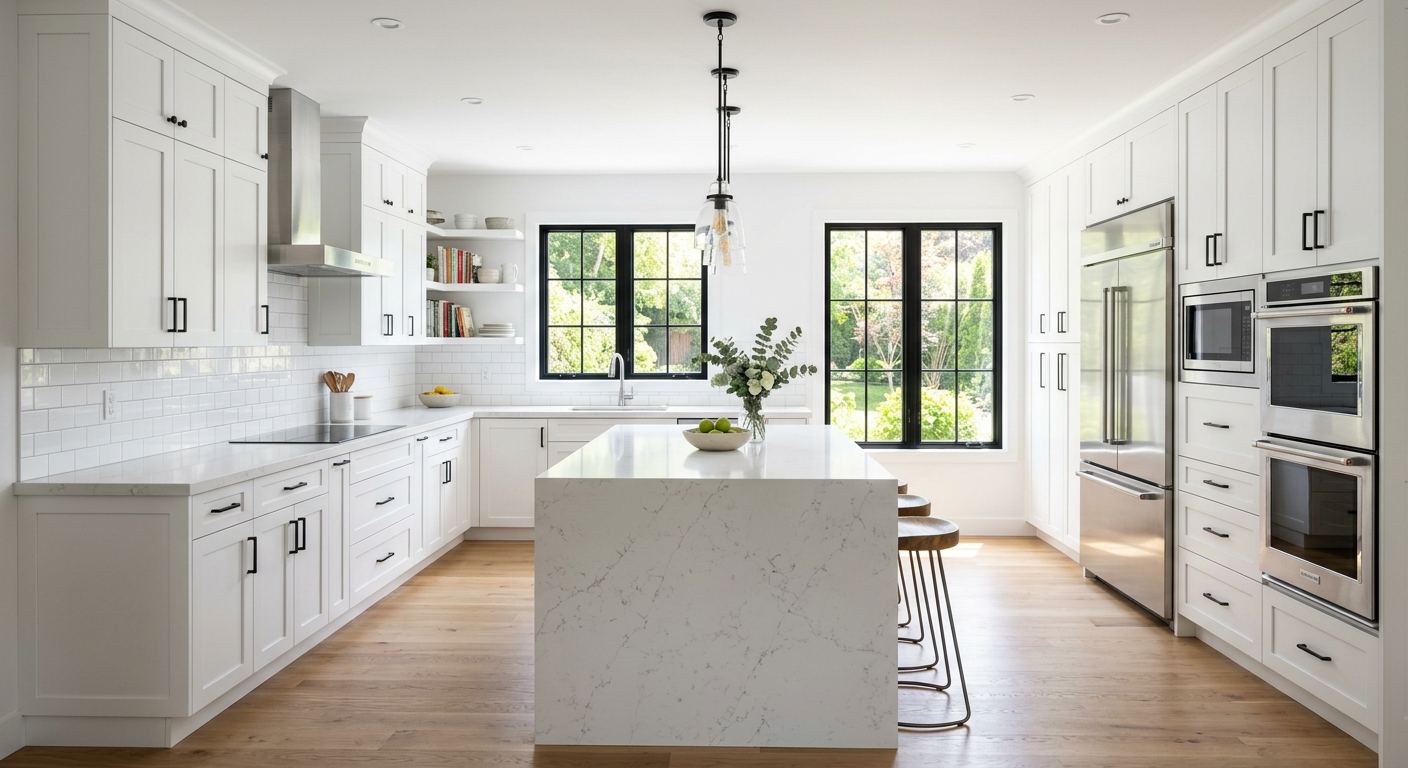
Kitchen renovation options and costs in Brockville
Brockville homeowners usually have three clear paths when planning a kitchen renovation: a cosmetic refresh, a mid-range full renovation, or a higher-end build. With a median household income of $63,600 (Statistics Canada, 2021 Census), many families in town target finishes that look “updated” but stay within a predictable budget. Brockville’s housing mix also matters—single-detached homes make up 47.5% of dwellings, and a large share of the local stock (71.6%) predates 1981, so you’re often renovating around older plumbing runs, original electrical layouts, and framing that limits where cabinets and islands can land without extra work.
In the Kingston–Pembroke economic region, kitchen costs track more closely with buyer expectations and home value than with weather. Contractors typically tell clients to plan about 7–10% of the home’s value for a full kitchen renovation, and that lines up with the region’s mix of modest starter homes and higher-value pockets. Availability also plays a role: demand is steadier in larger hubs across the region (like Kingston), but Brockville still sees bursts in spring and early summer when trades focus on occupied homes—so lead times and labour pricing can tighten seasonally.
Local work is especially in demand in and around the downtown core and nearby neighbourhoods where many older homes were built with compact kitchen footprints and later additions. That means layout refinishing and electrical upgrades (under-cabinet lighting, new outlets, island power) often show up in estimates even when clients are mainly focused on cabinets and countertops. Use the table below to compare realistic cost bands by scope, then we’ll break down what drives the price up or down.
| Renovation Tier |
What's Included |
Typical Duration |
Price Range |
| Cosmetic refresh (paint, hardware, new appliances only) |
Cabinet paint or repaint (no cabinet box changes), new hardware/pulls, appliance swap, basic caulking, and touch-up trim work |
3–7 days |
$7,000–$18,000 |
| Mid-range full renovation (new cabinets, counters, sink, tile) |
Semi-custom or quality stock cabinets, countertop installation, new sink + faucet, backsplash tile, select flooring refresh, and standard electrical updates |
2–5 weeks |
$25,000–$55,000 |
| High-end full renovation (custom cabinets, stone counters, island) |
Fully custom millwork, premium quartz/stone counters, island build-out, extended backsplash, upgraded lighting/electrical, and more involved plumbing/gas coordination |
4–8 weeks |
$55,000–$65,000 |
| Cabinet refacing only (new doors + drawer fronts, same boxes) |
Refacing material and new doors/drawer fronts, updated hardware, minor adjustments, and sealing/finishing on existing cabinet boxes |
1–3 weeks |
$6,000–$25,000 |
| Countertop swap only (laminate to quartz or stone) |
Removal of old top, fabrication and install of new countertop, new sink cut-out (if applicable), and backsplash trim as needed |
3–10 days |
$6,000–$12,000 |
| Backsplash tile installation only |
Tile supply and install, surface prep, waterproofing where required behind tile, grouting/sealing, and clean finish around outlets |
2–6 days |
$1,500–$8,000 |
Prices are estimates only and vary by project scope, site access and material selection.
What affects the price of kitchen renovation in Brockville
In Brockville and across the Kingston–Pembroke economic region, quotes for what sounds like the same kitchen can vary by 30–50%—even when cabinet styles look similar. The biggest reasons are finish tier choices and how much the renovation team must fix “hidden” site conditions in older homes built before 1981. Labour pricing also flexes by scheduling: when trades are booked out, drywall, tile, cabinet install crews, and countertop fabricators can bunch up, which can raise effective labour costs for occupied homes.
Local home values and median income shape the typical finish tier far more than climate. In higher-value pockets, homeowners often default to quartz or stone counters and semi-custom cabinetry because those upgrades are easier to recover on resale. In more modest homes, laminate and stock cabinet systems dominate because they deliver a strong visual ROI without locking you into premium millwork pricing. That’s why many Brockville projects land somewhere in the $25,000–$55,000 mid-range band, while premium island builds and custom millwork push into the upper tier near $55,000–$65,000.
Layout changes add the most unpredictable costs regardless of finish level. Moving a wall, adding an island, or relocating a gas line typically forces coordinated plumbing/gas/electrical work, which can change timelines and permit needs. In Brockville specifically, older plumbing supply lines and drain locations can be dated, so a “simple” sink move can trigger extra labour to rework rough-ins. On the other hand, if your cabinet boxes and floor are still straight, you can keep costs lower by using refacing or limiting countertop changes.
| Price Factor |
Why It Matters |
Cost Impact |
| Cabinet tier — stock vs. semi-custom vs. fully custom millwork |
Cabinet carcasses, drawer systems, door quality, and custom sizing drive material and labour time |
Often the largest swing; can change total cost by tens of thousands |
| Countertop material — laminate vs. quartz vs. granite vs. stone |
Fabrication complexity, edge profiles, thickness, and material cost vary widely |
May move your budget several thousand dollars within similar cabinet scopes |
| Layout change — wall removal, island add, plumbing/gas move |
Rough-in work, structural checks, and coordination between trades drive variability |
One of the highest unpredictability factors in any budget band |
| Appliance package tier — builder vs. mid-range vs. pro-grade |
Ventilation requirements, dimensions, and electrical/gas specs can differ |
Can add or reduce a noticeable portion of the total project cost |
| Flooring — refinish existing vs. full replacement |
Subfloor condition, tile/grout integrity, and matching transitions affect tear-out and re-install |
Replacement commonly adds several thousand compared to targeted repairs |
| Backsplash — ceramic tile vs. marble vs. full-height slab |
Material weight, grout/sealing requirements, and layout complexity |
Tile-only projects can range from modest to premium depending on finishes |
| Electrical — new circuits for island, under-cabinet lighting |
Additional outlets, lighting runs, and load considerations require licensed work |
Small upgrades are relatively contained; major island electrics grow quickly |
| Permit fees and licensed trade requirements |
Some changes trigger permits and inspections; others don’t |
Can add direct fees and indirect scheduling cost |
Permits & regulations in Ontario
In Ontario, many straightforward upgrades in a kitchen do not require permits—such as swapping cabinets, changing countertops, replacing a faucet, or installing a new backsplash—because they don’t change building systems or structural elements. However, permits and licensed trades typically come into play when you alter plumbing supply/drain routes, relocate a gas appliance connection, remove a load-bearing wall, or add new electrical circuits. For Brockville homeowners, the practical takeaway is this: if the work touches gas lines, moves where water drains or supplies connect, adds wiring beyond simple plug swaps, or changes the structure, assume you’ll be dealing with permits and inspections.
Step-by-step, you can verify a contractor properly before you sign: (1) ask for their Ontario licence details (where applicable to the trades they perform or coordinate), (2) request a certificate of insurance and confirm active liability coverage, (3) ask for WSIB clearance for relevant work, and (4) check that any gas work is performed by a licensed gas fitter and inspected. For electrical, ensure a licensed electrician handles new circuits (for example, island receptacles and under-cabinet lighting power), and that the permit/inspection path is included when required.
Always confirm in writing who is pulling permits and paying associated fees. A good contractor will clearly assign responsibilities in the contract—so you’re not left handling follow-up with the city/inspection process after the fact.
Cabinets, countertops and layout decisions in Brockville
When you renovate in Brockville, the biggest cost differences usually come from three decisions: (1) cabinet tier, (2) countertop material, and (3) whether you change the layout. Cabinet tier drives both schedule and budget. Stock cabinets are the fastest and typically cheapest, semi-custom is the most common mid-range option because it balances price with the ability to fit real-world wall conditions, and custom cabinets cost the most because every measurement and door/drawer detail is built to fit.
Countertops are the next major decision. Laminate is budget-friendly and durable for everyday use, but seams and heat susceptibility are real considerations. Quartz is popular across the Kingston–Pembroke resale market because it’s low-maintenance and holds up well to daily cooking. Granite/natural stone can be a premium look, while butcher block adds warmth but needs sealing discipline. Marble is stunning but generally requires more care for staining and sealing.
Layout changes—open-concept wall removal, island addition, or plumbing/gas relocation—are where “just upgrading” can become a structural and trade-coordination project. In older Brockville homes, this is especially relevant: older rough-ins can mean extra work when moving a sink or stove. In resale terms, buyers tend to pay for usable space and consistent materials. For example, upgrading from laminate to quartz might feel like a “nice-to-have,” but if you’re already spending for new cabinets and new backsplashes, a quartz countertop upgrade can be justified because it modernizes the whole sightline. If you’re only doing a small refresh, however, paying for premium stone when your cabinetry is staying as-is is often harder to recoup.
To ground it in dollars: moving from a laminate top to quartz in many mid-range renovations typically adds several thousand dollars, and that’s usually easiest to justify when the rest of the kitchen is also being refreshed. If you’re keeping the layout and budget, focus your spend on cabinets plus a durable countertop surface rather than major plumbing/gas moves.
| Option |
Durability |
Maintenance |
Best For |
Price Range |
| Stock cabinets (big-box) |
Good day-to-day durability; hinges and drawer longevity vary by model |
Low—avoid overloading drawers and use proper cleaners to protect finishes |
Quick updates, tighter budgets, kitchens that match standard sizing |
$6,000–$20,000 |
| Semi-custom cabinets (local dealer) |
Strong build quality; better internal accessories (slides, organizers) for daily use |
Low—use recommended care products and keep moisture contained around sinks |
Most Brockville projects aiming for modern looks and better fit |
$15,000–$35,000 |
| Custom cabinets (local millwork shop) |
Highest fit and finish; excellent for specialized storage and unusual spaces |
Low—solid finishes hold up well when cleaned properly |
Large layouts, heritage/older homes needing tailored dimensions, premium resale |
$30,000–$55,000 |
| Laminate countertop |
Resists everyday wear; can be sensitive to heat and seam exposure |
Easy—wipe clean; use trivets to limit thermal shock |
Budget-first renovations that still want a fresh look |
$2,500–$6,000 |
| Quartz engineered countertop |
Very durable; resists staining and daily kitchen impacts well |
Low—typically no sealing; clean with mild soap and avoid abrasive pads |
Busy households wanting a “set it and forget it” surface |
$4,500–$10,000 |
| Granite / natural stone countertop |
High durability; natural variation is part of the appeal |
Moderate—often benefits from periodic sealing depending on stone |
Premium appearance with strong performance in everyday use |
$6,000–$12,000 |
| Butcher block countertop |
Durable when maintained; can show wear if neglected |
Higher—oil regularly and manage moisture at seams |
Warm, casual styles; homeowners ready for maintenance |
$3,000–$8,000 |
| Marble countertop |
Looks premium; more susceptible to staining and etching than quartz |
Higher—requires careful cleaning and sealing discipline |
Design-forward kitchens where you’ll manage care consistently |
$8,000–$15,000 |
How to choose a kitchen renovation contractor in Brockville
Choosing a kitchen contractor in Brockville comes down to proof: Ontario licensing/qualification where applicable, liability insurance, and WSIB/WCB coverage so you’re protected if something goes wrong. Start by asking the contractor to provide current certificates for insurance and clearance/coverage documentation (or a WSIB/WCB clearance letter where required). Then verify the details by checking what’s listed on their certificate and matching that against their legal business information. If subcontractors are used for electrical or gas work, request confirmation that those trades are properly licensed and that inspections are handled when required.
For pricing, ask for 2–3 itemised written quotes. You want labour and materials broken out—cabinet supply, countertop fabrication and install, plumbing changes, electrical work, tile/backsplash, disposal, and any permit-related line items. Avoid “one-number” lump sums that hide what’s excluded. Read the scope for: demolition limits, what they do with old materials, whether disposal/dump fees are included, whether plumbing/electrical changes include rough-in and final connections, and whether backsplash tile prep and backer board are covered.
Warranty also matters. Confirm workmanship warranty length, what manufacturer warranties apply to cabinets/countertops, and whether warranties transfer to you if you sell your home. Payment schedule should be conservative—typically no more than 10–15% upfront, and hold back a portion until the project is complete and any punch list items are finished. Finally, get start and completion dates in writing, along with the key milestones (cabinet order lead times, countertop templating day, and install schedule).
- Request insurance certificate: liability coverage active and aligned to the project scope.
- Ask for WSIB/WCB clearance or documentation for applicable trade work.
- Confirm who pulls permits (if required) and who pays permit fees.
- Get quotes itemised by cabinet supply, install labour, counters, sink/faucet plumbing work, tile, and electrical.
- Ensure disposal/dump fees are included (or clearly excluded).
- Confirm whether demolition includes drywall protection, waste sorting, and dust control.
- Ask how they protect floors and where they place temporary plastic/containment.
- Verify warranty: workmanship start date, duration, and what “covered” means.
- Ask whether product warranties are transferable on resale.
- Confirm lead times for cabinets and countertops and who is responsible for delays.
- Require a written payment schedule with a holdback until final walkthrough.
- Get a written timeline with installation-day expectations and inspection timing for any permitted work.
Red flags to watch for in Brockville: (1) “verbal only” scope with no line-item quote, (2) refusing to provide insurance/coverage documentation, (3) promising a timeline without considering cabinet/counter lead times, (4) unclear responsibility for permits/licensed trade inspections, and (5) requesting large upfront deposits beyond typical 10–15% norms.
Frequently asked questions — kitchen renovation in Brockville
Should I reface or replace my cabinets?
In Brockville kitchens, refacing can be a smart choice when your cabinet boxes are still solid, the doors/drawer fronts are the only dated part, and the layout doesn’t need to move. Replacing cabinets is usually better if boxes are warped from moisture around older sinks, if you want major internal storage changes, or if your kitchen has significant sizing mismatches in older 1970s/early-1980s framing. A typical cabinet refacing-only project often falls in the $6,000–$25,000 range, while a mid-range full renovation (including new cabinets and counters) commonly lands around $25,000–$55,000. If you’re already budgeting near the full renovation band, replacing can reduce future maintenance hassles—especially when you’re pairing cabinets with new countertops and backsplash.
Do I need a permit for a kitchen renovation in Ontario?
Many cabinet and countertop swaps in Ontario do not require permits, because they don’t change plumbing, gas, electrical circuits beyond like-for-like, or structure. In Brockville, you typically need permits (and licensed trade work/inspections) when you move plumbing supply or drain lines, relocate a gas stove or other gas connections, remove a load-bearing wall, or add new electrical circuits (for example, dedicated island receptacles or added under-cabinet lighting with new wiring). The best approach is to have your contractor confirm permit responsibility in the written contract before work begins. If your contractor can’t clearly explain what needs a permit and what doesn’t, it’s a sign to slow down and ask for a scope breakdown line-by-line.
What's the ROI on a kitchen renovation?
ROI varies based on how closely the renovation matches local buyer expectations. In Brockville, where a large portion of the housing stock is older (71.6% built before 1981) and where many households have incomes around $63,600 (Statistics Canada, 2021 Census), buyers often respond best to clean, durable surfaces and functional storage rather than ultra-luxury upgrades. Mid-range renovations in the $25,000–$55,000 band tend to align well with what many homeowners can finance and what buyers can justify. If you push into custom cabinetry and premium stone near $55,000–$65,000, it can pay off for higher-value homes and waterfront/historic-style properties—but only when the layout improvements and finishes feel cohesive. The “best ROI” generally comes from smart cabinet/counter choices plus a sensible layout, not from premium materials alone.
How do I budget for a kitchen renovation?
Start by choosing your renovation tier based on the scope you want: cosmetic refresh, mid-range full renovation, or high-end full renovation. Then map your choices to budget reality. In the Kingston–Pembroke region, a common planning guideline is roughly 7–10% of your home’s value for a full kitchen, and Ontario mid-range guide ranges for full renovations often sit around $25,000–$55,000, while premium projects can exceed $60,000. In practice, cabinets typically take the biggest share (often 30–40%), while countertops plus backsplash commonly land around another 15–25% combined. Build a buffer for surprises—older homes frequently need extra prep, electrical updates, or subfloor fixes. Having 2–3 itemised quotes helps you separate “wish-list” upgrades from true cost drivers.
Can I move my kitchen sink or stove?
Yes, but moving plumbing for a sink and utilities for a stove is exactly where costs and permitting become unpredictable. In Brockville homes built before 1981, you may find older rough-in locations, older venting, or electrical that needs rerouting—so the “simple move” can turn into additional labour. Moving a sink typically means new supply and drain work, and that can require permits and inspections depending on the scope. Moving a gas stove or range hood with gas can also trigger additional requirements because gas work must be done by a licensed gas fitter. The safe budgeting approach is to get your contractor to price the move with clear line items (rough-in, connections, finishes) rather than assuming it’s a minor change.
What's the most cost-effective kitchen upgrade?
The most cost-effective upgrade is usually the one that delivers the biggest visual impact without requiring major rerouting of utilities. For many Brockville homeowners, that’s either refacing cabinets or focusing on new countertops plus a fresh backsplash—especially if the layout stays put. Cabinet refacing-only projects often fall in the $6,000–$25,000 range, and countertop swaps alone can be priced in a smaller band around $2,500–$12,000 depending on material. If your cabinets are structurally fine but look tired, refacing plus modern hardware can make the kitchen look completely different with minimal demolition. If your countertops are worn or dated, upgrading to quartz is often a sweet spot for durability and low maintenance in daily Canadian life. The “best” value depends on what’s truly worn out—so a quick in-person assessment is the fastest way to avoid spending where ROI is weakest.