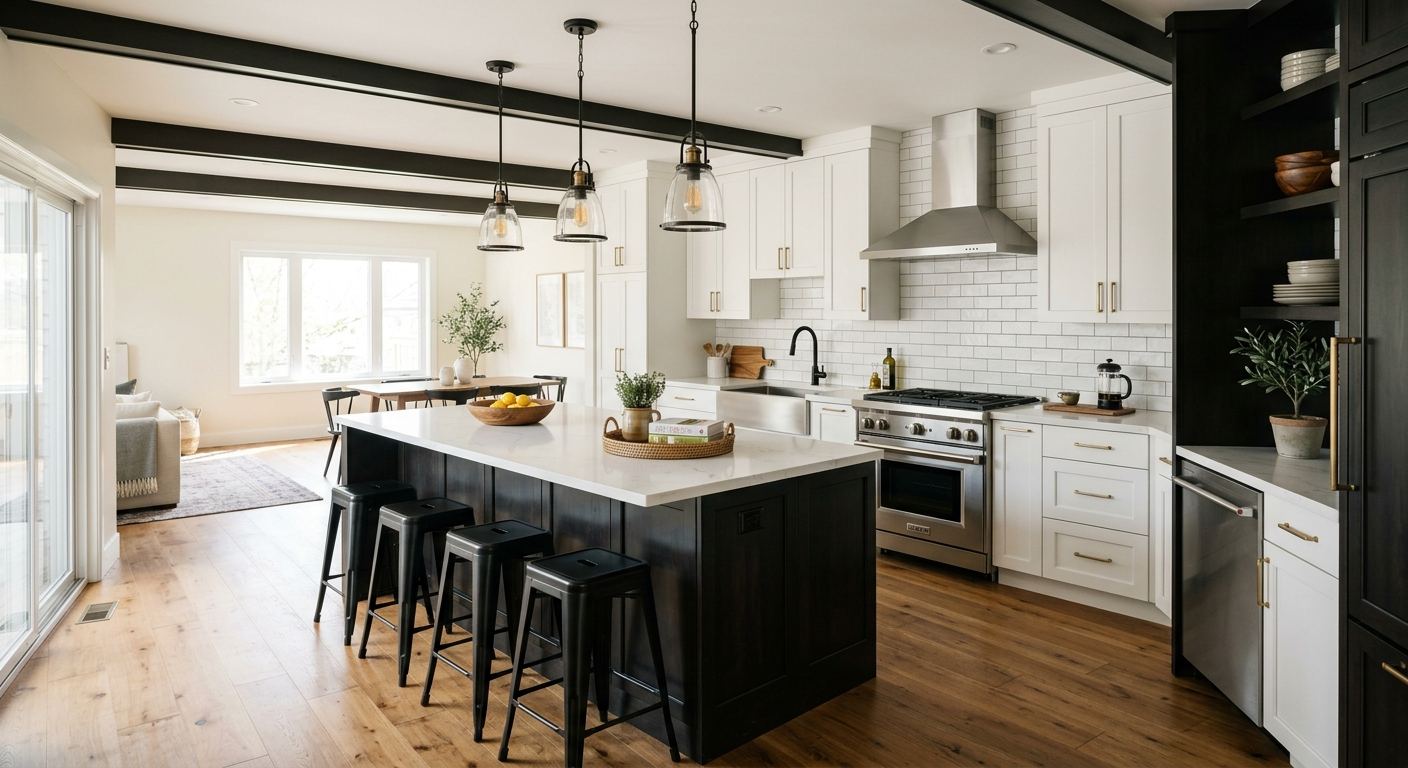
Kitchen renovation options and costs in Napanee Downtown
In Napanee Downtown, kitchen renovations typically come down to the same handful of choices—how much you change and which finish tier you pick—but the cost still varies a lot by scope. With a small local population (1,500 residents, Statistics Canada, 2021 Census), most projects are driven by owner-occupants and steady small-trade availability, so scheduling can be tight during peak contractor demand. At the regional level (the Toronto economic market), households often plan upgrades with resale in mind, and renovation decisions tend to track local income and home value expectations rather than weather. In practice, higher-value pockets across the Greater Toronto Area more often steer homeowners toward quartz or natural stone and semi-custom cabinetry, while more price-sensitive projects stay mid-range with refaced or semi-custom cabinets and laminate or entry quartz.
One reason quotes can feel unpredictable is that the Toronto market behaves like a “finish-first” economy. Labour and permit costs are relatively consistent, but homeowners frequently choose higher-end countertops and bigger islands when the kitchen is visible from dining and living spaces. Climate also plays a supporting role: Ontario’s freeze–thaw cycles don’t directly drive cabinet material prices, but they do affect how contractors evaluate subfloor conditions, wall movement, and ventilation needs—especially in older housing stock where moisture control and caulking details matter.
In Napanee Downtown’s core residential streets—where many homes have compact layouts and kitchens are central to everyday living—contractors are especially in demand for layout upgrades and appliance-ready installs. From there, the easiest way to compare options is to look at typical tiers and durations.
| Renovation Tier |
What's Included |
Typical Duration |
Price Range |
| Cosmetic refresh (paint, hardware, new appliances only) |
Cabinet paint or stain touch-up, new pulls/knobs, appliance swap (no plumbing/gas moves), caulking and basic countertop cleaning/spot repairs |
3–7 days |
$8,000–$15,000 |
| Mid-range full renovation (new cabinets, counters, sink, tile) |
New semi-custom or upgraded stock cabinets, countertop install, new sink and faucet (standard plumbing tie-in), backsplash tile, flooring prep, paint (typical) |
2–4 weeks |
$35,000–$65,000 |
| High-end full renovation (custom cabinets, stone counters, island) |
Custom millwork, upgraded quartz or natural stone, island (with added electrical and/or plumbing if required), full-height or premium backsplash, higher-end appliance integration |
4–8 weeks |
$70,000–$90,000 |
| Cabinet refacing only (new doors + drawer fronts, same boxes) |
Refacing materials, new door/drawer fronts, re-hardware, optional cabinet lighting and minor trim work (boxes remain) |
1–2 weeks |
$10,000–$28,000 |
| Countertop swap only (laminate to quartz or stone) |
Remove and dispose of existing top, new quartz/stone fabrication and install, sink cut-out (if kept compatible), sealing and silicone detail |
3–7 days |
$5,000–$15,000 |
| Backsplash tile installation only |
Tile supply and install, waterproofing membrane where needed, outlets finish work, grout/caulk and clean-up |
2–5 days |
$2,500–$10,000 |
Prices are estimates only and vary by project scope, site access and material selection.
What affects the price of kitchen renovation in Napanee Downtown
Even when two homeowners ask for “the same kitchen,” quotes across the Toronto region can swing by 30–50%. The biggest reason is that finish selections and trade scope are chosen differently—especially in an Ontario market where many renovations are planned around resale timelines. In higher-value Toronto-area pockets, buyers and sellers often expect quartz or stone counters and semi-custom cabinetry, which pushes projects toward a higher share of the typical full-kitchen budget (for example, moving from the mid-range around $35,000–$65,000 toward the $70,000–$90,000 end when an island and premium millwork are involved). In more price-sensitive areas, laminate or entry quartz and cabinet refacing keep the work closer to the lower bands.
Local home values and median income shape the typical finish tier far more than climate. Contractors may talk about winter conditions and ventilation, but the real driver is what homeowners consider a “safe spend” when resale matters. Layout changes are the unpredictable part regardless of finish: removing a wall, adding an island, or moving a gas line/plumbing rarely stays within the same price envelope as a swap-only renovation.
In Napanee Downtown, I see cost pressure rise when homeowners have older homes with dated drain routing—opening walls can reveal older subfloor or water shutoff constraints that require additional plumbing labour. Costs can also drop when the existing cabinet boxes are sound and you can re-face rather than rebuild, keeping you in the cabinet refacing band. Conversely, if your current backsplash is uneven or tiled to the ceiling in a non-standard way, the “simple tile” part can expand quickly into extra prep and patching.
Bottom line: if you’re targeting the lower end of the full renovation band, keep plumbing/gas and electrical where possible; if you want the higher end, plan for the additional work that supports island functionality and premium surfaces.
| Price Factor |
Why It Matters |
Cost Impact |
| Cabinet tier — stock vs. semi-custom vs. fully custom millwork |
Custom sizing, hardware quality, and finish consistency change labour and material waste |
Can add several thousand to tens of thousands depending on the scope |
| Countertop material — laminate vs. quartz vs. granite vs. stone |
Fabrication complexity, edge profiles, and sealing requirements affect both cost and schedule |
Material and install can shift a project by a large portion of the budget |
| Layout change — wall removal, island add, plumbing/gas move |
Structural, plumbing, and gas work introduce permits, inspections, and labour uncertainty |
Most unpredictable increase; often the biggest swing factor between quotes |
| Appliance package tier — builder vs. mid-range vs. pro-grade |
Dimensions, venting needs, and electrical/gas requirements can require new rough-in work |
Can move you from “refresh” pricing toward full-reno pricing |
| Flooring — refinish existing vs. full replacement |
Subfloor condition and removal impacts prep time and disposal |
May add moderate cost if replacement is required after demo |
| Backsplash — ceramic tile vs. marble vs. full-height slab |
Material weight and pattern matching change install labour; slab installs often need precision |
Small jobs can jump if material is heavy or cutting is complex |
| Electrical — new circuits for island, under-cabinet lighting |
More lighting and outlets can require new circuits and licensed work |
Costs rise quickly if you add multiple circuits or island power/plumbing |
| Permit fees and licensed trade requirements |
Work like gas and electrical changes trigger inspections and licensed contractor scope |
Often adds a steady baseline; layout changes can add more |
Permits & regulations in Ontario
For Ontario homeowners planning a kitchen in Napanee Downtown, the key is separating “swap work” from “reconfiguration work.” In general, cabinet and countertop swaps (replacing what’s already there without changing plumbing/gas/electrical routes) typically don’t require permits. However, if you’re moving plumbing supply/drain lines, relocating gas for a stove or making changes that affect gas equipment (including certain range hood setups that involve gas venting), removing a load-bearing wall, or adding new electrical circuits for an island or under-cabinet lighting, you should expect permits and licensed trades. Gas work must be completed by a licensed gas fitter, and electrical work must be done by a licensed electrician; both require inspections where applicable.
Step-by-step, here’s how I recommend verifying a contractor’s compliance before you sign in Napanee Downtown:
- Request the contractor’s licence numbers and confirm the correct trade class (gas fitter vs. electrician vs. general contractor where applicable) through the Ontario online registries.
- Ask for a current certificate of insurance (liability) showing adequate coverage for renovation work.
- Confirm workplace coverage: ask for WSIB/WCB documentation for the trades involved.
- In writing, confirm who pulls any permits and who is responsible for inspection scheduling.
- After work starts, ensure changes (like moving plumbing) trigger the correct licensed trade and inspection plan.
- Keep copies of all documents—licence details, insurance certificates, and inspection/clearance paperwork—since they’re essential if you have warranty or claim issues later.
Always confirm permit responsibility with the contractor before signing—scope and responsibility must be stated clearly in the contract.
Cabinets, countertops and layout decisions in Napanee Downtown
Your best results in a Napanee Downtown kitchen renovation usually come from making three big decisions early: (1) cabinet tier, (2) countertop material, and (3) whether you change the layout. Cabinet choice determines how quickly the job moves and how well it fits irregular walls. Stock cabinets are typically the fastest and cheapest path, while semi-custom is the most common balance for resale-ready kitchens. Custom cabinetry gives the tightest fit and best storage buildouts, but it’s where budgets start climbing quickly.
Countertops are the next lever. Laminate can be a budget-friendly, durable surface for day-to-day use, but it can be less forgiving around seams and edges. Quartz engineered stone tends to be the Ontario “sweet spot” for low maintenance and consistent appearance. Natural stone like granite adds character and value perception, but it demands more careful sealing and attention to edge details over time. Butcher block looks warm and works well if you’re willing to oil/maintain it.
Finally, layout changes are often worth it only when you’re solving a real usability problem. In compact Napanee Downtown homes—common in older housing stock—an open-concept wall removal or island addition can feel transformative. But if it forces plumbing or gas relocation, the cost jumps. For example, if you’re trying to stay in the mid-range full renovation band ($35,000–$65,000), choosing semi-custom cabinetry and quartz can keep you on track; adding an island while keeping plumbing in place is often the difference between staying mid-range and pushing closer to $70,000–$90,000.
Take into account Toronto-area resale expectations: buyers increasingly look for integrated lighting, clean hardware lines, and durable, easy-care surfaces—especially in kitchens that are visible from living spaces.
| Option |
Durability |
Maintenance |
Best For |
Price Range |
| Stock cabinets (big-box) |
Good for standard dimensions; durability depends on construction and finish |
Low day-to-day care; hinges and hardware quality vary by brand |
Quick turnarounds and cost-controlled refreshes |
$12,000–$22,000 |
| Semi-custom cabinets (local dealer) |
Strong balance of build quality and options; better fit for common wall variations |
Low to moderate; routine tightening and cleaning |
Most homeowners targeting resale-ready results without full custom pricing |
$18,000–$35,000 |
| Custom cabinets (local millwork shop) |
Highest fit and longevity; tailored storage and door/drawer alignment |
Low day-to-day care; benefits from high-quality hardware and finishing |
Complex layouts, premium builds, and maximum storage design |
$30,000–$55,000 |
| Laminate countertop |
Durable surface for normal cooking; seams can be a concern over time |
Easy cleaning; avoid prolonged heat exposure and monitor seam edges |
Budget-friendly upgrades when keeping total project spend controlled |
$3,000–$7,000 |
| Quartz engineered countertop |
Very durable; resistant to staining and everyday wear |
Low—simple soap and water; no sealing needed |
Popular “mid-to-high” choice for clean look and easy maintenance |
$5,000–$12,000 |
| Granite / natural stone countertop |
Hard, impact-resistant; performance varies by stone type |
Requires sealing and careful care; edges and seams need professional finishing |
Homeowners who want natural variation and premium curb appeal |
$7,000–$15,000 |
| Butcher block countertop |
Strong for cutting; can dent and is sensitive to standing water |
Higher maintenance—regular oiling and prompt drying |
Warm, traditional kitchens where maintenance is acceptable |
$4,000–$10,000 |
| Marble countertop |
Beautiful but softer than quartz/granite; can etch from acids |
Moderate to high; requires careful cleaning and sealing schedule |
Premium “statement” kitchens and owners comfortable with careful use |
$9,000–$15,000 |
How to choose a kitchen renovation contractor in Napanee Downtown
Choosing the right contractor in Napanee Downtown is mostly about verification and clarity before work starts—not just price. First, confirm Ontario licensing and coverage. For each licensed trade involved, ask for licence documentation and check it using Ontario’s online trade/registry tools. Then request a certificate of liability insurance and verify it’s current for renovation work (not just small handyman coverage). Finally, confirm WSIB/WCB coverage for the contractor and the trades they subcontract. If they can’t provide proof or they avoid documentation, that’s a warning sign.
Next, get 2–3 itemised written quotes, not lump sums. You want the breakdown for labour and materials (cabinets, countertops, tile, demo/disposal, electrical/plumbing/gas work if applicable). Read the scope carefully: what’s excluded (drywall patching beyond a set allowance, subfloor repairs, painting), is permit pulling included, and is disposal included? For timelines, insist on a start date and completion estimate in writing, including milestones for cabinet delivery and countertop templating.
Payment schedule matters. Never pay more than 10–15% upfront. A practical approach is milestone-based progress payments with a holdback until final walkthrough and punch-list items are completed. Also check warranties: workmanship warranty length, manufacturer warranty terms, and whether warranties are transferable to future homeowners if you sell soon after the reno.
- Request licence and insurance documents before finalizing the quote.
- Confirm WSIB/WCB clearance for trades that will be on-site.
- Demand itemised line-by-line pricing (labour vs materials vs allowances).
- Ask who pulls permits and who schedules inspections for any plumbing/gas/electrical changes.
- Clarify what “demo” includes and whether disposal/garbage is included.
- Confirm protection plan for floors, doors, and counters during installation.
- Check countertop templating timing and lead times for cabinet delivery.
- Review warranty coverage in writing for both workmanship and products.
- Verify how change orders are priced (fixed rate vs hourly + markup).
- Use a payment schedule with 10–15% max upfront and a holdback for completion.
- Ask for references from recent Ontario kitchen projects with similar scope.
- Get a written start date, expected duration, and a communication plan for delays.
Red flags I see with kitchen contractors in Napanee Downtown include: quotes that omit permit/disposal details, “allowance-only” countertop or tile numbers with no clear brand/spec, promises of exact completion dates without acknowledging cabinet/counter lead times, refusal to provide insurance/licence/WSIB documentation, and change orders handled verbally after demo has started. If you spot two or more of these, it’s usually worth pausing and getting a second quote.
Frequently asked questions — kitchen renovation in Napanee Downtown
Can I live at home during a kitchen renovation in Napanee Downtown?
In most Napanee Downtown renovations, yes—especially for cosmetic refreshes and mid-range work where we can keep a functional “core” area. For example, a cosmetic refresh (paint/hardware and appliance swaps only) usually fits well with daily living because it avoids major demolition and lengthy plumbing/electrical disruptions. For a mid-range full renovation, you may still live at home, but expect short periods when sinks, dishwashers, or cooktops are disconnected while lines are tied in. If your project is pushing toward higher-end work with an island and stone counters, the footprint may feel more disruptive because of countertop templating, delivery scheduling, and electrical work. Plan a temporary cooking setup (microwave, induction hot plate, or BBQ where safe) and confirm noise/dust containment expectations in your contract.
Should I renovate my kitchen before selling in Napanee Downtown?
Often, a kitchen renovation before selling is worth it when it improves layout usability and modernizes finishes buyers expect, but you need to match your spend to the market. In the Toronto economic area, homeowners commonly invest more when they choose quartz/stone and semi-custom cabinetry, aiming for resale confidence rather than just personal taste. In practical terms, if you’re considering a full kitchen renovation, budgets commonly land in the mid-range ($35,000–$65,000) or high-end ($70,000–$90,000) depending on cabinetry and countertop choices. If your home needs structural or plumbing upgrades to support the new layout, those costs can reduce your return, so prioritize the highest-impact changes (storage, lighting, functional workflow). A good contractor can also suggest a “sell-ready” finish tier that looks premium but avoids unnecessary structural work, especially if your layout change would require costly plumbing/gas relocation.
What's the most popular kitchen style in Napanee Downtown right now?
Right now in Napanee Downtown and across the Toronto economic region, the most requested direction is clean, modern transitional: flat-panel or simple shaker-style cabinets, warm neutrals (white, greige, light greys), and a countertop that reads upscale without excessive maintenance. Quartz engineered countertops are a common choice because they offer a consistent look and low upkeep, which helps kitchens feel “move-in ready” for buyers. Many homeowners choose matte or satin hardware and add under-cabinet lighting to brighten dark countertop zones. If you’re aiming for a mid-range renovation, semi-custom cabinets paired with quartz is the typical best balance of look and budget. If you want a higher-end look, custom millwork and stone countertops with an island tend to be the upgrade path. Style trends also follow practical needs—compact layouts often benefit from better storage, not just a different colour.
How do I know if I need to update my kitchen plumbing in Napanee Downtown?
You usually need plumbing updates when symptoms show up or when the renovation scope requires line changes. Signs include slow drains, frequent leaks under the sink/dishwasher, outdated shutoff valves, corrosion around supply lines, or water stains suggesting pinhole leaks. Even if the sink is “just being replaced,” opening walls for cabinet changes can reveal older drain routing or inadequate venting that only becomes apparent during demo. If you’re adding an island with a new sink or changing the layout, plan for plumbing supply/drain relocation and likely inspections tied to the work—this is where quotes can diverge widely. In older Ontario housing stock, I often see shutoff accessibility issues and subfloor conditions that affect how confidently we can tie in new lines. Ask your contractor to include a plumbing assessment step and clarify whether unforeseen plumbing repairs are handled as change orders.
What is the difference between a galley and open-concept kitchen?
A galley kitchen is a narrow, efficient layout with counters on two opposite sides, typically with a walkway down the middle. An open-concept kitchen removes walls or boundaries to connect the kitchen to dining and living areas, changing how light travels and how cooking zones are displayed. In Napanee Downtown, many homes lean galley because rooms are compact and older floor plans were built around separation. Converting to open-concept can be compelling for resale—buyers often like the feeling of space and visibility—but it can also trigger bigger scope: structural evaluation, potential wall removal, new electrical planning, and sometimes HVAC/venting considerations. If your galley is functional, keeping it often helps you stay in the mid-range budget; if you need a layout upgrade for usability, a controlled modification (like better lighting and storage) may deliver more value than a full open-concept conversion.
How do I get accurate kitchen renovation quotes in Napanee Downtown?
Accurate quotes start with clear scope and itemised assumptions. First, provide detailed measurements and photos, plus your target finish tier—so the contractor can price correctly for cabinetry and countertops. Ask for 2–3 quotes that break down labour and materials separately and include allowances for items that aren’t finalized (tile, under-cabinet lighting, sink/faucet, flooring repairs). Confirm whether the quote includes permit pulling if you’re moving plumbing/gas or adding electrical circuits, and whether demolition/disposal is included. Also request lead-time assumptions for cabinet delivery and countertop templating. For example, if you’re expecting a mid-range full renovation around $35,000–$65,000, make sure the quote doesn’t quietly switch you into higher-end millwork or stone selections through vague allowances. Finally, make sure the contractor can show proof of Ontario licensing/insurance/WSIB coverage and that the contract spells out exclusions and change-order pricing.