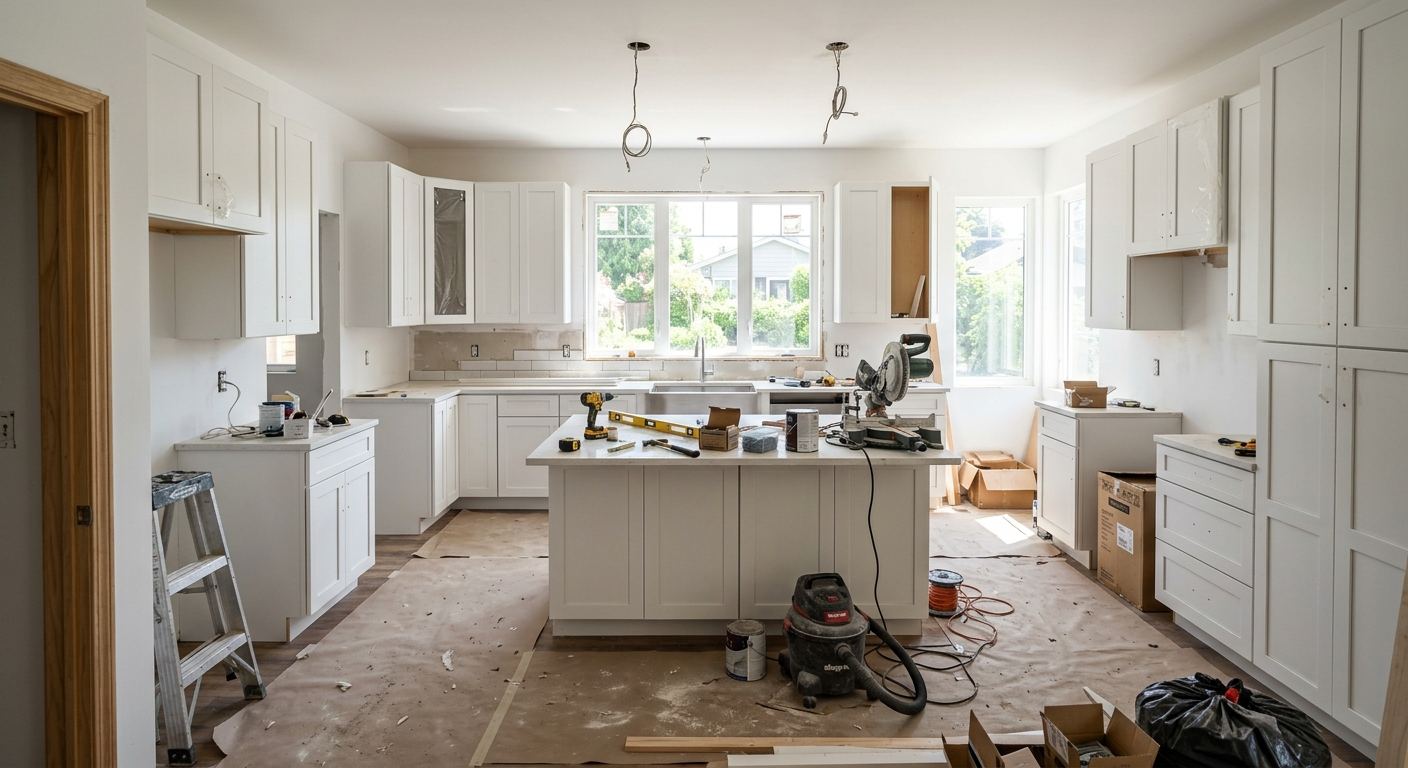
Kitchen renovation options and costs in St. Thomas
Kitchen renovation costs in St. Thomas vary a lot by how much you change, and the finish tier you choose. With 42,840 residents and 12,245 homeowner households (67.8% owning) (Statistics Canada, 2021 Census), most renovations are planned with resale in mind, not just day-to-day use. That matters because the median household income is $75,000 (Statistics Canada, 2021 Census), which influences what homeowners feel is a “safe” spend level—especially in established, owner-heavy neighbourhoods where buyers look for modern cabinets, durable counters and a clean backsplash. In the London region around St. Thomas, the climate doesn’t usually create major swings in cabinetry or countertop labour; rather, it’s the local housing mix and contractor availability that drive timing and pricing. Projects in busier seasons (spring and summer) tend to book faster, and stone-and-tile lead times can tighten the schedule. Homes built before 1981 make up 57.7% of the local housing stock (Statistics Canada, 2021 Census), so older layouts often need more careful plumbing/electrical planning to avoid surprises behind existing walls and floors.
In practice, you’ll see most homeowners start by deciding between a cosmetic refresh and a mid-range full renovation, then jump tiers if they’re adding an island or upgrading to quartz or natural stone. For budgets that fit typical Ontario ranges, a full renovation often lands between $18,000 and $65,000 depending on the cabinet tier and countertop choice. Below is a practical comparison to help you map your options to realistic timelines and price bands.
| Renovation Tier |
What's Included |
Typical Duration |
Price Range |
| Cosmetic refresh (paint, hardware, new appliances only) |
Prep and paint (walls/ceiling), new hardware, appliance-only swap (no cabinet or countertop changes) |
3–7 days |
$10,000–$18,000 |
| Mid-range full renovation (new cabinets, counters, sink, tile) |
Cabinet replacement (semi-custom/stock), new countertop, sink and faucet, backsplash tile, limited flooring/tile touch-ups |
2–4 weeks |
$25,000–$45,000 |
| High-end full renovation (custom cabinets, stone counters, island) |
Custom cabinetry, natural stone or premium quartz, island (often electrical/plumbing rough-in), upgraded backsplash and tile |
4–7 weeks |
$50,000–$65,000 |
| Cabinet refacing only (new doors + drawer fronts, same boxes) |
Door/drawer-front replacement, hardware upgrades, matching trim; excludes cabinet box rewiring/structural work |
1–2 weeks |
$3,500–$18,000 |
| Countertop swap only (laminate to quartz or stone) |
Measure, removal, new countertop install, backsplash caulking/trim adjustments; typically excludes cabinet work |
3–8 days |
$2,500–$12,000 |
| Backsplash tile installation only |
Tile supply and install (ceramic/porcelain), surface prep, grout/seal where required, edge finishing |
3–10 days |
$1,500–$8,000 |
Prices are estimates only and vary by project scope, site access and material selection.
What affects the price of kitchen renovation in St. Thomas
In St. Thomas and the broader London economic region, two quotes for the “same” kitchen can differ by 30–50% because the finish tier, layout risk, and what’s included (permits, disposal, flooring patching) can change behind the scenes. Local home values and household income influence what tier homeowners select—so contractors typically price to reflect that expectation. In higher-value pockets of the London area, many clients plan for quartz or natural stone counters and semi-custom cabinetry because the renovation cost can be more easily recovered on resale. In more modest or move-up plans, laminate countertops and stock cabinets dominate because they deliver a strong visual upgrade without stretching the budget beyond what the household can comfortably finance. Climate plays a secondary role; the real cost swings often come from older housing (57.7% pre-1981) where walls and subfloors can hide plumbing surprises or out-of-square framing (Statistics Canada, 2021 Census).
Two examples we see often in St. Thomas: (1) If you’re upgrading from a basic refresh to a mid-range full renovation ($25,000–$45,000), the cabinet tier choice can shift your total quickly—semi-custom doors and dovetail drawers cost more than stock, but they reduce rework later because the boxes and fit are more consistent. (2) If you want an island or to move plumbing/gas, labour can jump even when materials stay mid-range, because you’re paying for rough-in, inspections, and patching, not just cabinets. On the other hand, a countertop-only swap (often $2,500–$12,000) is usually one of the more predictable options—especially if you keep the same sink footprint and don’t change the base cabinet layout. For many homeowners, that predictability is why phased upgrades remain common in St. Thomas.
| Price Factor |
Why It Matters |
Cost Impact |
| Cabinet tier — stock vs. semi-custom vs. fully custom millwork |
Custom fit, internal drawer construction, and finish options directly affect labour and material pricing |
Medium to high (often the largest single line-item after counters) |
| Countertop material — laminate vs. quartz vs. granite vs. stone |
Material price, installation method, and weight/handling requirements change labour and risk |
Medium to high (can materially shift a $25,000–$45,000 job) |
| Layout change — wall removal, island add, plumbing/gas move |
Structural and rough-in work adds time, permits, and patching complexity |
High and most unpredictable |
| Appliance package tier — builder vs. mid-range vs. pro-grade |
Higher-tier appliances increase cost and may require electrical/venting adjustments |
Low to medium (but can become medium if venting changes) |
| Flooring — refinish existing vs. full replacement |
Removal and subfloor prep costs rise quickly if you need full replacement |
Low to medium |
| Backsplash — ceramic tile vs. marble vs. full-height slab |
More complex cuts, heavier stone, and vertical coverage increase install time and materials |
Medium |
| Electrical — new circuits for island, under-cabinet lighting |
Licensed electrical work and inspection requirements impact schedule and labour |
Medium (can be high if wiring paths are long) |
| Permit fees and licensed trade requirements |
Certain work requires permits/inspections; compliance affects cost even when materials are unchanged |
Low to high depending on scope |
Permits & regulations in Ontario
In Ontario, a straight cabinet and countertop swap typically does not require a permit because you’re replacing surfaces and fixtures without changing the underlying plumbing, gas, electrical, or structure. However, once you start moving plumbing supply or drain lines, relocating a sink, changing where a range sits, running new gas connections, removing a load-bearing wall, or adding electrical circuits (for an island receptacle run, for example), permits and licensed trade involvement usually come into play. Gas work—such as relocating a gas stove or modifying a gas line for a range—must be completed by a licensed gas fitter and is subject to inspection. Electrical work that adds circuits or changes distribution for new loads (like under-cabinet lighting, additional outlets, or dedicated circuits) must be done by a licensed electrician with inspection.
For a homeowner in St. Thomas, the verification process is straightforward. First, ask for the contractor’s Ontario licence information where applicable for the trades they lead, and request liability insurance plus WSIB/WCB coverage documentation. Second, confirm that the certificates of insurance match the company name on the contract and that the coverage is active during the job. Third, for any permitted scope, ensure the contractor clearly states who pulls permits and who is responsible for inspections in the written agreement. Do not rely on “we’ll handle it” without naming the party and listing the permit steps in the contract.
Cabinets, countertops and layout decisions in St. Thomas
Your best bang-for-buck in St. Thomas usually comes from making three consequential decisions early: (1) cabinet tier, (2) countertop material, and (3) layout changes. On cabinet tier, stock cabinets are the fastest path and generally the cheapest because the sizes and finishes are standard. Semi-custom is usually the most popular mid-range choice in St. Thomas because you can adjust common dimensions, choose better drawer hardware and improve the overall fit. Custom cabinets deliver the highest accuracy for odd spaces (common in older homes), but they cost more and require longer lead times.
Countertops follow a similar logic. Laminate is budget-friendly and durable for everyday cooking, but it can be less forgiving with heat and seams—so it’s ideal when you want a clean look within the $18,000–$45,000 renovation envelope. Quartz is a strong “resale-friendly” option: it resists staining better, holds up well to typical household use, and usually fits well with semi-custom cabinetry. Granite and natural stone add prestige and unique patterning, but you should plan for higher material cost and more careful installation. Butcher block brings warmth, though it needs periodic maintenance to protect against moisture—important in any climate, but especially relevant if you’re replacing older counters in a pre-1981 home where plumbing risk should be addressed before sealing.
Layout changes are where costs become harder to predict. Removing a wall for an open-concept feel or adding an island can justify the spend when it improves flow and adds seating; however, moving plumbing/gas line locations often triggers the highest labour and inspection complexity. A concrete example: upgrading counters only (often $2,500–$12,000) can deliver a big look with less disruption. By contrast, a full renovation in the mid-range ($25,000–$45,000) becomes more cost-effective only if you’re also improving the cabinet layout, adding a backsplash, and planning electrical where you’ll actually use it.
| Option |
Durability |
Maintenance |
Best For |
Price Range |
| Stock cabinets (big-box) |
Good for everyday use; durability depends on finish and drawer construction |
Low (wipe clean; avoid soaking base areas around sinks) |
Tight timelines and straightforward layouts |
$3,500–$20,000 |
| Semi-custom cabinets (local dealer) |
Very good; better drawer mechanisms and option for more refined finishes |
Low; ensure caulking and water protection around the sink |
Most St. Thomas mid-range renovations |
$15,000–$30,000 |
| Custom cabinets (local millwork shop) |
Excellent; best fit for irregular walls, ceilings and older-room framing |
Low; higher-end hardware may need occasional adjustment |
Maximizing storage and achieving a perfect built-in look |
$25,000–$45,000 |
| Laminate countertop |
Good for routine cooking; seams can be a weak point if not installed carefully |
Low; avoid prolonged heat exposure |
Budget-forward upgrades with a clean, modern surface |
$2,500–$6,000 |
| Quartz engineered countertop |
Excellent; consistent surface and strong stain resistance |
Low; routine cleaning only |
Resale-friendly, low-maintenance kitchens |
$5,500–$10,000 |
| Granite / natural stone countertop |
Excellent; very durable though heavier and more sensitive to installation |
Medium; may require sealing depending on stone |
Premium look and unique stone character |
$7,000–$12,000 |
| Butcher block countertop |
Good to very good; strong but vulnerable to standing water and knife nicks |
Medium; periodic oiling and careful drying near sink |
Warm, casual style where maintenance is acceptable |
$4,000–$9,000 |
| Marble countertop |
Good; elegant but more susceptible to etching/staining |
Higher; sealing and gentle cleaning routines |
Statement kitchens where homeowners accept more care |
$8,000–$12,000 |
How to choose a kitchen renovation contractor in St. Thomas
Choosing a contractor in St. Thomas is about more than pictures online—it’s about confirming they can legally and safely manage the scope you want. Start by verifying Ontario licensing where the work requires it through the trades involved (especially gas and electrical). Ask for liability insurance and WSIB/WCB coverage documentation before the first workday. You should receive certificates of insurance showing the policy is active and covers the named contractor/company, and WSIB/WCB clearance or equivalent evidence that the company is properly registered for workplace coverage. If they can’t provide clear documentation promptly, that’s a serious warning sign.
Next, request 2–3 itemised written quotes with a labour and materials breakdown—don’t accept a single lump sum number without line items. Confirm what’s included for permits (and who pulls them), disposal/garbage removal, and any patching for drywall, flooring, and subfloor after demo. Pay attention to warranty terms: workmanship warranty length, product/manufacturer warranty details, and whether warranties transfer if you sell your home. For payments, use a schedule that never asks for more than 10–15% upfront; hold back a portion until key milestones and final punch list items are completed. Finally, insist on a written start date and a completion estimate tied to material lead times for cabinets, countertops, and tile.
- Ask for a written scope that lists every material allowance and finish level.
- Confirm who is responsible for permits, inspections and any required licensed trades.
- Request proof of liability insurance (policy active during construction).
- Verify WSIB/WCB clearance or coverage evidence for the contractor and workers.
- Get quotes itemised by demolition, carpentry, electrical, plumbing, tile, and countertop install.
- Ensure disposal is included (dump fees can add up).
- Check the schedule for cabinet and stone lead times and how delays are handled.
- Verify warranty coverage in writing (workmanship and product warranties).
- Use a payment plan with limited upfront deposit and milestone-based draws.
- Ask how they protect floors and keep dust controlled during demo and tile work.
- Confirm measurements include level/flat checks to avoid countertop fit issues.
- Require a punch list process and final walkthrough date in the contract.
Red flags I see in the St. Thomas market: (1) contractors who won’t put scope and exclusions in writing, (2) vague “we’ll handle permits” language without naming responsibility, (3) no proof of insurance or WSIB/WCB coverage, (4) asking for large upfront payments without milestones, and (5) quoting countertop installs without confirming template and site measure timing.
Frequently asked questions — kitchen renovation in St. Thomas
Can I move my kitchen sink or stove?
Yes, you can move a sink or stove in St. Thomas, but it’s one of the scope changes that most often drives the biggest cost and scheduling differences. Moving a sink typically means new plumbing supply and drain runs, wall opening, patching and, in most cases, permits and licensed plumbing work. Relocating a gas stove requires additional compliance steps; gas modifications must be completed by a licensed gas fitter, with inspection requirements attached to the work. If you’re working in an older home (57.7% built before 1981) (Statistics Canada, 2021 Census), there can also be surprises behind walls—like old venting or limited access—that affect labour time. If you want a predictable budget, many homeowners keep the sink footprint and do a countertop swap (often within the $2,500–$12,000 band) while upgrading cabinets and finishes.
What's the most cost-effective kitchen upgrade?
For many St. Thomas homeowners, the most cost-effective upgrade is often a “visual anchor” change—either refacing cabinets or swapping countertops—because you get the biggest face-lift with less demolition. Cabinet refacing only (new doors and drawer fronts) can be a strong value when your existing cabinet boxes are solid; typical pricing sits in the $3,500–$18,000 range depending on the door style and hardware. Countertop-only upgrades can also be predictable (often $2,500–$12,000), especially if you keep the same layout and don’t change the sink location. If you’re deciding between tiers, consider that a full mid-range renovation ($25,000–$45,000) is better when you also need layout improvements, new tile, or upgraded appliances. Otherwise, a focused project usually preserves more of your existing structure and reduces the risk of hidden issues common in older housing stock.
Custom vs stock cabinets — is custom worth it?
Custom cabinets can be worth it in St. Thomas when your kitchen layout is challenging—older homes, out-of-square walls, awkward ceiling lines, or when you want specific storage solutions (pantry pull-outs, appliance garages, tall storage runs). Stock cabinets are usually the most budget-friendly and fastest option, but they often require more compromises on fit. Semi-custom is the middle ground and is commonly selected for move-up renovations because it delivers a better fit and upgraded drawer construction without the long lead times of fully custom millwork. In practical budgeting, you might be comparing a stock or basic refacing approach in the lower band (for example $3,500–$20,000 for stock cabinetry scope) against a semi-custom or custom approach that pushes you into the mid-range or upper budget tiers. If you’re aiming for a $25,000–$45,000 renovation, semi-custom typically provides the best balance of “upgrade impact per dollar.”
How do I choose a kitchen contractor in St. Thomas?
Start with documentation and transparent scopes. In Ontario, verify the contractor’s liability insurance and request WSIB/WCB clearance evidence before work begins. If your scope includes gas or electrical changes, confirm the relevant licensed trades will be used and that inspections are addressed. Then get 2–3 itemised quotes—labour and materials separated—so you can compare like-for-like instead of just a single total price. Read the exclusions: disposal included or not, permit responsibility, and whether drywall/floor patching is included after demo. Ask about warranties: workmanship coverage length, manufacturer warranty details, and whether warranties are transferable if you sell. Finally, use a sensible payment schedule—avoid paying more than 10–15% upfront and hold back until a completed punch list. A contractor who answers these clearly is usually the safest bet for a project in St. Thomas.
What order do kitchen renovation steps happen in?
A typical St. Thomas kitchen renovation order is: demolition and protection (dust control), rough-in (plumbing/gas/electrical) if you’re changing anything, inspections when required, then build stage (framing adjustments and cabinet install). Cabinets go in before countertops because the counters need a level, solid base. After cabinets, countertops are templated (for stone) and installed, followed by sink/faucet hookup. Tile/backsplash usually comes after cabinets are set so measurements are exact, and then flooring patching or replacement is finished depending on what was planned. Finally, you complete trim, paint touch-ups, caulking/grout sealing, and a final walkthrough/punch list. If you’re doing a smaller upgrade—like countertops only—you’ll shorten the sequence and avoid the full demo and rough-in steps. That’s one reason countertop-only projects are often more predictable within the $2,500–$12,000 band.
Can I live at home during a kitchen renovation in St. Thomas?
Often yes, but it depends on how extensive the demo and plumbing/electrical disruption is. In many St. Thomas homes, a cosmetic refresh or backsplash-only job can be done while living at home because the kitchen remains largely functional. For a mid-range full renovation ($25,000–$45,000), you may use a temporary prep area (like a microwave and kettle setup in a separate room) while the main sink and cooktop area is shut down during countertop and appliance installation. If you’re moving plumbing/gas lines or opening walls, it can be more disruptive and may require short periods where access is limited for safety and inspection readiness. Weather doesn’t usually shut jobs down permanently, but scheduling matters—older homes can need longer for patching and curing timelines. Discuss your “stay-at-home” plan early so the contractor can schedule critical work first and protect the rest of your home from dust and debris.