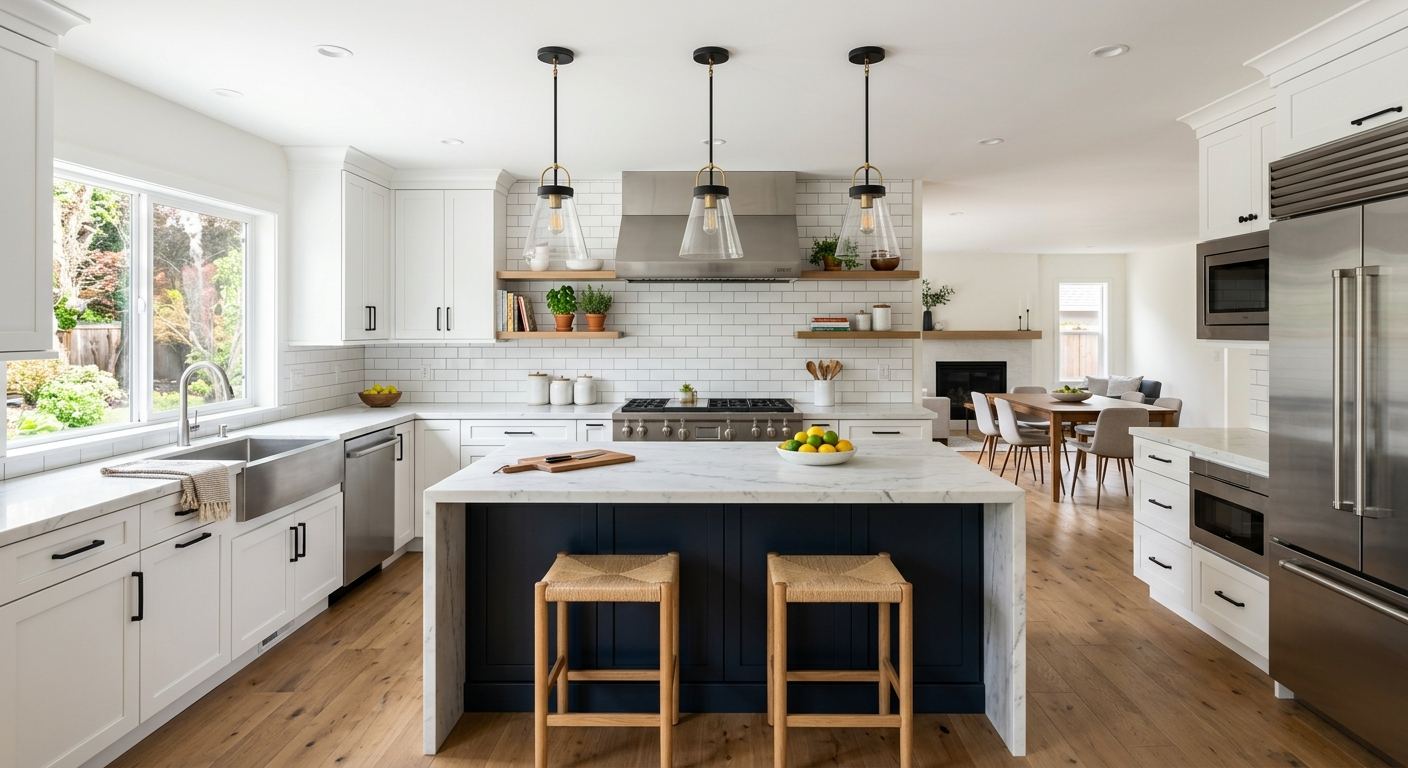
Kitchen renovation options and costs in Woodbine-Lumsden
Kitchen renovation costs in Woodbine-Lumsden usually start with one big choice: how much change you want—just surfaces, or the full “new kitchen” experience. With a 2021 population of 7,865 (Statistics Canada, 2021 Census), neighbourhood demand is steady, but the projects I see most often follow the broader Toronto market pattern: homeowners align finishes with the value of the home and the appeal to the resale buyer. Even though Woodbine-Lumsden is not a “new build” neighbourhood, many homes have kitchens that feel dated after 15–25 years, so owners commonly refresh for both comfort and buyer confidence.
In the Toronto area, budgets track closely to home values and household incomes rather than weather. In higher-value pockets across the GTA, owners often target a premium look—frequently quartz or natural stone and semi-custom or custom cabinetry—because the renovation cost is easier to recover on resale. That “finish-first” approach pushes full renos toward the upper end of the local bands, while more price-sensitive projects in the region typically stay in the mid-range using refacing or stock cabinets and durable laminate or quartz.
On top of that, the region’s labour market influences pricing. Toronto-area trades are busy, and timelines can shift when multiple renos overlap—especially for cabinetry installs, tile, plumbing rough-ins, and electrical work. On older housing stock, hidden issues like out-of-level floors, dated plumbing runs, or imperfect wall surfaces can add labour even if the finishes are chosen to be budget-friendly.
In Woodbine-Lumsden, this demand is especially noticeable around the established residential corridors where buyers often want a modern, bright kitchen—so homeowners start planning around cabinetry leads and countertop templating. Below is a practical way to compare renovation tiers before you request quotes.
| Renovation Tier |
What's Included |
Typical Duration |
Price Range |
| Cosmetic refresh (paint, hardware, new appliances only) |
Cabinet paint or touch-ups, new hardware, appliance swap, minor caulking/trim, basic deep clean & re-install |
1–3 weeks |
$5,000–$18,000 |
| Mid-range full renovation (new cabinets, counters, sink, tile) |
New cabinets (stock or semi-custom), countertop (laminate or quartz), sink & faucet, backsplash tile, flooring repairs/replace (if needed), plumbing hookups |
4–8 weeks |
$25,000–$55,000 |
| High-end full renovation (custom cabinets, stone counters, island) |
Custom millwork, premium stone counters, island build, expanded backsplash (often tile-to-ceiling), upgraded appliance package, electrical for island (pendants/lights) |
8–14 weeks |
$65,000–$90,000 |
| Cabinet refacing only (new doors + drawer fronts, same boxes) |
Refacing panels, new doors/drawers, hardware, alignment/trim, optional interior upgrades (organizers), limited countertop changes |
2–5 weeks |
$8,000–$35,000 |
| Countertop swap only (laminate to quartz or stone) |
Remove old counters, template & install new countertops, sink cut-out adjustments, basic finishing (backsplash re-tuck if required) |
1–2 weeks |
$3,000–$15,000 |
| Backsplash tile installation only |
Surface prep, tile supply/installation, caulking at transitions, grout/seal where applicable |
5–10 days |
$2,000–$10,000 |
Prices are estimates only and vary by project scope, site access and material selection.
What affects the price of kitchen renovation in Woodbine-Lumsden
Even when two homeowners ask for the “same” kitchen renovation in Woodbine-Lumsden, quotes across the Toronto economic region can differ by 30–50% because the big drivers aren’t just labour—they’re finish tier, layout complexity, and how many trades must coordinate around plumbing, electrical, and cabinetry lead times. In Ontario, the local market also rewards a certain look: in higher-value parts of the GTA, homeowners commonly budget for quartz or natural stone and semi-custom cabinetry because buyers expect it and because the cost is easier to justify at resale. In more cost-sensitive areas of the region, many projects stay in the mid-range with laminate tops and stock or refaced cabinets to protect overall ROI.
Toronto climate isn’t the primary reason costs change—kitchens are mainly costed by trades and materials—but climate still shows up indirectly. Older homes can have more seasonal movement, which is why tile substrates and countertop supports must be installed correctly. If your floor is out of level, tile and cabinet alignment work can become more labour-intensive, even if the finish materials are affordable. Also, scheduling matters: countertop templating and cabinet delivery windows can add time, and time becomes money for coordinating installers and inspections.
Two concrete examples I see in Woodbine-Lumsden: (1) if you want to add an island that requires electrical for under-cabinet lighting or island pendants plus potential plumbing changes, labour and rough-in costs rise quickly—often pulling a mid-range project toward the $55,000 area. (2) if you keep the existing plumbing lines and choose a quartz swap only, you can often keep the project closer to the $3,000–$15,000 countertop band, avoiding demolition and extended permit work. Use those same logic points to compare low–mid ranges (around $25,000) against larger custom builds that approach $80,000+ when walls move and premium finishes are chosen.
| Price Factor |
Why It Matters |
Cost Impact |
| Cabinet tier — stock vs. semi-custom vs. fully custom millwork |
Higher tiers change material quality, hardware options, fit and finish, and lead times |
Shifts a full reno roughly by +$10,000 to +$25,000 depending on scope |
| Countertop material — laminate vs. quartz vs. granite vs. stone |
Material and edge profiles affect both material cost and fabrication/install complexity |
Often +$3,000 to +$20,000 versus laminate, depending on size and edge |
| Layout change — wall removal, island add, plumbing/gas move |
Structural, plumbing, and gas/electrical scope introduces coordination, permits, and longer schedules |
Commonly +$5,000 to +$25,000 even with similar finishes |
| Appliance package tier — builder vs. mid-range vs. pro-grade |
Higher tiers require better ventilation, matching electrical specs, and longer delivery timelines |
Typically +$2,000 to +$12,000 across the package |
| Flooring — refinish existing vs. full replacement |
Traffic, subfloor condition, and demolition scope determine how much floor work is needed |
Often +$1,500 to +$8,000 |
| Backsplash — ceramic tile vs. marble vs. full-height slab |
Premium materials add cutting complexity and increase labour and waste |
Can add +$1,000 to +$7,000 versus standard ceramic |
| Electrical — new circuits for island, under-cabinet lighting |
New circuits increase electrician hours and required inspections |
Typically +$1,000 to +$6,000 |
| Permit fees and licensed trade requirements |
Permits and inspections add administrative cost and schedule steps |
Usually +$500 to +$5,000 depending on what changes |
Permits & regulations in Ontario
In Ontario, a simple cabinet and countertop swap typically does not require a building permit. If you’re only replacing surfaces—like installing new countertops over the existing base cabinets—or changing finishes and fixtures without altering plumbing, gas, or electrical locations, many homeowners can proceed without permits. However, kitchen renos often cross the line into permit territory once you start moving systems.
Work that typically does require permits and licensed trades includes moving plumbing supply or drain lines, relocating a sink, relocating a stove/range, changing venting, removing a load-bearing wall, or adding new electrical circuits (for example, dedicated circuits for an island, new under-cabinet lighting runs, or relocating receptacles to meet modern spacing). Gas work—for ranges and certain venting/hood configurations—must be performed by a licensed gas fitter, with inspections as required. Electrical work must be performed by a licensed electrician, also requiring inspection steps.
To verify a contractor in Woodbine-Lumsden, I recommend a simple step-by-step approach: (1) Ask for their Ontario licence/registration details relevant to the trade they’re performing; confirm through the applicable online registry and verify the licence is active. (2) Request a certificate of insurance (liability) naming you as an additional insured where appropriate. (3) Confirm WSIB/WCB coverage for workers involved in your project. (4) Get a clearance letter or coverage confirmation in writing if your contractor provides it. (5) Finally, confirm in writing who is pulling permits and scheduling inspections—responsibility should be explicit before you sign.
Cabinets, countertops and layout decisions in Woodbine-Lumsden
The three most consequential decisions in a Woodbine-Lumsden kitchen renovation are cabinet tier, countertop material, and whether you change the layout. These choices matter in Toronto’s resale market because buyers tend to scan kitchens for a clean, modern profile: straight cabinetry lines, consistent hardware spacing, durable surfaces that look good in bright daylight, and a practical flow between sink, prep area, and cooking zone. Ontario’s housing stock also plays a role—many homes have older subfloors and walls that require careful shimming and substrate prep, so better framing and mounting systems protect your finished look over time.
Cabinet tier is the first lever. Stock cabinets are usually the fastest and cheapest, while semi-custom is the most common “sweet spot” in the GTA—more sizes and better interior options without going full custom. Custom cabinets cost more, but they shine when you need unusual dimensions, a built-in appliance wall, or a perfectly integrated hood and surround.
Second is countertop material. Laminate is budget-friendly and can look great, but it’s more prone to wear at seams and edges. Quartz is a durable middle-to-premium option that many homeowners choose for low maintenance. Granite/natural stone looks upscale and performs well, but it often costs more and may need sealing depending on the stone.
Third is layout. Opening up with a wall removal or adding an island can be justified when it creates a clear work triangle and improves accessibility. For a realistic dollar example: upgrading from laminate to quartz might be a manageable step within the countertop band (often keeping you closer to the $3,000–$15,000 swap range). But adding an island with plumbing/electrical changes can push labour, rough-in, and inspection costs well beyond the material upgrade—so it’s usually where projects jump toward the mid-range full reno band like $25,000–$55,000 or higher if you choose premium finishes.
| Option |
Durability |
Maintenance |
Best For |
Price Range |
| Stock cabinets (big-box) |
Good for standard layouts; hinges and finishes vary by model |
Low day-to-day effort; expect limited custom fit |
Speed, affordability, straightforward kitchen dimensions |
$8,000–$20,000 |
| Semi-custom cabinets (local dealer) |
Very solid construction with better size and interior options |
Low maintenance; easier to fine-tune for your room |
Most Woodbine-Lumsden renos aiming for a modern resale look |
$15,000–$35,000 |
| Custom cabinets (local millwork shop) |
Highest fit and finish; best for irregular walls and built-ins |
Low maintenance; premium hardware and finishing options |
Full custom plans, unique storage needs, integrated design |
$30,000–$60,000 |
| Laminate countertop |
Resistant to daily use but sensitive at seams/edges |
Easy cleaning; avoid heat and prolonged moisture at seams |
Budget-first builds and rentals |
$3,000–$7,000 |
| Quartz engineered countertop |
High durability; good impact and stain resistance |
Minimal sealing; wipe-clean routine |
Most homeowners balancing look and low maintenance |
$6,000–$14,000 |
| Granite / natural stone countertop |
Excellent durability; performance varies by stone density |
May require periodic sealing; handle heat carefully depending on stone |
Premium look when budget allows |
$8,000–$18,000 |
| Butcher block countertop |
Strong for prep; can be scratched or dented |
Needs oiling/maintenance; best treated like a working surface |
Warm, casual style kitchens |
$4,000–$10,000 |
| Marble countertop |
Beautiful but softer; more prone to etching and staining |
Higher maintenance; careful with acidic foods and daily wear |
Statement kitchens with lifestyle fit |
$10,000–$22,000 |
How to choose a kitchen renovation contractor in Woodbine-Lumsden
Choosing the right contractor is where many Woodbine-Lumsden homeowners either protect their budget—or lose control of it. Start by verifying Ontario licensing for the trades involved. Cabinets and counters may be handled by the contractor, but plumbing and electrical must be done by licensed professionals. Ask for proof of liability insurance and confirm WSIB/WCB coverage for the workers on your site. To check these, request documents up front: (1) insurance certificate (and whether subcontractors are covered), (2) WSIB/WCB account confirmation, and (3) trade-specific licence details. If they can’t provide paperwork promptly, treat it as a risk signal.
Next, get 2–3 itemised written quotes. You want a breakdown that separates labour and materials, not just a single lump sum. Ask whether the quote includes demolition, hauling/disposal, site protection, electrical rough-in adjustments, and whether permits are included. Pay attention to exclusions: are you responsible for unexpected drywall repair, subfloor leveling, or replacing water-damaged cabinet bases? Clarity matters because these are common in older homes.
Warranty matters too. Confirm the workmanship warranty length (often 1 year or more), how manufacturer warranties are handled for cabinets and countertops, and whether warranties are transferable if you sell. For payment, never pay more than 10–15% upfront; hold back a portion until milestones are complete (for example, after install and final finish). Finally, insist on a timeline with a written start date, cabinet/counter delivery assumptions, and a completion estimate.
- Provide Ontario licence details relevant to the trades performing the work
- Show a current certificate of liability insurance
- Confirm WSIB/WCB coverage for workers
- Use a written scope with line-item labour and materials
- State what permits (if any) are included and who pulls them
- Confirm demolition and disposal/hauling are included
- Include cabinet installation standards (shim/level, fastening methods)
- Specify countertop templating lead time and responsibility for any re-template costs
- Clarify electrical scope (circuits, locations, under-cabinet lighting)
- Confirm plumbing scope (shutoffs, reconnections, shutoff valve changes)
- Give a clear warranty plan: workmanship + product/manufacturer
- Agree on a payment schedule with a holdback until completion
In Woodbine-Lumsden, red flags I commonly see are: quotes that aren’t itemised (so you can’t verify what’s included), contractors who won’t provide insurance/coverage documents, vague timelines with no cabinet/counter lead-time assumptions, “permit included” promises that don’t specify who is responsible, and warranty language that’s only a short verbal statement.
Frequently asked questions — kitchen renovation in Woodbine-Lumsden
Do I need a permit for a kitchen renovation in Ontario?
In Ontario, a straightforward cabinet and countertop swap typically does not require a permit because you’re not changing the building systems. Most homeowners can do things like replace cabinets, install new counters (including a quartz swap), update backsplash, and refresh finishes without permitting—assuming plumbing, gas, and electrical locations stay the same. Permits are commonly triggered when you move plumbing supply/drain lines (like relocating a sink), relocate gas equipment, remove a load-bearing wall, or add new electrical circuits (for example, bringing power to an island). In Woodbine-Lumsden, older homes can also reveal hidden issues that change the scope, so confirm who pulls permits before you sign. Your contractor should clearly state permit responsibility in the contract and schedule any inspections with the licensed trades.
What's the ROI on a kitchen renovation?
ROI varies a lot by finish tier and how much you change the layout. In the Toronto market, kitchens are one of the highest-attention rooms for buyers, so a well-executed renovation can support resale value, especially when finishes align with the neighbourhood’s expectations. That said, ROI isn’t only about spending—it’s about the choices that buyers recognise: durable countertops (often quartz), good cabinet construction, and a clean backsplash. If you keep the plumbing footprint and focus on the “visible” upgrade path, you can often stay nearer the mid-range bands (for example, a full refresh or mid-range reno around $25,000–$55,000) and avoid paying for costly system relocations. If you go fully custom and build an island with additional rough-in work, budgets can reach $65,000–$90,000, and ROI becomes more dependent on your home’s value and the buyer profile in your area.
How do I budget for a kitchen renovation?
Budgeting starts with selecting your renovation tier and locking down scope before you shop materials. For Woodbine-Lumsden homeowners, I suggest mapping your project into one of the local price bands and then deciding what must be changed (layout, plumbing/gas locations) versus what can be kept (cabinet boxes, plumbing footprint). If you’re repainting, swapping hardware, and replacing appliances only, you may fit into the cosmetic refresh range around $5,000–$18,000. If you want new cabinets and counters with a fresh backsplash and a new sink, plan for a mid-range full renovation around $25,000–$55,000. For custom millwork and premium stone counters, budgets commonly move to the high-end band around $65,000–$90,000. Also add a contingency for older housing conditions—things like uneven floors, damaged drywall behind cabinets, or dated wiring—because those affect labour and can’t be predicted from photos alone.
Can I move my kitchen sink or stove?
You can, but it’s usually where the “cheap renovation” plans turn into “full project” pricing. Moving a sink typically requires running new plumbing supply and drain lines, which increases labour and often triggers permit requirements and licensed plumbing work. Moving a stove/range also has permit implications and can involve gas line changes, which must be completed by a licensed gas fitter. In Ontario, electrical updates are also common if you relocate the stove area and adjust hood controls, receptacles, or add task lighting. If you’d like to improve functionality without major system moves, a practical alternative is to refresh the existing footprint: new countertops, a better sink/faucet choice, upgraded backsplash, and adding storage or a more efficient layout within the same plumbing lines. This is one of the fastest ways to keep your project closer to the countertop swap band (often $3,000–$15,000) rather than a full high-cost build.
What's the most cost-effective kitchen upgrade?
The most cost-effective upgrade is usually the one that upgrades the “look” without forcing extensive demolition or system relocations. For many Woodbine-Lumsden homes, a countertop swap is a strong value move—especially if your cabinet boxes and layout are already in good condition. Moving from laminate to quartz can dramatically improve the appearance while keeping installation scope simpler than a full reno. That kind of countertop-only work is often in the $3,000–$15,000 range, depending on kitchen size, edge profiles, and sink/cut-out complexity. Another high-value option is refacing cabinets (new doors and drawer fronts while keeping the boxes), which can refresh the whole kitchen without removing everything—commonly around $8,000–$35,000. If your goal is maximum impact per dollar, a new backsplash tile package alongside refreshed hardware can also help, especially in kitchens that feel dated but are structurally sound.
Custom vs stock cabinets — is custom worth it?
Custom cabinets are worth it when your kitchen has unusual dimensions, you want a specific built-in design (like an appliance wall or integrated hood surround), or you’re chasing a higher-end look that stock cannot match. In Woodbine-Lumsden, many older homes have out-of-square walls and ceilings, and custom cabinetry can deliver a tighter fit that looks “intentional” rather than “patched.” Stock cabinets are typically faster and cheaper, making them a good fit for straightforward layouts and quicker timelines, often starting in the lower cabinet tiers (part of projects that can keep you closer to the cosmetic or mid-range bands). Semi-custom is often the middle ground—popular because it balances better sizing options and storage with reasonable cost. Practically, if your renovation budget is anchored near the mid-range full renovation band ($25,000–$55,000), semi-custom is usually the most balanced choice. If you’re building toward the high-end tier ($65,000–$90,000), custom can be justified—especially with premium countertops and an island.