Kitchen renovation options and costs in King
King, Ontario homeowners typically choose among three main renovation paths: a cosmetic refresh, a mid-range full renovation, or a high-end upgrade. In a community of 27,333 people (Statistics Canada, 2021 Census) with about 88.2% of households owning their homes, most projects are designed to last—often reflecting the area’s homeowner income level. With a median household income around $141,000 (Statistics Canada, 2021 Census), many families are willing to invest in better-performing materials and smoother cabinetry, especially when resale value is a consideration.
In the Toronto economic region, kitchen budgets generally track home values and homeowner income far more than day-to-day weather. Ontario’s winters don’t drive labour pricing, but they do affect scheduling: contractors plan around indoor-drying time, winter access, and delivery windows for cabinets and slabs. That said, the bigger cost swings in King usually come from finish tier and whether you change the layout—Toronto-area demand for custom millwork can also lengthen lead times during peak seasons.
In King’s neighbourhoods such as Nobleton and surrounding rural pockets along Highway 27, kitchen contractors are especially in demand because many homes are older: 37.9% were built before 1981 (Statistics Canada, 2021 Census). Those older builds often need electrical upgrades, floor patching, or plumbing alignment, which influences both scope and price. From there, you can compare options quickly in the table below.
| Renovation Tier |
What's Included |
Typical Duration |
Price Range |
| Cosmetic refresh (paint, hardware, new appliances only) |
Cabinet paint/laminate touch-ups, new pulls/hinges, new matching appliance set (cooktop/oven/range hood as applicable), minor caulking and touch-up drywall, existing countertop kept |
1–2 weeks |
$12,000–$25,000 |
| Mid-range full renovation (new cabinets, counters, sink, tile) |
Semi-custom or quality stock cabinets, new quartz or laminate countertops, new undermount sink and faucet, backsplash tile, new flooring transitions at kitchen, updated plumbing connections at sink |
3–6 weeks |
$25,000–$55,000 |
| High-end full renovation (custom cabinets, stone counters, island) |
Fully custom cabinetry, premium quartz or natural stone counters, designed island (or structural modifications), upgraded sink and fixtures, higher-end backsplash (tile feature or slab), electrical upgrades for island lighting, coordinated appliance package |
6–10 weeks |
$65,000–$90,000 |
| Cabinet refacing only (new doors + drawer fronts, same boxes) |
Door/drawer replacement, new hardware, new shaker or slab profiles, surface prep for existing cabinet boxes, usually limited countertop changes, optional new backsplash tile |
1–3 weeks |
$8,000–$35,000 |
| Countertop swap only (laminate to quartz or stone) |
Remove old top, supply and install quartz/stone, new sink cut-out if changing sink type, recaulk, new edge treatment, basic backsplash patching if needed |
5–10 days |
$3,000–$15,000 |
| Backsplash tile installation only |
Prep and waterproofing as required, tile supply and installation (ceramic/porcelain), grout and sealant, edge finishing to existing countertops |
3–7 days |
$2,000–$10,000 |
Prices are estimates only and vary by project scope, site access and material selection.
What affects the price of kitchen renovation in King
In King and across the GTA, the same “kitchen refresh” description can produce quotes that vary by roughly 30–50% once you compare finish selections, layout risk, and what’s included. That’s because Toronto-area homeowners often recover renovation spend through resale value. In the higher-value pockets of the Toronto economic region (including parts of Vaughan/Markham and demand-heavy parts of King), many owners move toward quartz or stone countertops and semi-custom cabinetry—sometimes targeting the 8–15% of home value mindset—so contractors price around those expectations. In more price-sensitive areas like outer Mississauga or Brampton, more projects stay in the lower–mid range with laminate and stock/refaced cabinets, balancing ROI and affordability. The result is that finish tier typically dominates the quote, not local “weather strain.”
Still, local conditions in King can raise or lower costs in predictable ways. First, older homes built before 1981 (37.9% in King) often hide outdated electrical, low-voltage wiring, or non-standard plumbing runs—so a simple countertop swap may turn into add-on electrical for under-cabinet lighting or a sink line rework. Second, houses with tight rural access or long driveway delivery routes can increase installation and material handling time. Third, if you’re moving from a mid-range project around the $25,000–$55,000 band to a higher-end scope closer to $65,000–$90,000, the price jump is usually tied to custom millwork, island structure, and higher-end stone/fixture packages—not the calendar or seasonal climate.
As a rule of thumb, layout changes are the most unpredictable cost regardless of finish level: removing a wall, adding an island, or moving a gas line or plumbing will reshape your scope and labour days more than switching backsplash tile from basic ceramic to a higher finish.
| Price Factor |
Why It Matters |
Cost Impact |
| Cabinet tier — stock vs. semi-custom vs. fully custom millwork |
Custom sizing, special finishes, internal organizers, and higher-quality hardware increase material and build time |
Largest swing in budget; can shift projects by tens of thousands |
| Countertop material — laminate vs. quartz vs. granite vs. stone |
Material cost, edge finishing, templating time, and weight/handling affect installation scope |
Typically moves the job up or down several thousand dollars, especially with premium stone |
| Layout change — wall removal, island add, plumbing/gas move |
Structural work and re-routing services drive labour complexity and coordination |
Often the biggest “unknown”; can add substantial cost even with the same finishes |
| Appliance package tier — builder vs. mid-range vs. pro-grade |
Pro-grade units cost more and may require different electrical/venting clearances |
Can add thousands; sometimes affects electrical and cabinetry cut-outs |
| Flooring — refinish existing vs. full replacement |
Underfoot condition determines patching vs replacement and impacts transition details |
Can add or remove several thousand depending on subfloor and matching |
| Backsplash — ceramic tile vs. marble vs. full-height slab |
Complex patterns, slab weight, and full-height workmanship require more labour and precision |
Can move the budget by a few thousand dollars quickly |
| Electrical — new circuits for island, under-cabinet lighting |
Electrical scope determines how many licensed hours and inspection steps are needed |
Often a hidden driver; can add thousands when expanded |
| Permit fees and licensed trade requirements |
Permits and inspection scheduling affect timing and documented compliance costs |
Costs vary by scope, but coordination can add meaningful overhead to complex projects |
Permits & regulations in Ontario
In Ontario, not all kitchen work requires permits. Swapping cabinets or countertops on existing footprints typically does not require a building permit—meaning you can refinish, install new cabinetry, and change countertops without pulling permits. However, once you change the plumbing system (moving supply or drain lines), relocate gas components (such as a stove/range area connected to gas), remove a load-bearing wall, or add new electrical circuits (for example, new island receptacles or under-cabinet lighting tied to new circuits), permits and licensed trades are commonly required.
Step-by-step for a King homeowner:
- Ask your contractor for a written scope that clearly states what is “in-place replacement” versus what is “relocation or system alteration.”
- When gas is involved (range/stove, some cooktops, or venting tied to gas), confirm the work will be performed by a licensed gas fitter and inspected as required.
- When electrical is involved (new circuits, new outlets in an island, dedicated circuits for appliances), confirm it will be performed by a licensed electrician.
- Verify contractor licensing using Ontario’s online licence/registration listings (trade-specific where applicable), and request proof of current eligibility before work begins.
- Request a certificate of insurance for general liability and confirm WSIB/WCB clearance for workers (where applicable for your contractor type). Ask for the most recent clearance letter or documentation provided by the contractor.
- Confirm in writing who pulls permits and who pays permit fees—this should be in your contract before you sign.
The key is to pin responsibility to the contract. If a contractor can’t clearly explain permits, licensed trades, and documentation, treat it as a major red flag.
Cabinets, countertops and layout decisions in King
For most King kitchens, three decisions determine both your final cost and how “worth it” the renovation feels: (1) cabinet tier, (2) countertop material, and (3) whether you change layout. On the Toronto resale market, buyers often expect durable surfaces and a layout that works in everyday life—especially in homes built before 1981 where wiring, plumbing routes, and room proportions may limit easy upgrades without planning. Climate plays a supporting role: Ontario’s winter temperature swings can amplify humidity and movement, so sealing details (backsplash edges, caulking, and countertop installation tolerances) matter as much as the surface itself.
Cabinets: Stock cabinets are the fastest and usually the lowest upfront option. Semi-custom cabinets are the most popular mid-range choice because you get better storage layouts and more sizing flexibility. Fully custom cabinets are best when you have unusual wall lengths or want built-ins that maximize storage. Countertops: Laminate is budget-friendly but more prone to damage from heat and sharp impacts. Quartz is the common “sweet spot” because it’s resilient, easy to maintain, and handles daily use well. Granite/natural stone looks premium and can be very durable, but it typically carries higher stone and installation costs. Butcher block can be beautiful for warm, modern-rustic looks, but it requires regular oiling and protective habits.
Layout changes: Adding an island or opening up an old wall can justify cost when it creates real function—better traffic flow, more seating, or improved work zones. But plumbing/gas relocation is where cost jumps unpredictably. For example, moving from a mid-range $25,000–$55,000 renovation to a higher-end $65,000–$90,000 project is often justified when you’re adding an island plus upgraded cabinetry and quartz/stone—rather than paying high-end pricing just to keep the same basic footprint.
| Option |
Durability |
Maintenance |
Best For |
Price Range |
| Stock cabinets (big-box) |
Good everyday durability; limited custom sizing and finishes |
Standard cleaning; hardware upgrades can reduce wear |
Fast timelines and cost control |
$8,000–$20,000 |
| Semi-custom cabinets (local dealer) |
Very solid; better storage options and fitting flexibility |
Low; wipe-clean finishes and sturdy hinges recommended |
Most King homeowners aiming for a balanced budget |
$18,000–$35,000 |
| Custom cabinets (local millwork shop) |
Highest fit and build quality; ideal for unusual dimensions |
Low to moderate depending on finish type; care with coatings |
Maximum storage, built-ins, and “made for your home” design |
$35,000–$60,000 |
| Laminate countertop |
Moderate; vulnerable to heat and edge chipping if not protected |
Wipe-clean; avoid hot pans and strong abrasion at seams/edges |
Budget-first refreshes and rental-friendly durability |
$3,000–$7,000 |
| Quartz engineered countertop |
High durability; resists stains and typical kitchen wear |
Easy care; regular cleaner, avoid impact on edges |
Most popular mid-to-upscale King renovations |
$5,000–$12,000 |
| Granite / natural stone countertop |
Very durable surface; variation means different performance by slab |
Periodic sealing for many stones; protective mat use recommended |
Premium look with long-term use |
$8,000–$15,000 |
| Butcher block countertop |
Good with care; can scratch and dent without routine protection |
Regular oiling/conditioning; protect from standing water |
Warm design and heavy “prep cooking” lifestyles |
$4,000–$10,000 |
| Marble countertop |
Beautiful but softer; can etch with acidic spills |
Requires careful cleaning and prompt spill management; sealing often |
Statement kitchens where you’re okay with patina |
$10,000–$18,000 |
How to choose a kitchen renovation contractor in King
Choosing a kitchen renovation contractor in King is mostly about proving capability and protecting yourself on paper. Start with Ontario licensing: confirm the contractor’s ability to legally perform (or coordinate) the relevant trades, and verify licensed trade involvement for electrical and gas work. Request proof of liability insurance, and ask for WSIB/WCB clearance or the appropriate clearance documentation before work begins—especially important in a job that may involve demolition and new service connections.
Next, get 2–3 itemised written quotes. You want labour and material breakdowns (not a single lump-sum line), including: cabinet supply and install, countertop templating and install, demolition/haul-away, flooring patching, electrical scope, plumbing scope, and backsplash tile labour. This prevents “scope drift,” where what you thought was included becomes a change order.
Read the scope carefully for exclusions: disposal/garbage removal, drywall patching, leveling/subfloor work, permit pulling responsibility, and whether appliance delivery/installation is included or separate. Confirm warranty details: workmanship warranty length (and whether it covers re-caulk, drawer alignment, and grout cracks), product/manufacturer warranties, and whether warranties are transferable if you sell your home.
Finally, set realistic payment terms. Never pay more than 10–15% upfront. Use a holdback until completion and verification (including punch-list sign-off). Require a written timeline with a start date and completion estimate.
- Ask for Ontario licence/registration details and verify them online.
- Request a current certificate of liability insurance (and match the insured name to the contractor on your contract).
- Confirm WSIB/WCB clearance documentation or equivalent clearance proof.
- Get at least 2–3 itemised quotes with line-by-line labour/material breakdowns.
- Ensure demolition, disposal, and site protection are explicitly included.
- Confirm permit responsibility and whether inspections are included in scheduling.
- Ask who handles countertop templating and slab selection timing (lead time matters in GTA supply chains).
- Verify appliance cut-outs, ventilation, and electrical requirements are part of the scope review.
- Request a written warranty that includes workmanship and specific defect coverage.
- Use a payment schedule with holdback until punch-list completion.
- Confirm who coordinates subtrades (plumber, electrician, gas fitter) and how schedule changes are communicated.
- Get start date and completion estimate in writing, with assumptions about material lead times.
Red flags in King: contractors who won’t itemise labour/materials, who won’t show insurance/WSIB clearance documentation, “too-good-to-be-true” pricing that ignores countertop templating and electrical scope, vague timelines with no lead-time plan, and change-order language that gives no cap or written basis.
Frequently asked questions — kitchen renovation in King
Custom vs stock cabinets — is custom worth it?
In King, custom cabinets are usually worth it when your layout has irregular wall lengths, you want integrated storage (pantries, appliance garages, pull-outs), or you’re aiming for a “fitted” look that matches your home’s older proportions. Stock cabinets are typically the fastest and most budget-friendly, but you can lose efficiency in storage and might need filler pieces that don’t always look intentional. Semi-custom is often the practical middle in a Toronto resale market where buyers notice storage and finish cohesion—especially when you’re spending in the mid-range band of $25,000–$55,000 for a full renovation. If you’re staying more budget-focused, refacing or stock can deliver good ROI, but for premium stone and an island, custom millwork is what makes the whole kitchen feel cohesive.
How do I choose a kitchen contractor in King?
Start by verifying Ontario licensing for the relevant trades and confirming liability insurance and WSIB/WCB coverage. Then request 2–3 itemised quotes with labour + materials breakdowns—especially for cabinets, countertop templating, electrical scope, and demolition/disposal. In a King context, demand for contractors can be higher around busier rural servicing periods, so lead times matter: ask how they handle cabinet and slab delivery windows and who schedules the electrician/gas fitter if permits are needed. Review the warranty and payment schedule too: a solid contractor won’t ask for more than about 10–15% upfront and will hold back until the punch list is completed. If a quote is only a single lump sum or leaves permit responsibility unclear, keep looking.
What order do kitchen renovation steps happen in?
Typically in King, the order is: (1) confirm measurements and selections (cabinet plan, countertop template scheduling, tile/backsplash layout), (2) demo and removal of old cabinets/counters, (3) rough-in work for electrical/plumbing/gas if you’re relocating services (licensed trades + inspections as required), (4) install cabinets and level/secure them, (5) install countertops after templating and slab arrival, (6) install sink and final plumbing connections, (7) tile backsplash and flooring transitions, (8) paint/trim touch-ups, (9) final electrical connections, appliance set-up, and (10) punch list and cleanup. If you’re doing a countertop-only swap, the sequence compresses around templating, removal, and install. Budget-wise, a countertop-only change usually falls in the $3,000–$15,000 band, while a full renovation can take weeks longer due to subtrade coordination.
Can I live at home during a kitchen renovation in King?
Often yes, especially for a cosmetic refresh or refacing, but it depends on dust level, plumbing access, and how many weeks the project runs. In King, many homes have tight work access and the winter season can complicate airflow and drying; contractors plan dust control and protect floors and pathways. If you’re doing a full renovation that includes moving plumbing or adding electrical circuits, you may temporarily lose sink and cooking function. Many homeowners choose a “stay-in-place” strategy for cosmetic and partial projects, and relocate cooking to a temporary setup. For a mid-range full renovation around $25,000–$55,000, some families stay, but expect at least limited downtime and a staged plan. If the scope includes island construction with new circuits or gas line changes, ask the contractor for a day-by-day access plan and timeline in writing.
Should I renovate my kitchen before selling in King?
Usually, yes—but you want the right kind of renovation. In King and the broader Toronto economic region, buyers pay attention to updated surfaces (cabinet finish, countertops, backsplash cohesion) and functional layout. A modest cosmetic refresh can help, but often a buyer expects modern materials and updated fixtures. A practical approach is to invest in the features that photograph and perform: semi-custom or well-finished cabinets and quartz countertops commonly land in the mid-range full renovation budget of $25,000–$55,000. If you go high-end with custom cabinetry and stone, the $65,000–$90,000 territory can make sense when the house value supports it and you’ll recoup more through the overall condition and buyer appeal. Timing matters too: avoid rushing—countertop and cabinet lead times can affect your listing date. If your home is older (many in King were built before 1981), budget for electrical/plumbing upgrades that reduce inspection surprises.
What's the most popular kitchen style in King right now?
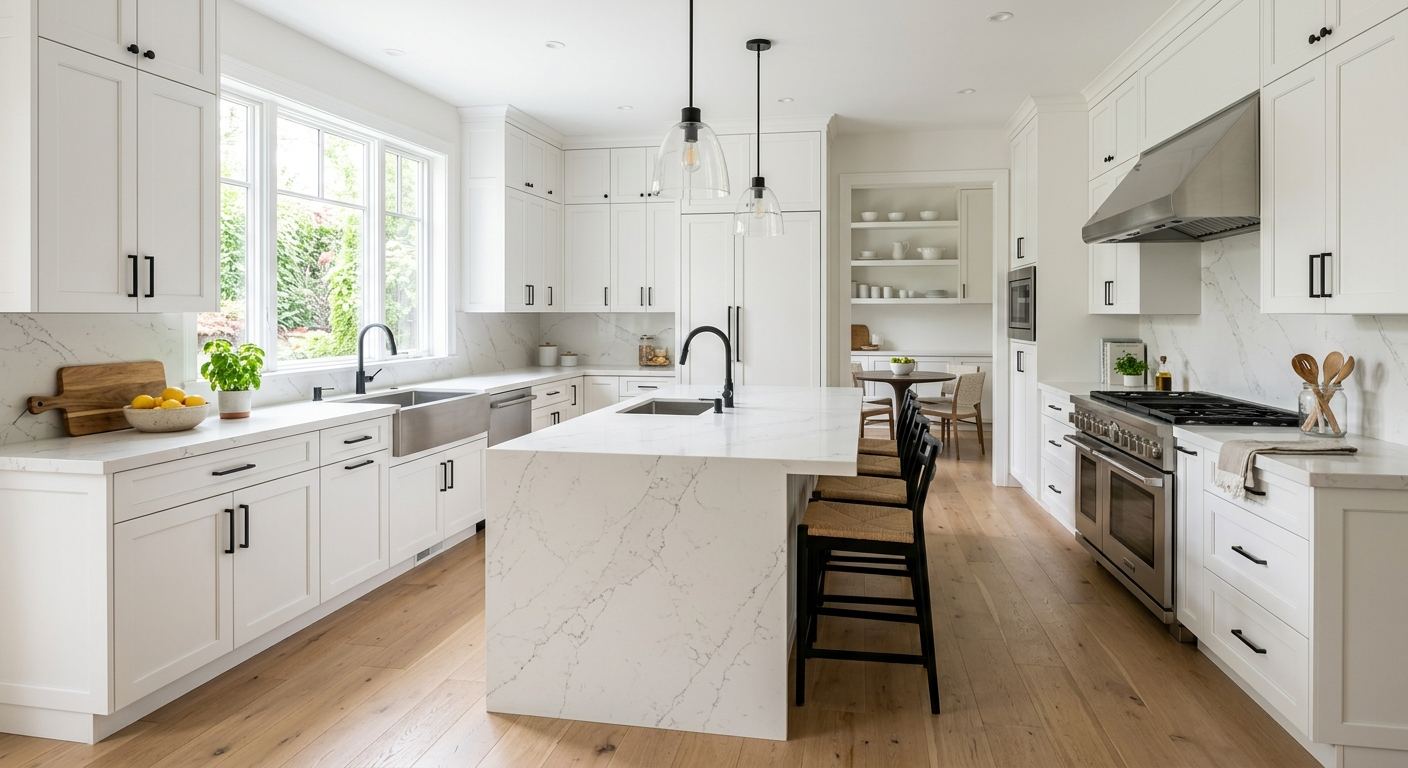
Right now, many King homeowners lean toward a clean, modern-transitional look: shaker-style cabinetry, warm whites/creams or light greys, and quartz countertops in subtle patterns. That preference lines up with what buyers in the Toronto region tend to favour because it’s durable, easy to maintain, and matches a wide range of home styles—especially in older housing stock (37.9% of dwellings built before 1981, Statistics Canada, 2021 Census). For backsplashes, homeowners often choose a neutral ceramic/porcelain tile or a higher-end feature that ties into the countertop tones rather than bold colour. When budgets rise, islands and under-cabinet lighting become common because they improve function and highlight the cabinetry. If you’re working within a mid-range full renovation budget like $25,000–$55,000, this style is usually achievable without going fully custom.