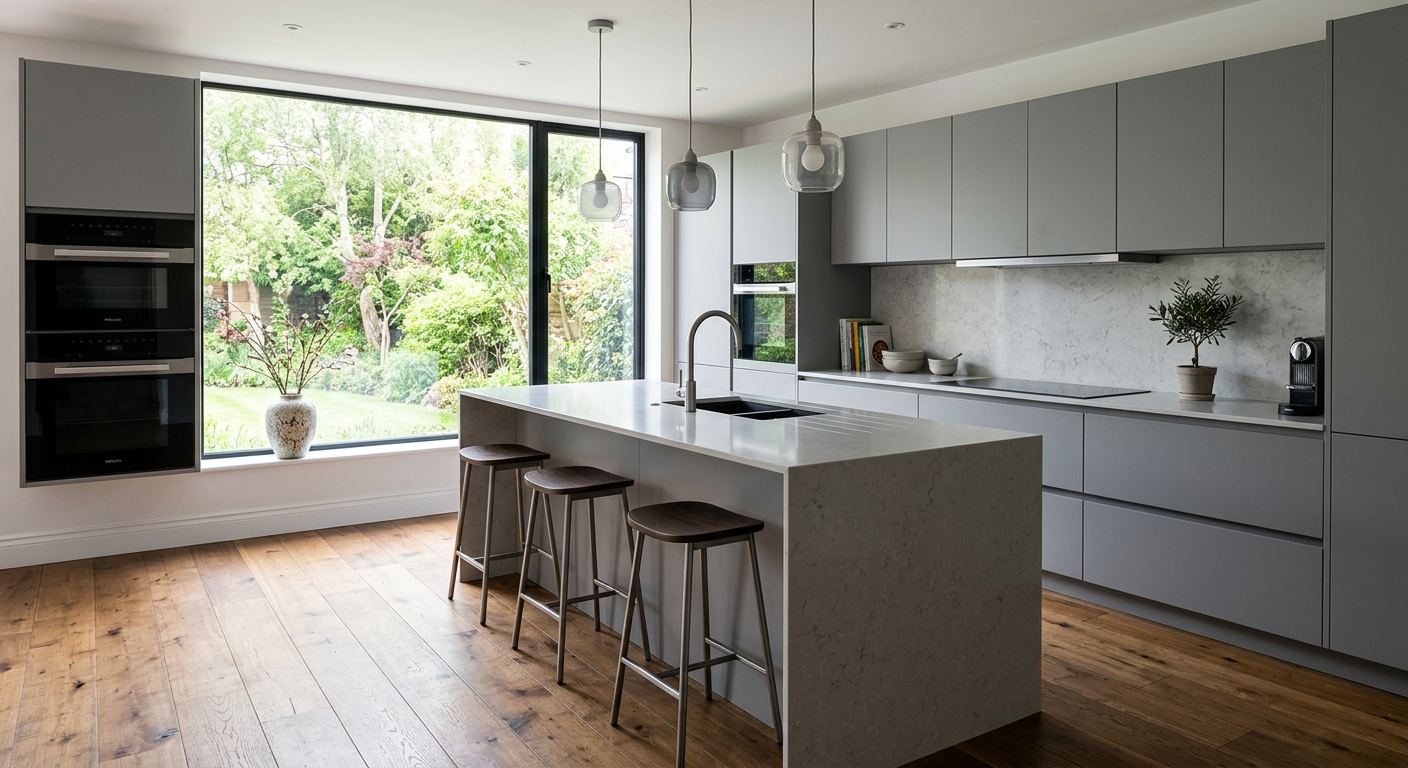
Kitchen renovation options and costs in Richmond
Renovating a kitchen in Richmond, British Columbia is a practical mix of style and resale-minded budgeting. With a median household income of $79,000 and a population of 209,937 (Statistics Canada, 2021 Census), many homeowners here plan renovations that look “current” to buyers without overspending for finishes they won’t recoup. In the Lower Mainland–Southwest, costs are driven more by expected finish level and home value than by weather extremes—so you’ll see more semi-custom and stone-counter choices in higher-value Richmond pockets, while the same footprint in a more restrained scope can stay mid-range with laminate and stock cabinetry.
Contractor availability also matters. Richmond’s consistent demand (including repairs tied to older homes) means schedules are often busiest for complete remodels—especially in neighbourhoods like Steveston, where many properties were built decades ago and owners frequently update ageing cabinetry, countertops, and dated electrical. Separately, the region’s kitchen work is typically labour-focused: cabinet installation, millwork accuracy, trade coordination, and countertop fabrication tolerances tend to dominate timelines and pricing more than climate-driven material changes.
If you’re comparing options, the quickest way is to start with scope: a cosmetic refresh moves fastest; a full renovation changes more trades; and a premium rebuild is where made-to-fit cabinetry, a stone island, and layout revisions stack up quickly. Use the table below to anchor your planning before you request itemised quotes from Richmond crews.
| Renovation Tier |
What's Included |
Typical Duration |
Price Range |
| Cosmetic refresh (paint, hardware, new appliances only) |
Paint/stain touch-ups, cabinet hardware swap, new fridge/range/dishwasher, basic caulking and trim re-touch |
3–7 days |
$10,000–$25,000 |
| Mid-range full renovation (new cabinets, counters, sink, tile) |
Stock or semi-custom cabinets, new countertop (quartz/laminate), sink and faucet, backsplash tile, flooring patch/partial replace, standard plumbing adjustments |
3–6 weeks |
$40,000–$75,000 |
| High-end full renovation (custom cabinets, stone counters, island) |
Custom cabinetry, stone counters (granite/stone/quartz), island with upgraded hardware, full-height backsplash options, upgraded electrical (lighting/circuits), often layout tweaks |
6–12 weeks |
$80,000–$120,000 |
| Cabinet refacing only (new doors + drawer fronts, same boxes) |
Door/drawer replacement, new veneer/edges if needed, hardware, repaint interiors as required, new backsplash prep, minor alignment adjustments |
1–3 weeks |
$12,000–$35,000 |
| Countertop swap only (laminate to quartz or stone) |
Remove existing counters, new quartz/stone template and install, sink/faucet transfer (as applicable), countertop edging, basic reseal and caulk |
1–2 weeks |
$4,500–$12,000 |
| Backsplash tile installation only |
Tile supply and install, wall prep, waterproofing where needed, grout sealing, trim and outlet finishing |
3–7 days |
$1,800–$6,000 |
Prices are estimates only and vary by project scope, site access and material selection.
What affects the price of kitchen renovation in Richmond
In the Lower Mainland–Southwest, it’s common for the same kitchen “style” to land 30–50% apart in total price when you compare estimates across British Columbia. The big driver is usually not weather—it’s the finish tier buyers expect and the resale logic around it. In higher-value Richmond areas, homeowners often gravitate toward quartz or stone counters and semi-custom cabinetry because the investment is easier to explain to future buyers. In more modest or strictly budgeted projects, laminate and stock cabinets can deliver a strong ROI without paying for premium millwork details.
Layout changes create the most unpredictable cost regardless of finish level. Moving a wall, adding an island, or relocating plumbing/gas tends to trigger more demolition, subfloor/framing corrections, and trade coordination. For example, switching from a standard line of cabinets to an island layout often increases electrical and ventilation complexity and can push you from a mid-range scope toward high-end totals quickly.
Richmond’s housing stock also influences what you’ll pay. A meaningful share of local homes were built before 1981, which often means dated wiring routes, older shutoffs, or non-standard cabinet spacing—small surprises that can add hours even when the finish remains “mid-range.” In dollar terms, cabinet/counter upgrades are typically a foundation of the project (for many kitchens, mid-range full renovations sit around $40,000–$75,000), and stone + custom island work is where budgets often move toward $80,000–$120,000.
Two concrete Richmond examples we see often: (1) upgrading under-cabinet lighting can require new electrical runs and junction-box locations to avoid future access issues, and (2) older plumbing rough-ins can force rework at the sink base when you change cabinet depth or cabinet-to-counter fit. Those items can raise labour even before you touch “premium” materials.
| Price Factor |
Why It Matters |
Cost Impact |
| Cabinet tier — stock vs. semi-custom vs. fully custom millwork |
Determines fit/finish, adjustability, door styles, and how much labour is needed to align everything to walls and ceilings |
Stock can save roughly 15–35% vs. semi-custom; custom can add 25–60% vs. stock |
| Countertop material — laminate vs. quartz vs. granite vs. stone |
Material cost, fabrication complexity, edge profiles, and weight/handling affect both price and scheduling |
Counter swaps alone often sit around $3,000–$12,000 depending on material and sink/edge work |
| Layout change — wall removal, island add, plumbing/gas move |
Alters structural, plumbing, ventilation, and electrical scope—labour and inspections become harder to estimate |
Can add several thousand to tens of thousands, often the biggest swing factor in the total |
| Appliance package tier — builder vs. mid-range vs. pro-grade |
Electrical/venting needs, rough-in tolerances, and installation time vary by brand and feature set |
Upgrading to pro-grade commonly increases appliance line items and sometimes triggers extra cut-outs or venting |
| Flooring — refinish existing vs. full replacement |
Whether you keep flooring intact changes surface prep, patching risk, and how much dust control is required |
Full replacement can add $1,500–$5,000+ depending on materials and repairs |
| Backsplash — ceramic tile vs. marble vs. full-height slab |
Premium stone and full-height coverage increase surface prep, sealing, and install time |
Typical backsplash-only budgets range $1,500–$6,000 based on material and height/complexity |
| Electrical — new circuits for island, under-cabinet lighting |
More outlets, lighting, and dedicated circuits add licensed labour and planning time |
Often a few thousand dollars; increases quickly when island + lighting + appliance upgrades stack |
| Permit fees and licensed trade requirements |
Some work needs permits/inspections; that affects scheduling and administrative time |
Not every kitchen needs permits, but when they do, the cost and timeline impact is noticeable |
Permits & regulations in British Columbia
In British Columbia, cabinet and countertop swaps typically do not require permits by themselves. If you’re simply replacing cabinets, changing countertops, or installing a backsplash without altering services, most jobs stay permit-light. However, permits and licensed trades are required when you change the systems that run behind or through walls: moving plumbing supply or drain lines, relocating gas (including gas stoves/ranges or certain hood venting), removing a load-bearing wall, or adding new electrical circuits (for example, new island outlets or upgrading under-cabinet lighting with additional wiring). Gas work must be performed by a licensed gas fitter, and electrical work must be done by a licensed electrician; both usually involve inspection steps.
For a Richmond homeowner, verification should be step-by-step before signing:
- Check the contractor’s British Columbia licence status (and relevant trade registrations if the company claims to self-perform trades).
- Request a certificate of insurance and confirm it matches the scope (liability coverage appropriate for a renovation).
- If applicable to their role, confirm workplace coverage through WSIB/WCB documentation—ask for the clearance letter or proof of coverage and keep it in your project file.
- Ask who pulls permits for your scope and whether responsibility is written in the contract (you want clarity on what trades are permitted and when inspections occur).
- Confirm inspection timing so you don’t lose weeks waiting on scheduling.
Always confirm permit responsibility with the contractor in writing. In kitchens, the scope detail is where misunderstandings happen.
Cabinets, countertops and layout decisions in Richmond
The three most consequential decisions in a Richmond kitchen renovation are (1) cabinet tier, (2) countertop material, and (3) layout changes. Cabinet tier sets the timeline and the “fit” you feel every day: stock is fastest and typically least expensive, semi-custom is the popular mid-range balance, and custom millwork is the best route for tricky rooms, ceiling height variations, and built-in features. Countertop material then drives durability and long-term maintenance—especially important in Richmond’s active household kitchens where spills and daily cleaning are routine.
In the Lower Mainland–Southwest resale market, buyers often expect a cohesive look: quartz or quality stone usually signals a more updated, higher-finish home than laminate. Laminate can be a strong budget option, and butcher block adds warmth for cooking families, but both can require more care. If you’re upgrading only one surface, countertops are usually worth prioritising. Finally, layout decisions—open-concept wall removal, island addition, or plumbing/gas relocation—should be justified by space gain. An island that improves traffic flow can be a selling feature, but if it requires major plumbing reroutes, the cost can jump even before you choose premium materials.
Here’s a realistic dollar example from Richmond scopes: upgrading from a laminate countertop to quartz often adds meaningful cost but can still keep you in a mid-range renovation plan, while adding an island plus stone counters is where you start approaching high-end totals. In other words, stone counters can be “worth it” for resale polish; moving plumbing/gas is worth it only if the new layout meaningfully improves usability.
| Option |
Durability |
Maintenance |
Best For |
Price Range |
| Stock cabinets (big-box) |
Good everyday durability; tolerates normal use but fit may require finishing and careful spacing |
Low—wipe clean; hinges/hardware maintenance depends on brand quality |
Quick timelines and budget-focused mid-range refreshes |
$8,000–$25,000 |
| Semi-custom cabinets (local dealer) |
Very good durability with better sizes, options, and hardware/door finishes |
Low to moderate—keep hinges aligned and clean as instructed |
Most Richmond renovations balancing resale appeal and cost |
$15,000–$45,000 |
| Custom cabinets (local millwork shop) |
Excellent durability; best for irregular walls, tall ceilings, and built-ins |
Low—long-life finishes when properly installed and maintained |
Design-led kitchens and premium resale presentation |
$35,000–$80,000 |
| Laminate countertop |
Decent for day-to-day use; can be more vulnerable to heat and edge wear |
Low—avoid direct heat and use gentle cleaners; watch seams/edges |
Budget renovations and appliance-focused updates |
$3,000–$6,000 |
| Quartz engineered countertop |
High durability and stain resistance; holds up well under frequent cleaning |
Low—wipes clean with standard household products; no sealing |
Busy kitchens needing a “looks-updated” finish with minimal fuss |
$6,500–$11,000 |
| Granite / natural stone countertop |
Very durable; strong resistance to daily wear with good sealing practices |
Moderate—usually requires periodic sealing and careful edge protection |
Premium finishes when you want natural variation and upscale appearance |
$8,000–$14,000 |
| Butcher block countertop |
Good durability with natural resilience; more sensitive to heat and moisture edges |
Moderate to high—oil and maintenance schedule matters to prevent drying/warping |
Cooking-heavy households wanting warmth and repairable wear |
$4,000–$10,000 |
| Marble countertop |
Stylish and durable but more prone to etching/staining from acids |
Higher—requires careful cleaning habits and sealing maintenance |
Design-first kitchens where maintenance expectations are realistic |
$10,000–$20,000 |
How to choose a kitchen renovation contractor in Richmond
Choosing a kitchen contractor in Richmond starts with verification. In British Columbia, confirm licensing and the right coverage before work begins: ask for their proof of insurance (liability), and request documentation for workplace coverage (WSIB/WCB clearance letter or proof of coverage, depending on their status). If the company is subcontracting licensed trades, you should still request the relevant contractor details and certificates so you’re not left holding gaps if something goes wrong.
Next, get 2–3 itemised written quotes. The best bids break labour and materials into clear lines (cabinet supply, install labour, demolition, electrical/plumbing trade fees if applicable, countertop fabrication/templating, and disposal). Avoid “lump sum only” quotes that don’t explain exclusions. Read the scope carefully: is permit pulling included when required? Is material disposal included? Are wall repairs and drywall refinishing included after plumbing/electrical changes? Also confirm who is responsible for site protection and dust control—kitchens involve cabinets, tile, and countertop fabrication areas that get damaged if prep is rushed.
Finally, watch the commercial terms. Workmanship warranty should be stated with a duration and what it covers; product/manufacturer warranty should list the brand and whether it’s transferable if you sell. For payment schedule, never let the contract exceed about 10–15% upfront; a holdback tied to completion helps ensure punch-list items get fixed. Insist on a written start date and completion estimate—kitchen schedules are real, and countertop lead times can affect the entire sequence.
- Verify BC licence status and trade registrations before signing.
- Request certificate of insurance and check the policy is active for the project period.
- Ask for WSIB/WCB clearance letter or proof of workplace coverage.
- Get at least 2–3 itemised quotes with line-by-line materials and labour.
- Confirm whether permits are included and which trades will be permitted.
- Ensure disposal/haul-away is included for demolition and packaging.
- Clarify who repairs drywall, flooring, and paint after mechanical changes.
- Confirm countertop templating timing and who schedules fabrication.
- Ask about cabinet handling, alignment procedures, and adjustment allowances.
- Review warranty details: workmanship length and product warranty transferability.
- Use a payment schedule with limited upfront deposit and a completion holdback.
- Get a written schedule: start date, key milestones, and estimated completion.
Red flags we commonly see with Richmond kitchen contractors: (1) quotes that don’t specify whether counters are quartz/stone by brand and thickness, (2) unclear scope around permits for plumbing/electrical/gas changes, (3) refusing to provide insurance documentation, (4) demanding a large deposit before templates and approvals, and (5) “no surprises” promises without a detailed allowance list for demolition surprises.
Frequently asked questions — kitchen renovation in Richmond
What is the difference between a galley and open-concept kitchen?
A galley kitchen is typically a corridor-style layout: counters on two parallel walls with a walkway in between. It often works well in older Richmond homes where space is compact, and it can be efficient for cooking because everything is within arm’s reach. An open-concept kitchen removes barriers between the kitchen and living area, usually by eliminating a wall (where permitted) and adjusting ventilation and lighting expectations. In British Columbia’s higher-value resale areas, open-concept layouts are popular because they read modern to buyers, but they can cost more if you must handle plumbing/electrical reroutes and, in some cases, permit work. If you’re renovating in a pre-1981 home stock pocket, plan extra time for service upgrades that aren’t aligned to newer layouts.
How do I get accurate kitchen renovation quotes in Richmond?
To get accurate Richmond quotes, you’ll want the scope defined enough that contractors can price the same work. Provide measurements, photos, and—if possible—whether you want stock vs. semi-custom vs. custom cabinetry and which countertop tier you’re targeting. Ask for 2–3 itemised quotes with line items for demolition, cabinet supply/installation, countertop templating and install, tile work, and any licensed trade allowances. Specify whether you’re relocating a sink, moving a gas range, adding an island, or adding circuits—those items drive major differences. Even with a clear plan, older Richmond homes (including those built before 1981) can reveal wiring, shutoff placement, or framing irregularities, so ask for an allowance for “unknowns.” As a benchmark, some mid-range full renovations commonly land in the $40,000–$75,000 range, while higher-end builds can move toward $80,000–$120,000 depending on layout and materials.
What's the best countertop material for a busy Richmond kitchen?
For most busy households in Richmond, quartz is often the best balance of durability and low maintenance. It’s resistant to stains from everyday cooking and usually doesn’t require sealing like many natural stones. If you want a premium look without a lot of upkeep planning, quartz is a strong “daily use” choice—especially when paired with durable cabinet hardware and a sensible backsplash. Laminate can work if your priority is budget, but it’s more sensitive to heat and wear at edges and seams. Natural stone like granite or marble can be beautiful, yet marble in particular demands careful cleaning habits due to etching from acidic spills. Price-wise, quartz countertop projects commonly fall within the $6,500–$11,000 range, while laminate is often closer to $3,000–$6,000, and premium stone can push higher depending on thickness and edge profiles.
How do I add an island to my Richmond kitchen?
Adding an island starts with layout feasibility: clearances, cabinet-to-walkway space, and whether your flooring/subfloor can support the island footprint. Then you decide whether the island needs a sink, dishwasher, or cooktop. If you’re planning plumbing relocation (sink) or gas/venting for a cooktop, you should expect additional scope, inspections, and licensed trades in British Columbia—those are not “swap-only” changes. Even if you’re keeping services where they are and making the island primarily for seating and storage, you may still add electrical for outlets or pendant lighting. In Richmond homes built decades ago, service locations can be unpredictable, which can affect where you can tie in drains/supply lines efficiently. If you’re budgeting, remember that island work can quickly shift a plan upward: an otherwise mid-range renovation can move toward higher-end totals when the island triggers plumbing/gas and electrical complexity.
How much does a kitchen renovation cost in Richmond?
Kitchen renovation cost in Richmond usually depends on renovation tier, cabinet choice, countertop material, and whether you change the layout. A cosmetic refresh (paint, hardware, and new appliances only) often stays closer to about $10,000–$25,000. A mid-range full renovation—new cabinets and counters plus a sink and backsplash—commonly lands around $40,000–$75,000. If you’re doing custom millwork, stone counters, and an island with higher-end finishes, budgets often land in the $80,000–$120,000 range. Keep in mind that the Lower Mainland–Southwest market can push owners toward premium materials for resale polish, even when the layout is similar. Also, if your kitchen is in an older home (many were built before 1981), allowances for wiring and plumbing updates may be needed, which affects total cost.
How long does a kitchen renovation take in Richmond?
Timelines in Richmond depend on scope and lead times, but you can plan with realistic ranges. Cosmetic refresh projects can move quickly—often 3–7 days—because they avoid heavy demolition and fabrication. A mid-range full renovation (cabinet + countertop + tile + typical plumbing adjustments) often takes about 3–6 weeks. High-end renovations with custom cabinetry and stone islands can run 6–12 weeks because cabinet production, countertop templating, and coordination between trades take time. If layout changes require permits and inspections (for plumbing, gas, or electrical), schedule certainty becomes more important, because inspections can add waiting days. Also, countertop fabrication scheduling can affect when you can install and finish stages. The best contractors provide a written schedule with milestone dates and a completion estimate, rather than a single vague “a few weeks” plan.