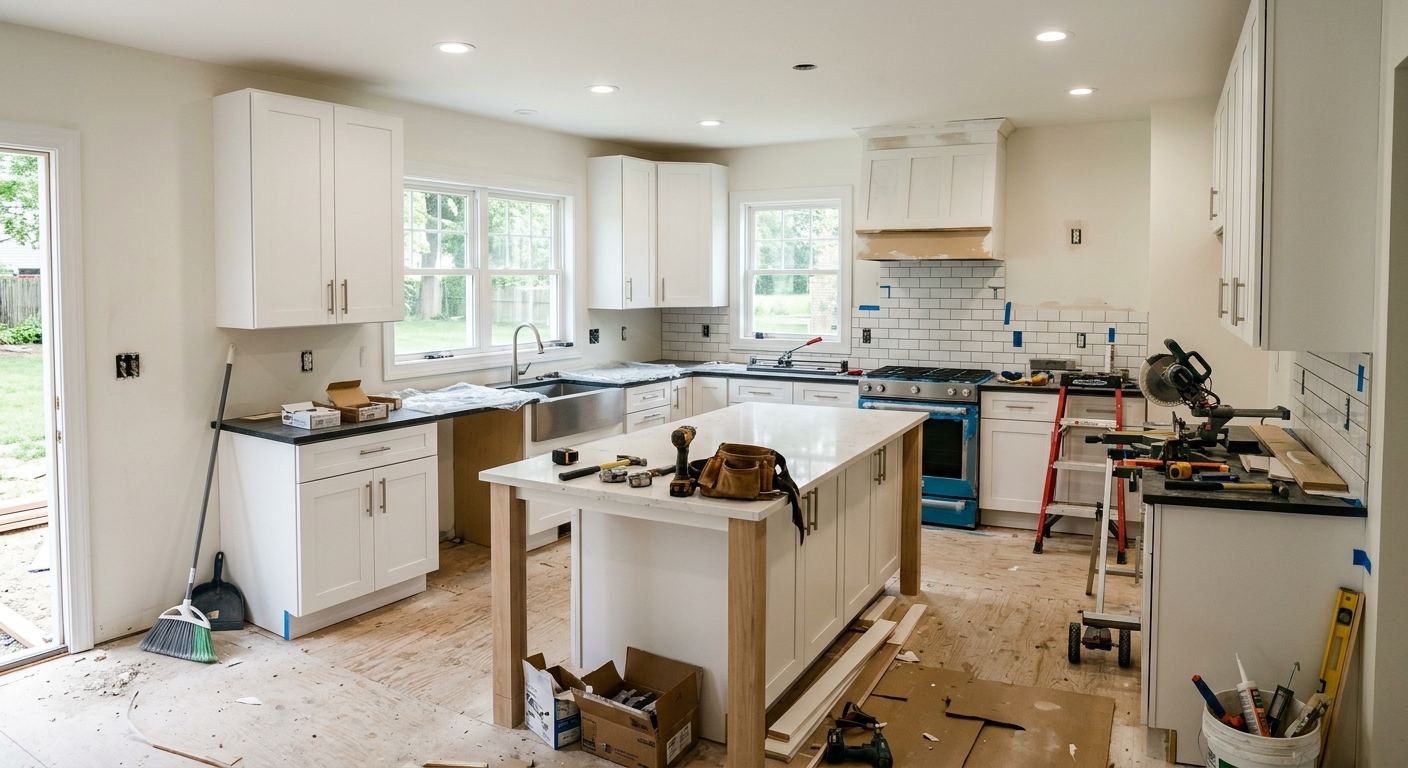
Kitchen renovation options and costs in Powell River
Powell River kitchen renovations typically sort into a few predictable “tiers,” but the final price still depends on how finished you want the kitchen to look. With a median household income of $67,000 (Statistics Canada, 2021 Census) and a housing stock where 66.5% of homes were built before 1981, many homeowners aim for practical upgrades that improve daily function without overbuilding for the space. At the same time, Lower Mainland–Southwest buyers often pay attention to finish quality, so even in Powell River you’ll see more demand for modern cabinet fronts, better drawer hardware, and durable surfaces than in past refreshes.
In this region, costs are driven more by home value and finish expectations than by climate alone—British Columbia’s coastal weather does, however, influence material selection and detailing. Powell River’s frequent damp spells and salty air (especially near the waterfront) mean cabinet box quality, door sealing, and moisture-resistant materials matter, and that can nudge pricing upward versus a purely “dry” interior. Contractor availability is also a factor: for demand spikes in nearby ferry/commuter zones and for trades tied up with whole-home renovations, schedule-driven labour premiums can appear.
If you’re in the Oceanview / downtown-adjacent areas, trade demand is especially noticeable because many projects are in older homes with narrower clearances and more complicated service runs. The good news is you can still control cost by choosing the right tier—use the table below to compare common scopes and typical timelines before you book site visits.
| Renovation Tier |
What's Included |
Typical Duration |
Price Range |
| Cosmetic refresh (paint, hardware, new appliances only) |
Paint and trim touch-ups, new pulls/knobs, appliance swap (dishwasher/range/hood or fridge where plumbing is unchanged), minor caulking and resealing, basic electrical checks |
1–2 weeks |
$8,000–$20,000 |
| Mid-range full renovation (new cabinets, counters, sink, tile) |
New semi-custom or quality stock cabinets, new countertop installation, sink and faucet, backsplash tile, under-cabinet lighting where wiring is ready, floor refresh (partial or full), disposal hook-up and basic plumbing adjustments if needed |
3–6 weeks |
$40,000–$85,000 |
| High-end full renovation (custom cabinets, stone counters, island) |
Fully custom millwork, stone (quartz/stone) counters, island (often with upgraded electrical and plumbing coordination), premium hardware, upgraded backsplash (full-height option), higher-end sink/faucet package, flooring replacement, coordinated electrical/plumbing for new features |
6–10 weeks |
$85,000–$120,000 |
| Cabinet refacing only (new doors + drawer fronts, same boxes) |
Remove and replace doors/drawer fronts, reface panels where feasible, new hardware, optional internal updates (pull-outs), prep/painting or veneer system depending on existing box condition |
2–4 weeks |
$8,000–$35,000 |
| Countertop swap only (laminate to quartz or stone) |
Remove existing countertop, install new quartz or stone, new sink cut-out coordination, reseal/caulk, basic backsplash tie-in (not full tile build-back unless specified) |
3–7 days |
$3,500–$12,000 |
| Backsplash tile installation only |
Surface prep, tile supply and layout, grout/seal, edge finishing, integration with existing countertop/sill lines |
4–7 days |
$1,500–$6,000 |
Prices are estimates only and vary by project scope, site access and material selection.
What affects the price of kitchen renovation in Powell River
In Lower Mainland–Southwest (and across British Columbia more broadly), the same kitchen renovation can land 30–50% apart because quotes reflect finish tier, labour availability, and how much change you’re actually asking for—not just cabinet and counter materials. While climate plays a role in detailing and moisture management, local market pricing is more about homeowner expectations and resale logic. In higher-value parts of the Lower Mainland–Southwest, owners more often default to quartz or stone counters and semi-custom cabinetry because the added cost is easier to recoup on resale. In more modest markets, laminate and stock cabinets dominate since they deliver a strong visual upgrade without pushing total project budgets into the highest bands.
In Powell River, two conditions commonly push costs upward: (1) older homes built before 1981 often have wiring/plumbing that needs correction before new fixtures go in, and (2) tight layouts mean more labour for demolition, re-framing, and finish carpentry. Even with the same cabinet line, your layout decisions can be the biggest swing factor—removing a wall, adding an island, or moving a gas line can force trade coordination, inspections, and longer schedules. If you’re aiming for a mid-range full renovation, many projects start around the $40,000–$85,000 band, but layout complexity can quickly edge upward toward higher-end totals.
Concrete examples from Powell River jobs I’ve seen: upgrading under-cabinet lighting from “none” to a proper circuit frequently adds days of electrician time; replacing rotted toe-kick framing (hidden under existing cabinets) can add carpentry and material costs; and if your backsplash plan goes from basic ceramic to a full-height tile wall, labour and tile quantity rise noticeably. The result is that a refresh-only scope can stay restrained, while full rebuilds scale fast once cabinetry and stone counters are installed and the trades have to coordinate around older rough-ins.
| Price Factor |
Why It Matters |
Cost Impact |
| Cabinet tier — stock vs. semi-custom vs. fully custom millwork |
More custom means more shop time, made-to-fit sizing, higher-grade materials, and longer lead times |
Typically shifts project totals by several tens of thousands; common spreads within the $40,000–$120,000 band |
| Countertop material — laminate vs. quartz vs. granite vs. stone |
Material cost, templating complexity, and fabrication/installation labour vary significantly |
Countertops alone often range from about $3,000–$12,000 depending on material and sink cut-outs |
| Layout change — wall removal, island add, plumbing/gas move |
Triggers new framing, inspection requirements, and coordination between trades |
Can add the most unpredictable cost regardless of finish level; often the swing that pushes mid-range toward high-end |
| Appliance package tier — builder vs. mid-range vs. pro-grade |
Higher tiers come with better warranties, fit/finish, and more electrical requirements |
Appliance upgrades can add thousands and sometimes change electrical/plumbing scope |
| Flooring — refinish existing vs. full replacement |
Older subfloors may need prep; demolition and disposal drive labour time |
Partial refresh costs less, while full replacement commonly raises totals by a noticeable margin |
| Backsplash — ceramic tile vs. marble vs. full-height slab |
Premium materials cost more per square foot and often require more precise installation |
Tile-only scopes typically run $1,500–$6,000; marble/full-height options trend high |
| Electrical — new circuits for island, under-cabinet lighting |
Electrical work is time-based and requires licensed installation and inspections |
Frequent add-on when adding islands and lighting; can expand labour days |
| Permit fees and licensed trade requirements |
Some work requires permits/inspections, and licensed trades must perform it |
Adds direct permitting costs and coordination time, especially for plumbing/gas and major electrical |
Permits & regulations in British Columbia
In British Columbia, swapping cabinets or changing countertops typically does not trigger permitting—cabinet and countertop replacements are usually considered finishing work as long as you aren’t altering structural supports or moving services. However, Powell River homeowners should expect permits and licensed trades when the scope touches plumbing, gas, structural elements, or new electrical circuits. For example, moving plumbing supply or drain lines, relocating a gas stove/range, or changing the venting pathway for a hood are common permit-triggering tasks. Likewise, removing a load-bearing wall or adding/altering circuits (like dedicated power for an island, new under-cabinet lighting runs, or rewiring affected areas) typically requires permits, inspections, and work by licensed professionals.
Here’s a practical way to verify a contractor before signing, tailored to Powell River homeowners: (1) Ask for the company’s licence/registration details for the trade(s) involved and confirm they match the work proposed (gas fitters for any gas-related changes; electricians for electrical work). (2) Request a current certificate of insurance and check that it lists liability coverage appropriate for renovations and the correct legal entity. (3) Ask about work coverage—coverage for workers (often referred to as WSIB/WCB) should be documented or confirmed, particularly if the contractor employs trades or coordinates subcontractors. (4) Verify these documents and licences before payment milestones. (5) Ensure permit responsibility is stated in your written contract—who pulls permits, who pays fees, and who schedules inspections—so surprises don’t land at the end of the job.
Cabinets, countertops and layout decisions in Powell River
For Powell River kitchens, the three most consequential decisions are cabinet tier, countertop material, and whether you change the layout. Cabinet tier affects cost and schedule more than almost anything else. Stock cabinets are the fastest and usually the cheapest route, while semi-custom is the most popular mid-range choice because you can adjust heights and configurations without the long lead times of fully custom millwork. Custom cabinets cost more, but they’re where you get the best fit in older homes with out-of-square walls and unusual dimensions.
Countertop material should be chosen for durability and maintenance in British Columbia’s coastal conditions. Laminate can be a budget-friendly option, but it’s less forgiving for heat and sharp impacts. Quartz engineered countertops are a common “sweet spot” because they resist staining and hold up well to everyday cooking, and many homeowners find the price difference justifiable when they’re replacing damaged surfaces or planning to stay in the home longer. Natural stone like granite looks premium but is still a higher-cost path once fabrication and installation are included; marble is beautiful but requires more care and more disciplined maintenance.
Layout changes are where costs can jump. Removing a wall or adding an island can be worth it when it creates real space gain—better circulation, more seating, or improved work triangle. But if the plumbing/gas has to be moved, you’re not just paying for labour—you’re paying for coordination time with licensed trades and potential inspection steps.
One example: if your current counters are worn and you’re already planning a mid-range renovation, moving from laminate to quartz often makes sense because the upgrade is typically in the $3,000–$12,000 countertop range depending on the job size and cut-outs, and quartz can better handle daily use than laminate in a busy coastal household. If you’re only doing a refresh and keeping most service points, laminate might be the smarter ROI—but for buyers expecting a modern finish, quartz tends to land closer to what they want.
| Option |
Durability |
Maintenance |
Best For |
Price Range |
| Stock cabinets (big-box) |
Good everyday durability; performance depends on door finish and hinges |
Low maintenance; clean with non-abrasive products |
Fast renovations and tighter budgets with straightforward layouts |
$15,000–$35,000 |
| Semi-custom cabinets (local dealer) |
Very solid construction with better options for widths/heights and storage features |
Low to moderate; quality hardware helps reduce wear |
Most Powell River homeowners aiming for a modern look without custom wait times |
$25,000–$55,000 |
| Custom cabinets (local millwork shop) |
Excellent fit and build quality; best for irregular walls and unique storage |
Low maintenance, but rely on careful finishing and hardware choice |
When the layout needs exact millwork solutions and you want a premium end result |
$45,000–$90,000 |
| Laminate countertop |
Moderate; can chip or wear near sinks and seams with heavy impacts |
Wipe clean; avoid heat/standing water at seams |
Refresh projects or rental/shorter ownership timelines |
$3,000–$6,000 |
| Quartz engineered countertop |
High durability; resists staining and everyday wear |
Very low; typically no sealing required |
Busy family kitchens and resale-focused renovations |
$6,000–$11,000 |
| Granite / natural stone countertop |
High durability and heat tolerance; performance depends on polishing and edging |
Moderate; periodic sealing and careful stain management |
Homeowners wanting natural variation and a high-end look |
$7,500–$12,000 |
| Butcher block countertop |
Good impact resistance; needs protection from prolonged moisture |
Moderate; regular oiling and keeping seams dry |
Casual/heritage kitchens and homeowners comfortable with upkeep |
$4,000–$8,500 |
| Marble countertop |
Beautiful but softer; can scratch/etch more easily |
Higher maintenance; sealing and gentle cleaning |
Statement kitchens where appearance is the priority |
$8,000–$14,000 |
How to choose a kitchen renovation contractor in Powell River
Choosing the right contractor in Powell River is mostly about verifying credentials, then tightening your scope in writing. For British Columbia work, confirm the contractor’s licensing for the trades involved (especially gas-related and electrical scopes). Ask for liability insurance and documentation of worker coverage (WSIB/WCB) for their crews or subcontractors. How to check: request certificates directly, confirm the legal business name matches the quote and invoices, and make sure coverage dates are current—then keep copies with your renovation file for your records.
Get 2–3 itemised written quotes that break labour and materials apart, not one lump sum. A good quote should list cabinetry supply, countertop supply, installation labour, sink/faucet costs, backsplash labour and tile supply, demolition/disposal, electrical/plumbing allowances, and any contingency for field measurements—especially important in older homes built before 1981 where wall lines and subfloor flatness can vary. Read exclusions carefully: is permit pulling included (if required), and is disposal included (demo hauling, dump fees)? A written scope should also specify lead times for cabinets and countertops.
Warranty matters: ask for the workmanship warranty length and how product/manufacturer warranties are handled, including whether they’re transferable if you sell the home. Payment schedule should be conservative—never more than 10–15% upfront—and hold back a final portion until the job is substantially complete. Finally, ask for a start date and an estimated completion date in writing, plus what happens if materials arrive late.
- Confirm trade licensing for any gas and electrical work in writing.
- Request a current certificate of liability insurance (and verify dates and business name).
- Ask for WSIB/WCB coverage proof for employees or subcontractor responsibility in the contract.
- Demand itemised labour and materials breakdown (not only a total).
- Ensure demolition, disposal, and site protection (flooring/cardboard protection) are included.
- Clarify whether permits are pulled by the contractor or by you.
- Check whether plumbing/gas relocations include allowances or are quoted as “re-measure.”
- Verify countertop templating and cut-out responsibilities for sinks and cooktops.
- Confirm warranty on workmanship and who you contact if something fails after completion.
- Require a written schedule showing key milestones (demo, rough-in, cabinets, counters, final trim).
- Use a payment schedule with staged milestones and a final holdback until completion.
- Ask about dust control and how they protect vents, HVAC returns, and adjacent rooms.
Red flags in Powell River: a quote that’s not itemised (you can’t compare apples-to-apples), contractors who dismiss permits or say “we handle it later,” vague timelines with no dates, payment requests beyond 10–15% upfront, and workmanship warranty that’s either missing or shorter than you’d expect for the scope.
Frequently asked questions — kitchen renovation in Powell River
What's the most cost-effective kitchen upgrade?
In Powell River, the most cost-effective upgrade is usually a targeted “visual lift” that doesn’t require moving plumbing or major electrical—paint plus new hardware, paired with either a backsplash refresh or a limited appliance update. If your existing layout is functional, you can often keep costs down by staying in the lower tiers; for example, a cosmetic refresh is commonly in the $8,000–$20,000 range depending on appliance choices and how much wall preparation is needed. For a bigger payoff, a countertop swap (often about $3,000–$12,000) can transform the look without triggering the same coordination costs as a full rebuild. The key is avoiding layout changes that require permits and licensed trade involvement, because that’s what tends to push budgets into the $40,000–$85,000 mid-range and beyond.
Custom vs stock cabinets — is custom worth it?
Custom cabinets can be worth it in Powell River when your kitchen has awkward dimensions, out-of-square walls, or a layout that needs exact storage solutions. Stock cabinets (big-box) are usually the fastest and cheapest path, but they may leave gaps or force compromises in fit—especially common in older homes built before 1981. Semi-custom often lands in the best “value zone” for most homeowners: you can get better storage configurations and finishes without paying full custom millwork pricing. If you’re comparing options for a full renovation, remember the cabinet tier affects schedule and total cost, and in high-finish projects the overall budget often moves toward the $85,000–$120,000 high-end band. If you want an upgrade that buyers recognize quickly, quartz counters and quality drawer hardware paired with semi-custom cabinets often deliver the best balance.
How do I choose a kitchen contractor in Powell River?
Start by verifying the contractor’s ability to handle the trades your project requires in British Columbia—especially electrical and gas-related work. Ask for written proof of liability insurance and documentation of worker coverage (WSIB/WCB) and make sure licences align with the scope. Next, get 2–3 itemised quotes so labour and materials can be compared line-by-line; don’t rely on a single lump sum. Confirm what’s included: permits (if required), disposal, floor protection, and allowances for plumbing or electrical changes. A good contractor will outline a realistic timeline and include a workmanship warranty with clear contact steps if issues arise later. Finally, keep your payment schedule conservative—no more than about 10–15% upfront—and hold back a portion until completion, which reduces risk on real-world Powell River projects.
What order do kitchen renovation steps happen in?
A typical kitchen renovation sequence in Powell River looks like this: first, measure and confirm layout (and order cabinets/counters based on accurate dimensions). Then comes demolition and site prep, followed by any rough-ins—plumbing/drain changes, gas work (if applicable), and electrical rough wiring for outlets and lighting. After rough-ins are inspected, framing/patching and drywall repairs happen, then flooring (if you’re replacing it) and backsplash surface prep. Cabinets are installed next, counters are templated and then fabricated, and countertop installation follows. Finishing steps—backsplash tiling, trim, caulking, paint touch-ups, appliance hookups, and final calibration—come at the end. If you’re staying in a countertop-only scope, the order compresses, but good installers still template carefully to avoid sink cut-out and seam issues.
Can I live at home during a kitchen renovation in Powell River?
Often yes, but it depends on scope and schedule. In Powell River, smaller scopes like a cosmetic refresh or backsplash tile-only job are usually manageable with minimal disruption—you may be able to use a temporary sink and keep everyday routines going. For mid-range full renovations ($40,000–$85,000), many homeowners set up a temporary kitchen in another room and use a safe cooking alternative while demolition and rough-in work is underway. If you’re doing high-end builds ($85,000–$120,000) with layout changes and new services, living onsite is possible but more challenging, because construction areas need protection and daily access can be limited. Discuss dust control, bathroom access, and how the contractor will manage power and water shutoffs. Your comfort matters—if gas/plumbing is being moved or the layout is heavily opened up, plan for partial relocation or extended accommodation.
Should I renovate my kitchen before selling in Powell River?
Usually, you renovate to match what buyers in British Columbia expect for a functional, modern kitchen—without overspending for your specific property profile. In Powell River’s market, many homeowners with older homes choose improvements that reduce visible wear and improve usability, such as fresh cabinets/finishes and quartz or stone counters. A full mid-range renovation often makes sense when your kitchen layout works but surfaces are dated; the $40,000–$85,000 band is where many buyers start to feel “this is updated,” especially when paired with quality hardware, a clean backsplash line, and modern lighting. However, if your budget pushes into the high-end territory ($85,000–$120,000), you should be confident the upgrades match your home’s value and buyer profile—otherwise the spend may not translate into resale recovery. A practical approach is to get a pre-renovation walkthrough, identify what’s most visible and most costly to fix later, and build a scope that’s defensible for your home’s size and condition.