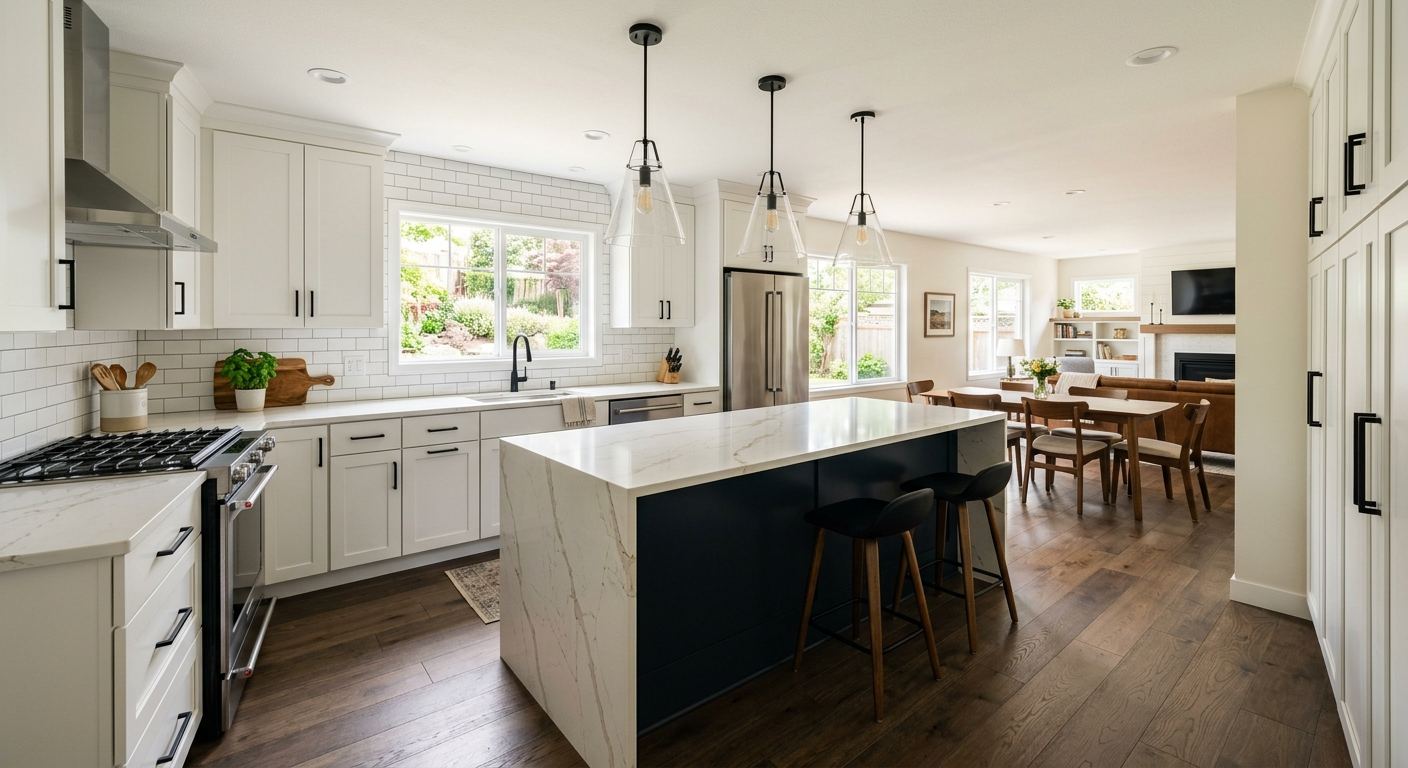
Kitchen renovation options and costs in Clayburn
Clayburn, British Columbia is a great place to renovate because many homes are now reaching the point where kitchens feel dated—but buyers still expect clean, durable finishes. With a population of 11,755 (Statistics Canada, 2021 Census), local demand is steady, and in the Lower Mainland–Southwest many homeowners plan renovations around resale timelines rather than “someday.” In higher-value pockets of the region, finish expectations tend to climb quickly: owners commonly step up to semi-custom cabinetry and quartz/stone counters because the cost is easier to recover when the kitchen looks modern and cohesive. That’s also why contractor availability can feel different across the region; in more premium corridors, crews are booked earlier due to larger millwork and stone packages.
In the Lower Mainland–Southwest, the climate doesn’t usually drive major cost inflation the way it can in extreme cold provinces; instead, kitchen renovation pricing is driven more by home value, income, and the selected finish tier. You’ll still see price movement from weather-related scheduling delays (rain-heavy stretches affect drying times for floors, tile, and some finishes), but the bigger swings come from how complex your cabinetry is and whether you’re changing plumbing, gas, or electrical. If you’re in and around Abbotsford-area commuter corridors, you’ll also notice steady trade demand for kitchen carpentry and countertop installs.
To help you compare quotes fairly, here are common renovation tiers and typical ranges you’ll see in Clayburn projects—then you can line up your scope against the table.
| Renovation Tier |
What's Included |
Typical Duration |
Price Range |
| Cosmetic refresh (paint, hardware, new appliances only) |
Cabinet paint/stain (where applicable), new pulls/handles, caulking, appliance swap, minor countertop protection/spot touch-ups, basic cleaning & trim adjustments |
1–2 weeks |
$8,000–$20,000 |
| Mid-range full renovation (new cabinets, counters, sink, tile) |
New stock or semi-custom cabinets, countertop install, sink & faucet, backsplash tile, updated flooring plan (refinish or partial replacement), electrical/plumbing updates as needed |
3–6 weeks |
$40,000–$75,000 |
| High-end full renovation (custom cabinets, stone counters, island) |
Fully custom millwork, quartz or natural stone counters, island with enhanced lighting, full-height backsplash option, upgraded fixtures/hardware, more complex layout and trade coordination |
6–12 weeks |
$90,000–$120,000 |
| Cabinet refacing only (new doors + drawer fronts, same boxes) |
New door/drawer fronts, upgraded hardware, veneer replacement where needed, optional interior upgrades (shelves/roll-outs), countertop not included |
1–3 weeks |
$8,000–$35,000 |
| Countertop swap only (laminate to quartz or stone) |
Removal and disposal, template & install, sink cut-outs, seam finishing, basic backsplash top line changes (if needed) |
5–14 days |
$3,000–$12,000 |
| Backsplash tile installation only |
Tile supply and install (ceramic/porcelain), edge trimming, waterproofing prep, grouting and caulking |
3–7 days |
$1,500–$6,000 |
Prices are estimates only and vary by project scope, site access and material selection.
What affects the price of kitchen renovation in Clayburn
When homeowners in Clayburn get two quotes for the “same” kitchen, it’s common to see totals swing by 30–50% across the Lower Mainland–Southwest and other parts of British Columbia. The reason isn’t climate—it’s that buyers and lenders tend to value finished kitchens differently depending on local home values, household income, and the expected finish tier. In higher-value neighbourhoods, quartz or stone counters and semi-custom cabinetry are often the default, because homeowners can justify the spend on resale. In more modest pockets, laminate surfaces and stock cabinets still offer a strong return because the kitchen looks refreshed without a premium build.
Layout changes are the most unpredictable cost driver regardless of finish level. Removing a wall, adding an island, or moving a gas line can trigger new framing, venting/line work, and extra electrical circuits—so your “small” change can behave like a full rebuild portion. For example, in an older home stock (many kitchens are dated but structurally sound), shifting a sink to an exterior wall can cost more than swapping counters; the cabinetry might remain “mid-range,” but the plumbing scope pushes labour and permit time upward.
Concrete Clayburn examples we see: (1) a simple cabinet swap over existing plumbing runs typically sits in the $40,000–$75,000 mid-range band; (2) once you add an island with under-cabinet lighting and additional circuits, the same footprint often moves toward the higher $90,000–$120,000 tier if you upgrade to stone and custom panels; (3) full-height tile backsplashes can add weeks and higher tile labour compared with a standard backsplash, even if cabinets stay stock.
| Price Factor |
Why It Matters |
Cost Impact |
| Cabinet tier — stock vs. semi-custom vs. fully custom millwork |
Custom sizing, interior options, and finish quality directly change labour, fitting time, and material cost |
Typically shifts budget by $15,000–$40,000 on full renos |
| Countertop material — laminate vs. quartz vs. granite vs. stone |
Material price and installation complexity (seams, edge profiles, thickness) affect total cost |
Can add $3,000–$20,000 depending on choice |
| Layout change — wall removal, island add, plumbing/gas move |
Framing, venting, line relocation, and inspection time increase scope even if surfaces are modest |
Often adds $8,000–$35,000 |
| Appliance package tier — builder vs. mid-range vs. pro-grade |
Upgrade drives both appliance cost and installation details (clearances, ventilation, electrical readiness) |
Typically $2,000–$12,000 difference |
| Flooring — refinish existing vs. full replacement |
Protection and partial repair are cheaper; full replacement requires subfloor prep and matching transitions |
Often $1,500–$10,000 |
| Backsplash — ceramic tile vs. marble vs. full-height slab |
Tile density, stone weight, and substrate prep change labour intensity and risk |
Typically $1,500–$6,000+ for backsplash-only lines |
| Electrical — new circuits for island, under-cabinet lighting |
New circuits require licensed work and inspection; lighting adds parts and wiring time |
Often $1,500–$6,000+ |
| Permit fees and licensed trade requirements |
Work involving gas, load-bearing structural changes, or electrical additions triggers permitting and inspection steps |
Can add $500–$3,500+ depending on scope |
Permits & regulations in British Columbia
In British Columbia, many kitchen “refresh” tasks do not require permits—especially surface-level swaps. Typically, cabinet and countertop swaps are permit-free when you’re keeping the existing cabinet positions and using the same countertop footprint (no major structural changes). Likewise, replacing appliances with like-for-like units usually stays in the non-permit bucket. However, once you change services or structure, you should expect permits and licensed trades.
Work that typically DOES require a permit: moving plumbing supply/drain lines (sink relocation, wet bar sink additions), relocating a gas stove or changing a gas line (and related range hood venting), removing a load-bearing wall or making structural modifications, adding new electrical circuits for island outlets or under-cabinet lighting, and any work that requires inspection sign-off. Work that typically does NOT require a permit: repainting cabinets, replacing doors/drawer fronts in a refacing, countertop replacement on the same base footprint, installing backsplash with no electrical or plumbing changes, and swapping appliances when hookups don’t change.
For Clayburn homeowners verifying a contractor, ask for three things in writing: (1) the contractor’s licence info (for trades that must be licensed), (2) liability insurance certificate of insurance (COI) showing adequate coverage, and (3) proof of workers’ coverage for their workers (commonly WSBC/WCB coverage). Then: request the COI be current, and ask the contractor to confirm who is pulling permits (they should name the trade and permit responsibility in the contract). If the contractor can’t provide documentation promptly, that’s a serious scheduling and risk flag before you sign.
Cabinets, countertops and layout decisions in Clayburn
In a Clayburn kitchen renovation, the three most consequential choices are: (1) cabinet tier, (2) countertop material, and (3) whether you change the layout (open a wall, add an island, or relocate plumbing/gas). Start with cabinets because they set the timeline and the overall look. Stock cabinets are fastest and typically cheapest; semi-custom is the “sweet spot” in the Lower Mainland–Southwest because you get better sizing and finishes without the long lead times of full custom. Custom cabinets can be ideal when you need tall panels, unusual ceiling heights, or custom storage, but the labour and millwork cost rises quickly.
Next is countertops. In this region, buyers often expect quartz or stone at mid-to-higher tiers. Laminate can still perform well for a lighter-duty budget, but quartz is the practical upgrade: it’s durable for everyday cooking, offers consistent appearance, and generally looks more upscale in photos and showings. For money-smart upgrades, a countertop change alone can land in the $3,000–$12,000 range, while fully moving into a stone-and-island build pushes toward the higher full renovation band.
Finally, layout changes. Adding an island or moving a sink/gas line can create a stronger “flow,” but it’s justified only if you’re gaining usable space—not just re-pointing cabinetry. For example, if your current layout is functional and you simply dislike finishes, choosing new semi-custom cabinets and quartz counters can keep you closer to the mid-range. If you want an island plus under-cabinet lighting and relocated plumbing, plan for the job to behave like a larger renovation, even if cabinet boxes remain similar.
Consider your Clayburn home style and humidity exposure during install: longer moisture-sensitive steps (tiling and some flooring) can be more time-consuming during wetter weeks, so keeping decisions tight helps scheduling.
| Option |
Durability |
Maintenance |
Best For |
Price Range |
| Stock cabinets (big-box) |
Good for most everyday use; limited options for exact fit |
Low; protect hinges/soft-close if included |
Budget refreshes and faster turnarounds |
$8,000–$25,000 |
| Semi-custom cabinets (local dealer) |
Very good; better sizing and options for storage |
Low; keep seals clean around sink areas |
Most Clayburn renos aiming for resale-ready finishes |
$20,000–$55,000 |
| Custom cabinets (local millwork shop) |
Excellent; tailored tolerances and refined details |
Low; requires careful installation to stay perfect |
Unique spaces, ceiling-height runs, high-end storage |
$45,000–$90,000 |
| Laminate countertop |
Moderate; can chip at edges if abused |
Easy; avoid prolonged standing water at seams |
Cost-controlled updates where cabinet look is priority |
$3,000–$6,000 |
| Quartz engineered countertop |
High; resistant to stains and everyday wear |
Low; wipe with standard cleaners |
Resale-friendly upgrades in the Lower Mainland–Southwest |
$6,000–$10,000 |
| Granite / natural stone countertop |
High; very durable, with natural variation |
Moderate; may need periodic sealing depending on stone |
Homeowners wanting natural texture and premium look |
$8,000–$12,000 |
| Butcher block countertop |
Medium-high; can handle cutting with care |
Higher; regular oiling and drying between wet use |
Warm, traditional style and casual family use |
$4,000–$8,000 |
| Marble countertop |
Medium; beautiful but more prone to etching/staining |
Higher; careful cleaning and immediate spill attention |
Statement kitchens where maintenance is acceptable |
$9,000–$14,000 |
How to choose a kitchen renovation contractor in Clayburn
Choosing the right contractor in Clayburn starts with verification. For British Columbia work, confirm (1) licensing where required for trades (ask specifically for which trades are licensed on your scope), (2) liability insurance via a current certificate of insurance (COI), and (3) workers’ coverage—typically WSBC/WCB coverage for their crews. Then verify paperwork before scheduling demolition: ask for the COI at quote stage, and request the clearance/coverage information if they subcontract. If a contractor can’t provide these documents quickly, expect delays and extra risk.
Next, don’t accept a single lump-sum number. Get 2–3 itemised written quotes that break labour and materials (cabinet supply, countertop fabrication/installation, tile labour, electrical/plumbing allowances, disposal, protection, and patch/paint). Carefully read the scope: what’s excluded (eg. removing old cabinets, subfloor repairs, drywall re-finishing, permit fees, or appliance installation)? Confirm whether permit pulling is included and who covers changes if inspectors require corrections. Also ask about warranty: a workmanship warranty should be clearly stated, and you should know product/manufacturer warranty terms and whether they’re transferable if you sell.
For payment, avoid large early deposits; a common safe approach is keeping upfront at about 10–15%, then paying milestones as work is completed. Hold back a final portion until the punch list is closed. Finally, insist on a written start date and completion estimate—kitchens slip when lead times for cabinets/counters aren’t locked early.
- Confirm which trades are licensed for your exact changes (gas/plumbing/electrical).
- Ask for a detailed demolition/disposal allowance and who hauls debris.
- Get confirmation that backsplash install includes waterproofing prep where required.
- Require an itemised cabinet scope (doors/drawers, soft-close, fillers, toe-kick details).
- Ensure countertop templating timing is included so install doesn’t stall.
- Check whether old flooring is protected or removed, and who repairs transitions.
- Ask if paint patching and trim reinstatement is included after cabinets/tile.
- Confirm electrical scope includes under-cabinet lighting, island circuits, and switches/outlets.
- Verify plumbing allowances include valves, supply lines, and any necessary adjustments.
- Ask how they handle schedule impacts from rain-heavy weeks (drying times, protection).
- Review warranty length for labour and whether it’s in writing.
- Use a contract with permit responsibility clearly stated before work begins.
In Clayburn, red flags include: vague scopes that don’t mention disposal or site protection, insisting on a large upfront payment, avoiding proof of liability insurance/coverage, quoting without allowing for countertop templating lead times, and refusing to put start/end dates and warranty terms in writing.
Frequently asked questions — kitchen renovation in Clayburn
Quartz vs granite countertops — which is better?
In Clayburn and across the Lower Mainland–Southwest, quartz is often the practical “best” choice for most homeowners because it offers a consistent look, resists staining from everyday cooking, and typically needs less upkeep than many natural stones. Granite is very durable and can look stunning, but it can be more variable in pattern and usually requires sealing practices (depending on the specific stone). If you’re comparing budgets, a countertop swap alone can fall around $3,000–$12,000; within that range, quartz commonly fits the mid-to-upper end of many kitchen projects, while premium natural stone may push higher once cut complexity and edge profiles are included. If your resale target leans toward a clean, modern finish, quartz usually lands well with buyers.
Should I reface or replace my cabinets?
Refacing is a smart move when your existing cabinet boxes are solid, square, and not water-damaged—especially in older Clayburn homes where the structure is often okay but the doors and finishes feel dated. It’s usually faster than a full replacement and can reduce the demolition and dust footprint. Replacement makes more sense when you want to correct layout issues, change storage configurations (like custom corner solutions), address sagging or warped boxes, or move to a different cabinet system. If you’re aiming for a budget-friendly uplift, refacing commonly sits in the cabinet-focused band of $8,000–$50,000 depending on door styles and interior upgrades; replacement often pushes a full renovation into the $40,000–$120,000 realm once counters, tile, and trade coordination are included.
Do I need a permit for a kitchen renovation in British Columbia?
Many kitchen updates in British Columbia are permit-free, particularly when you are not changing structural elements or relocating services. In general, countertop swaps and cabinet replacements/refacing (without moving plumbing/electrical/gas locations) typically do not require permits. You will typically need permits and licensed trade involvement if you move plumbing supply/drain lines, relocate gas equipment or run gas lines, remove a load-bearing wall, or add new electrical circuits (for island outlets or added lighting). For Clayburn homeowners, the easiest way to avoid surprises is to ask your contractor to confirm permit responsibility in the contract—then request the permit status and inspection plan before demolition. Also ensure gas work is handled by a licensed gas fitter and electrical by a licensed electrician.
What's the ROI on a kitchen renovation?
ROI in Clayburn isn’t one fixed percentage because it depends on the market expectations at sale time and how “complete” the renovation is. In the Lower Mainland–Southwest, homeowners in higher-value segments often recover more because the buyer pool expects quartz/stone counters, modern hardware, and a layout that supports everyday living. Renovations that remain purely cosmetic may refresh the space, but they don’t always move the needle as much as replacing worn surfaces and updating the workflow. A practical way to budget is to target a scope that looks coherent in photos and during showings: cabinets, counters, backsplash, and lighting. If you’re deciding between tiers, your total commonly lands in a mid-range renovation of $40,000–$75,000 or a higher-end full renovation of $90,000–$120,000, and buyers tend to pay most attention to finish quality and function rather than the cheapest material options.
How do I budget for a kitchen renovation?
Budgeting works best when you start from the “tier” that matches your goals, then add realistic allowances for the parts that can expand scope—especially layout and services changes. In Clayburn and the wider Lower Mainland–Southwest, even with similar kitchen sizes, quotes vary because finish expectations differ by home value and income. Start with the full kitchen band (often $40,000–$120,000) and then break it down: cabinets, countertops, backsplash/tile, electrical/plumbing adjustments, demolition/disposal, and flooring patching. If you’re only changing surfaces, you might stay in smaller bands like countertop swaps around $3,000–$12,000 and backsplash tile installation around $1,500–$6,000. Always include a contingency for uncovered issues (old plumbing conditions, drywall repairs, subfloor unevenness), since older homes can hide surprises behind the existing cabinetry.
Can I move my kitchen sink or stove?
Yes, you can move a kitchen sink or stove in Clayburn, but it usually costs more than most homeowners expect because it involves plumbing and/or gas relocation and often triggers permits plus licensed trade work in British Columbia. Moving a sink typically means rerouting drain and supply lines, patching/repairing subfloor and cabinetry bases, and coordinating with countertop templating so the new cut-outs land correctly. Moving a stove can involve gas line changes (handled by a licensed gas fitter) and venting considerations. Electrically, moving locations may also require new circuits for an island area or hood controls. If you want a rule of thumb: moving services is where “simple” upgrades become full renovations—so discuss layout changes early and ensure your contractor provides a clear line-item scope and permit responsibility in the written contract.