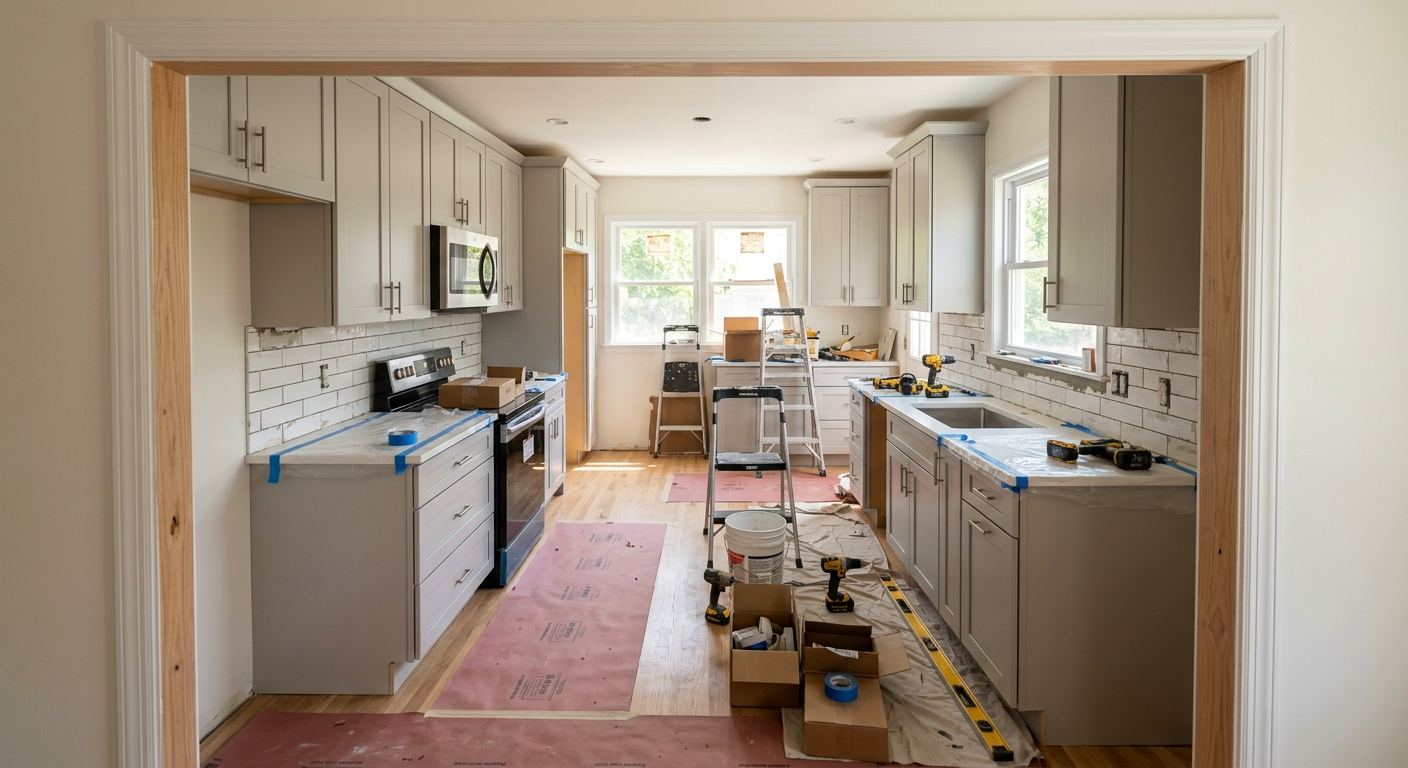
Kitchen renovation options and costs in Tillicum
Tillicum homeowners typically choose a kitchen renovation approach based on their home value and how “ready for resale” they want the finish to feel. In the Lower Mainland–Southwest, the population is 10,080 (Statistics Canada, 2021 Census), and that generally translates to steady demand for trades as more kitchens move from dated layouts to modern, durable finishes. While Tillicum isn’t a separate pricing bubble, the broader Metro Vancouver market often sets expectations: higher-value homes tend to support semi-custom or custom cabinetry and quartz or stone counters, because buyers notice those upgrades.
That’s why you’ll see pricing driven more by finish tier than by climate. British Columbia kitchens don’t usually face the same extreme freeze-thaw stress that affects some other regions; instead, cost shifts with material choices, labour competition, and how complex the site work is (stairs, long driveway runs, and whether cabinetry needs special handling). In Tillicum, trade demand is especially steady in neighbourhoods with older ranch-style housing stock near the Galloping Goose / Saanich Peninsula commuting routes, where renovations often include layout tweaks, new lighting, and updated ventilation.
Contractors in this region also quote differently depending on whether you’re doing a refresh (keep boxes and change surfaces) or a full rebuild (open up walls, move services, and install new cabinets and counters). Use the tiers below as a practical starting point, then compare quotes side-by-side using the same scope and allowances.
| Renovation Tier |
What's Included |
Typical Duration |
Price Range |
| Cosmetic refresh (paint, hardware, new appliances only) |
Cabinet paint or refinish (no box replacement), new hardware, new appliances, minor caulking and cosmetic trim touch-ups |
3–10 business days |
$8,000–$25,000 |
| Mid-range full renovation (new cabinets, counters, sink, tile) |
New semi-custom or quality stock cabinets, countertop installation (quartz or similar), sink and faucet, backsplash tile, standard plumbing hook-ups, new under-cabinet lighting (if included) |
3–6 weeks |
$40,000–$85,000 |
| High-end full renovation (custom cabinets, stone counters, island) |
Custom millwork, premium stone counters (granite/stone), island with integrated storage, upgraded appliance package, higher-end hardware, full backsplash treatment, more detailed lighting and finish carpentry |
6–12 weeks |
$85,000–$120,000 |
| Cabinet refacing only (new doors + drawer fronts, same boxes) |
Refaced fronts and doors, replacement drawer fronts/pulls, new trim and finishing, re-hardware, optional interior re-laminate |
1–3 weeks |
$8,000–$35,000 |
| Countertop swap only (laminate to quartz or stone) |
Removal and disposal of existing countertop, install new quartz/stone, new sink cut-out/adjustments as required |
5–12 business days |
$3,000–$12,000 |
| Backsplash tile installation only |
Backsplash tile supply (allowance) and installation, surface prep, waterproofing/appropriate underlayment as needed |
3–8 business days |
$1,500–$6,000 |
Prices are estimates only and vary by project scope, site access and material selection.
What affects the price of kitchen renovation in Tillicum
In Tillicum and across the Lower Mainland–Southwest, it’s common to see two quotes for the “same” kitchen come in 30–50% apart. The difference usually isn’t weather—it’s how homeowners choose to spend. Local home values and expected resale returns strongly influence the finish tier. In higher-value areas of the Lower Mainland–Southwest, owners often default to quartz or stone counters and semi-custom cabinetry because the cost is easier to recover when the sale comes. In more modest pockets, laminate surfaces and stock cabinet systems can still deliver a strong ROI, especially when the layout is practical.
Layout changes create the biggest unpredictability regardless of finish level. Removing a wall, adding an island, or moving plumbing/gas lines can add substantial labour, permit complexity, and schedule risk. That’s why you’ll frequently see mid-range renovations start around the $40,000 band, then jump quickly when services must be reworked. On the other end, high-end builds that include custom cabinetry and an island are typically closer to the $85,000–$120,000 range once stone counters and upgraded hardware are included.
Concrete examples from Tillicum: (1) If your kitchen has older concealed plumbing runs, even a “small” sink relocation can require more wall opening and patching than expected. (2) If you’re adding under-cabinet lighting or upgrading to a higher-demand appliance package, electrical scope can expand beyond the initial plan. (3) If the existing floor is uneven (common in older homes), demo and tile/level-plate prep can increase labour before cabinets even arrive. The climate doesn’t drive costs directly, but coastal humidity can accelerate cabinet finishing prep requirements and make dust control more important during paint/stain or cabinet refacing work.
| Price Factor |
Why It Matters |
Cost Impact |
| Cabinet tier — stock vs. semi-custom vs. fully custom millwork |
Custom sizing, internal options, and finishing detail change both material and installation time |
Often the largest swing item; can move a kitchen from mid-range toward high-end |
| Countertop material — laminate vs. quartz vs. granite vs. stone |
Material cost and fabrication complexity (seams, edge profiles, cut-outs) vary widely |
Can add several thousand dollars and impact lead time |
| Layout change — wall removal, island add, plumbing/gas move |
Alters structure, vents, and service runs; requires trade coordination and patching |
Most likely to cause a 10%–25% or more overage if discovered late |
| Appliance package tier — builder vs. mid-range vs. pro-grade |
Ventilation, electrical needs, and trim kits can differ by model |
Upgrades can add noticeable cost even when cabinets stay the same |
| Flooring — refinish existing vs. full replacement |
If walls/cabinets are removed, the floor often must be levelled and renewed in disturbed areas |
Full replacement adds labour and materials beyond the cabinet footprint |
| Backsplash — ceramic tile vs. marble vs. full-height slab |
More intricate materials require better prep and careful sealing or waterproofing |
Can shift a backsplash from a few thousand to several more |
| Electrical — new circuits for island, under-cabinet lighting |
New circuits require licensed work and potentially panel adjustments |
Often a few thousand; scales with how many devices and locations change |
| Permit fees and licensed trade requirements |
Some work requires permits/inspections; licensed trades add coordination time |
Can affect both direct costs and schedule predictability |
Permits & regulations in British Columbia
In British Columbia, many “surface-level” kitchen upgrades don’t require permits. Cabinet and countertop swaps typically fall into work that can be done without permits—assuming you are not altering plumbing/gas or structural elements. So, replacing cabinet boxes isn’t usually the same as moving services: swapping doors/fronts, installing new countertops, and updating a backsplash are commonly permit-light.
Permits and licensed trades become necessary when you change the underlying systems. Moving plumbing supply or drain lines (for example, relocating a sink), relocating gas (stove/range connections and certain hood setups), removing or altering a load-bearing wall, and adding new electrical circuits (like an island circuit or rewiring for added lighting) all typically require permits and inspections. Gas work must be carried out by a licensed gas fitter, and electrical work must be done by a licensed electrician; both require inspections where applicable.
For a homeowner in Tillicum, the verification process is straightforward:
- Ask for the contractor’s licence details and confirm them using the relevant online provincial registry for the trades involved (gas and electrical especially).
- Request a certificate of insurance (liability) showing current coverage and the job address or description.
- Confirm workers’ compensation coverage (WSIB/WCB) for the contractor and any subcontractors before work starts.
- Have the contractor state, in writing, which permits they will pull (or which trade will pull them) and who is responsible.
- Keep the clearance/coverage documents on file so you can reference them if any inspection issues arise.
Cabinets, countertops and layout decisions in Tillicum
Your three most consequential decisions in a Tillicum kitchen renovation are cabinet tier, countertop material, and whether to change the layout. (1) Cabinet tier: stock is the fastest and usually the cheapest, semi-custom is the most common mid-range choice, and custom millwork is the highest cost but delivers the best fit for unusual dimensions. (2) Countertop material: laminate is budget-friendly, quartz offers a durable “day-to-day” surface with low maintenance, granite/stone is premium and adds natural variation, butcher block brings warmth but needs more care, and marble is beautiful but more sensitive to etching.
(3) Layout changes: open-concept wall removal and island additions can be justified when the space gain improves flow and storage, but they are the most expensive when they also require plumbing/gas relocation. In the Lower Mainland–Southwest, resale buyers often expect a cleaner, brighter look—frameless or well-finished doors, modern hardware, and countertops that handle busy weekdays. That’s why mid-range renovations can land around the $40,000–$85,000 band when you keep plumbing mostly in place, while high-end builds with an island and stone counters typically stretch toward $85,000–$120,000.
A practical dollar example: if you’re deciding between laminate and quartz, the countertop-only swap band is commonly $3,000–$12,000 depending on size and edge/profile. If your layout is staying put, spending the upgrade difference on quartz can be a smart “visible” upgrade. If you’re also moving the sink and adding an island, it may be better to keep countertop spend in balance because the layout/service work can dominate the budget regardless of finish.
| Option |
Durability |
Maintenance |
Best For |
Price Range |
| Stock cabinets (big-box) |
Good for standard sizes; hinges and runners vary by model |
Low; wipe clean, check alignment periodically |
Budget-focused refreshes with a straightforward layout |
$8,000–$25,000 |
| Semi-custom cabinets (local dealer) |
Better internal options; more consistent finishing and fit |
Low to moderate; requires normal care of coatings |
Most Tillicum renovations targeting durable, modern storage |
$20,000–$50,000 |
| Custom cabinets (local millwork shop) |
Highest build quality; optimized for non-standard walls and storage needs |
Low; depends on finish system, but typically straightforward |
Design-led kitchens, islands, and homes with unique dimensions |
$45,000–$90,000 |
| Laminate countertop |
Resists staining; edges and seams need better protection |
Wipe clean; avoid prolonged heat exposure |
Value-focused renovations and short-term upgrades |
$3,000–$6,500 |
| Quartz engineered countertop |
High scratch and stain resistance; consistent performance |
Low; simple cleaning and normal care |
Busy households wanting a polished, resale-friendly surface |
$5,500–$10,000 |
| Granite / natural stone countertop |
Very durable; heat tolerant; natural variations are part of the look |
Moderate; sealing may be required depending on stone |
Premium look when you want natural character |
$7,000–$12,000 |
| Butcher block countertop |
Good with proper care; can dent but can be refinished |
Higher; periodic oiling and mindful heat/moisture handling |
Warm, rustic style and households committed to upkeep |
$4,500–$9,000 |
| Marble countertop |
Beautiful but more prone to scratching/etching than quartz |
Higher care; sealant and careful cleaning routine |
Statement kitchens where aesthetics matter most |
$8,000–$12,000 |
How to choose a kitchen renovation contractor in Tillicum
Choosing the right contractor in Tillicum starts with verification, not sales speed. Ask for proof of British Columbia licensing where applicable for the trades involved—especially gas fitting (if relocating a range/hood with gas) and electrical work (new circuits, island receptacles, and under-cabinet lighting). Then request liability insurance certificates and confirm workers’ compensation coverage (WSIB/WCB) for the contractor and any subcontractors. You should be able to see certificates, not just verbal confirmation. If a contractor can’t provide documentation or acts offended when you ask, that’s a warning sign.
Next, get 2–3 itemised quotes—not lump sums. Your quote should break out labour and materials (demo, carpentry, cabinet install, countertop fabrication/installation, electrical/plumbing allowances, disposal, and finish work). Read exclusions carefully: is permit pulling included, is disposal included, and what happens if site conditions require extra prep? Warranty matters too: confirm the workmanship warranty length and whether product/manufacturer warranties transfer if you sell the home.
Payment schedule should be conservative. Avoid paying more than 10–15% upfront; hold back a portion until key milestones are complete (cabinets installed, counters templated/installed, and final inspection). Finally, require a written timeline with a start date and a completion estimate tied to material lead times—important in the Lower Mainland–Southwest where countertop and cabinetry fabrication schedules can affect the entire job flow.
- Verify gas/electrical licences for the scope that touches plumbing/gas and circuits.
- Confirm liability insurance certificate validity and that the address/job is covered.
- Ask for WSIB/WCB clearance documents for the contractor and subcontractors.
- Require 2–3 itemised quotes with labour and material breakdowns.
- Confirm whether permits (if needed) are pulled by the contractor or by the specialty trade.
- Check exclusions: drywall repair depth, floor level-up, and cabinet base shimming.
- Confirm disposal: demo debris haul-away and recycling/landfill fees.
- Get details on countertop templating timing and who measures (countertop supplier vs. contractor).
- Ask who schedules inspections if plumbing/electrical/gas permits are required.
- Review warranty terms in writing: workmanship and product warranties, and transferability.
- Set milestones for payment: deposit, cabinet install, countertop install, final finish.
- Ask for schedule constraints (lead times, delivery dates, and weather/dust controls).
In Tillicum, red flags I see include: vague “allowances” that don’t match your chosen finishes, quotes that don’t specify who is responsible for permits, missing insurance/coverage documentation, pushing large deposits early, and changing the scope during the build without written change orders.
Frequently asked questions — kitchen renovation in Tillicum
What order do kitchen renovation steps happen in?
In Tillicum, a sensible kitchen renovation sequence usually starts with measuring and confirming the scope (cabinets, countertop template requirements, and appliance dimensions). Then you do demo, protect the rest of the home, and handle rough work first: framing/drywall patching, plumbing/drain or gas relocations (when applicable), and electrical rough-ins for new circuits and lighting. After that, cabinets go in, followed by countertop templating and installation. Finally, you complete finishes: backsplash tile, trim, paint, appliance hook-ups, and last adjustments. If you’re staying mostly within the existing footprint, timelines are smoother. If services move, the schedule becomes trade-dependent and permits/inspections can add time.
Can I live at home during a kitchen renovation in Tillicum?
Often yes, but it depends on your kitchen’s layout and how disruptive the scope is. During a cosmetic refresh (paint, hardware, new appliances), most homeowners can stay put because demo is minimal and there’s little impact to plumbing/gas. During a mid-range full renovation (typically in the $40,000–$85,000 range), living in the home is still possible if you set up a temporary cooking area (microwave, hot plate, and a kettle) and keep dust containment tight. For high-end builds with an island and stone counters (commonly $85,000–$120,000), there may be longer periods when the main kitchen is unusable due to countertop templating and finish work. In British Columbia, the biggest “living risk” is scheduling: plan for a multi-week disruption if electrical/plumbing inspections affect progress.
Should I renovate my kitchen before selling in Tillicum?
In Tillicum and the broader Lower Mainland–Southwest, kitchens sell homes—they also attract buyers quickly when finishes feel current and durable. If your layout is functional but dated, a targeted refresh (new hardware, updated lighting, and a countertop/backsplash upgrade) can be a cost-effective path toward improved presentation. If you’re heading into a full renovation scope, it’s smart to align with the tier buyers expect at your price point: quartz counters and upgraded cabinet finishes generally help with perceived value. If your budget is around the $40,000 band, focus on cabinet and countertop quality and keep plumbing moves limited. If you’re seeing water staining, sagging floors, or outdated wiring, address those issues first because they can slow closing. Always confirm with your real estate agent what matters most for your specific buyer segment.
What's the most popular kitchen style in Tillicum right now?
Right now, Tillicum homeowners commonly lean toward modern transitional styles: clean lines, shaker-style or slab-inspired cabinetry, and neutral palettes that photograph well for listings. Many projects also include an “upgraded functionality” look—soft-close doors/drawers, better pantry storage, and under-cabinet lighting to brighten work surfaces. Quartz countertops are especially popular because they balance appearance and easy maintenance for everyday cooking. Homeowners who go higher-end often add a statement element such as an island with a richer stone tone, upgraded hardware, and a more deliberate backsplash treatment (sometimes extending to a taller wall section). While climate doesn’t dictate style, coastal humidity in British Columbia can make proper surface prep and ventilation important for paint and cabinet refinishing durability.
How do I know if I need to update my kitchen plumbing in Tillicum?
Look for signs that your existing plumbing may be nearing the end of its service life: recurring leaks under the sink, low or uneven water pressure, slow drains, corrosion around supply lines, or frequent disposal clogs. If you’re moving the sink location, upgrading appliances, or changing to a different faucet style, you’ll likely need plumbing adjustments even if nothing is “broken.” In British Columbia, plumbing changes often require coordinated rough-in work and may involve permits/inspections, depending on the scope. A good contractor will inspect shutoffs, supply line condition, drain configuration, and access paths before quoting. If you discover issues only after demolition, you can expect added labour for rerouting, wall opening, and patching—so it’s worth addressing early.
What is the difference between a galley and open-concept kitchen?
A galley kitchen is typically long and narrow with counters on two opposing sides, often with a clear path through the middle. It’s efficient for cooking and can work well in compact layouts, but it limits sightlines and can feel closed off during entertaining. An open-concept kitchen removes or changes dividing walls to connect the kitchen to living/dining space, which usually improves flow and social interaction. In practice, open-concept often costs more when you remove a wall or modify structural elements, and it can trigger additional electrical/plumbing planning. In Tillicum, many homeowners choose open-concept when the payoff is a better traffic pattern and a larger feel for the home. If you like the efficiency of a galley, a redesign that improves storage and lighting can still deliver a modern feel without the higher risk of service moves.