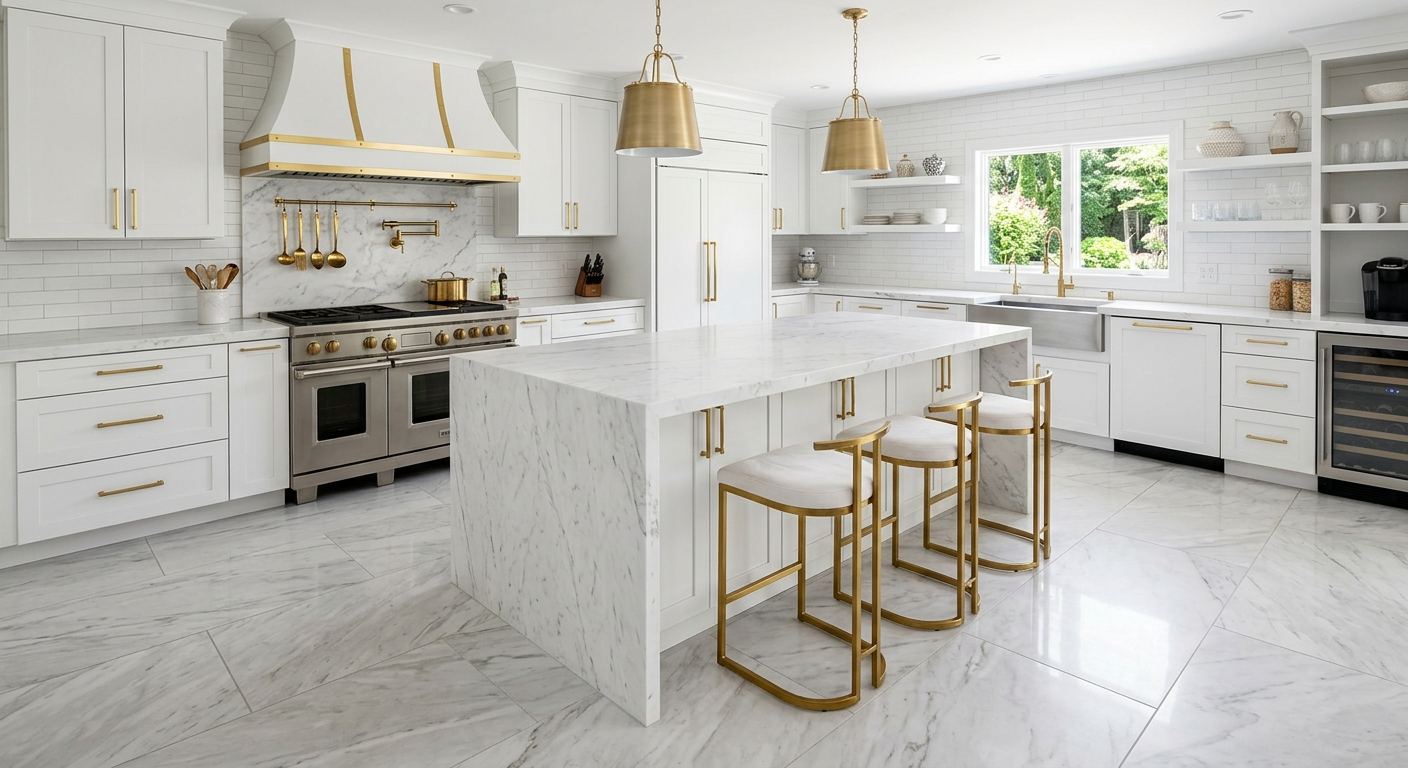
Kitchen renovation options and costs in Harbour Village
Kitchen renovation costs in Harbour Village, British Columbia often track what buyers expect when they walk into a higher-value Metro Vancouver home—not just the physical work. While Harbour Village itself is smaller (population 2,711, Statistics Canada, 2021 Census), the Lower Mainland–Southwest market is influenced by the broader regional pull toward cleaner finishes, updated layouts, and more “showroom-ready” kitchens. In many households here, income levels support better-than-basic upgrades, and that typically shows up in quote requests for quartz counters and upgraded cabinetry. In practice, the same kitchen size can come in very different ways depending on whether you’re doing a practical refresh or a full rebuild with made-to-fit millwork.
Climate is less of the main driver than in northern provinces, but it still matters in the details: winter indoor humidity swings and dryer temperatures can affect how materials perform and how carefully installers need to manage sealing, caulking, and countertop support. Labour availability also shapes schedules—when multiple trades are booked at once for cabinetry, electrical, plumbing, and tile, timelines (and therefore site costs) can rise. In and around popular service areas such as Tsawwassen-adjacent communities and the South Delta/Boundary Road corridor influence, demand for kitchen trades tends to follow overall renovation activity across the Lower Mainland–Southwest.
Below is a practical way to compare renovation tiers in Harbour Village so you can match your scope to a realistic budget—then we’ll break down what moves the price up or down in Section 2.
| Renovation Tier |
What's Included |
Typical Duration |
Price Range |
| Cosmetic refresh (paint, hardware, new appliances only) |
Cabinet paint/finish touch-ups, new pulls/knobs, caulking refresh, new appliances only (no cabinet rebuild), basic minor prep |
2–5 days |
$8,000–$20,000 |
| Mid-range full renovation (new cabinets, counters, sink, tile) |
New cabinets (stock or semi-custom), new counters, sink and faucet, backsplash tile, floor/tile updates as included, basic plumbing hookups, appliance re-install |
3–6 weeks |
$40,000–$75,000 |
| High-end full renovation (custom cabinets, stone counters, island) |
Custom cabinetry, stone or premium counters, island build, upgraded hardware and lighting, full backsplash treatment, higher-end appliance package support, expanded carpentry |
6–12 weeks |
$85,000–$120,000 |
| Cabinet refacing only (new doors + drawer fronts, same boxes) |
Refaced cabinet fronts, new pulls, alignment/re-leveling, new toe-kick finish if needed, hinges where required; counters not included unless specified |
1–3 weeks |
$8,000–$30,000 |
| Countertop swap only (laminate to quartz or stone) |
Remove and replace countertops, new sink cut-out where needed, basic edge updates; backsplash not included unless bundled |
4–10 days |
$3,000–$12,000 |
| Backsplash tile installation only |
Tile supply-and-install (ceramic/porcelain), preparation and waterproofing as appropriate, grout and caulking, finish trim where required |
3–7 days |
$1,500–$6,000 |
Prices are estimates only and vary by project scope, site access and material selection.
What affects the price of kitchen renovation in Harbour Village
In the Lower Mainland–Southwest, kitchen quotes for the “same” kitchen can swing by about 30–50% across British Columbia because the biggest cost levers are tied to market expectations and finish tiers—not weather. Local home values and household income influence whether homeowners choose laminate and stock cabinets (better ROI for a refresh) or quartz/stone and semi-custom cabinetry (more resale-aligned). When you’re in a higher-value part of the Lower Mainland–Southwest, it’s common for budgets to move toward full remodels that land closer to the $40,000–$120,000 full renovation range, while modest updates stay nearer the cabinet/counter/backsplash bands.
In Harbour Village, two practical examples show how costs shift quickly. First, if your current kitchen is on older-style framing with uneven walls, getting cabinets perfectly level can add extra labour and materials; that can turn a mid-range plan toward the top end of the $40,000–$75,000 band. Second, if you want an island and it requires moving plumbing or adding an electrical circuit, that work usually becomes the unpredictable part of the budget—often regardless of whether you pick laminate or quartz. Moving a gas stove or modifying a range hood setup also adds schedule and trade complexity.
Climate plays a supporting role: British Columbia’s wet-to-dry indoor seasonality can reveal poor sealing around sinks and backsplash edges earlier than you’d see in steadier climates, so good prep and waterproofing isn’t optional. Bottom line: the most stable way to control cost is to keep layout changes minimal, choose a cabinet tier intentionally, and plan for the “trade stacking” that happens when plumbing, electrical, and tile trades need to coordinate on one schedule.
| Price Factor |
Why It Matters |
Cost Impact |
| Cabinet tier — stock vs. semi-custom vs. fully custom millwork |
Custom work changes how much carpentry and fitting is required; it also drives hinge/slide quality, hardware options, and waste |
Often +$10,000 to +$60,000 versus a stock refresh, depending on scope |
| Countertop material — laminate vs. quartz vs. granite vs. stone |
Material cost, thickness/edge style, and fabrication complexity vary widely; heavier stone also impacts support and install labour |
Can swing by roughly $3,000 to $12,000 for countertop-only work, and more in full remodels |
| Layout change — wall removal, island add, plumbing/gas move |
Moving supply/drain or gas lines requires coordinated licensed trades and can expose hidden framing/electrical issues |
Often the largest variable; add $5,000+ for minor moves and significantly more for major rework |
| Appliance package tier — builder vs. mid-range vs. pro-grade |
Pro-grade ranges, ventilation, and integrated features can require different power/venting and cabinet clearances |
Typically +$2,000 to +$15,000 depending on what you upgrade |
| Flooring — refinish existing vs. full replacement |
Renovations frequently disturb subfloors or tile transitions; matching existing finishes may be difficult |
Often +$1,500 to +$8,000 depending on floor type and extent |
| Backsplash — ceramic tile vs. marble vs. full-height slab |
Stone and full-height installations require more precision, waterproofing strategy, and cutting time |
Backsplash-only can range from about $1,500 to $6,000+ based on finish |
| Electrical — new circuits for island, under-cabinet lighting |
Additional circuits, lighting runs, and potential panel upgrades increase labour and inspection coordination |
Often +$1,000 to +$6,000+ depending on wiring complexity |
| Permit fees and licensed trade requirements |
When permits/inspections apply, you pay for admin, scheduling and compliance; it also affects contractor sequencing |
Commonly adds several hundred dollars to a few thousand, plus schedule time where required |
Permits & regulations in British Columbia
In British Columbia, many surface-level kitchen upgrades do not trigger permits—swapping cabinets or countertops is typically permit-free as long as you’re not altering major systems. However, if you’re moving plumbing supply or drain lines, relocating or installing new gas connections, removing a load-bearing wall, or adding electrical circuits (for example, dedicated power for an island, or new under-cabinet circuits), permits and licensed trades are generally required. Gas work must be performed by a licensed gas fitter, and electrical work must be done by a licensed electrician; both usually require inspections before you can proceed confidently with final close-in and finishing.
For a Harbour Village homeowner, the verification process should be step-by-step:
1) Ask the contractor for their licence numbers and business details up front. 2) Request a certificate of insurance (liability coverage) and confirm it’s current for the project duration. 3) Verify coverage for work crews via the appropriate workers’ coverage documentation (often shown as proof from the contractor/registrations). 4) Confirm who is pulling permits when they’re required—do not assume it’s “handled.” 5) Get the contractor’s written scope and responsibilities in your contract before any deposit is paid.
You should also keep an eye on “shop drawings” or plan changes for electrical/plumbing layout; clear paperwork reduces surprises when trades schedule inspections. If anything is unclear, insist on it being written—permit responsibility belongs in the contract, not in conversation.
Cabinets, countertops and layout decisions in Harbour Village
The three most consequential decisions in a Harbour Village kitchen renovation are your cabinet tier, your countertop material, and whether you change the layout. In the Lower Mainland–Southwest resale-focused market, these choices often determine both the look and how expensive the build becomes once labour is scheduled. Cabinet tier influences fitting time and wall tolerance allowances: stock cabinets are the fastest to install, semi-custom is the common mid-range sweet spot, and fully custom millwork is where budgets can jump quickly. Countertop material then sets daily-life performance expectations—laminate can be economical but is less forgiving with heat and chips; quartz is a popular balance; granite/natural stone adds character but requires more careful installation and maintenance planning; butcher block needs conditioning; marble is beautiful but more sensitive to staining.
Layout is where cost becomes unpredictable. Removing a wall, adding an island, or moving plumbing/gas lines can drive your budget into a different tier even if you keep finishes modest. For a concrete example: if you stay “mid-range” with semi-custom cabinets and choose quartz instead of laminate, you might still target the $40,000–$75,000 band. But if you add an island that requires rerouting drain and electrical, that same kitchen can move toward the top end of a full remodel because the trades must coordinate and you may need subfloor/structural adjustments.
British Columbia’s indoor moisture swings also argue for careful sealing around sink bases and backsplash edges—those details protect your cabinet fronts and countertop transitions long after installation.
| Option |
Durability |
Maintenance |
Best For |
Price Range |
| Stock cabinets (big-box) |
Good for standard layouts; tolerances can limit perfect alignment on older walls |
Low—keep up with hardware and wipe-down; less custom sealing/trim work |
Fast timelines, tighter budgets, straightforward kitchen dimensions |
$15,000–$35,000 |
| Semi-custom cabinets (local dealer) |
High—more sizing choices, better fit to irregular wall conditions |
Low to moderate; solid finishing and easier serviceability |
Most Harbour Village renovations targeting a “clean, modern” look |
$25,000–$55,000 |
| Custom cabinets (local millwork shop) |
Excellent—tailored reveals, hardware placement, and optimized storage |
Low once installed; quality hinges/slides reduce long-term wear |
Unique layouts, high-end resale presentation, island-heavy designs |
$45,000–$90,000 |
| Laminate countertop |
Moderate—can chip at impact points and may mark under heat |
Low; avoid hot pans directly and use cutting boards |
Budget refreshes and rental-friendly upgrades |
$2,500–$6,000 |
| Quartz engineered countertop |
High—resists staining and everyday wear; more consistent than natural stone |
Low; simple cleaning and careful handling of heavy items during install |
Families who want a premium look without the stone care routine |
$5,500–$12,000 |
| Granite / natural stone countertop |
High—durable for normal cooking; edges and thickness matter |
Moderate; may require periodic sealing depending on stone |
Owners who want unique patterning and timeless appeal |
$7,000–$15,000 |
| Butcher block countertop |
Moderate to high—very functional, but impacts and water exposure need attention |
Moderate; requires oiling/conditioning to maintain finish |
Warm, casual styles and light-to-moderate cooking households |
$4,500–$10,000 |
| Marble countertop |
Moderate—elegant but more prone to etching and staining than quartz |
Higher; requires careful cleaning and often sealing strategy |
Statement kitchens where maintenance is acceptable |
$8,000–$18,000 |
How to choose a kitchen renovation contractor in Harbour Village
Choosing the right contractor in Harbour Village starts with proof, not promises. First, verify British Columbia licensing: ask for the licence number(s) relevant to their scope and confirm it matches the trade work they’re performing (general contracting, plumbing coordination, gas fit work where applicable, and electrical through a licensed electrician). Next, verify liability insurance—request a certificate of insurance showing coverage for the project. For workers’ coverage, ask for proof of workers’ coverage compliance (commonly provided as a clearance/coverage document). If a contractor won’t share these items early, that’s usually a sign to pause.
Then request 2–3 itemised written quotes. You want a breakdown that separates labour and materials (cabinets, counters, tile, plumbing/electrical allowances, disposal), not one lump-sum number. Read the scope carefully for exclusions: Is permit pulling included when required? Is demolition/disposal included, and where does it go? Are appliances included or excluded? Confirm warranty terms: workmanship warranty length, product/manufacturer warranty coverage, and whether warranties are transferable to the next homeowner.
Payment schedule matters. Never pay more than about 10–15% upfront; hold back the remainder until the job is complete and deficiencies are corrected. Finally, insist on timeline clarity: a written start date, projected completion, and key dependencies like countertop fabrication lead time.
- Confirm the contractor’s licence details and match them to the work in the scope
- Request current liability insurance before deposits are taken
- Ask for workers’ coverage proof/clearance documentation
- Get quotes that are itemised (labour vs. materials, not just totals)
- Check what’s included in demolition and disposal
- Confirm who pulls permits and who pays permit fees when layout/system changes occur
- Verify appliance inclusion (and whether hookups/fit are included)
- Confirm electrical scope for island outlets/lighting if you’re planning them
- Confirm plumbing scope for sink relocation (and whether drain routing is included)
- Ask about countertop templating timing and how delays are managed
- Read warranty documents for workmanship and product coverage
- Use a payment schedule with a small upfront deposit and holdback until close-out
Red flags to watch in Harbour Village: quotes that ignore layout/plumbing/electrical complexity, “allowances” that are too low compared with real-world hardware and fabrication, missing permit responsibility in the contract, vague warranty language, or requests for large upfront payments without a signed schedule and scope.
Frequently asked questions — kitchen renovation in Harbour Village
Should I reface or replace my cabinets?
In Harbour Village and across the Lower Mainland–Southwest, refacing is usually best when your existing cabinet boxes are solid (straight, level, and not water-damaged). If the old boxes are worn, sagging, or poorly aligned—common in kitchens that pre-date modern hinge standards—replacement often gives a cleaner result and avoids repeat labour later. Refacing also makes sense when you want a visual refresh while keeping the project closer to a cabinet refacing band like $8,000–$30,000 instead of moving to a mid-range full renovation. If you’re considering changing storage layouts (bigger drawers, pull-outs, corner solutions) or redoing the entire look with new cabinet heights and modern reveal lines, replacement or semi-custom is typically the better long-term value. If you’re unsure, ask for an on-site assessment of cabinet box condition and how level your walls are.
Do I need a permit for a kitchen renovation in British Columbia?
Some kitchen work in British Columbia is permit-free, especially surface updates like replacing countertops and cabinet swaps as long as you’re not changing plumbing, gas, load-bearing structure, or adding significant electrical work. Permits generally come into play when you move plumbing supply or drain lines, relocate a gas stove/range hood with gas connections, remove a load-bearing wall, or add new electrical circuits (for example, an island receptacle circuit). For Harbour Village homeowners, the practical step is to ask your contractor to list which tasks require permits and confirm who is responsible for pulling them. Ensure the work is done by licensed trades where required (gas fitter for gas, electrician for electrical) and that inspections are planned. Don’t sign until your contract clearly states permit responsibility, because “we’ll handle it” should be written down in the scope.
What's the ROI on a kitchen renovation?
ROI in the Lower Mainland–Southwest is strongly tied to finish tier and how well the kitchen fits buyer expectations at resale. In higher-value neighbourhood markets, upgraded cabinetry and durable counters (often quartz or stone) typically make the home more competitive—especially when paired with an efficient layout. Renovations can also hurt ROI if the layout changes don’t translate into functional gains (for example, awkward island placement) or if finishes feel mismatched. A practical approach is to spend within your likely buyer segment: if you’re targeting a mid-range presentation, projects commonly sit around $40,000–$75,000 for a full renovation scope; if you go premium—custom cabinets and stone—budgets often reach the $85,000–$120,000 range. In Harbour Village, many homeowners choose “sale-ready” upgrades rather than high-cost custom features unless the layout truly improves day-to-day use and perceived value.
How do I budget for a kitchen renovation?
Budgeting well means separating stable costs from variables. Stable items usually include cabinets, countertop fabrication, and tile/backsplash, while the biggest variable is layout and system work (plumbing/electrical/gas). Start by selecting your renovation tier, then add realistic allowances for trade coordination, disposal, and any patching required after demolition. If you’re planning a refresh, you might be looking at a cosmetic tier like $8,000–$20,000—but remember this typically doesn’t change cabinet structure or move plumbing lines. For a more complete mid-range scope, many projects land around $40,000–$75,000. For premium builds with an island and custom cabinets, many budgets move into the $85,000–$120,000 band. Finally, set aside a contingency for surprises behind walls—especially in older housing stock where framing may not be perfectly square.
Can I move my kitchen sink or stove?
Yes, you can move a kitchen sink or stove in Harbour Village, but cost and complexity rise quickly because you may need plumbing reroutes and, for a gas stove, licensed gas work. Moving a sink typically involves adjusting the drain and supply lines and ensuring proper slope, venting strategy, and watertight transitions under the countertop and around the cabinet base. Moving a stove (especially gas) also requires careful handling of gas connections and range hood ventilation. The most important budgeting step is to ask your contractor to itemise what’s included: demolition, route planning, licensed trade work, inspections, and reconnect/commissioning. If the move is minor and stays close to existing lines, it may stay within your chosen tier; if it means longer runs or structural changes, you can see the quote climb into higher bands like a full renovation scope instead of a simple countertop or backsplash add-on.
What's the most cost-effective kitchen upgrade?
The most cost-effective upgrade in British Columbia is usually one that changes the look without triggering major trades—so a cabinet refacing or targeted surface upgrade can be a strong value. Cabinet refacing often delivers a “new kitchen” feel while staying in a band like $8,000–$30,000, especially when the layout and cabinetry boxes are already in good condition. If your cabinets are fine but counters are dated, a countertop swap can be a high-impact improvement within a countertop-only range such as $3,000–$12,000, and a backsplash tile installation can modernise the space further around $1,500–$6,000. If you’re deciding between options, pick the upgrade that lets you avoid layout changes—moving plumbing or adding electrical circuits usually costs more than improving surfaces. In Harbour Village, we often see homeowners achieve the best “bang for buck” by upgrading fronts/finishes first, then deciding later whether to invest in a full remodel.