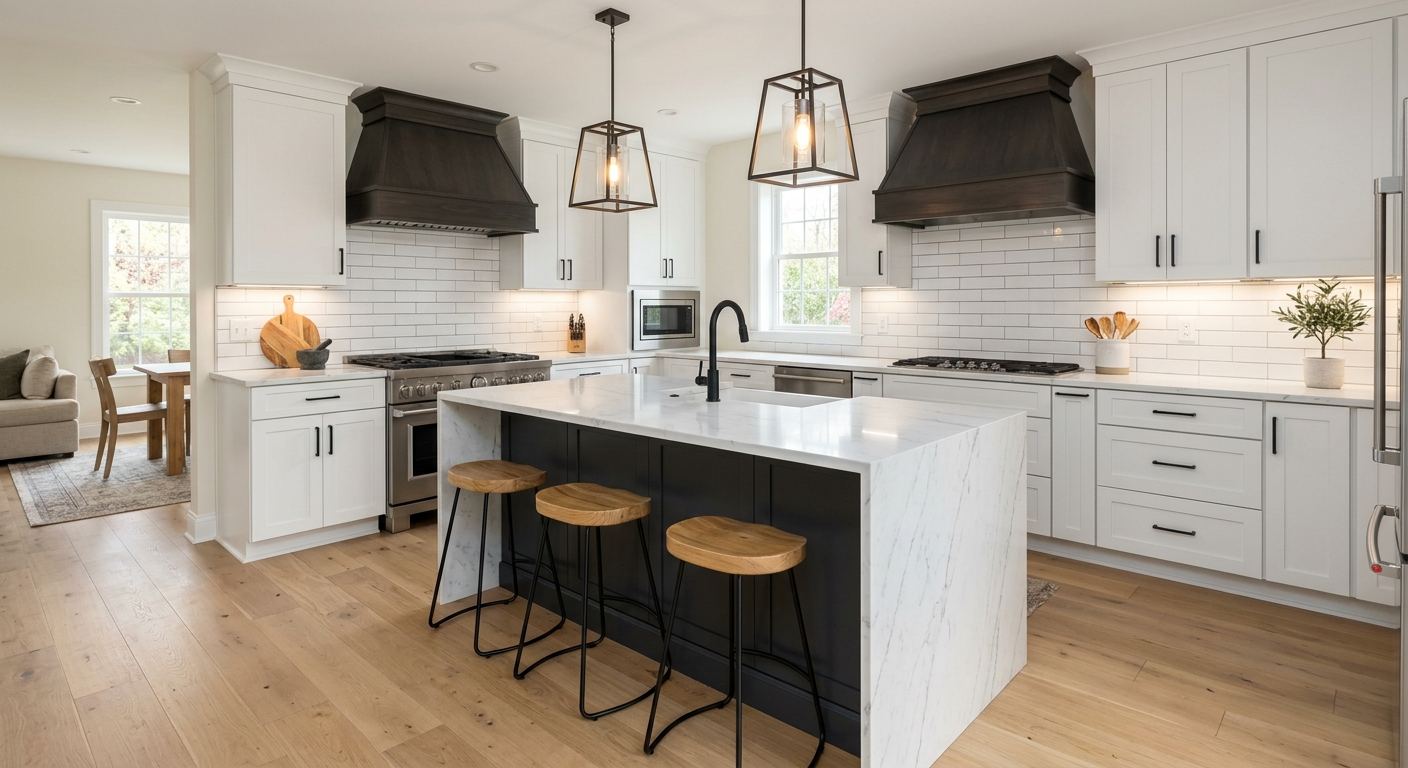
Kitchen renovation options and costs in Sunshine Hills
In Sunshine Hills, British Columbia, homeowners typically renovate kitchens with one of three goals: refresh what’s already working, update the core surfaces and cabinetry, or redesign the layout for longer-term comfort and resale. With Sunshine Hills sitting in a broader Lower Mainland–Southwest market of about 9,900 people (Statistics Canada, 2021 Census), kitchen choices often track the income and home-value reality of the Lower Mainland–Southwest. In many parts of this economic region, higher-value buyers tend to spend more on design-led cabinetry and durable stone surfaces because the renovation cost is easier to recover at resale. That’s why you’ll see the same kitchen size price out very differently depending on whether it’s a practical refresh or a custom rebuild. Even though our coastal climate doesn’t “drive” costs the way labour availability can, humidity swings and wet-season scheduling still influence how materials are acclimated, how quickly trades can return for follow-ups, and how finishes are protected during demolition and install.
Contractors also tend to be busiest where there’s consistent turnover and family move-ups—so in Sunshine Hills, the areas with more established single-family neighbourhoods (and the surrounding Surrey/White Rock–adjacent demand pattern) are especially active for kitchen trades. If your plan includes cabinet changes and a modern finish level, you should expect timelines and pricing to look closer to a mid-range full renovation than a simple paint-and-appliance swap. Use the tiers below to compare realistic ranges, then we can dial your quote based on your exact measurements, cabinet plan, and finish selections.
| Renovation Tier |
What's Included |
Typical Duration |
Price Range |
| Cosmetic refresh (paint, hardware, new appliances only) |
Cabinet paint or repaint (no box/cabinet rebuild), new hardware, appliance swap, touch-up trim, basic caulking and alignment |
1–2 weeks |
$8,000–$22,000 |
| Mid-range full renovation (new cabinets, counters, sink, tile) |
New semi-custom cabinets or upgraded stock, countertop replacement, new sink & faucet, backsplash tile, updated flooring prep, disposal and haul-away |
3–6 weeks |
$40,000–$85,000 |
| High-end full renovation (custom cabinets, stone counters, island) |
Fully custom millwork, stone countertops (quartz/stone), island design, premium hardware, upgraded lighting, full backsplash, deeper layout refinements |
6–12 weeks |
$85,000–$120,000 |
| Cabinet refacing only (new doors + drawer fronts, same boxes) |
Replace doors/drawer fronts, new pulls/knobs, refinish existing frames as required, new filler panels where needed |
2–4 weeks |
$8,000–$30,000 |
| Countertop swap only (laminate to quartz or stone) |
Remove old counters, install new quartz/stone, polish/edge finishing, new sink cut-out as applicable, basic sealants and caulking |
1–2 weeks |
$20,000–$45,000 |
| Backsplash tile installation only |
Tile supply and install on walls, waterproofing membranes as needed, grout sealing, edge transitions and trim pieces |
3–7 days |
$1,500–$6,000 |
Prices are estimates only and vary by project scope, site access and material selection.
What affects the price of kitchen renovation in Sunshine Hills
In the Lower Mainland–Southwest, quotes for the “same” kitchen can swing by 30–50% across British Columbia because pricing is driven more by what’s being built (cabinet complexity, finish tier, and layout changes) than by climate alone. In higher-value Lower Mainland pockets, homeowners more often select quartz or stone counters, semi-custom or custom cabinetry, upgraded hardware, and lighting—so average totals rise even when the kitchen footprint doesn’t. In more modest markets, laminate and stock cabinets dominate because it delivers better ROI, and the resale expectation tends to be more value-focused than design-led.
Local home values and median income shape the typical finish tier far more than weather. When buyers expect “move-in ready,” builders and homeowners choose materials that read premium in photos and hold up to real daily use; that’s why stone and semi-custom cabinetry commonly pair together, especially when homeowners plan to recover costs on resale. In Sunshine Hills, concrete examples show where costs climb: (1) replacing cabinet boxes that are warped from past moisture exposure may add cabinet rebuild or floor/wall prep time; (2) adding an island in a compact footprint can trigger plumbing/gas and electrical work, which is usually the most unpredictable cost regardless of finish level. On a mid-range renovation starting around $40,000, a layout shift can push you into higher ranges by adding trades and coordination; conversely, a straight refresh can stay closer to the lower end of the $8,000–$22,000 band.
Housing-stock age also matters. Older Lower Mainland homes can have out-of-square walls and dated wiring runs that need correction before new cabinetry lands perfectly; that prep time can add labour even when materials are mid-range. Scheduling can be more sensitive in wet-season periods as well, because work sequencing and protection of subfloors and drywall affects how fast crews can return to complete caulking, trim, and final inspections.
| Price Factor |
Why It Matters |
Cost Impact |
| Cabinet tier — stock vs. semi-custom vs. fully custom millwork |
Custom doors, drawer systems, interior layouts, and fit-for-wall work take more labour and design time |
~$10,000–$50,000 swing depending on full kitchen scope |
| Countertop material — laminate vs. quartz vs. granite vs. stone |
Material cost, edge profiles, seaming complexity, and fabrication time vary widely |
~$3,000–$12,000 for install, plus higher countertop material tiers |
| Layout change — wall removal, island add, plumbing/gas move |
Trade coordination, inspections, and rough-in changes drive unpredictability |
Often the largest delta: +$5,000–$30,000 |
| Appliance package tier — builder vs. mid-range vs. pro-grade |
Ventilation requirements, electrical needs, dimensions, and finish compatibility |
~$2,000–$12,000 impact versus entry packages |
| Flooring — refinish existing vs. full replacement |
Subfloor conditions, matching patterns, and cabinet base removal affect labour |
~$1,500–$8,000 depending on prep and replacement extent |
| Backsplash — ceramic tile vs. marble vs. full-height slab |
Pattern matching, stone weight, and substrate prep can add time and materials |
~$1,500–$6,000, with larger increases for specialty stone |
| Electrical — new circuits for island, under-cabinet lighting |
New load calculations and rewiring costs are tied to the plan, not materials |
Often +$1,000–$6,000 depending on scope |
| Permit fees and licensed trade requirements |
Where plumbing/gas/electrical or structural work is required, schedules and documentation add cost |
Can add +$500–$4,000 plus coordination time |
Permits & regulations in British Columbia
In British Columbia, many kitchen updates do not require permits—simple swaps and cosmetic work are typically straightforward. Cabinet and countertop swaps generally do not require a permit, and replacing like-for-like fixtures (for example, a sink set in the same location) is usually treated as a non-structural update. However, if your Sunshine Hills renovation involves moving plumbing supply or drain lines, relocating a gas appliance (including the stove and certain range hood setups where gas is involved), removing a load-bearing wall, or adding new electrical circuits (such as for an island or under-cabinet lighting plan), permits are typically required and only licensed trades can do the work.
Here’s how a homeowner should verify properly, step-by-step. First, ask for your contractor’s licence and proof of liability insurance before materials are ordered—request the certificate of insurance and confirm it matches your legal name/address. Next, verify the licensed electrician and gas fitter credentials directly with the provincial online registry (for the trade doing the work), and ask each trade for their insurance paperwork as well. Finally, confirm inspection and documentation responsibility: the contractor should state in writing who pulls permits, who schedules inspections, and which scope is covered by permit approvals. If you’re unsure, ask for a written scope breakdown showing “requires permit” vs “does not require permit” work items—this belongs in your contract.
Cabinets, countertops and layout decisions in Sunshine Hills
In Sunshine Hills kitchens, the three most consequential decisions are the cabinet tier, the countertop material, and whether you change the layout. Start with cabinets: stock cabinets are the fastest and lowest cost, semi-custom is the most popular balance in the Lower Mainland–Southwest, and custom millwork delivers the best fit when you have difficult angles, unusual ceilings, or want a fully designed storage layout. Next, choose countertops. Laminate is cost-effective and can look clean with the right colour/edge, but it’s less forgiving with heat and sharp impacts. Quartz engineered surfaces generally offer a strong durability-to-maintenance balance, while granite and natural stone read premium and can be very durable but may require more care depending on the stone and finish.
Layout is where costs become most justified—or most wasteful. Removing a wall/open-concept conversion and adding an island can significantly improve flow and resale appeal, especially when buyers can see a usable prep zone and seating. But those benefits depend on feasibility: moving plumbing/gas or adding electrical for island outlets and lighting can quickly raise labour and inspection coordination. For a practical example, an upgrade from laminate to quartz might add a manageable delta within your countertop installation budget, while changing sink location or running new supply/drain lines can increase overall project totals far more than upgrading materials alone. In a mid-range full renovation (often starting near $40,000), keeping plumbing in roughly the same zone can preserve budget for cabinetry and tile details that buyers notice. In a high-end full renovation, an island plus stone counters can be a smart spend—if the space gain truly improves day-to-day function.
| Option |
Durability |
Maintenance |
Best For |
Price Range |
| Stock cabinets (big-box) |
Good for standard measurements; durability depends on hinge quality and finish system |
Low—wipe clean; minor adjustments may be needed as floors settle |
Quick updates and tighter budgets |
$12,000–$35,000 |
| Semi-custom cabinets (local dealer) |
Very good build quality with better interior storage options |
Low to moderate; keep hardware aligned and reseal around sinks as needed |
Most Sunshine Hills homeowners aiming for resale-friendly finishes |
$25,000–$55,000 |
| Custom cabinets (local millwork shop) |
Excellent fit and structural stability where walls/ceilings are irregular |
Low—built for longevity; occasional hardware tune-ups |
Complex layouts, high-end storage, and perfect fit |
$45,000–$80,000 |
| Laminate countertop |
Moderate; can chip and is less heat-resistant than stone |
Easy daily care; avoid heat exposure and heavy dragging |
Value-focused refreshes |
$3,000–$8,000 |
| Quartz engineered countertop |
High resistance to staining and everyday impact |
Low—routine cleaner only; still protect from extreme heat |
Most popular premium option for BC resale look |
$7,000–$12,000 |
| Granite / natural stone countertop |
High durability; performance varies by finish and stone type |
Moderate—may need periodic sealing depending on stone |
Premium appearance and longer service life with proper care |
$9,000–$16,000 |
| Butcher block countertop |
Good for chopping, but sensitive to moisture if not maintained |
Higher—oil/finish maintenance to prevent drying/warping |
Warm, cottage-style kitchens and active cooks |
$6,000–$12,000 |
| Marble countertop |
Premium look; softer and more stain-prone than quartz |
Higher—requires disciplined sealing and cleaning |
Design-forward kitchens where owners accept extra care |
$12,000–$20,000 |
How to choose a kitchen renovation contractor in Sunshine Hills
Choosing the right contractor in Sunshine Hills starts with verification. In British Columbia, confirm your contractor’s licensing (where applicable), and ask for a current certificate of liability insurance before work begins. For insured trades, request their insurance documents too. Regarding worker coverage, homeowners should confirm how trades handle coverage through the appropriate employer coverage arrangements for their staff (commonly referenced through WCB protections). Practically, the best process is: ask the contractor for proof of coverage/clearance documentation for their subcontractors and keep copies with your contract package.
Next, get 2–3 itemised written quotes—not lump sums. You want a breakdown for labour and materials by scope: demolition/disposal, rough-in changes, cabinetry and install labour, countertop fabrication/install, tile/backsplash labour, and finishing/trim. Read what’s excluded: is permit pulling included when required, who supplies drywall patching, and is site protection and disposal part of the price? Warranty matters: ask for workmanship warranty length, the manufacturer warranty terms on cabinets/counters, and whether warranties transfer if you sell the home. Payment schedule should stay controlled—never pay more than 10–15% upfront, and hold back a final portion until completion and punch-list corrections are done. Finally, demand a timeline with a start date and an estimated completion window in writing so you can plan for appliances delivery, inspections, and countertop fabrication lead times.
- Confirm the contract scope is itemised (labour and materials separately).
- Ask who pulls permits and who schedules inspections for any gas, electrical, or plumbing changes.
- Request cabinet lead times and countertop fabrication lead times in writing.
- Verify insurance certificates are current and name you/your property as appropriate.
- Confirm the demolition/disposal plan and whether bins are included.
- Check who protects floors and walls during demo and cabinet installation.
- Ask how out-of-square walls are handled (shimming vs. reframe).
- Get a written change-order process with defined labour and material rates.
- Confirm caulking, sealing, and water protection details around sinks and backsplashes.
- Require a materials specification sheet (cabinet grade, countertop type, tile type, hardware finish).
- Ask about warranty length and whether it’s transferable.
- Ensure payment milestones align to completed, verifiable stages (not vague promises).
Red flags in Sunshine Hills include: quotes that omit disposal or protection; “we’ll handle permits” without naming who is responsible; vague warranty language with no workmanship duration; a payment schedule asking for more than 10–15% upfront; and no itemised breakdown for cabinet, countertop, and electrical/plumbing scopes.
Frequently asked questions — kitchen renovation in Sunshine Hills
Do I need a permit for a kitchen renovation in British Columbia?
In British Columbia, many kitchen upgrades don’t need permits. Typically, cabinet and countertop swaps are permit-free, and cosmetic updates like paint, hardware, and like-for-like appliance replacements are generally straightforward. Permits are usually required when the project changes core systems: moving plumbing supply or drain lines, relocating gas appliances or certain gas venting setups, removing a load-bearing wall, or adding new electrical circuits (for example, island outlets or new lighting feeds). For Sunshine Hills homeowners, the safest approach is to ask your contractor to list every “permit-triggering” item in the written contract before signing, including who will pull permits and schedule inspections. Also confirm each licensed trade’s credentials and provide copies of their insurance and documentation.
What's the ROI on a kitchen renovation?
Kitchen ROI in Sunshine Hills is less about chasing a fixed percentage and more about building buyer-perceived value: layout practicality, durable finishes, and clean, modern details. In the Lower Mainland–Southwest, higher-value buyers often expect quartz/stone counters and semi-custom cabinetry, so spending that supports that expectation tends to be easier to justify than budget-only upgrades that look dated quickly. As a practical benchmark, a mid-range full renovation often lands around $40,000–$85,000, while a refresh may be closer to $8,000–$22,000. ROI varies by home condition and market timing, but renovations that keep plumbing in a similar zone (fewer trade changes) can deliver better cost-to-impact because you protect the budget for the finishes buyers see most.
How do I budget for a kitchen renovation?
Budgeting well in Sunshine Hills starts by choosing the tier before you pick finishes. Many homeowners plan around the realistic project bands: a full renovation commonly falls within $40,000–$120,000 depending on cabinetry tier, countertops, and layout changes. If your goal is mainly visual and functional (handles, paint, appliance upgrades), a cosmetic refresh often fits within $8,000–$22,000. Then add contingency for unknowns—older homes can hide wiring issues, uneven walls, or subfloor problems once cabinets are removed. In BC’s wet-season conditions, sequencing and material protection can also affect labour time, so build in a reasonable buffer for site logistics and rework. The best method is an itemised quote plus a clear allowance for countertop, backsplash, and any plumbing/gas/electrical scope that may be uncovered during demo.
Can I move my kitchen sink or stove?
Yes, you can move a kitchen sink or stove in Sunshine Hills, but it’s usually where permit requirements and costs increase. Moving a sink typically involves rerouting plumbing supply and drain lines; moving a stove can involve gas relocation, and in many cases that must be done by a licensed gas fitter. If the plan includes rerouting, expect added trades coordination, inspections, and schedule time. It’s often more cost-effective to keep the sink and stove roughly in their original plumbing/gas zones and adjust cabinetry around them. If you do move them, make sure your contractor provides a written plan that names exactly what will be rerouted, who is responsible for permits, and how electrical outlets/ventilation will be handled so you don’t get surprises late in the job.
What's the most cost-effective kitchen upgrade?
For Sunshine Hills, the most cost-effective upgrade usually depends on what’s already outdated: if your cabinets are structurally fine but visually tired, cabinet refacing can be a smart middle step. Cabinet refacing only (new doors and drawer fronts, keeping the boxes) often fits within about $8,000–$30,000, which can dramatically improve the look without the full removal/rebuild cost. If your layout is already functional but counters are the main dated element, a countertop swap can also deliver strong impact—especially when moving from laminate to quartz or stone—while typically staying within the countertop installation bands (and sometimes less than a full cabinet refresh). If you’re aiming for quick visual lift, a backsplash tile installation only can be a targeted win within the $1,500–$6,000 range. The best “value” choice is the one that upgrades the elements buyers notice first without triggering a lot of plumbing/electrical work.
Custom vs stock cabinets — is custom worth it?
Custom cabinets can be worth it in Sunshine Hills when your kitchen has challenges: out-of-square walls, awkward angles, ceiling height constraints, or a specific storage plan you can’t achieve with standard sizes. But if your space is fairly straightforward and you mainly need a clean, updated look, semi-custom or even good stock can deliver much of the benefit for less money. In cost terms, stock typically prices lower, while fully custom millwork is usually a premium line item—often pushing the overall kitchen package higher within the $40,000–$120,000 full-renovation band once counters, backsplash, and install labour are included. Also consider resale expectations in the Lower Mainland–Southwest: buyers often reward consistent design and reliable function, so semi-custom that fits well can be the best balance. A good contractor will show you how each tier affects lead times, installation quality, and the number of custom fillers you’ll need.