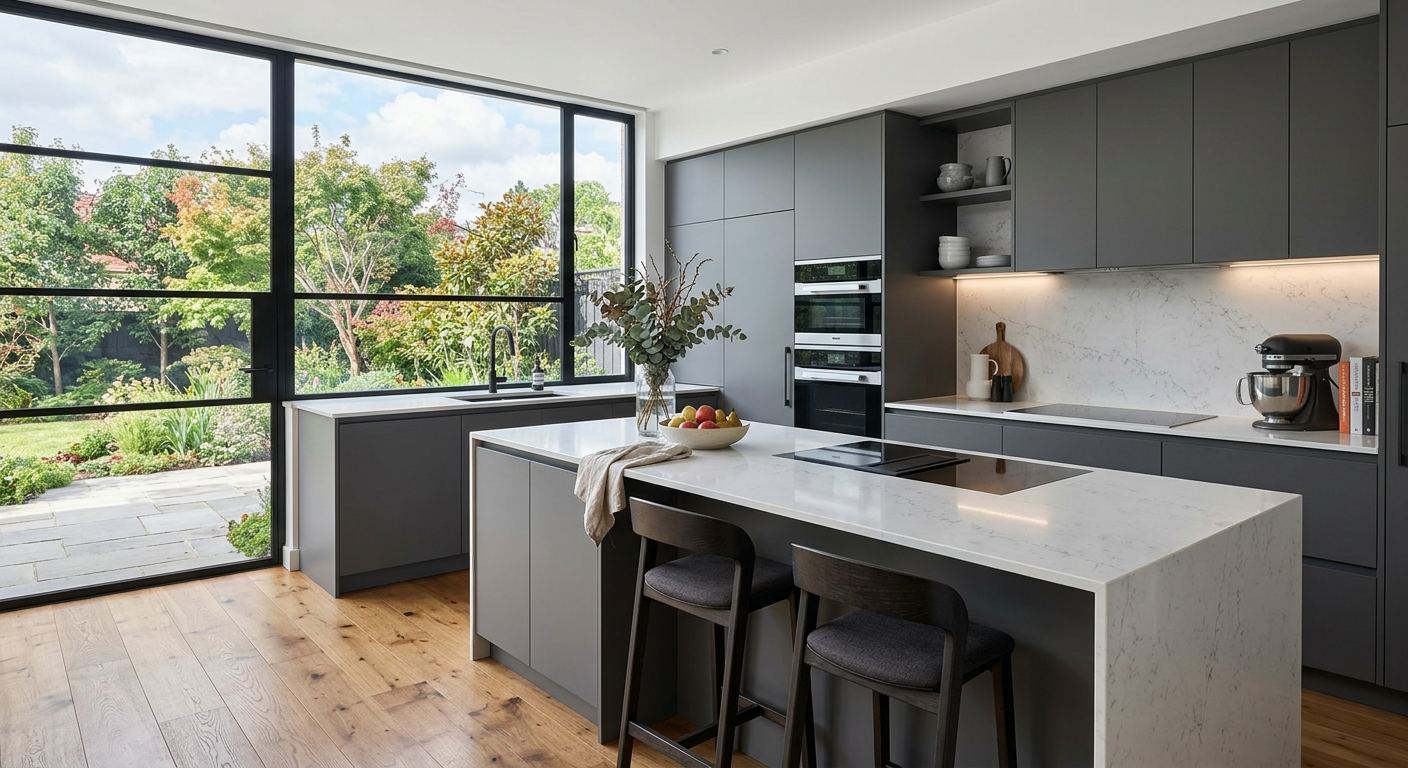
Kitchen renovation options and costs in Ironwood
Ironwood is a smaller community (Population 6,236 per the Statistics Canada, 2021 Census), but kitchen renovations in the Lower Mainland–Southwest still price close to the broader Metro Vancouver finish market. In practice, the same room can land in very different budget lanes because buyers in this region tend to anchor on home value and the expected finish tier at resale. In lower-cost refreshes, homeowners commonly stay practical with laminate and stock cabinetry; in higher-value homes, they often gravitate to semi-custom or custom cabinetry and quartz or stone counters because those materials align with what future buyers expect (Statistics Canada, 2021 Census).
Climate in British Columbia can add real friction—condensation cycles, wet-season access issues, and the way older homes have unpredictable subfloor conditions—but in this region, market demand usually drives the biggest swings. Contractor availability and scheduling also matter: when multiple trades are booked (cabinet lead times, countertop fabrication windows, and tile drying times), the “same scope” can cost more simply due to coordination and site protection. In Ironwood, kitchen work is especially in demand in the more active residential pocket where renovations cluster around family homes and older turn-over properties—this is typically where you’ll hear the most talk about refreshed layouts, upgraded finishes, and replacing dated cabinets.
Below are the common renovation tiers homeowners compare when requesting quotes, from a quick cosmetic refresh through a full custom rebuild.
| Renovation Tier |
What's Included |
Typical Duration |
Price Range |
| Cosmetic refresh (paint, hardware, new appliances only) |
Cabinet paint or re-spray (if chosen), new hardware, new fridge/range/dishwasher, minor caulking/silicone touch-ups |
3–7 days |
$8,000–$22,000 |
| Mid-range full renovation (new cabinets, counters, sink, tile) |
New cabinets (stock or semi-custom), new countertop, new sink and faucet, backsplash tile, install new or adjusted plumbing connections, flooring refinishing where feasible |
3–6 weeks |
$40,000–$85,000 |
| High-end full renovation (custom cabinets, stone counters, island) |
Custom millwork, stone counters (quartz/stone), larger island, upgraded hardware and fixtures, full backsplash scope, higher-end lighting and electrical add-ons |
6–12 weeks |
$85,000–$120,000 |
| Cabinet refacing only (new doors + drawer fronts, same boxes) |
Replace doors/drawer fronts, new panels, hinge hardware, reface trim details, paint prep where required |
2–4 weeks |
$8,000–$35,000 |
| Countertop swap only (laminate to quartz or stone) |
Remove old counters, install new quartz/stone, silicone and edge finishing, cut-outs for sink and cooktop where applicable |
2–10 business days (plus fabrication) |
$3,000–$12,000 |
| Backsplash tile installation only |
Remove old backsplash (if needed), backer prep, ceramic tile install, trim/caulking to match cabinet lines |
5–10 business days |
$1,500–$6,000 |
Prices are estimates only and vary by project scope, site access and material selection.
What affects the price of kitchen renovation in Ironwood
In Ironwood and across the Lower Mainland–Southwest, you can see the same kitchen renovation scope come in 30–50% apart from one quote to the next—and it’s usually not because “one contractor is being expensive.” It’s driven by home value expectations and finish tier choices that are typical in the region. In higher-value pockets of Metro Vancouver, homeowners more often budget for quartz or stone counters, upgraded hardware, and semi-custom cabinetry because the renovation cost is easier to justify at resale. In more modest markets, laminate and stock cabinets often dominate, keeping budgets closer to practical ROI. That’s why the same kitchen footprint might sit at the lower end of the full renovation range (for example, $40,000–$85,000) or jump toward the high end ($85,000–$120,000) when you add custom millwork and an island.
Lower Mainland–Southwest market dynamics also influence lead times. Cabinet brands and stone fabrication slots can be booked ahead, and older homes in British Columbia can require extra prep (straightening frames, moisture-checked surfaces, subfloor corrections) that add labour even when the finish looks “simple.” Layout changes are the most unpredictable cost regardless of finish tier: removing a wall, adding an island, or moving a gas line can trigger trade coordination and permit steps that raise your all-in number.
Concrete Ironwood examples we commonly price: (1) replacing just countertops may land in the $3,000–$12,000 band, but if your base cabinets need reinforcement for a heavier stone edge or undermount sink, the “counter-only” plan quietly becomes a broader renovation; (2) upgrading to semi-custom cabinetry can add cost through longer lead time and more on-site fit adjustments; (3) full tile backsplashes can stay relatively controlled, but full-height or marble-look tile with careful pattern matching often pushes labour toward the upper end of the $1,500–$6,000 band.
| Price Factor |
Why It Matters |
Cost Impact |
| Cabinet tier — stock vs. semi-custom vs. fully custom millwork |
Custom boxes, door styles, and built-to-fit dimensions change material cost and installation time. |
$8,000–$60,000 |
| Countertop material — laminate vs. quartz vs. granite vs. stone |
Material pricing, fabrication complexity, and weight/edge detailing affect labour and readiness of the base. |
$3,000–$20,000 |
| Layout change — wall removal, island add, plumbing/gas move |
Trade coordination increases; wall removals and utility relocations drive permit steps and site protection. |
$5,000–$40,000 |
| Appliance package tier — builder vs. mid-range vs. pro-grade |
Higher tiers cost more up-front and may require different venting, clearances, and electrical specs. |
$2,000–$15,000 |
| Flooring — refinish existing vs. full replacement |
If cabinets come out or tile is replaced, flooring scope and subfloor prep can expand quickly. |
$1,500–$12,000 |
| Backsplash — ceramic tile vs. marble vs. full-height slab |
Pattern matching, premium stone slabs, and full-height detail increase labour and material risk. |
$1,500–$12,000 |
| Electrical — new circuits for island, under-cabinet lighting |
More circuits, lighting runs, and island power add labour and may require inspections. |
$1,000–$8,000 |
| Permit fees and licensed trade requirements |
When plumbing/gas/electrical changes trigger permits, administrative steps and inspections add costs. |
$500–$6,000 |
Permits & regulations in British Columbia
In British Columbia, some kitchen updates are considered straightforward from a permit standpoint, while others require permits and licensed trades. Generally, swapping cabinets, replacing countertops, or changing a backsplash does not require a permit. A countertop swap is typically treated as an install change, not a building system modification. Cabinet and countertop swaps usually proceed without permits as long as there’s no structural change and plumbing or gas lines are not relocated.
Permits and licensed trades are typically required when you change the building systems. Examples that usually DO require permits include moving plumbing supply or drain lines, relocating gas equipment (such as a stove/range, or venting that involves gas appliances), removing a load-bearing wall, and adding new electrical circuits for an island or significant under-cabinet lighting changes. Gas work must be performed by a licensed gas fitter, and electrical work must be done by a licensed electrician; both trades typically require inspections after rough-in and/or completion, depending on the scope.
For an Ironwood homeowner, the best step-by-step verification is: (1) ask the contractor for their current licence numbers and documentation for any trades involved; (2) request proof of liability insurance and a clear statement of who holds responsibility for permits; (3) for coverage, ask for proof consistent with workers’ compensation coverage (WCB/coverage letter) and confirm how subcontractors are covered. Verify the trade licences online through the appropriate provincial registries, then cross-check the certificate of insurance dates and the coverage letter you’re given before signing. Finally, make sure permit responsibility is written into your contract—don’t rely on verbal reassurance.
Cabinets, countertops and layout decisions in Ironwood
The three most consequential decisions in an Ironwood kitchen renovation are cabinet tier, countertop material, and layout changes—because each one compounds labour, lead times, and what your kitchen can “support” structurally and electrically. Start with cabinet tier: stock cabinets are usually the fastest and cheapest, while semi-custom is the most popular mid-range option in the Lower Mainland–Southwest because it balances better door/drawer fit with reasonable install timelines. Custom cabinets provide the best fit for irregular rooms and maximize storage, but they also carry the highest pricing and more on-site adjustments.
Next, countertop material drives both daily durability and resale appeal. Laminate is the most budget-friendly and can look quite modern, but it’s more vulnerable to heat and surface wear. Quartz is a common “sweet spot” in British Columbia—resists staining and daily abuse better than laminate, and it’s typically less maintenance than natural stone. Granite/natural stone offers premium character but can be more sensitive to sealing needs depending on the stone and finish. In kitchens prone to wet-season humidity swings, stable materials and proper ventilation matter as much as the slab choice.
Finally, layout changes justify cost only when they create clear function gains. Removing a wall to open sightlines or adding an island can be worth it if it improves traffic flow, adds seating, and allows electrical/plumbing upgrades in a planned way. If you’re only chasing a “nicer look,” moving plumbing or gas lines usually isn’t justified.
For a concrete example: upgrading countertops from laminate to quartz may fit within the $3,000–$12,000 countertop swap range, but if you add an island and need new circuits and a planned sink drain route, your project can quickly drift into a mid-range full renovation scope ($40,000–$85,000) due to electrical, installation time, and coordination.
| Option |
Durability |
Maintenance |
Best For |
Price Range |
| Stock cabinets (big-box) |
Solid for normal use; limited flexibility for odd dimensions. |
Low; keep hinges adjusted and protect from standing water. |
Quick refresh with a reliable budget |
$8,000–$25,000 |
| Semi-custom cabinets (local dealer) |
Good build quality; better fit and storage layouts. |
Low to moderate; finishes handle daily wear well when installed square. |
Most Ironwood homeowners seeking mid-range value |
$20,000–$45,000 |
| Custom cabinets (local millwork shop) |
Highest fit and storage efficiency; ideal for complex layouts. |
Low; durable, but requires careful handling at install to avoid minor damage. |
Premium renovations and difficult room geometry |
$35,000–$70,000 |
| Laminate countertop |
Moderate; avoid heat impact and heavy cutting directly. |
Easy clean; protect edges from water intrusion. |
Budget-first upgrades and rental-friendly refreshes |
$3,000–$6,000 |
| Quartz engineered countertop |
High; resists staining and stands up well to everyday cooking. |
Low; wipe clean, no regular sealing required. |
Best balance of durability and low maintenance |
$6,000–$12,000 |
| Granite / natural stone countertop |
High; very durable but varies by stone and finish. |
Moderate; sealing and stain management may be needed. |
Premium look with natural variation |
$8,000–$18,000 |
| Butcher block countertop |
Good for cutting; can be scratched and needs protection from water. |
Higher; regular oiling and careful drying at seams. |
Warm, rustic style and families who maintain the surface |
$5,000–$11,000 |
| Marble countertop |
Beautiful but softer; more prone to etching and staining. |
Higher; needs sealing and gentle care. |
Statement kitchens where maintenance is expected |
$10,000–$22,000 |
How to choose a kitchen renovation contractor in Ironwood
Choosing the right contractor in Ironwood is mainly about verification and clarity. Start with British Columbia licensing and insurance: ask for the contractor’s current licence details (and the licence numbers for any subcontractors) and request proof of liability insurance. Also ask for workers’ compensation coverage documentation (commonly WCB/coverage proof) so you’re not left holding the risk if a worker is injured on site. If subcontractors are involved, confirm that coverage applies to the actual crew who will work in your home—don’t accept generic statements.
Next, get 2–3 itemised written quotes instead of a single lump sum. The best quotes break down labour and materials separately (cabinet install, countertop install, tile labour, disposal, electrical/plumbing coordination) so you can compare scopes fairly. Read exclusions: is permit pulling included (if needed), is demo included, and is waste disposal included or billed separately? Kitchen renovations often involve delays if material lead times aren’t planned; a good contractor should list assumed lead times and how they’ll protect schedules if production slips.
Warranty matters too: confirm the workmanship warranty length and what it covers (for example, cabinet install settling, tile cracks due to prep issues, or under-cabinet lighting failures). Ask whether product/manufacturer warranties are transferable to you and whether you’ll receive documentation at close-out. On payments, keep it conservative—never pay more than 10–15% upfront; hold back funds until the job is complete and key items pass final inspection.
Finally, insist on a start date and a completion estimate in writing. A firm timeline is also a quality signal because it requires real planning around countertop fabrication, cabinet deliveries, and trade availability.
- Verify the contractor’s British Columbia licence and any trade licences they rely on.
- Request liability insurance and confirm coverage dates match your project period.
- Confirm workers’ compensation coverage (WCB/coverage proof) for workers on your job.
- Get 2–3 itemised quotes with labour and materials separated.
- Ask what’s included for demo and disposal (and whether dumpsters are included).
- Clarify countertop fabrication and install dates, including lead-time assumptions.
- Confirm whether permits are required and who is responsible for pulling them.
- Request an electrical/plumbing allowance line if any systems are being changed.
- Review the scope for “exclusions” like subfloor repairs, drywall patching, or trimming.
- Ask for the workmanship warranty length and how claims are handled.
- Set payment milestones tied to completion checkpoints, not promises.
- Get a written start date and a realistic completion window, with contingencies.
Red flags to watch for in Ironwood: (1) a quote that’s “lump sum” with no labour/material breakdown; (2) promises to do electrical or gas changes without naming the licensed trades and inspection steps; (3) requesting a large deposit (more than 10–15%); (4) vague timelines that don’t account for cabinet and countertop lead times; (5) no clear warranty terms or refusal to provide proof of insurance and coverage.
Frequently asked questions — kitchen renovation in Ironwood
What's the ROI on a kitchen renovation?
In British Columbia, kitchen renovations can improve day-to-day value immediately, but ROI depends on whether you match the finish tier buyers expect in your local market. In the Lower Mainland–Southwest, higher-value neighbourhood buyers more often look for quartz/stone counters, solid cabinet construction (often semi-custom), and clean, modern layouts. If you keep scope practical—like a mid-range renovation ($40,000–$85,000) that upgrades cabinets, counters, and a functional backsplash—you’re typically more aligned with what resale-oriented buyers can justify. Conversely, overspending on premium custom millwork without layout or storage improvements can reduce ROI. The best ROI usually comes from upgrading the “first-view” items (cabinets, counters, hardware, lighting) and correcting worn plumbing/electrical where needed, not from chasing the most expensive finish on a layout that doesn’t work.
How do I budget for a kitchen renovation?
Budgeting in Ironwood starts with choosing a renovation tier and then protecting a contingency. A simple refresh is often the lowest-cost path, while a full renovation rises quickly once cabinets, counters, and tile are included. If you’re planning a cabinet-and-counter-driven upgrade, many homeowners target the mid-range full renovation band ($40,000–$85,000). If you’re adding an island and stepping up to premium materials and custom cabinetry, budgets commonly move toward the high end ($85,000–$120,000). Add a contingency for the “unknowns” typical in older British Columbia housing stock—unlevel floors, hidden water staining, or the need for drywall patching after demo. Also account for lead times (cabinet delivery and countertop fabrication) because schedule changes can affect labour costs and site protection. Finally, get an itemised quote so you can see exactly what’s included versus excluded.
Can I move my kitchen sink or stove?
In most cases, yes—but whether it’s affordable depends on the plumbing and gas/electrical work required. Moving a sink usually means altering plumbing supply and drain lines, which in British Columbia commonly triggers permits and licensed plumbing work. If your stove/range involves gas, relocating it may also require permit steps and must be done with a licensed gas fitter. For homeowners in Ironwood, the cost jump can be significant because moving utilities adds more demolition, patching, inspection scheduling, and trade coordination. If you’re only moving a couple of inches to improve layout, it can still be manageable. But moving far across the kitchen often pushes the project toward the broader full-renovation bands due to plumbing/gas relocation and added electrical adjustments for venting, lighting, and receptacles.
What's the most cost-effective kitchen upgrade?
The most cost-effective upgrade is usually one that changes the visual impact without forcing major trade moves. In Ironwood and across the Lower Mainland–Southwest, a backsplash installation only (typically $1,500–$6,000) can dramatically modernize the room when paired with new hardware or refreshed cabinet fronts. If your cabinets are structurally fine, cabinet refacing is another high-impact option because it avoids removing and reinstalling all base cabinets—often landing in the $8,000–$50,000 range depending on scope and finishes. Countertops are also a strong value play: swapping to quartz can fall within the $3,000–$12,000 countertop swap range. The “smart” choice is the one that upgrades what buyers see first (cabinets, counters, backsplash, lighting) while keeping plumbing and gas lines where they are.
Custom vs stock cabinets — is custom worth it?
Custom cabinets are worth it when your room layout is difficult, when you need unusual dimensions, or when you’re trying to maximize storage with built-in features. For most Ironwood homeowners, the decision comes down to whether you can achieve the look and fit you want with semi-custom or stock options. Stock cabinets (often used for faster, lower-cost builds) can be a good fit if the kitchen is fairly square and you’re keeping layout changes minimal. Semi-custom is commonly the sweet spot for the Lower Mainland–Southwest because it upgrades fit and finish without the full custom lead-time and premium millwork cost. Fully custom can push budgets upward quickly, especially when you’re also adding an island and premium counters. If your renovation plan is already in the $85,000–$120,000 range, custom can make sense; if you’re trying to stay closer to $40,000–$85,000, semi-custom is usually the safer ROI bet.
How do I choose a kitchen contractor in Ironwood?
Start by verifying British Columbia licensing and coverage before you compare prices. Ask for proof of liability insurance and workers’ compensation coverage (WCB/coverage proof) and confirm that the subcontractors who do plumbing/gas/electrical are licensed and covered. Then require 2–3 itemised written quotes with labour and materials broken out—not one lump number. Make sure the scope is clear: what’s included for demo and disposal, whether permits are included (when required), and what repairs are covered (drywall patching, subfloor correction, underlayment adjustments). A reputable contractor should provide a workmanship warranty and explain whether manufacturer warranties are transferable. For payments, keep it conservative (no more than 10–15% upfront) and hold back until completion. Finally, get a written start date and a realistic completion window; kitchen work depends on cabinet and countertop lead times, so vague schedules are a common failure point.