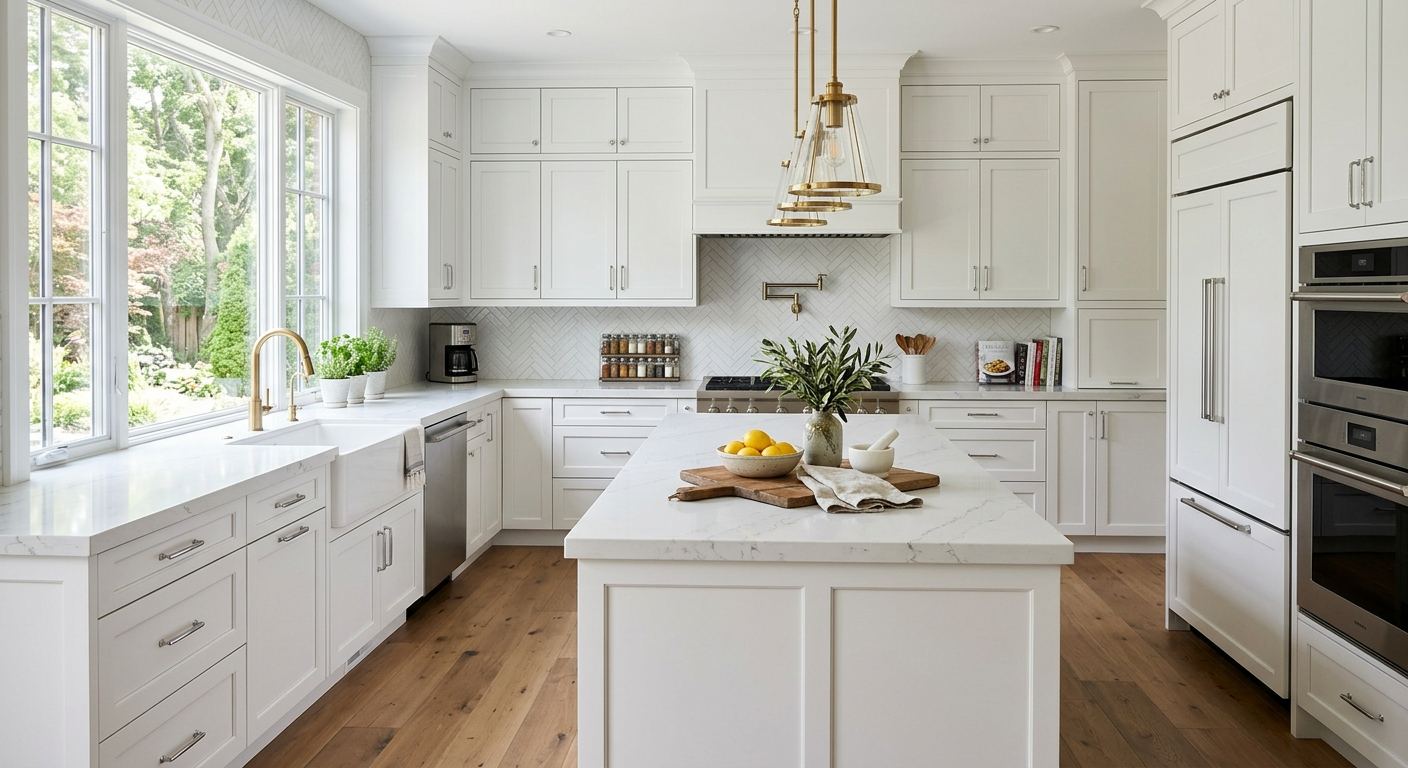
Kitchen renovation options and costs in Halfmoon Bay
Halfmoon Bay kitchen renovations typically start with a simple question: how far do you want to go—cosmetic only, a mid-range refresh, or a full rebuild? With a population of about 2,800 (Statistics Canada, 2021 Census), many projects here are planned carefully and timed around availability for trades and stone fabrication slots. In the Lower Mainland–Southwest, pricing is also tied closely to what local buyers expect at resale; even though Halfmoon Bay is smaller than the Metro Vancouver core, the broader market influences finish choices and the level of cabinetry homeowners will pay for.
The big driver is the Lower Mainland–Southwest home-value and income mix: homeowners in higher-value pockets often choose semi-custom or custom cabinetry and upgrade to quartz/stone counters because the cost is more “recoverable” on resale. In this region, climate plays a secondary role in cost compared with the supply chain and the expected finish tier—so you’ll more often see differences from material selection, layout complexity, and labour availability rather than temperature or humidity alone. That said, coastal British Columbia conditions do matter for longevity: faster wear at hinges/fasteners and moisture-related cabinet stress can show up if the wrong materials or sealing details are chosen.
Trade demand is especially strong in the broader Sunshine Coast–Gulf Islands corridor (where cabinetry, plumbing, electrical, and flooring teams often get booked quickly once island and coastal schedules line up). As a result, contractors may price with a premium for tighter scheduling—particularly when stone fabrication and cabinet lead times overlap.
Below are realistic cost bands for the six most common renovation directions in Halfmoon Bay, so you can compare proposals side-by-side before you talk scope.
| Renovation Tier |
What's Included |
Typical Duration |
Price Range |
| Cosmetic refresh (paint, hardware, new appliances only) |
Paint/finish updates, new cabinet hardware, new appliances (swap-in), basic resealing where needed |
3–7 days |
$8,000–$18,000 |
| Mid-range full renovation (new cabinets, counters, sink, tile) |
New semi-custom or stock cabinets, countertop (quartz or stone-look), sink & faucet, tile backsplash and select floor tile/backsplash updates |
3–6 weeks |
$40,000–$80,000 |
| High-end full renovation (custom cabinets, stone counters, island) |
Custom cabinetry/millwork, premium stone counters, island with upgraded base/finish, advanced backsplash (tile or slab), upgraded lighting and detailing |
6–12 weeks |
$90,000–$140,000 |
| Cabinet refacing only (new doors + drawer fronts, same boxes) |
New door/drawer fronts, refinishing/veneering boxes as needed, new pulls/soft-close hardware, matching trims |
1–3 weeks |
$8,000–$30,000 |
| Countertop swap only (laminate to quartz or stone) |
Remove old counters, install new quartz/stone, cut-outs for sink/cooktop, caulking & final alignment |
4–10 days |
$3,000–$12,000 |
| Backsplash tile installation only |
Surface prep, tile supply allowance, installation, grout/seal where required, trim and finishing |
3–8 days |
$1,500–$6,000 |
Prices are estimates only and vary by project scope, site access and material selection.
What affects the price of kitchen renovation in Halfmoon Bay
In Halfmoon Bay and across the Lower Mainland–Southwest, quotes for the “same” kitchen can vary by roughly 30–50% once you look past the headline scope. The reason is that pricing is usually anchored to local home values, buyer expectations, and the finish tier you choose—not to climate alone. In higher-value Metro Vancouver–adjacent markets within the Lower Mainland–Southwest, homeowners more often default to quartz or stone counters and semi-custom cabinetry because the upgrade aligns with how kitchens are marketed for resale. In more modest scopes, laminate and stock cabinets still deliver good ROI because buyers tend to value layout functionality first, then finishes.
Even in coastal British Columbia, the biggest cost swings come from what changes behind the scenes. Moving plumbing supply or drain lines, relocating a gas range, or adding an island changes the labour and sub-trade work regardless of whether you choose laminate or quartz. A simple example: adding an island typically triggers new electrical for outlets/lighting and often new plumbing planning for an under-mount sink or dishwasher access, which can quickly lift a “mid-range” budget toward a higher full-renovation band.
Concrete Halfmoon Bay examples we see often: (1) older homes with outdated rough-in can require extra wall opening to reach acceptable shut-offs and venting, increasing labour even if the new finishes are mid-range; (2) if you choose full-height backsplash tile for durability and wipeability in a coastal environment, material and install time rise—typically pushing backsplash-only work toward the top of the $1,500–$6,000 band; and (3) if the cabinetry needs to be elevated or shimmed for uneven floors due to age and coastal moisture movement, installation time increases—especially for tight, custom-fit runs.
Use the price bands as a guide: a refresh may remain closer to the lower end of full renovation ranges, while any layout change plus upgraded cabinetry and counters can move you quickly into the $40,000–$120,000 full-renovation band.
| Price Factor |
Why It Matters |
Cost Impact |
| Cabinet tier — stock vs. semi-custom vs. fully custom millwork |
Custom sizing, dovetail/soft-close options, materials, and lead times |
Can shift the cabinet portion by thousands, often moving a job $10,000+ overall |
| Countertop material — laminate vs. quartz vs. granite vs. stone |
Material cost + install complexity (seaming, thickness, edge profiles) |
Typically adds or subtracts several thousand; countertop swaps commonly land in the $3,000–$12,000 band |
| Layout change — wall removal, island add, plumbing/gas move |
More demo, structural considerations, revised rough-in, inspections |
Most unpredictable; can be the difference between mid-range and high-end totals |
| Appliance package tier — builder vs. mid-range vs. pro-grade |
Finish matching, ventilation demands, installation requirements |
Mid-range vs pro-grade commonly moves appliance spend by thousands and affects labour for fit/venting |
| Flooring — refinish existing vs. full replacement |
Prep, subfloor condition, and underlayment changes during demo |
Refinish keeps costs lower; full replacement adds both materials and install days |
| Backsplash — ceramic tile vs. marble vs. full-height slab |
Cut complexity, tolerance demands, sealing, and wall preparation |
Full-height or marble can push backsplash costs near the top of the $1,500–$6,000 range or beyond |
| Electrical — new circuits for island, under-cabinet lighting |
Licensed work, new breakers, wiring routes, and inspection scheduling |
Adds cost even with the same cabinets/counters; often a driver in remodels |
| Permit fees and licensed trade requirements |
Required sign-offs for plumbing/gas/electrical or structural changes |
Can increase totals and timeline; required scope is harder to “estimate tight” |
Permits & regulations in British Columbia
In British Columbia, some kitchen updates are straightforward from a permitting standpoint, but several common remodel actions can’t be done “as a cosmetic swap.” A cabinet and countertop replacement generally does not require a permit. Likewise, replacing like-for-like finishes (for example, a new backsplash tile where plumbing and electrical locations do not change) is usually treated as a finish trade.
Where permits do come into play is when you change services or structure. You’ll typically need permits and licensed trades if you move plumbing supply or drain lines, relocate a gas stove or make changes related to gas appliances (including gas range and certain venting/hood setups), remove or modify a load-bearing wall, or add new electrical circuits (for example, adding outlets on an island or installing wiring for new under-cabinet lighting). Gas work must be done by a licensed gas fitter, and electrical work must be completed by a licensed electrician—both typically require inspections.
For a Halfmoon Bay homeowner, the best verification process is simple and documented. First, ask the contractor for their valid licence numbers for gas fitting and electrical where applicable (and confirm who is doing the work). Then request a certificate of insurance (liability) naming you/your property as required, plus evidence of coverage for workers. Finally, ask for the clearance/inspection process details tied to the permit if permits are expected.
Before you sign, make sure the contract clearly states who pulls permits (the contractor or homeowner), who pays fees, and what is excluded from the scope—this is where the most expensive misunderstandings happen.
Cabinets, countertops and layout decisions in Halfmoon Bay
When you renovate a kitchen in Halfmoon Bay, three decisions drive both cost and long-term satisfaction: (1) cabinet tier, (2) countertop material, and (3) layout changes. Cabinet tier influences the speed of installation and how well the kitchen “fits” older or uneven coastal-era flooring and wall conditions. Stock cabinets are usually the fastest and cheapest because sizes are standardized. Semi-custom cabinets are the most popular mid-range approach here because they balance lead times and cost with better options for corners, pantry height, and appliance garage details. Custom cabinets cost more, but they can be worth it when you want exact wall-to-wall alignment, built-ins, or an island that matches a specific plan.
Countertop material is where durability versus maintenance really shows up. Laminate is budget-friendly but can be less forgiving with heat and heavy daily wear. Quartz engineered counters are a common best-value upgrade in the Lower Mainland–Southwest because they’re durable and require minimal sealing. Natural stone (granite/other stone) adds depth and resale appeal but may require more careful maintenance depending on the stone and finish.
Layout changes (open-concept wall removal, island addition, or plumbing/gas relocation) are the most justified when they solve a functional problem, not just because the design is trendy. For example, if an island improves circulation and allows better seating flow, it can be a worthwhile jump—even if it pushes the project upward within the full renovation range. As a concrete dollar example, choosing quartz instead of laminate might add a few thousand, while relocating plumbing/gas can add substantially more labour and sub-trade coordination; that’s why we often recommend locking layout first, then selecting finishes.
| Option |
Durability |
Maintenance |
Best For |
Price Range |
| Stock cabinets (big-box) |
Solid for everyday use, but limited sizing for tricky spaces |
Low; wipe-down and standard hardware care |
Fast refreshes where layout is staying the same |
$8,000–$20,000 |
| Semi-custom cabinets (local dealer) |
Good strength with better corner/fit options |
Low; soft-close hardware typically reduces wear |
Most Halfmoon Bay remodels balancing fit and budget |
$20,000–$45,000 |
| Custom cabinets (local millwork shop) |
Built to your dimensions; best for complex layouts |
Low-to-moderate; depends on finish type |
When you need exact wall fit, premium storage, or a statement island |
$45,000–$80,000 |
| Laminate countertop |
Moderate; can chip at edges and scratch under heavy impact |
Low; avoid cutting on the surface and manage heat exposure |
Budget-focused upgrades with a strong focus on ROI |
$3,000–$6,500 |
| Quartz engineered countertop |
High; resilient to staining and everyday wear |
Low; no sealing usually required |
Busy households wanting a premium look without heavy upkeep |
$6,500–$12,000 |
| Granite / natural stone countertop |
High; naturally durable but varies by slab and finish |
Moderate; some stones benefit from periodic sealing |
Homeowners who want natural variation and upscale appearance |
$7,500–$13,000 |
| Butcher block countertop |
Good; can show dents/scratches but wears in nicely |
Higher; requires oiling and careful moisture management |
Farmhouse/heritage styles and cooks who like natural patina |
$5,000–$10,000 |
| Marble countertop |
Moderate; can etch with acidic spills |
Higher; needs more careful cleaning and sealing |
Statement kitchens where appearance is the priority |
$10,000–$18,000 |
How to choose a kitchen renovation contractor in Halfmoon Bay
Choosing the right contractor matters more in Halfmoon Bay than in larger cities because trades may be scheduled tightly and the project can be sensitive to lead times for cabinetry and stone. Start by verifying British Columbia licensing and coverage. Ask who will perform the work that requires licences: gas fitting and electrical, for example, must be completed by the appropriate licensed trades. Next, request proof of liability insurance (certificate of insurance) and confirm coverage details that apply to your specific jobsite. For worker safety coverage, ask for documentation relating to workers’ compensation coverage; if they can’t provide it, you should treat that as a serious gap.
Then get 2–3 itemised written quotes. You want a line-by-line breakdown for labour and materials—not a single lump sum. The best quotes show cabinet supply costs, countertop allowance and fabrication, tile quantities, demolition/disposal, plumbing/electrical allowances, and any permit-related items. Read exclusions carefully: is permit pulling included, are old appliances/disposal included, and who protects floors and stairs during demo?
Warranty is another differentiator. Ask for the workmanship warranty length (and what it covers), plus the manufacturer warranty on cabinets, countertops, and appliances. Confirm whether warranties are transferable if you sell the home.
Finally, be cautious with payment timing. In a renovation, never pay more than 10–15% upfront, and hold back a portion until the job is complete and the final punch list is done. Get the start date and completion estimate in writing, with dependencies noted (cabinet lead time, stone template timing, and inspection scheduling).
- Request licence numbers for the trades that require them (gas/electrical) and confirm who is performing the work.
- Ask for a certificate of liability insurance and verify it covers renovation-related work at your address.
- Confirm workers’ compensation coverage for trades who will be on site.
- Use itemised quotes with labour/material breakdowns and explicit inclusions/exclusions.
- Clarify whether permits are pulled by the contractor or you, and who pays permit fees.
- Confirm disposal/recycling for demo debris (and whether appliances are included).
- Ask who is responsible for protecting floors, stairs, and doorways during demo and installation.
- Verify countertop templating and install dates; delays often come from templates/stone fabrication.
- Ask about cabinet installation methods for uneven floors and coastal humidity movement.
- Require a workmanship warranty in writing and ask how it’s handled after completion.
- Set a payment schedule with no more than 10–15% upfront and a holdback until final completion.
- Ensure the timeline includes inspection days if electrical/gas/plumbing permits are required.
Red flags in Halfmoon Bay include: insisting on a large deposit up front, providing only lump-sum pricing without allowances, refusing to confirm who pulls permits, vague timelines that ignore cabinet/stone lead times, and not offering written warranty terms or itemised scopes.
Frequently asked questions — kitchen renovation in Halfmoon Bay
What's the ROI on a kitchen renovation?
In Halfmoon Bay and across British Columbia, a kitchen renovation’s ROI depends less on chasing the most expensive finishes and more on delivering a functional, well-finished space that matches what local buyers expect. In the Lower Mainland–Southwest, upgrades such as durable countertops (often quartz), reliable cabinet storage, and a layout that improves flow typically hold value better than purely cosmetic changes. For context, a full kitchen renovation often falls in the $40,000–$120,000 range, and returns tend to be stronger when the renovation is consistent with your home’s price tier and buyer profile. If you already have a decent layout, concentrating spending on cabinets/counters and lighting usually beats “all-show” refreshes that leave dated plumbing/electrical behind. A good contractor can also suggest options that improve daily use now while still reading well at resale.
How do I budget for a kitchen renovation?
Budgeting starts with deciding the renovation tier and then building a realistic allowance for the parts that most often inflate cost: layout changes, electrical/plumbing updates, and finish choices. In Halfmoon Bay, you can use the region’s common bands as guardrails: for example, a full renovation is often in the $40,000–$120,000 range, while cabinet refacing commonly sits around the $8,000–$50,000 range depending on coverage and finish. If you’re leaning toward mid-range, plan for cabinets, counters, and tile together rather than treating them as separate projects—stone and tile schedules can affect labour days. Also budget for demolition/disposal and contingency (often 10% is reasonable for older homes) because older rough-ins can be more complex once walls open. Finally, confirm what’s included: permits, teardown, protection, and whether appliances are part of the scope.
Can I move my kitchen sink or stove?
Yes, but moving a sink or stove changes the scope dramatically in British Columbia because it may require permitted work and licensed trades. A sink move typically involves plumbing supply and drain routing; that usually brings in permits and a coordinated plan to meet drainage and venting requirements. Moving a stove can also involve gas work (if you have a gas range), which must be performed by a licensed gas fitter and inspected where required. If you’re in Halfmoon Bay’s coastal environment and your home is older, the rough-in behind walls may not match today’s standards, and the contractor may need extra openings to make connections properly. The cost difference can be significant compared with a countertop-only swap (often $3,000–$12,000). The safest approach is to finalize the layout plan first, then estimate rough-in changes before selecting final finishes.
What's the most cost-effective kitchen upgrade?
For many Halfmoon Bay homeowners, the most cost-effective upgrade is improving the surfaces and “high-visibility” components without changing services. Two common value plays are a countertop swap (often $3,000–$12,000 depending on material) and a backsplash tile update (commonly $1,500–$6,000 for install-only, with material allowances). Upgrading hardware and refreshing paint is also economical, especially if your existing cabinets are structurally sound. However, the best ROI comes from pairing upgrades: for instance, if your cabinets are aging but boxes are fine, refacing can refresh the look more affordably than full cabinet replacement. If your layout already works, investing in quartz counters plus an updated backsplash often gives the strongest “after” impact per dollar. A contractor can also suggest where to stop: sometimes the smartest choice is to hold off on layout changes until you’re ready for the bigger permit-and-trade coordination costs.
Custom vs stock cabinets — is custom worth it?
Custom cabinets can be worth it in Halfmoon Bay when you’re working with an awkward space, want precise alignment, or need a built-in island/storage plan that stock units can’t match. Stock cabinets are typically the fastest and lowest cost, but they can leave compromises in corners, appliance garages, or wall-to-wall fit—especially in older homes where floors and walls aren’t perfectly square. Semi-custom is often the “sweet spot” for many Lower Mainland–Southwest projects because it improves fit while keeping lead times and pricing manageable. If your goal is mainly visual refresh, refacing or stock with a durable finish can outperform custom on ROI. As a practical guide, cabinetry choices can move the overall project dramatically within the full renovation bands (which often land between $40,000 and $120,000), so custom is usually justified when you’re getting a functional win (storage, circulation, island design) rather than only a higher-end look.
How do I choose a kitchen contractor in Halfmoon Bay?
Start by verifying credentials and documentation relevant to British Columbia. Ask for the contractor’s liability insurance certificate and confirm who holds the required licences for work that must be done by licensed trades (notably electrical and gas where applicable). Then request itemised written quotes that split labour and materials—so you can compare cabinet types, countertop allowances, tile scope, disposal, and whether permits are included. Read the scope closely: confirm what’s excluded (for example, floor replacement, drywall repairs, or permit pulling) and whether site protection and debris removal are included. For warranty, ask for workmanship warranty length and whether product warranties are transferable if you sell. Payment should be conservative: never more than 10–15% upfront, and hold back until completion and sign-off. Locally, one more tip: confirm lead times for cabinets and stone templating so the schedule fits your home’s access and readiness.