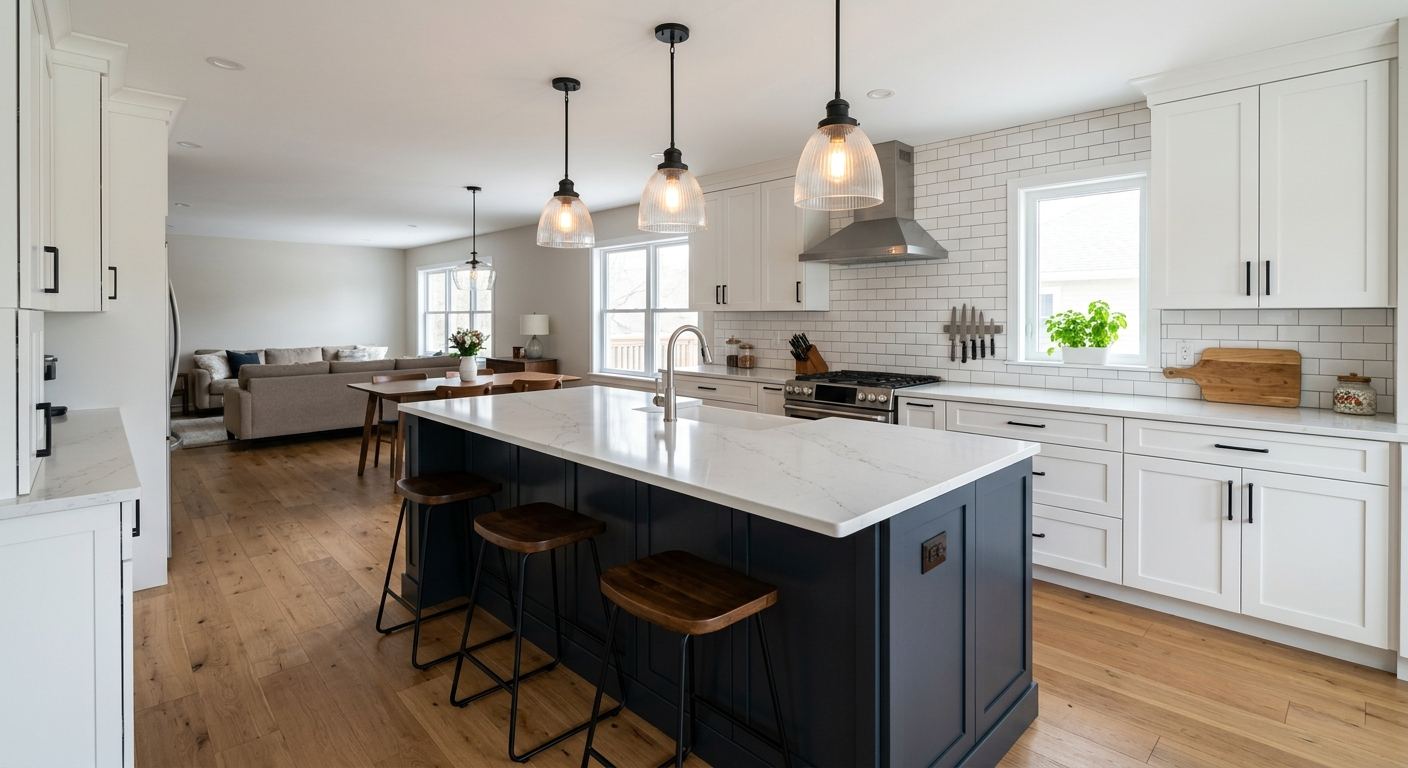
Kitchen renovation options and costs in Terrace
Kitchen renovation options in Terrace usually start with the same question: what can you realistically buy for your budget? With a population of 12,017 (Statistics Canada, 2021 Census) and a strong base of owner households—3,415 homeowner households, or 70.1% of all households (Statistics Canada, 2021 Census)—many projects are planned to improve daily function and long-term resale value. Terrace’s median household income of $90,000 (Statistics Canada, 2021 Census) also pushes most homeowners toward practical, mid-range finishes rather than the highest premium line-ups. Across the North Coast, many buyers still prioritize “quiet upgrades” (cabinets that close smoothly, counters that resist stains, and durable floors) over luxury-only spending, because the market tends to reward livability and durability.
Cost is shaped more by finish tier and scope than by climate. Even though Terrace gets cold winters and heavy precipitation, your kitchen’s biggest cost swings come from layout and trades work—moving plumbing/drain lines, relocating a gas line, upgrading electrical for an island, and removing/altering walls. Contractor availability and remote logistics add modest travel and scheduling pressure, but the finish and layout decisions drive most bids. In Terrace’s Brookside and Thornhill areas—where many homes were built before 1981 and have older kitchen layouts—homeowners commonly choose full cabinet-and-counter replacements with upgraded tile or quartz-style surfaces.
Below is a practical comparison of typical renovation tiers to help you align scope, timing, and pricing before you request itemised quotes.
| Renovation Tier |
What's Included |
Typical Duration |
Price Range |
| Cosmetic refresh (paint, hardware, new appliances only) |
Cabinet paint/stain or touch-ups, new hardware/fixtures, appliance swap, minor countertop cleaning/repair (no structural work), basic caulking and trim detailing |
5–10 working days |
$8,000–$18,000 |
| Mid-range full renovation (new cabinets, counters, sink, tile) |
Stock or semi-custom cabinets, new countertops (laminate or entry-level quartz), sink + tap swap, backsplash tile, flooring refresh (common: sheet vinyl/LVP or tile patching), electrical refresh for standard outlets |
3–5 weeks |
$30,000–$55,000 |
| High-end full renovation (custom cabinets, stone counters, island) |
Custom cabinetry, premium quartz/stone (granite or natural stone), island build with extended electrical, upgraded backsplash (full-height feature options), higher-end plumbing fixtures, flooring replacement and refined lighting plan |
6–10 weeks |
$55,000–$75,000+ |
| Cabinet refacing only (new doors + drawer fronts, same boxes) |
New cabinet doors/drawer fronts, new hardware, veneer/finish work, optional filler panels, basic backsplash rework (limited), no major plumbing relocation |
2–4 weeks |
$6,000–$20,000 |
| Countertop swap only (laminate to quartz or stone) |
Remove and dispose old counters, new countertop install (template + fabrication), sink cut-out and re-set, basic sealing, backsplash adjustment (small areas as needed) |
4–10 working days |
$2,500–$9,000 |
| Backsplash tile installation only |
Tile layout and install (ceramic tile or upgrade options), waterproofing/edge detailing, grout + caulk at corners, finish trim around outlets |
3–7 working days |
$2,000–$8,000 |
Prices are estimates only and vary by project scope, site access and material selection.
What affects the price of kitchen renovation in Terrace
In Terrace and the broader North Coast (Prince Rupert, Terrace, Kitimat and surrounding communities), the same kitchen can come in 30–50% apart depending on contractor approach, how much trades work is triggered, and which finish tier you choose. It’s tempting to assume “labour is labour,” but in reality the finish choices—especially cabinets and counters—set the baseline for what your project becomes. Local home values and the area’s median household income of $90,000 (Statistics Canada, 2021 Census) influence typical buyer expectations: many homeowners lean toward laminate or entry-level quartz counters and stock/semi-custom cabinets, while higher-value homes more often justify custom cabinetry and premium stone. In those higher-equity scenarios, the renovation is easier to “buy back” at resale, so spending on long-term durability tends to pencil out.
Climate plays a smaller role in the total quote than you might think. Cold winters and wet shoulder seasons can stress caulking and flooring seams, but they usually affect maintenance rather than the core build cost—unless the job requires more subfloor prep or replacement. The bigger cost swings are layout changes: removing a wall, adding an island, or moving a gas line. Those items can push you from the lower band toward mid-range full renovation pricing—think roughly $30,000–$55,000 for a full replacement scope—while premium stone and custom millwork push budgets toward the upper range, including high-end projects that can exceed $55,000–$75,000+.
Concrete examples in Terrace: (1) older homes built before 1981 frequently have less flexible plumbing runs, so moving a sink often requires additional labour and wall/ceiling patching; (2) if you upgrade to an island with under-cabinet lighting, electrical rough-ins can add time and coordination; (3) if you replace flooring throughout, you may uncover subfloor irregularities that add prep, especially after long wet seasons. These are predictable sources of cost variance, even when the finish list looks similar on paper.
| Price Factor |
Why It Matters |
Cost Impact |
| Cabinet tier — stock vs. semi-custom vs. fully custom millwork |
Materials, build accuracy, and custom sizing drive both material and install time |
Can shift total budget by roughly $10,000–$25,000+ on full renovations |
| Countertop material — laminate vs. quartz vs. granite vs. stone |
Fabrication complexity, thickness, edge profiles, and sink/cooktop cut-outs |
Often $2,500–$9,000 for swap-only; more with island or premium stone |
| Layout change — wall removal, island add, plumbing/gas move |
Triggers framing, drywall, insulation, venting, and licensed trade work |
Most unpredictable; commonly the largest swing even with similar finishes |
| Appliance package tier — builder vs. mid-range vs. pro-grade |
Electrical requirements, depth/fit, and installation complexity (especially ranges) |
Can add several thousand dollars and influence cabinet sizing |
| Flooring — refinish existing vs. full replacement |
Old subfloor issues and matching/transition detailing |
Refinish is cheaper; full replacement can add $3,000–$10,000 depending on scope |
| Backsplash — ceramic tile vs. marble vs. full-height slab |
Material weight, cutting, waterproofing details, and edge finishing |
Typical backsplash tile ranges from about $2,000–$8,000 installed |
| Electrical — new circuits for island, under-cabinet lighting |
New outlets, GFCI needs, and lighting wiring affect rough-in timing |
Often modest on refresh; can become major with island/lighting upgrades |
| Permit fees and licensed trade requirements |
Required inspections, scheduling lead times, and coordination overhead |
Adds cost variability; typically a smaller portion than layout/finish changes |
Permits & regulations in British Columbia
In British Columbia, a straight cabinet or countertop swap typically does not require a permit because you are not altering plumbing routes, gas connections, load-bearing walls, or electrical circuits. However, if your Terrace kitchen renovation includes plumbing supply/drain line changes, relocating a gas appliance (including adjusting work around stoves or range hoods where gas is involved), removing a load-bearing wall, or adding new electrical circuits (for example, dedicated circuits for an island or adding multiple under-cabinet lighting runs), permits and licensed trades are usually required.
Here’s the practical way to think about it for your quote: (1) Usually no permit: replacing cabinets in-place, swapping countertops that keep the same sink location, installing a backsplash without moving plumbing/gas lines, and replacing like-for-like appliances. (2) Likely permit + licensed trade: moving a sink, adding a dishwasher requiring new drain/pump considerations, changing shutoffs or supply piping, relocating or modifying gas components, removing structural walls, and adding electrical circuits or changing panel loads.
When you’re signing up in Terrace, verify licensing and coverage before work starts. Ask for the contractor’s documentation: (a) licence details for gas work from the licensed gas fitter and electrical work from a licensed electrician; (b) certificate of insurance and liability coverage; and (c) worker coverage (commonly WSIB/WCB coverage) for the crew performing the work. Where to look: check the relevant provincial online registries for contractor/licence status, and request updated insurance certificates directly from the contractor—don’t rely on copies sent weeks earlier. Also confirm in writing who pulls permits and who schedules inspections.
Cabinets, countertops and layout decisions in Terrace
The three most consequential decisions in a Terrace kitchen renovation are cabinet tier, countertop material, and layout changes—because they drive both the look buyers expect and the trades complexity behind the scenes. Start with cabinets. Stock cabinets are fastest and cheapest to install, but you’ll accept more standard sizing. Semi-custom cabinets (a very common Terrace choice) balance better fit and quicker lead times—especially helpful in homes with older, slightly out-of-square walls. Custom cabinets produce the best fit, but they cost more and can lengthen scheduling due to fabrication.
Next, countertops. Laminate is the budget-friendly option and can look very clean with modern edges, but it’s less forgiving if you routinely set hot pots directly on the surface. Quartz is a strong mid-range choice for the North Coast because it resists staining and handles daily cooking wear well with relatively low maintenance. Granite and other natural stones can offer a premium, resale-friendly appearance, while requiring more attention around sealing and careful handling of chips. Butcher block adds warmth and can be appealing in older homes, but in a wet coastal environment you need disciplined maintenance to keep seams sealed and to avoid swelling at the edges.
Finally, layout. If your kitchen is cramped, an island or open-concept wall change can be justified—but only when the plumbing/gas and electrical work aligns with what’s already in the walls. A typical example: upgrading to quartz and semi-custom cabinetry might move a mid-range kitchen toward the $30,000–$55,000 band, but adding a sink move and island plumbing often pushes labour and permitted trades into the upper portion of that band or beyond. In Terrace’s older housing stock, layout tweaks are where budgets can jump even when finishes stay similar, so it’s worth prioritizing space gains that don’t require major re-routing.
| Option |
Durability |
Maintenance |
Best For |
Price Range |
| Stock cabinets (big-box) |
Good for everyday use; fit depends on how level your existing walls are |
Low; standard hardware care and occasional caulk/adjustment |
Budget-first renovations where speed and predictable pricing matter |
$6,000–$18,000 |
| Semi-custom cabinets (local dealer) |
Very solid build; better sizing options for typical Terrace wall variations |
Low; hardware tuning and standard cleaning |
Most common Terrace mid-range projects with improved fit and resale appeal |
$12,000–$30,000 |
| Custom cabinets (local millwork shop) |
Highest fit and build precision; best longevity if designed for your layout |
Low-to-moderate; still needs routine cleaning and hardware care |
When you’re doing a major layout change or want a “built-in” look |
$25,000–$50,000+ |
| Laminate countertop |
Durable for normal use; edges and seams are the critical wear points |
Easy daily care; avoid excessive heat and standing water at seams |
Renovations where you want modern appearance without premium stone |
$2,500–$5,500 |
| Quartz engineered countertop |
Very good impact and stain resistance for everyday cooking |
Low; wipe clean and avoid abrasive pads |
High value-to-cost option for Terrace homes (including families and resale) |
$4,500–$9,000 |
| Granite / natural stone countertop |
Excellent durability; natural variation means selection matters |
Moderate; often requires periodic sealing and careful chip protection |
Premium look seekers and higher-equity kitchens |
$6,000–$12,000 |
| Butcher block countertop |
Durable but sensitive to moisture/edge exposure if not maintained |
Moderate; regular oiling and protective routine around seams |
Warm, cabin-style looks where owners maintain surfaces consistently |
$3,500–$8,000 |
| Marble countertop |
Beautiful but softer; higher risk of etching and staining without care |
Higher maintenance; requires careful cleaning and protection |
Statement kitchens where appearance outweighs low-maintenance priorities |
$8,000–$15,000+ |
How to choose a kitchen renovation contractor in Terrace
Choosing a kitchen renovation contractor in Terrace should start with verification: British Columbia licensing and insurance are not optional details, they’re the foundation of a safe, well-coordinated build. For gas work, the licensed gas fitter must perform and certify the work; for electrical, a licensed electrician must handle the circuit changes and inspections. Ask the contractor for a certificate of insurance (liability coverage) and proof of worker coverage (commonly WSIB/WCB coverage) for the crew doing the work. Then check licence status using the appropriate provincial online registry and confirm the certificate dates are current.
Next, get 2–3 itemised written quotes (not just one lump-sum number). Itemisation should separate labour versus materials, and specify allowances for cabinets, countertops, tile, disposal, and demolition. Also ensure the scope is clear: what’s included and what’s excluded—permit pull included or not, old materials disposal included or not, and who handles adjustments if your home’s walls are out of plumb (common in older Terrace homes). Read the warranty terms carefully: look for a workmanship warranty length (how long they stand behind installation) and product/manufacturer warranties, and whether warranties are transferable if you sell your home.
Payment schedule matters too. Never accept a deal with large upfront deposits. As a practical rule, aim for no more than 10–15% upfront, then staged payments tied to milestones, with a holdback until the job is complete and inspected. Finally, insist on a start date and a completion estimate in writing so you can plan around school schedules, work travel, and winter conditions.
- Confirm the right licensed trade is assigned for gas and electrical work before signing.
- Request certificate of insurance and verify coverage limits match the project scope.
- Ask for proof of WSIB/WCB coverage for workers (or confirm how they handle it).
- Get 2–3 itemised quotes with a labour/material breakdown and allowances spelled out.
- Check whether permits are included in the quote or pulled by you/another party.
- Confirm disposal/haul-away is included (demo debris can be costly in remote logistics).
- Verify backsplash, flooring transitions, and caulking details are included (often omitted).
- Ask what happens if measurements change due to hidden framing/plumbing issues.
- Confirm the warranty duration for workmanship and product, and whether it’s transferable.
- Lock in a payment schedule with milestone payments and a holdback on completion.
- Get a written timeline with lead times for cabinets and countertop fabrication.
- Request references from similar kitchens in Terrace or the North Coast region.
In Terrace, four common red flags include: (1) quotes that only list totals with no material allowances, (2) contractors who won’t clearly state who pulls permits and schedules inspections, (3) refusing to provide insurance/coverage documents, and (4) pushing for large upfront payments or vague “we’ll figure it out” scope language after you sign.
Frequently asked questions — kitchen renovation in Terrace
How do I choose a kitchen contractor in Terrace?
Start by checking British Columbia requirements and documentation: the electrical work must be handled by a licensed electrician, and any gas-related work must be done by a licensed gas fitter. Ask your contractor for a current certificate of insurance and evidence of worker coverage (WSIB/WCB) for their crew, then confirm licence status through provincial online registries. Next, request 2–3 itemised quotes with a labour/materials breakdown—if the quote is only a single number, you can’t compare value. For budgeting, a mid-range full renovation in Terrace often lands around $30,000–$55,000, so pick the contractor who can deliver the scope you want within that band (and who explains where costs are coming from).
What order do kitchen renovation steps happen in?
Typically in Terrace, the sequence looks like: site measurement and design confirmation, then demolition (remove old cabinets/counters), rough trades (plumbing/gas changes and electrical rough-ins), framing/drywall repair if walls were opened, and then cabinet install. After cabinets are set and leveled, countertops are templated (or fabricated once specs are confirmed), while tile work (backsplash) is usually installed around the same general period to coordinate edges and outlet trim. Flooring patching or replacement happens either before cabinet install (if it’s a full replacement plan) or after demolition depending on your design. Finally, appliances, trim, caulking, and finishing details wrap up. Your contractor should provide a timeline in writing so you can plan around cabinet and countertop lead times.
Can I live at home during a kitchen renovation in Terrace?
Often, yes—especially for a cosmetic refresh or cabinet/countertop work where the kitchen remains partially usable. For a full renovation, many Terrace homeowners move to a temporary setup: a microwave on a cart, a kettle/hot plate, and a cleanable food prep area in a different room while construction crews are active. Expect noisy periods and dust control needs during demolition and tile prep. Projects that involve moving plumbing/drain lines, electrical circuits, or removing/altering walls are harder to “live through” because work can affect water access and power to certain areas temporarily. A practical approach is to ask your contractor for a daily work plan and staging plan, and to confirm when appliances, sink plumbing, and electrical are expected to be fully operational.
Should I renovate my kitchen before selling in Terrace?
Usually, kitchens are worth renovating when your current layout or finishes are holding the home back—especially if cabinets are dated, counters are worn, or the kitchen feels cramped. In Terrace’s owner-heavy market (70.1% of households own; Statistics Canada, 2021 Census), buyers often want durable surfaces and functional storage more than they want luxury. That said, full renovations aren’t always a direct resale win if the scope goes beyond what buyers typically expect for your neighbourhood. Many homeowners target a mid-range refresh strategy (often in the $30,000–$55,000 band for full replacement) because it improves day-to-day usability while keeping the spend reasonable. If you plan to sell soon, avoid complicated layout changes unless they clearly solve a core problem.
What's the most popular kitchen style in Terrace right now?
Based on typical Terrace homeowner choices (and what sells well in regional showings), the most popular “look” is clean, modern warmth: shaker-style cabinets in light to mid-tone finishes, quartz-style counters (or entry-level quartz), and straightforward ceramic tile backsplashes. Owners frequently choose semi-custom cabinets because they deliver better fit than stock while still controlling cost. The North Coast market tends to value durability over trend-only materials, so you’ll see fewer high-maintenance surfaces like marble in day-to-day homes. Many projects land in a practical middle ground—where finishes feel updated without jumping to the very top end of custom stone and fully custom cabinetry.
How do I know if I need to update my kitchen plumbing in Terrace?
You may need plumbing updates if you’re changing the sink location, adding a dishwasher, relocating supply/drain lines, or noticing recurring issues like slow drains, under-sink leaks, or corrosion. In older Terrace homes (58.1% built before 1981; Statistics Canada, 2021 Census), it’s common to find plumbing runs that are harder to match or not aligned for newer cabinet layouts, which can trigger additional labour and possibly permits depending on what’s altered. If you’re staying put with the existing sink location, a countertop swap may not require major plumbing work. Ask your contractor for a plumbing assessment during demolition—then compare two scopes: “repair/refresh” versus “full replacement of supply and drain components” to decide based on risk and total budget (for example, staying within a renovation plan near $25,000–$65,000 full renovation pricing versus adding more).