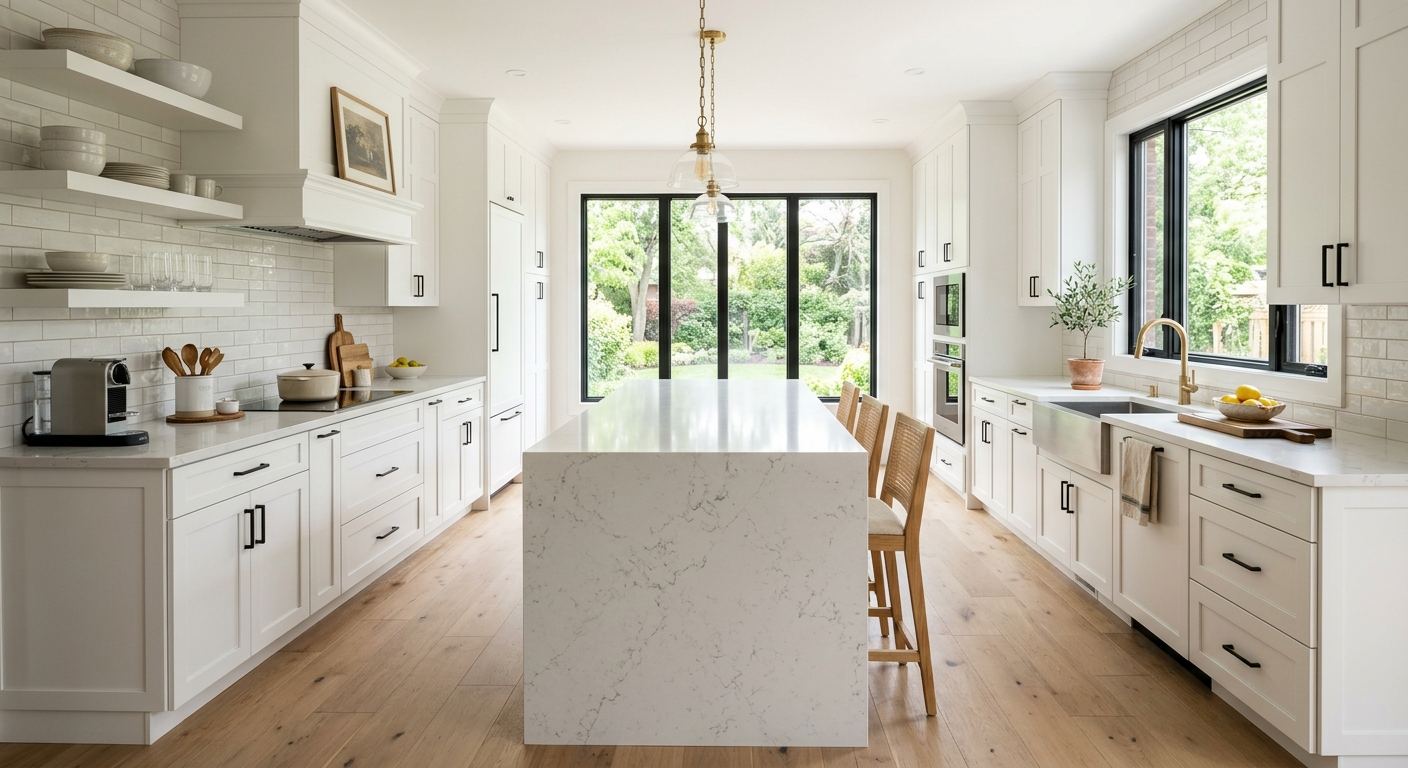
Kitchen renovation options and costs in South Arm
Kitchen renovations in South Arm, British Columbia tend to fall into a few predictable cost tracks, largely because homeowners here plan with Lower Mainland–Southwest resale expectations in mind. With a population of 7,503 (Statistics Canada, 2021 Census), the local market is small enough that supply and scheduling can vary by neighbourhood street-by-street, especially for cabinet installers and countertop fabricators. At the same time, South Arm is part of the same housing-value environment that drives higher finish choices across Metro Vancouver’s orbit: many buyers and sellers gravitate toward durable surfaces and better storage, even when the project starts as a “refresh.”
In the Lower Mainland–Southwest, pricing is usually less about weather and more about finish tier and contractor availability. British Columbia’s wet winters and coastal humidity can also affect materials during install and drying—paint, adhesives, and substrate prep need the right moisture conditions—so a rushed schedule can add cost later. You’ll also see trades cluster demand in older housing areas: in South Arm, renovations are especially common around Ladner / Ladner Trunk Road corridors and nearby residential pockets where homeowners often modernize dated kitchens without fully changing the footprint.
To help you compare scopes, below are realistic options you can take to quotes—then we’ll break down what moves pricing most.
| Renovation Tier |
What's Included |
Typical Duration |
Price Range |
| Cosmetic refresh (paint, hardware, new appliances only) |
Cabinet paint or finish touch-ups, new hardware, appliance swap (same locations), lighting refresh, basic caulking and trim |
3–6 business days (plus appliance lead times) |
$8,000–$25,000 |
| Mid-range full renovation (new cabinets, counters, sink, tile) |
New cabinets (semi-custom or quality stock), new countertop, sink + faucet, backsplash tile, flooring prep/patching, plumbing hookups (no major layout move) |
3–5 weeks |
$40,000–$75,000 |
| High-end full renovation (custom cabinets, stone counters, island) |
Custom cabinetry, quartz or natural stone, extended island with seating/overhang, upgraded plumbing/electrical for island, full backsplash with premium tile or slab accents |
5–10 weeks (longer with custom millwork) |
$75,000–$120,000 |
| Cabinet refacing only (new doors + drawer fronts, same boxes) |
New door/drawer fronts, hardware upgrades, re-laminated or resurfaced panels, fresh trim/caulk, alignment adjustments |
1–3 weeks |
$8,000–$35,000 |
| Countertop swap only (laminate to quartz or stone) |
Remove existing tops, install new quartz/stone, seam planning, sink cut-outs, caulking and polish; backsplashes left as-is unless requested |
3–10 business days |
$3,000–$12,000 |
| Backsplash tile installation only |
Surface prep, tile supply/setting labor, grout/seal where needed, cleanup and caulking; drywall repairs only if minor |
2–5 business days |
$1,500–$6,000 |
Prices are estimates only and vary by project scope, site access and material selection.
What affects the price of kitchen renovation in South Arm
Even when two homeowners ask for the “same” kitchen, quotes across the Lower Mainland–Southwest and the rest of British Columbia can swing by 30–50% because contractors price risk differently: complexity of cabinetry, trade scheduling, hidden demolition conditions, and finish expectations in higher-value areas. In the Lower Mainland–Southwest, local home values and household income generally push homeowners toward quartz or stone counters and semi-custom cabinetry more often than in markets where resale buyers are more tolerant of laminate and stock layouts. That’s why a similar kitchen in South Arm can land in a mid-range renovation band at one address, while another nearby project trends high-end once you add a stone island, upgraded hardware, and made-to-fit millwork.
Layout changes are the most unpredictable cost regardless of finish tier. Removing a wall, adding an island, or moving a gas line or plumbing run introduces engineering checks, licensed-trade hours, new subfloor/framing needs, and permit timelines. Here are a few South Arm realities that commonly move the needle:
- Older framing and out-of-level walls can require additional shimming and re-squaring before cabinets go in, adding labour.
- Ventilation upgrades for range hoods (especially where ducting is constrained) can add more work than expected.
- Coastal humidity and winter schedules can slow adhesive and paint readiness, which can stretch timelines even if materials are on hand.
As a benchmark, a cabinet-and-counter refresh can stay relatively contained in the $40,000–$75,000 mid-range zone when locations remain the same, but it typically climbs quickly once you combine island design, stone counters and a more complex cabinetry package. Conversely, a countertop swap only usually sits closer to the $3,000–$12,000 band, provided the sink cut-outs and edge profiles are straightforward.
| Price Factor |
Why It Matters |
Cost Impact |
| Cabinet tier — stock vs. semi-custom vs. fully custom millwork |
Design complexity, fit tolerances, finish quality and internal organization vary significantly |
Typically adds $10,000–$45,000 between tiers on full renos |
| Countertop material — laminate vs. quartz vs. granite vs. stone |
Material cost, fabrication complexity, and installation handling differ by surface |
Often $3,000–$18,000 depending on size and cut-outs |
| Layout change — wall removal, island add, plumbing/gas move |
Creates new framing, possibly permits, and increases trade hours and inspection steps |
Can add $8,000–$35,000 even with the same finishes |
| Appliance package tier — builder vs. mid-range vs. pro-grade |
Electrical requirements, specs, and finish/fit vary by brand tier |
Commonly $2,000–$12,000 difference within equivalent installs |
| Flooring — refinish existing vs. full replacement |
Whether you can reuse existing subfloor/finish determines demolition and materials |
Often $1,500–$10,000 swing |
| Backsplash — ceramic tile vs. marble vs. full-height slab |
Sheeting size, grout complexity, and heavier materials can require more labour |
Typically $1,500–$8,000 depending on height and material |
| Electrical — new circuits for island, under-cabinet lighting |
More outlets, lighting, and correct load planning drive electrician time and material |
Commonly $800–$6,000 for typical upgrades |
| Permit fees and licensed trade requirements |
Permits and inspections add administration time; licensed scopes reduce DIY risk |
Often $500–$3,500 in direct costs plus scheduling time |
Permits & regulations in British Columbia
In British Columbia, cabinet and countertop swaps generally do not require permits when you’re keeping existing plumbing and electrical where they are and you’re not changing structural elements. That means removing old cabinets and installing new ones, or replacing laminate with quartz, is typically treated as a finish-only upgrade. Likewise, a backsplash installation is usually straightforward if it doesn’t involve new electrical work.
Where permits do come into play in South Arm kitchens is when you change services or structure. Typically requiring permits and licensed trades includes: moving supply or drain lines for a sink or dishwasher, relocating a gas stove or making changes to gas piping/venting, removing a load-bearing wall (or doing structural alterations), and adding new electrical circuits for an island, under-cabinet lighting, or new dedicated outlets. Gas work must be performed by a licensed gas fitter, and electrical work must be done by a licensed electrician—both require inspection steps.
To verify a contractor properly before signing, ask for three things and check them in writing: (1) their British Columbia licence documentation for the relevant trade (and any subcontractors), (2) a current certificate of liability insurance and the coverage limits, and (3) proof of workers’ compensation coverage (WCB/WSIB-equivalent in their system). In practice, you should also request a clearance letter or coverage confirmation where applicable. Then confirm—also in your contract—who is pulling permits (if any) and who is responsible for inspection bookings and pass documentation.
Cabinets, countertops and layout decisions in South Arm
The three most consequential decisions in a South Arm kitchen renovation are cabinet tier, countertop material, and layout changes. In the Lower Mainland–Southwest resale market, buyers often expect cabinetry that closes smoothly, has durable finishes, and offers practical storage—so the “fit and finish” gap between stock and semi-custom is easier for homeowners to see at walk-through than the difference between mid-grade and premium appliances. Cabinet tier usually sets your baseline: stock cabinets are fastest and cheapest, semi-custom is the most popular mid-range balance, and custom millwork offers the best fit around older walls and unusual spaces.
Countertop choice is the next big driver. Laminate can be cost-effective but can be more vulnerable to impact and edge wear. Quartz is popular because it resists stains and handles everyday use well, and it holds up nicely in BC’s wet-season living where kitchens see more tracking from boots and higher humidity swings. Granite and natural stone look premium, but they come with different maintenance routines depending on the stone and finish. Butcher block is warm and repairable, yet it needs routine sealing—important to plan for in a coastal, moisture-exposed environment.
Finally, layout changes are where value can be justified or wasted. In many South Arm homes, adding an island improves flow and storage, but plumbing/gas relocation can erase savings fast. For example, if you’re keeping plumbing in the same general location, a mid-range renovation may sit around the $40,000–$75,000 band; if you add an island that requires moving plumbing and new electrical circuits, the same kitchen can move toward the $75,000–$120,000 high-end range even before premium finishes. The best justification is a real space gain: better work triangle, seating, and storage where you’ll actually use it daily.
| Option |
Durability |
Maintenance |
Best For |
Price Range |
| Stock cabinets (big-box) |
Good for everyday use; tolerances may be less forgiving on older floors/walls |
Low; typical cleaning and gentle hardware care |
Fast timelines and simpler layouts with minimal wall irregularities |
$8,000–$25,000 |
| Semi-custom cabinets (local dealer) |
Very solid; better sizes and internal options for realistic storage needs |
Low; quality hinges/drawers reduce wear issues |
Most South Arm renovations seeking best balance of price and fit |
$20,000–$55,000 |
| Custom cabinets (local millwork shop) |
Highest durability and precision fit; handles awkward spaces well |
Low; premium finishes hold up well with standard care |
Renovations with unusual dimensions, full-height features, or signature storage |
$45,000–$90,000 |
| Laminate countertop |
Moderate; can chip or peel at edges if impacts occur |
Easy daily cleaning; avoid prolonged moisture at seams |
Budget-focused upgrades where the rest of the kitchen is mid-range |
$3,000–$6,500 |
| Quartz engineered countertop |
High; resistant to staining and daily wear |
Low; normal cleaner and mindful care at seams/cut-outs |
Durable everyday kitchens and resale-friendly finish choices |
$6,500–$11,500 |
| Granite / natural stone countertop |
Very durable surface; depends on stone type and finish |
Can require periodic sealing; wipe up spills promptly |
Premium look and unique stone character |
$8,000–$14,000 |
| Butcher block countertop |
Good; repairable but can mark with heavy impact |
Higher; regular oil/seal routine required |
Farmhouse warmth and owners committed to upkeep |
$4,000–$9,000 |
| Marble countertop |
Beautiful but softer; susceptible to etching and staining |
Higher; requires careful cleaning and sealing plans |
Low-to-moderate cooking households prioritizing luxury appearance |
$10,000–$18,000 |
How to choose a kitchen renovation contractor in South Arm
Choosing the right contractor in South Arm, British Columbia starts with confirming licensing and coverage before you compare pricing. For licensed trades (gas fitting if applicable, and electrical), verify the contractor’s authorization and that any subcontractors are correctly registered for their scope. Ask for their liability insurance certificate and review the coverage limits and expiry date. For workers’ compensation, request proof of WCB/WSIB coverage (and a clearance letter where applicable). Don’t rely on a verbal “we’re covered”—you want current documents in your file.
Next, get 2–3 itemised written quotes—not just a lump sum. A proper kitchen quote separates labour and materials so you can see cabinet supply, countertop fabrication, install time, plumbing/electrical allowances, demolition, drywall patching, flooring underlayment/repairs, and disposal. Confirm whether permits are included, who pulls them, and whether inspection scheduling is part of the service. Also clarify exclusions: hidden water damage, mould remediation, subfloor reconstruction, or moving appliances outside the stated scope.
For warranty, ask for both workmanship warranty length and product/manufacturer warranties (and whether they’re transferable to future homeowners). On payment schedule, a safe approach is never paying more than 10–15% upfront; keep a holdback until completion and sign-off. Finally, insist on a start date and completion estimate in writing so you can plan around lead times for cabinets and countertop fabrication.
- Verify provincial licensing/authorization for relevant trades and their subcontractors’ scopes.
- Confirm current liability insurance (certificate provided) before the first deposit clears.
- Request proof of workers’ compensation coverage and a clearance letter where applicable.
- Get itemised quotes with line-by-line labour and materials (not a single total only).
- Ask whether demolition, disposal, and site protection (floor coverings) are included.
- Clarify cabinet install plan: shimming, wall prep, and any drywall repairs included.
- Confirm countertop measurements approach and who is responsible for templating delays.
- Ask if permit fees and inspections are included or billed separately (and by whom).
- Require a written start date, milestone dates, and an estimated completion range.
- Review warranty terms for both workmanship and manufacturer products; check transferability.
- Use a deposit/holdback plan (10–15% max upfront; holdback until punch-list completion).
- Request examples of similar South Arm kitchens (photos of layouts, islands, and stone seams).
Red flags I commonly see in South Arm include: vague scope language that hides exclusions, “cheap” cabinet pricing that doesn’t include hardware or installation prep, no permit/inspection responsibility stated when plumbing/electrical changes are proposed, warranties only offered verbally, and contractors asking for a large upfront payment before templating and ordering are confirmed.
Frequently asked questions — kitchen renovation in South Arm
Do I need a permit for a kitchen renovation in British Columbia?
In British Columbia, you typically do not need a permit for finish-only kitchen work like replacing cabinets in the same locations, installing a new countertop on existing plumbing cut-outs, or updating a backsplash with no electrical changes. Permits usually become necessary when you move services—such as relocating sink supply/drain lines, changing gas lines or moving a gas stove/range hood that uses gas, removing a load-bearing wall, or adding new electrical circuits (for example, for an island or new lighting plan). In South Arm, the permit responsibility must be clearly stated in your contract so you know who pulls the paperwork and schedules inspections. If your contractor can’t clearly describe what triggers a permit and who manages it, pause and ask for written clarification before you sign.
What's the ROI on a kitchen renovation?
ROI depends heavily on the finish tier and whether you match what local buyers expect in the Lower Mainland–Southwest. In higher-value neighbourhood pockets around South Arm, quartz/stone counters and solid cabinet packages often help resale appeal more than purely cosmetic updates, while still keeping the project grounded in practical durability. That said, ROI can drop when budgets chase high-end upgrades that don’t fit the home’s overall condition or layout needs. As a practical budgeting lens, homeowners who keep changes limited (no major plumbing/gas moves) can often target the mid-range renovation band around $40,000–$75,000, which tends to align better with buyer expectations than a full premium custom rebuild that lands closer to $75,000–$120,000 unless the rest of the home supports that level. The best “ROI” move is choosing durable materials and a layout that improves daily function.
How do I budget for a kitchen renovation?
Start with your scope, then assign ranges before you select materials. For many South Arm homeowners, a sensible approach is to separate: (1) cabinets (stock, semi-custom, or custom), (2) counters (laminate, quartz, stone), and (3) any layout/service moves. If you’re doing a mid-range full renovation without shifting plumbing or gas, budgeting around $40,000–$75,000 is a common reality check for cabinets, counters, sink, and tile. If you’re planning a high-end full renovation with an island and premium stone/custom millwork, plan for the $75,000–$120,000 band. Also add a contingency for surprises from demolition—older kitchens can hide subfloor issues and wall out-of-level conditions. Finally, confirm what is included for disposal, permit handling, and electrical/plumbing allowances so your final cost doesn’t “creep” past the band you planned.
Can I move my kitchen sink or stove?
You can move a kitchen sink or stove in South Arm, but it’s one of the fastest ways to increase project cost in British Columbia because it triggers licensed trades and often permits. Moving a sink usually means relocating supply and drain lines, which requires careful planning for venting and slope. Moving a stove—especially a gas range—can involve changes to gas piping and venting and must be done by a licensed gas fitter. If the stove is electric, the electrical scope may require new circuits by a licensed electrician. Because of the permit and inspection steps, the timeline can also stretch. If your goal is to stay in a tighter budget band, the most cost-effective strategy is often to keep plumbing and gas lines in the same general location, then improve storage and surfaces around them.
What's the most cost-effective kitchen upgrade?
For many South Arm kitchens, the most cost-effective upgrade is either a cabinet refacing strategy or a countertop swap—when your existing cabinet boxes and layout are still solid. A cabinet refacing-only project (new doors and drawer fronts, same boxes) typically sits around the $8,000–$35,000 range, and it can dramatically update the look without the full demolition cost. A countertop swap alone—like laminate to quartz—often lands in the $3,000–$12,000 band, especially when cut-outs and seams are straightforward. The key is choosing upgrades that buyers immediately notice (fronts, counters, and how the kitchen functions) while avoiding expensive layout/service moves. Purely cosmetic refreshes (paint, hardware, and appliances only) can also help, but they’re usually better when your cabinetry is already in good condition and you’re not dealing with dated layouts or worn surfaces.
Custom vs stock cabinets — is custom worth it?
Custom cabinets can be worth it in South Arm when you have awkward dimensions, need full-height solutions, or want a layout that fits perfectly around older walls and out-of-level conditions. If you’re aiming for a fast upgrade with a practical resale-friendly finish, stock cabinets can be the cheapest route, but tolerances may be less forgiving and you may lose options for storage layouts. Semi-custom often lands in the best middle ground for most homeowners in the Lower Mainland–Southwest—better fit and organization without the full custom premium. As a budgeting reality check, stock cabinetry generally costs less, while custom millwork pushes project totals higher and is more likely to move you toward the $75,000–$120,000 high-end renovation band when combined with premium counters and an island. The “worth it” test is whether the fit, storage, and design match your day-to-day needs and your home’s overall value—if not, semi-custom is frequently the smarter buy.