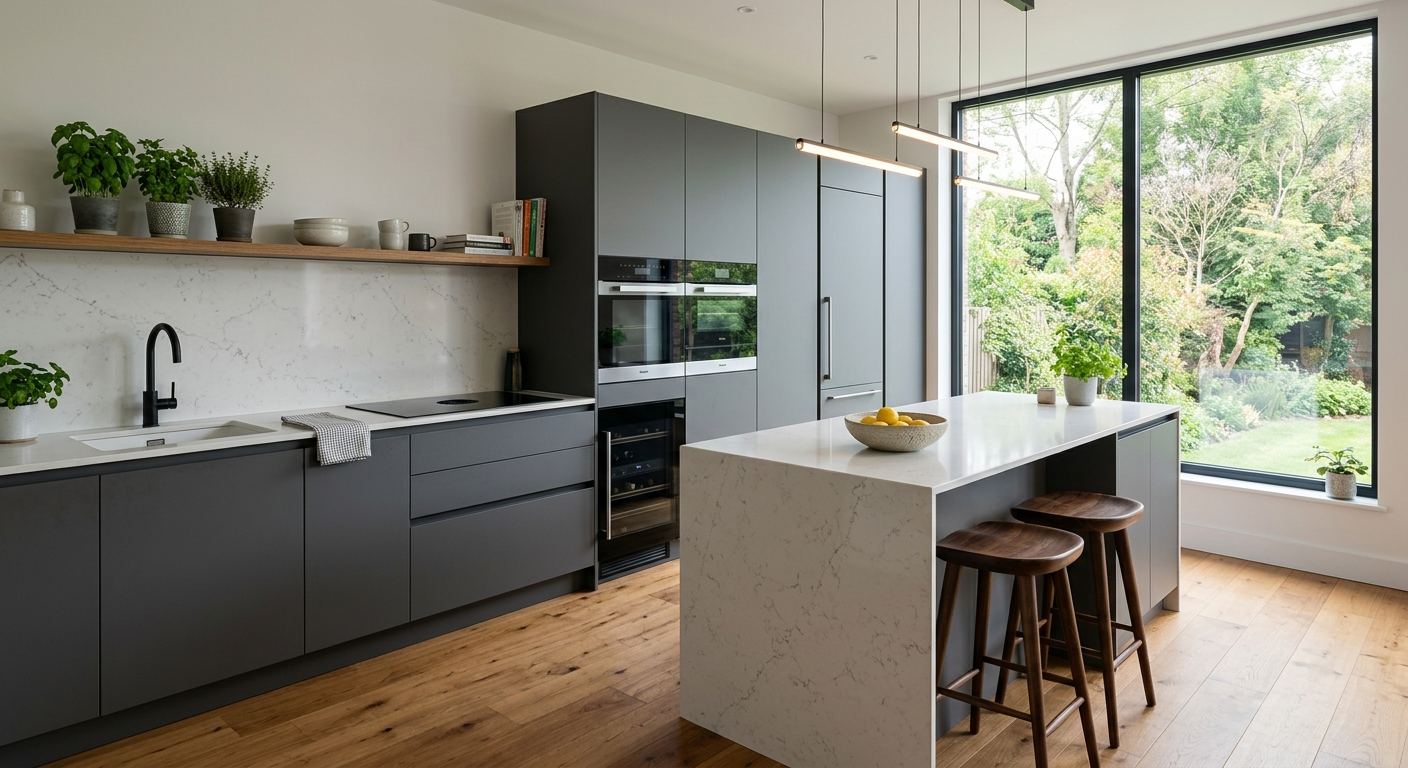
Kitchen renovation options and costs in Ranch Park
Kitchen renovations in Ranch Park often start with a simple decision—how much change you want to live with day to day—and then the local market quietly shapes the outcome. In the Lower Mainland–Southwest, household budgets are influenced by the region’s scale and housing demand; with a population of 7,925 in Ranch Park (Statistics Canada, 2021 Census), most renovations are driven by family-sized homes and resale expectations rather than “one-off” rural projects. At the same time, the wider Lower Mainland–Southwest pricing reality is that labour and premium finishes track higher-value neighbourhood expectations, so buyers increasingly favour cleaner lines, upgraded hardware, and durable surfaces.
Climate matters too, but in Ranch Park the bigger cost driver is usually finish level and cabinetry complexity—not snow load or extreme freeze cycles. Coastal conditions and humidity can affect caulking, wood movement, and how quickly older sealants fail around sinks and plumbing penetrations, so many homeowners see a “refresh trigger” at the same time they notice cabinet-door swelling or countertop edge lift. Contractor availability is also a factor: trades are busy across the broader Surrey/Abbotsford corridor and the Burnaby/Vancouver side, so scheduling can shift your total if you need specific installers on a tight timeline.
If your kitchen is in the denser retail-and-housing pockets of Ranch Park (near the main local shopping and transit routes), demand is especially high because homeowners there tend to renovate for both everyday use and resale. With that in mind, here’s how typical project tiers compare, so you can align scope before you ask for bids.
| Renovation Tier |
What's Included |
Typical Duration |
Price Range |
| Cosmetic refresh (paint, hardware, new appliances only) |
Cabinet paint or touch-ups, new hardware, new fridge/range/dishwasher (no layout/plumbing changes), caulking, basic deep clean |
5–10 business days |
$8,000–$25,000 |
| Mid-range full renovation (new cabinets, counters, sink, tile) |
New semi-custom or stock cabinets, countertop installation, sink and faucet, backsplash tile, under-cabinet lighting prep, flooring touch-ups as needed |
3–6 weeks |
$40,000–$75,000 |
| High-end full renovation (custom cabinets, stone counters, island) |
Custom cabinetry/made-to-fit millwork, stone counters (often quartz or natural stone), island build, upgraded hardware, extended backsplash, electrical upgrades for island lighting |
6–12 weeks |
$90,000–$120,000 |
| Cabinet refacing only (new doors + drawer fronts, same boxes) |
Door/drawer front replacement, hinge and pull replacement, new panels as required, optional cabinet painting/finishing |
1–3 weeks |
$8,000–$30,000 |
| Countertop swap only (laminate to quartz or stone) |
Removal and install of new countertop, sink and faucet re-set where possible, seam and edge finishing, re-caulk |
3–7 business days |
$3,000–$12,000 |
| Backsplash tile installation only |
Demo (if needed), cement board prep where required, tile install and grout/seal, finishing trims and caulking |
3–8 business days |
$1,500–$6,000 |
Prices are estimates only and vary by project scope, site access and material selection.
What affects the price of kitchen renovation in Ranch Park
The same kitchen renovation can land 30–50% apart in the Lower Mainland–Southwest compared with other parts of British Columbia because quotes reflect what homeowners typically “default” to for their local resale market. In higher-value segments around the Lower Mainland, buyers more often expect quartz or stone counters, semi-custom cabinetry, and better workflow layouts—so those material choices and more detailed millwork packages push totals higher. In more modest areas, laminate and stock cabinetry are still common because they deliver a strong refresh at a lower upfront cost and still meet basic resale expectations.
In Ranch Park, local home value and buyer income expectations influence the finish tier far more than climate does. Coastal humidity and damp air can accelerate sealant failure at sink cut-outs and around plumbing penetrations, so when a countertop edge or caulk line lets go, you may find hidden water damage and need additional prep before you install new surfaces. That said, the most unpredictable cost is usually layout change work: removing a wall, adding an island, or relocating a gas line or plumbing run often determines whether you’re in the “mid-range” band or pushed into full-renovation territory.
Two practical examples we see often: (1) homeowners upgrading from laminate to quartz sometimes add an expensive sub-top repair if the old substrate is water-warped near the sink; (2) adding an island can trigger electrical work for under-cabinet or toe-kick lighting and new circuits, which can push the project closer to the $40,000–$75,000 mid-range range—or, with custom millwork and stone, toward the $90,000–$120,000 high-end band. When you keep the plumbing where it is and choose stock-to-semi-custom transitions, costs stay more controllable.
| Price Factor |
Why It Matters |
Cost Impact |
| Cabinet tier — stock vs. semi-custom vs. fully custom millwork |
Custom boxes and tailored reveals change labour time, number of parts, and tolerances for installation |
Typically shifts a project by roughly $10,000–$40,000 |
| Countertop material — laminate vs. quartz vs. granite vs. stone |
Material and fabrication complexity affect pricing, seams, and edge profiles |
Often adds $2,000–$10,000+ depending on material and size |
| Layout change — wall removal, island add, plumbing/gas move |
New framing, structural work, re-routing services, and inspection steps increase uncertainty |
Can add $8,000–$35,000+ |
| Appliance package tier — builder vs. mid-range vs. pro-grade |
Different brands require different installation clearances, venting considerations, and power needs |
Usually shifts appliance line item by $1,500–$8,000+ |
| Flooring — refinish existing vs. full replacement |
Demo waste, subfloor corrections, and matching new flooring to existing areas drives cost |
Commonly $1,500–$10,000+ |
| Backsplash — ceramic tile vs. marble vs. full-height slab |
Higher-end materials need better substrate prep, more labour time, and stricter alignment |
Usually $1,500–$6,000, higher with full-height slab |
| Electrical — new circuits for island, under-cabinet lighting |
New outlets, switches, dedicated circuits and lighting add licensed labour and inspection requirements |
Often $800–$6,000+ |
| Permit fees and licensed trade requirements |
Triggered by plumbing/gas/electrical/service changes; also affects scheduling and documentation |
Varies, but budgeting $1,000–$5,000+ for admin/coordination is common |
Permits & regulations in British Columbia
In British Columbia, not every kitchen touchpoint requires a permit. A straightforward cabinet swap or countertop replacement typically does not require a permit—if you’re keeping plumbing and gas where they are and you’re not changing structural elements. Where permits and licensed trades come in is when you move plumbing supply/drain lines, relocate gas components (stove/range, gas connections, or related venting considerations), remove or alter a load-bearing wall, or add new electrical circuits (for example, an outlet or lighting circuit for an island).
Here’s the practical homeowner checklist for Ranch Park. Step 1: confirm exactly what the contractor intends to change—ask if plumbing will be moved, whether the gas line is touched, and whether any new circuits are planned for island lighting or additional receptacles. Step 2: verify licensing before work starts. For electrical, ensure the contractor uses a licensed electrician for circuit work; for gas-related changes, confirm a licensed gas fitter is responsible.
Step 3: verify coverage documents. Request a current certificate of insurance and keep it in your project file. Ask whether the contractor has Workers’ Compensation coverage (WCB) for their employees; if subcontractors are involved, make sure each trade’s coverage and responsibilities are clarified in writing. Step 4: if permits are required, make sure the contractor states who pulls the permit and who schedules inspections. Always confirm permit responsibility in your written contract—“we’ll handle it” is not the same as “you are or are not responsible for permit fees and inspections.”
Cabinets, countertops and layout decisions in Ranch Park
The three biggest decisions in a Ranch Park kitchen renovation are cabinet tier, countertop material, and layout changes. Cabinet tier determines installation complexity and how well the kitchen can be tailored to older openings and uneven walls common in many Lower Mainland homes. Stock cabinets are the fastest path and typically the lowest cost, while semi-custom is the most popular mid-range option because it balances lead times and fit. Custom cabinetry is the highest cost, but it’s also where you get the best bespoke fit—especially helpful when you’re dealing with corner constraints or want a true ceiling-to-floor design without awkward gaps.
For countertops, start with how you’ll use the space. Laminate can be a budget-friendly choice, but seam and edge wear are more noticeable over time, particularly around the sink where humidity and daily splash exposure accelerate deterioration. Quartz engineered countertops are a common sweet spot in the Lower Mainland–Southwest because they’re durable and consistent, and they typically cost more than laminate but less than many natural-stone options. Granite/natural stone and marble can elevate appearance, but they require more care and maintenance habits, and certain stone types can be more sensitive to staining if not sealed and cared for properly.
Layout changes—open-concept wall removal, island addition, and plumbing/gas relocation—are where cost becomes less predictable. An island is justified when it improves circulation, adds real prep capacity, and can support seating or functional storage without forcing awkward clearances. If you can keep plumbing near its current location and simply add an island with a dedicated electrical plan, you can often stay near the $40,000–$75,000 mid-range band. When you move plumbing/gas and build custom millwork around the new footprint, it can push toward $90,000–$120,000.
| Option |
Durability |
Maintenance |
Best For |
Price Range |
| Stock cabinets (big-box) |
Good everyday durability with standard hardware and finishes |
Low; wipe-clean surfaces, keep hinges adjusted |
Fast timelines and budget-first renovations |
$8,000–$20,000 |
| Semi-custom cabinets (local dealer) |
Very good durability; improved finishing and better option variety |
Low; occasional tightening and gentle cleaning |
Most Ranch Park mid-range full renovations |
$18,000–$45,000 |
| Custom cabinets (local millwork shop) |
Excellent; made-to-fit construction for tight spaces |
Low to moderate; durable finishes but expect more craftsmanship upkeep |
Complex layouts, full-height design, and high-end resale goals |
$35,000–$75,000 |
| Laminate countertop |
Fair to good; vulnerable at seams and edges over time |
Easy cleaning; avoid prolonged standing water at sink edges |
Budget refreshes that keep plumbing in place |
$3,000–$6,500 |
| Quartz engineered countertop |
Very good; strong against staining and everyday wear |
Low; wipe clean and use trivets for extreme heat |
Busy households in humid coastal conditions |
$6,000–$12,000 |
| Granite / natural stone countertop |
Very good; unique patterning with strong surface hardness |
Moderate; sealing and stain management depending on stone type |
Owners who want natural variation and premium look |
$7,000–$14,000 |
| Butcher block countertop |
Good; can dent but can be refinished |
Moderate; regular oiling and prompt drying after wet use |
Casual, family-friendly kitchens with hands-on maintenance |
$4,500–$9,500 |
| Marble countertop |
Beautiful but more susceptible to etching and staining |
Moderate to high; careful cleaners and sealing discipline |
Low-heat, “showpiece” kitchens or specialty use cases |
$9,000–$18,000 |
How to choose a kitchen renovation contractor in Ranch Park
Choosing the right contractor in Ranch Park is mostly about proof: proof of licensing, proof of coverage, and proof that your scope is clearly defined. In British Columbia, you can’t assume coverage is in place—verify it. For electrical work, ensure a licensed electrician will handle circuit changes (especially for island receptacles and under-cabinet lighting). For gas-related changes, a licensed gas fitter should be responsible. Ask for the contractor’s current certificate of insurance (liability) and confirm they carry Workers’ Compensation coverage for their employees (WCB). Then ask to see trade subcontractor insurance too, if their team uses subs.
Next, get 2–3 itemised written quotes rather than a single lump sum. You want a breakdown that shows labour versus materials, including countertop fabrication/installation, cabinet delivery and install, tile prep, disposal, and any allowances for drywall, paint, and subfloor repairs. Carefully read exclusions: is demo included? Is permit pulling included if plumbing/gas/electrical changes are triggered? Is waste disposal and recycling included, and where does the contractor haul debris? Also confirm who supplies and installs the sink, faucet, and venting components if appliances or ranges are being swapped.
Warranty matters. Ask for a workmanship warranty length and what it covers (for example, cabinet installation adjustments, tile substrate failures, and seam workmanship). Confirm product/manufacturer warranties for cabinets, countertops, and appliances—and whether the warranty is transferable to future owners if you sell. On payment schedule, avoid large deposits; a common safe approach is no more than 10–15% upfront, with a holdback until completion. Finally, get the start date and estimated completion timeline in writing, including lead-time assumptions for cabinets and stone.
- Provide BC licence details and confirm who performs permits, if required.
- Share certificate of insurance showing your jobsite address as applicable.
- Confirm WCB coverage for employees (and verify subcontractor coverage if used).
- Use itemised quotes with labour, materials, allowances, and quantities.
- Specify what’s included in demo, drywall patching, and paint touch-ups.
- Clarify disposal and debris hauling (and whether recycling is included).
- Confirm countertop template, fabrication, and seam expectations in writing.
- Ask about cabinet delivery dates and what happens if materials are delayed.
- Review electrical scope: new circuits, under-cabinet lighting, island power.
- Review plumbing/gas scope: who handles licensed trades and inspections.
- Get warranty details in writing (workmanship vs. product warranty).
- Lock payment schedule with a holdback and staged milestones.
Red flags in Ranch Park include quotes with no breakdown (only a lump sum), contractors who won’t confirm who pulls permits for plumbing/gas/electrical changes, vague “allowances” that understate cabinet and countertop costs, payment demands that exceed 10–15% upfront without milestone justification, and crews who refuse to provide insurance/WCB documentation or a written timeline.
Frequently asked questions — kitchen renovation in Ranch Park
How do I get accurate kitchen renovation quotes in Ranch Park?
To get accurate quotes in Ranch Park, start by preparing a clear scope and site access. Share your measurements, photos (especially of the sink/plumbing wall, venting, and electrical panel area), and your must-keep items (like the fridge location or existing vent hood footprint). Then ask for 2–3 itemised estimates that separate labour, cabinet supply/installation, countertop fabrication/installation, tile work, disposal, and any allowances for drywall/paint. If you’re considering a full refresh, many homeowners target the $40,000–$75,000 mid-range band; if you’re doing custom millwork or adding an island with major service changes, bids often climb toward $90,000–$120,000. Finally, confirm whether permits are included in the quote if plumbing/gas/electrical changes are proposed.
What's the best countertop material for a busy Ranch Park kitchen?
For a busy Ranch Park kitchen in the Lower Mainland–Southwest, quartz engineered countertops are often the most practical “set-and-forget” option. They’re durable against everyday staining, handle frequent cleaning well, and don’t demand the sealing routines that many natural stones require. Laminate can work for a tighter budget, but you’ll want to be mindful around the sink area—humidity and daily splashes can stress edges and seams over time. If you’re weighing price, laminate-only swaps typically fall in the $3,000–$6,500 range depending on size and sink cut-outs, while quartz installs often land closer to $6,000–$12,000. Granite and marble look premium, but they’re better suited to homeowners who want to manage sealing and careful cleaning habits.
How do I add an island to my Ranch Park kitchen?
Adding an island is usually a two-part plan: layout first, then services. If you want seating and better prep space, measure clearances so traffic lines don’t pinch—this is where many projects run into unplanned drywall and flooring repairs. The bigger cost swings come from whether you’re relocating plumbing or gas and whether you need electrical for island lighting and receptacles. Even if you keep plumbing where it is, under-cabinet lighting or new island circuits typically triggers licensed electrical work and scheduling. To manage cost and timeline, ask your contractor to price the island in a way that separates cabinetry/millwork, countertop cut-outs, electrical labour, and countertop templating. If your island scope keeps services minimal, you can sometimes stay closer to the mid-range $40,000–$75,000 band; more extensive changes often push projects toward the high-end range.
How much does a kitchen renovation cost in Ranch Park?
In Ranch Park, kitchen renovation totals typically depend on finish tier and whether you’re changing layout or services. As a baseline, a full kitchen renovation commonly falls in the $40,000–$120,000 range in the Lower Mainland–Southwest tier. If you’re doing a practical mid-range plan with new cabinets, counters, sink, and tile, many homeowners land around $40,000–$75,000. High-end projects with custom cabinetry, stone counters, and an island often sit around $90,000–$120,000. Smaller projects follow their own bands: cabinet refacing often runs $8,000–$30,000, a countertop-only swap is commonly $3,000–$12,000, and backsplash tile installation is often $1,500–$6,000. Your contractor should be able to explain how each line item contributes to the total so you can decide where to scale up or down.
How long does a kitchen renovation take in Ranch Park?
Timelines in Ranch Park usually depend on lead times for cabinets and countertops, and whether the job includes permits and licensed trades. A cosmetic refresh (paint/hardware/appliances only) often takes about 5–10 business days because there’s usually minimal demolition. Mid-range full renovations commonly run 3–6 weeks when cabinet and countertop production stays on schedule. Full high-end renovations with custom cabinetry and island builds can take 6–12 weeks due to more bespoke millwork and tighter countertop templating and fabrication windows. If plumbing/gas/electrical changes are planned, inspections can add a few days to the critical path even when the workmanship is ready. The key is to get your start date and an estimated completion date in writing, and to understand where delays may happen.
Quartz vs granite countertops — which is better?
“Better” depends on your maintenance tolerance and how your kitchen is used. Quartz is engineered for consistency and typically offers a more uniform look with easier day-to-day care—many homeowners like it because it stays low-maintenance compared with natural stone. Granite is a natural product with unique veining and strong durability, but it often requires sealing and more careful cleaning habits to keep stains at bay. In a Ranch Park household with frequent cooking and lots of cleaning, quartz is often the safer everyday choice. In cost terms, quartz installs commonly fall into the $6,000–$12,000 range depending on size, while granite/natural stone can be higher, often around $7,000–$14,000. If you want a premium natural look and you’ll maintain it, granite is compelling; if you want straightforward upkeep, quartz usually wins.