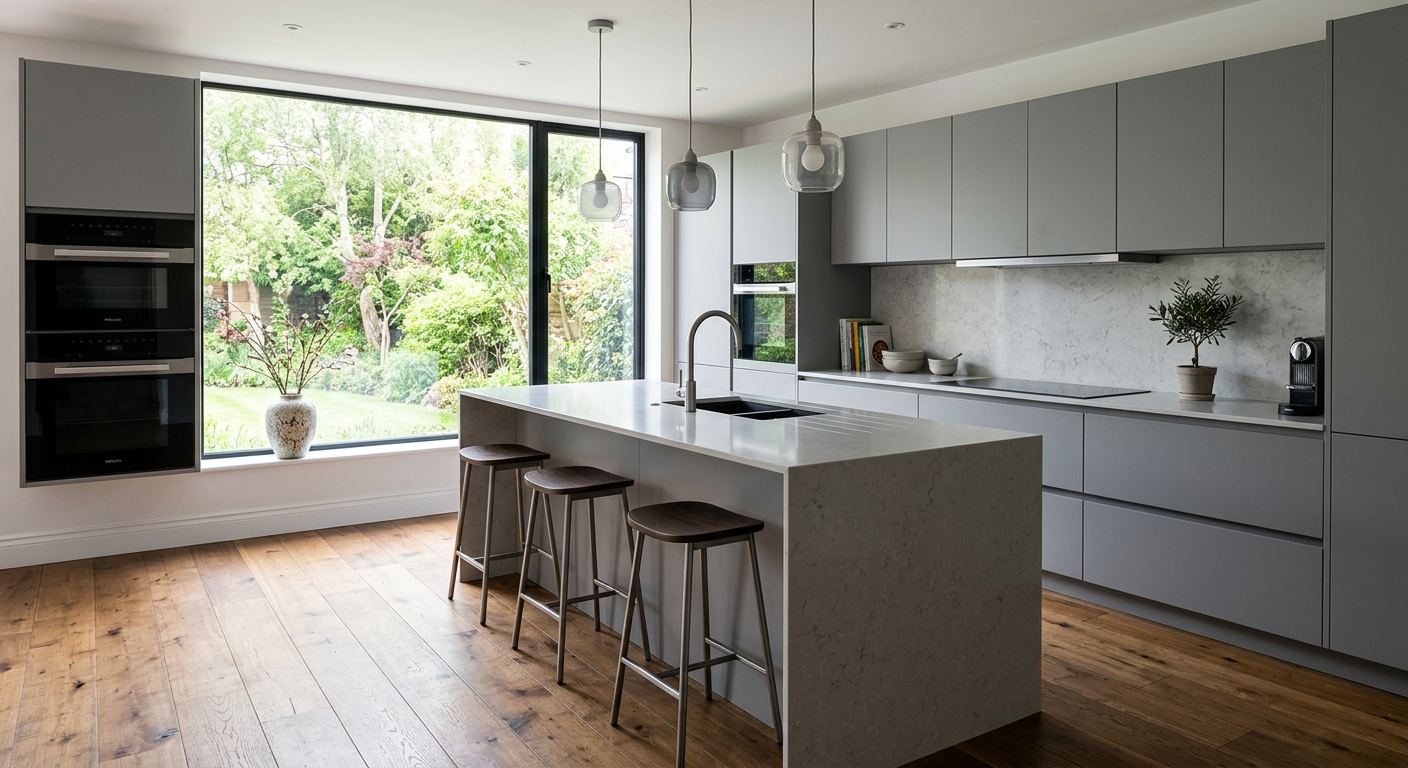
Kitchen renovation options and costs in Colwood
Colwood homeowners renovate kitchens for many reasons—aging finishes, resale plans, or a more practical layout—but the typical cost depends on how far you’re willing to go. With a median household income of about $102,000 (Statistics Canada, 2021 Census) and a homeowner-majority community (5,455 homeowner households), most projects in Colwood land in a tier that matches what buyers on Vancouver Island tend to expect: clean millwork lines, durable surfaces, and appliance packages that look current. In practice, the Vancouver Island and Coast market—especially in higher-value pockets—pushes many renovators toward quartz, natural stone, and semi-custom cabinetry, which shifts budgets upward into the province’s mid-range and high-end bands. That’s true even though our coastal climate doesn’t usually “drive” kitchen pricing the way freeze-thaw conditions do inland; rather, it influences material choices and expectations around longevity in a humid, salt-air-adjacent environment.
Older housing stock is also a factor in Colwood: 42.2% of homes were built before 1981, so ducting, electrical capacity, and original plumbing runs may require upgrades once you open walls. Contractors remain in especially strong demand around the Langford–Colwood corridor and nearby commercial nodes, where schedules fill quickly during renovation season. Below are the most common renovation options and what they typically cost, so you can align your scope with realistic budgets before you request quotes.
| Renovation Tier |
What's Included |
Typical Duration |
Price Range |
| Cosmetic refresh (paint, hardware, new appliances only) |
Cabinet paint or refinish, new hardware, updated lighting cover plates, and appliance swap only; no cabinet box replacement; no layout changes |
1–3 weeks |
$15,000–$35,000 |
| Mid-range full renovation (new cabinets, counters, sink, tile) |
New cabinets (stock or semi-custom), countertop install (often quartz), new sink + faucet, backsplash tile, new flooring surface (refinish or replacement), typical electrical/lighting refresh |
4–8 weeks |
$40,000–$85,000 |
| High-end full renovation (custom cabinets, stone counters, island) |
Custom cabinetry, stone countertops (granite/marble) with upgraded edges, island build, upgraded appliance package, enhanced lighting plan (task + under-cabinet), higher-end tile/finishes |
8–14 weeks |
$90,000–$150,000+ |
| Cabinet refacing only (new doors + drawer fronts, same boxes) |
New door/drawer fronts, new hardware, new toe-kick or trim where needed, countertop may be left as-is unless you bundle a swap |
2–5 weeks |
$8,000–$35,000 |
| Countertop swap only (laminate to quartz or stone) |
Remove existing top, new countertop template and install, backsplash detail varies (often limited to side/back splash unless tiled) |
1–3 weeks |
$3,000–$12,000 |
| Backsplash tile installation only |
Tile supply and install, surface prep, waterproofing where required, grout/caulk detail, standard reach (no major plumbing/electrical relocation) |
1–2 weeks |
$2,500–$9,000 |
Prices are estimates only and vary by project scope, site access and material selection.
What affects the price of kitchen renovation in Colwood
In Colwood and across the Vancouver Island and Coast region, two homeowners can receive quotes that differ by 30–50% for what sounds like the same kitchen—because contractors price the risks and decisions, not just the finished look. Across British Columbia, the biggest drivers are local home values and household incomes, which determine what finish tier is “normal” for resale. In higher-value pockets around Victoria/Langford and nearby areas, homeowners often choose quartz or natural stone and semi-custom cabinetry because the cost is easier to justify on resale; in more modest pockets or secondary suites, stock cabinets and laminate or entry-level quartz are common, keeping budgets closer to “refresh” or basic remodel levels. Climate doesn’t usually swing the cost dramatically here—cost is more about cabinetry tolerance, countertop care expectations, and moisture-tolerant installation practices in a coastal environment—but older builds can turn hidden issues into real dollars.
Concrete examples from Colwood: (1) Homes built before 1981 frequently have dated electrical runs behind the backsplash and under-cabinet areas, and adding circuits for island outlets or lighting can add cost even if the kitchen layout stays the same; (2) If you remove an interior wall to open the kitchen, the unpredictability is in framing, ducting, and possible structural adjustments—layout changes typically cost more than swapping finishes; and (3) Changing from laminate to quartz in a kitchen with a complex edge profile or multiple corners often increases labour because templating and fit-up are more involved than “straight runs.” A countertop-only project can sit in the $3,000–$12,000 band, while cabinet-and-counter scope often moves you into the $40,000–$85,000 mid-range depending on how many boxes, corners, and trades you need to involve.
| Price Factor |
Why It Matters |
Cost Impact |
| Cabinet tier — stock vs. semi-custom vs. fully custom millwork |
Higher tiers add custom sizing, upgraded materials, better hardware, and longer lead times; stock is faster to install |
Low to high: often the largest single swing (commonly 30%–40% of total) |
| Countertop material — laminate vs. quartz vs. granite vs. stone |
Material price and install complexity rise with heavier stone, specialty edges, and more joints/templating |
Moderate to high: countertop swaps can move from a low thousands band to much higher totals |
| Layout change — wall removal, island add, plumbing/gas move |
Opening walls and re-routing mechanical services adds demolition, reframing, inspections, and patching |
Often the most unpredictable—can outpace finish upgrades |
| Appliance package tier — builder vs. mid-range vs. pro-grade |
Premium units cost more and may require specific clearances, venting considerations, and electrical provisions |
Moderate: increases total even when cabinets/counters stay unchanged |
| Flooring — refinish existing vs. full replacement |
Kitchen renovations frequently disturb flooring and subflooring; mismatched flooring drives replacement decisions |
Low to moderate: replacement is usually more expensive than refinishing |
| Backsplash — ceramic tile vs. marble vs. full-height slab |
Premium backsplashes raise material cost and require straighter, more exact substrate prep and finishing |
Moderate: tile-only can still climb if you go full-height or natural stone |
| Electrical — new circuits for island, under-cabinet lighting |
New lighting/outlets may require additional circuits, junction work, and licensed trades |
Moderate: can add cost even when layout doesn’t change |
| Permit fees and licensed trade requirements |
Certain work triggers permits and inspections; licensed trades affect scheduling and documentation |
Low to moderate, but important for timing and compliance |
Permits & regulations in British Columbia
In British Columbia, swapping cabinets or countertops typically does not require a permit because you’re not changing the building’s plumbing, gas, structural load paths, or electrical systems. That means cabinet replacement, countertop installation, and most backsplash work are commonly handled as renovations without a permit. However, permits and licensed trades are required when you change the systems—such as moving plumbing supply/drain lines, relocating a gas stove or making changes that affect gas equipment, removing a load-bearing wall, or adding electrical circuits (for example, new island outlets or upgraded lighting that requires new wiring).
For a Colwood homeowner, the practical way to verify compliance is to check the contractor’s documents before you sign. Step 1: request proof of licence for any work that involves electrical or gas—confirm the electrician/gas fitter is licensed in BC. Step 2: ask for a certificate of liability insurance and ensure coverage is current and appropriate for renovation work. Step 3: confirm WSIB/WCB coverage where applicable for the contractor/subtrades (and request the paperwork). Step 4: ask whether the contractor is pulling permits (and exactly what permits), then confirm who is responsible for applications in writing. A clear contract prevents surprises at inspection time and helps ensure the finished kitchen is safe and buildable for resale.
Cabinets, countertops and layout decisions in Colwood
When planning a kitchen renovation in Colwood, the three biggest decisions are cabinet tier, countertop material, and whether you’ll change the layout. Cabinets drive the look and installation speed: stock cabinets are the fastest and typically cheapest, semi-custom is the most popular mid-range option for better fit around your existing room lines, and custom cabinets cost the most but offer the tightest integration (including unusual corners, higher-end hardware, and tailored storage). For countertops, laminate is budget-friendly but generally less durable against heavy daily wear; quartz is a balanced choice for durability and easy maintenance; granite/natural stone looks high-end but requires correct sealing/maintenance and careful handling during install; butcher block adds warmth but needs more attention around moisture; and marble is elegant yet more maintenance-heavy for homeowners who spill and clean frequently.
Layout decisions change the budget unpredictably. If you remove a wall to open the kitchen or add an island, you may need structural review and mechanical/electrical rework. In many Colwood homes built before 1981, plumbing runs and electrical capacity can force upgrades even when the layout idea is simple. A good rule: if you can keep plumbing and gas where they are, you can direct money to cabinets and counters. For example, choosing quartz instead of laminate might add a few thousand dollars toward the $40,000–$85,000 mid-range, but moving plumbing/gas can push you further into the same range—or beyond—because the trades and patching work multiply. On resale across Vancouver Island and Coast, buyers often expect a cohesive, modern cabinet line and a durable countertop surface; those choices usually deliver stronger perceived value than incremental “refresh” alone, especially in homes where buyers can see the whole open kitchen plan.
| Option |
Durability |
Maintenance |
Best For |
Price Range |
| Stock cabinets (big-box) |
Good for typical use; standardized sizes may require trim/adjustments |
Low: keep hardware tightened; avoid overloading weak shelves |
Fast timelines and tighter budgets |
$8,000–$25,000 |
| Semi-custom cabinets (local dealer) |
Very good durability; better options for internal storage and sizing |
Low to moderate: depends on finish and hardware selection |
Most Colwood mid-range remodels |
$20,000–$45,000 |
| Custom cabinets (local millwork shop) |
Excellent durability with tailored framing and fit |
Low: quality hinges/drawers typically stay smooth longer |
Unique layouts, full-height storage, premium resale look |
$45,000–$90,000+ |
| Laminate countertop |
Moderate; can chip at edges if bumped and is less heat-tolerant than stone |
Low: wipe clean; avoid prolonged heat exposure and standing water at seams |
Budget-focused refreshes |
$3,000–$7,000 |
| Quartz engineered countertop |
High; resists staining better and handles daily wear well |
Low: no sealing; regular cleaner and careful support during install |
Best balance of look, durability, and maintenance in coastal BC |
$6,000–$12,000 |
| Granite / natural stone countertop |
Very high; durable surface with unique patterns |
Moderate: sealing and periodic care depending on the stone |
Premium appearance where maintenance is acceptable |
$8,000–$18,000 |
| Butcher block countertop |
Moderate to high with proper care; susceptible to water if neglected |
Moderate to high: regular oiling and careful drying |
Warm, cottage-style kitchens |
$4,000–$10,000 |
| Marble countertop |
Moderate; beautiful but can scratch and etch |
High: sealing and quick cleaning for spills |
Statement finishes for lower-traffic kitchens or homeowners who maintain |
$10,000–$25,000+ |
How to choose a kitchen renovation contractor in Colwood
Choosing the right kitchen renovation contractor in Colwood comes down to proof, clarity, and schedule control. Start by verifying British Columbia licensing for any trade work: ask for the electrician’s licence proof for electrical upgrades and the gas fitter’s licence proof for any gas range/hood changes. Then request liability insurance paperwork and confirm WSIB/WCB coverage where applicable. A reputable contractor won’t treat this like “optional admin”—they’ll provide it quickly.
Next, get 2–3 itemised written quotes. Insist on a breakdown that separates labour from materials (cabinet supply, countertop supply, installation labour, tile labour, electrical scope, disposal, and any permit-related work). Avoid lump sums without a defined scope, because “allowances” can quietly expand. Read exclusions carefully: disposal included or not, permit pull responsibility, protected work areas, countertop templating timing, and whether demolition dust protection is in the scope. Also ask about warranties: workmanship warranty length (and what it covers), product/manufacturer warranty details, and whether warranties transfer to you if you sell the home. Finally, payment should be conservative—generally no more than 10–15% upfront—then hold back a portion until key milestones are complete, not just until everything is “mostly done.”
- Confirm licences for electrical and gas-related work, and ask for licence numbers.
- Request a current certificate of liability insurance before work starts.
- Verify WSIB/WCB coverage or acceptable equivalent documentation.
- Get 2–3 itemised quotes with labour/material line items, not lump sums.
- Ensure permits are clearly assigned in writing (who pulls, who pays, who schedules inspections).
- Check if demolition, haul-away, and disposal are included.
- Require clear allowance amounts for cabinets, countertops, tile, and appliances.
- Ask how countertop templating and ordering will be scheduled to avoid downtime.
- Confirm who is responsible for damage to adjacent finishes (walls, floors, paint touch-ups).
- Review warranty terms: workmanship duration, claim process, and what voids coverage.
- Agree to a start date and a completion estimate in writing, with milestone dates.
- Use a payment schedule with a holdback until punch-list items are finished.
Concrete red flags to watch for in Colwood: they won’t provide trade licence/insurance paperwork; quotes are not itemised and rely on vague “allowances”; they ask for large upfront payments (beyond 10–15%); they avoid talking about permits/inspection responsibility; or they promise impossible timelines despite cabinet/counter lead times.
Frequently asked questions — kitchen renovation in Colwood
Do I need a permit for a kitchen renovation in British Columbia?
In British Columbia, a kitchen refresh that stays within the footprint—like cabinet replacement, countertop swaps, and most backsplash work—typically does not require a permit. Where permits come in is when you change building systems: moving plumbing supply or drain lines, relocating gas appliances or making changes that affect gas equipment, removing a load-bearing wall, or adding/altering electrical circuits (for example, new island outlets or new wiring for under-cabinet lighting). In Colwood, a lot of older homes built before 1981 can trigger upgrades once walls open, so it’s smart to plan for licensed trade involvement. Always confirm permit responsibility with your contractor in the contract, including who pays and who schedules inspections.
What's the ROI on a kitchen renovation?
Kitchen renovations usually provide one of the strongest resale impacts because kitchens are a primary “decision room” for buyers in Colwood and across the Vancouver Island and Coast market. That said, ROI varies by scope: cosmetic-only work can improve buyer perception, but a high-cost full custom rebuild may not always be fully recouped. For budgeting, homeowners often target mid-range remodels—commonly around the $40,000–$85,000 band—because quartz counters and semi-custom cabinetry often align with what buyers expect in higher-value neighbourhoods. Also, ROI improves when the work is functional (better storage, sensible layout) and durable (quartz/stone surfaces) rather than purely aesthetic. The best “ROI” usually comes from matching finish tier to the home’s overall value and condition.
How do I budget for a kitchen renovation?
Budgeting starts with choosing a realistic tier and then planning for trade complexity. In Colwood, many homeowners begin by deciding whether they’re doing a refresh, a mid-range full renovation, or a premium rebuild. A refresh can be in the mid-teens to mid-thirties, while a mid-range full kitchen remodel often falls around $40,000–$85,000 depending on cabinets, countertop choice, and tile/flooring. If you’re doing a full custom-style kitchen with stone and an island, budgets often move toward $90,000–$150,000+. Then build in a contingency for older wiring/plumbing behind walls—especially in homes built before 1981. Ask contractors for itemised labour/material quotes and a clear list of what’s included (disposal, permits, and any electrical/plumbing changes).
Can I move my kitchen sink or stove?
Yes, you can move a kitchen sink or stove in British Columbia, but it’s where costs can jump because you’re changing plumbing and/or gas and sometimes the electrical load. Moving a sink usually means rerouting drain lines and water supply lines and ensuring proper venting and slope—plus patching drywall and potentially adjusting flooring. Moving a stove can mean relocating gas lines or reworking a gas range venting setup. Both types of work require licensed trades and may trigger permits and inspections. In Colwood, this is especially relevant in older homes where plumbing runs were originally laid out differently. If you want to reduce uncertainty, consider keeping major plumbing/gas rough-ins where possible and spend the savings on cabinets and quartz counters.
What's the most cost-effective kitchen upgrade?
The most cost-effective upgrades usually combine visible impact with limited demolition. Often, a cabinet refacing and/or a countertop swap delivers a “new kitchen” look without the full cost of a complete remodel. Cabinet refacing is commonly priced in the $8,000–$35,000 range, and countertop swaps alone (for example, laminate to quartz) often sit in the $3,000–$12,000 band—depending on size, edge profile, and access. If you want a quick visual upgrade, a backsplash tile install can also refresh the space, typically in the $2,500–$9,000 range. The key is to avoid unnecessary layout changes when you’re optimizing ROI; demolition-heavy moves (wall openings, plumbing/gas relocation) tend to cost more than finish-only upgrades.
Custom vs stock cabinets — is custom worth it?
Custom cabinets can be worth it when you have a challenging layout, want full-height storage, or need a very specific look that won’t be achievable with standard sizes. Stock cabinets are usually the most budget-friendly and fastest to install, which can make them a strong choice if your goal is a refresh and you can live with standardized dimensions. Semi-custom often hits the best value for many Colwood homeowners because it provides better fitting options at a moderate price tier. Fully custom millwork often pushes you toward the upper renovation band, especially when paired with stone countertops and an island; those projects typically align with $90,000–$150,000+ depending on scope. If your renovation includes layout changes and you’re already investing in electrical/plumbing updates, custom can be justified. If you’re keeping plumbing/gas and layout stable, semi-custom or even stock with smart upgrades (hardware, soft-close, better interior storage) can deliver better value.