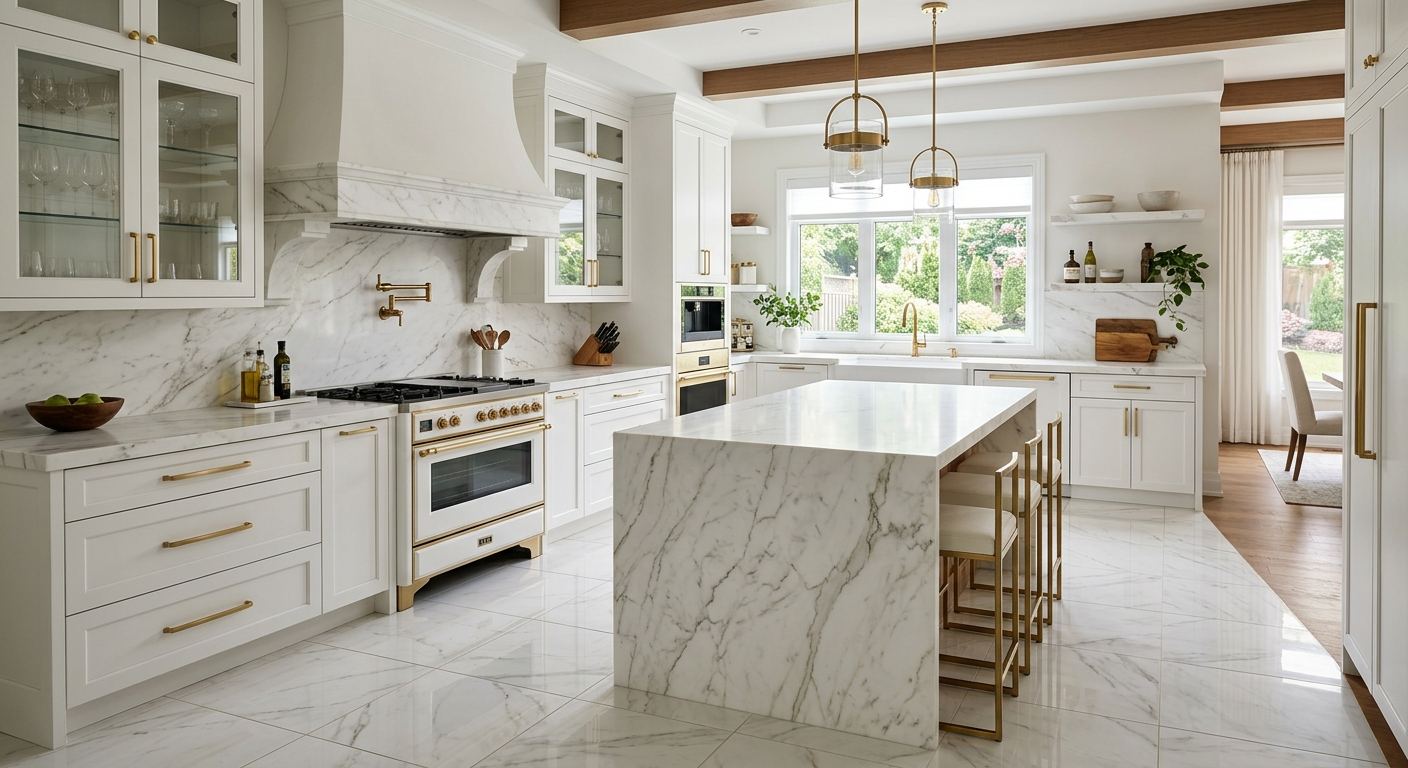
Kitchen renovation options and costs in Hockaday
In Hockaday, your kitchen renovation cost is usually decided less by weather and more by the finish level buyers expect for the Lower Mainland–Southwest market. With a local population of 10,373 (Statistics Canada, 2021 Census), Hockaday sits in a region where homeowners often plan renovations around resale timing and how a kitchen photographs and functions. Across the Lower Mainland, kitchens are also influenced by the broader housing economy—when neighbourhoods skew toward higher home values, projects commonly move up a tier faster, with quartz or stone counters and semi-custom cabinetry becoming the default rather than the “upgrade.” (Statistics Canada, 2021 Census)
Climate still matters here, but mostly in second-order ways: British Columbia’s damp shoulder seasons can stress certain materials if they’re installed over poor ventilation or if water management details are missed. The bigger cost driver is contractor availability and trade stacking. During busier renovation months, cabinet lead times and counter templating windows can compress schedules, which nudges labour and site coordination costs upward—even when the materials are the same.
In Hockaday, trade demand tends to concentrate around established residential pockets close to the core services, where contractors get repeat work for renovations and resale refreshes. If you’re comparing options, the fastest way is to map your needs into a tier—starting with a cosmetic refresh, then deciding whether you need a full mid-range renovation or a higher-end rebuild with an island.
Use the table below to compare realistic scopes and durations before you request itemised quotes.
| Renovation Tier |
What's Included |
Typical Duration |
Price Range |
| Cosmetic refresh (paint, hardware, new appliances only) |
Cabinet paint or touch-ups, new hardware, new/like-for-like appliances, minor caulking and trim, basic deep clean |
1–2 weeks |
$8,000–$25,000 |
| Mid-range full renovation (new cabinets, counters, sink, tile) |
New semi-custom or stock cabinets, new counters, sink and faucet, backsplash tile, plumbing hook-up, under-cabinet lighting (typical), flooring touch-up or partial replacement |
4–8 weeks |
$40,000–$85,000 |
| High-end full renovation (custom cabinets, stone counters, island) |
Fully custom cabinetry, premium stone or engineered stone, island (base + countertop), upgraded hardware, more complex lighting, more extensive tile and flooring replacement, coordination for layout + utility changes |
8–16 weeks |
$85,000–$120,000 |
| Cabinet refacing only (new doors + drawer fronts, same boxes) |
Door and drawer front replacement, new hardware, upgraded panels and edging where needed, surface prep and install; counters unchanged |
2–5 weeks |
$8,000–$28,000 |
| Countertop swap only (laminate to quartz or stone) |
Remove existing top, template and fabrication, install new quartz/stone, re-seat sink and faucet connections as required (no major plumbing relocation) |
1–2 weeks (plus lead time for templating/fabrication) |
$12,000–$35,000 |
| Backsplash tile installation only |
Tile supply and install, wall prep and backer board as needed, grout/seal where applicable, cleanup |
4–7 days |
$1,500–$6,000 |
Prices are estimates only and vary by project scope, site access and material selection.
What affects the price of kitchen renovation in Hockaday
In the Lower Mainland–Southwest and across British Columbia, the same kitchen renovation can land 30–50% apart between two quotes because the scope isn’t truly identical—one contractor is pricing “like-for-like,” while another is accounting for hidden conditions (old venting, outdated rough-in plumbing, subfloor dips) and higher-tier finish selections. In this region, local home values and income levels strongly influence what homeowners choose: in higher-value areas, quartz or stone counters and semi-custom cabinetry are common because the renovation cost is easier to recover on resale. In more modest scopes, laminate and stock cabinets dominate because they deliver practical ROI without moving too many trades at once.
In Hockaday specifically, layout changes are where surprises usually start. Removing a wall, adding an island, or relocating a gas line can create a cascade—carpentry, electrical, plumbing/gas trades, and permit handling. Even if your materials budget stays in the $40,000–$85,000 mid-range renovation band, moving a utility often pushes you toward the higher end of labour and coordination costs.
Here are a few concrete local examples we see: (1) Older Hockaday homes sometimes have dated under-slab or back-wall plumbing routes, so sink swaps can require additional patching and rework even when the cabinet footprint doesn’t change. (2) If your backsplash needs full-height treatment behind a range or along a steam-prone prep wall, tile prep and waterproofing details add cost quickly. (3) If your renovation timeline hits peak season, cabinet lead times can extend the site schedule, increasing labour overhead even with the same cabinet tier.
The takeaway: finish upgrades matter, but layout and trade scope are typically the deciding factors—especially if you’re transitioning from a cosmetic refresh into a full renovation.
| Price Factor |
Why It Matters |
Cost Impact |
| Cabinet tier — stock vs. semi-custom vs. fully custom millwork |
Tier changes material cost, build time, and how well the cabinets fit awkward walls and ceilings common in older homes |
$8,000–$45,000 |
| Countertop material — laminate vs. quartz vs. granite vs. stone |
Material density, edge profiles, and fabrication complexity drive price; stone also increases templating precision requirements |
$3,000–$12,000 |
| Layout change — wall removal, island add, plumbing/gas move |
Triggers multiple trades, potential permits, and demolition/patching of ceilings and floors |
$8,000–$35,000 |
| Appliance package tier — builder vs. mid-range vs. pro-grade |
Electrical requirements, ventilation, and trim kit compatibility change install labour and materials |
$2,500–$15,000 |
| Flooring — refinish existing vs. full replacement |
Kitchens often require partial removal; matching existing flooring can be difficult and drive waste |
$1,500–$8,500 |
| Backsplash — ceramic tile vs. marble vs. full-height slab |
Stone and full-height installs require more prep, alignment checks, and sealing |
$1,500–$6,000 |
| Electrical — new circuits for island, under-cabinet lighting |
New circuits require licensed electrical work, routing, and potential panel capacity checks |
$1,000–$7,500 |
| Permit fees and licensed trade requirements |
Work that changes plumbing, gas, load-bearing structure, or electrical often requires permits and inspections |
$500–$5,500 |
Permits & regulations in British Columbia
In British Columbia, a straightforward cabinet and countertop swap usually does not require a permit: replacing existing countertops, reinstalling fixtures where locations don’t change, and installing new cabinet faces/boxes are typically treated as finishing work. However, if you’re changing the function or route of services, you may be in permit territory.
Work that typically does require a permit and licensed trades includes moving plumbing supply or drain lines, relocating a gas stove or gas-fired range components (including gas-related work for range/hood hookups), removing a load-bearing wall or structural support, and adding new electrical circuits (for an island, dedicated outlets, or new under-cabinet lighting that requires new wiring). Gas work must be completed by a licensed gas fitter, and electrical work by a licensed electrician—both should be inspected as required.
Step-by-step for a Hockaday homeowner: (1) Ask your contractor what permit(s) are required and who pulls them; (2) confirm they carry liability insurance and provide a certificate of insurance; (3) request proof of their trade licence (and any required coverage documentation). You can verify credentials using the applicable online registry for trade status, and you should also see a clearance letter or insurance documentation tied to the work scope; (4) keep the written contract clear about permit responsibility, inspection scheduling, and how changes are handled if inspections identify issues.
Cabinets, countertops and layout decisions in Hockaday
When planning a kitchen renovation in Hockaday, three choices usually determine 80% of the final cost and the long-term satisfaction: (1) cabinet tier, (2) countertop material, and (3) layout changes. First, cabinet tier: stock cabinets are the fastest and cheapest, semi-custom is the most popular mid-range option for typical Lower Mainland–Southwest homes, and custom cabinets offer the best fit for uneven walls/ceilings but usually cost the most. Second, countertop material: laminate is budget-friendly and easy to upgrade later; quartz is a strong “set-and-forget” choice for durability and stain resistance; granite/stone adds natural character but requires the right sealing and care. Marble is beautiful but is more demanding in a busy kitchen.
Third, layout: open-concept wall removal or adding an island can be justified when it improves circulation and storage—especially if your current layout has dead corners or poor work zones. But moving plumbing or gas is where budgets frequently jump, even if you don’t “feel” like you changed the look.
Here’s a realistic dollar example: if you’re choosing between laminate and quartz for a typical mid-range kitchen, the countertop upgrade alone can move you into an “upper mid-range” total—often worth it for resale appeal in the Lower Mainland–Southwest. For many homeowners starting around the $40,000–$85,000 mid-range band, a quartz upgrade plus minor refinements can still fit, while adding an island with plumbing/gas relocation commonly pushes the project toward the $85,000–$120,000 high-end range due to additional trades, patching, and coordination.
In British Columbia’s coastal climate, the practical tip is simple: plan water management and ventilation details around sinks, dishwashers, and backsplash transitions. Good installation prevents moisture-related swelling that can undermine cabinet finishes over time.
| Option |
Durability |
Maintenance |
Best For |
Price Range |
| Stock cabinets (big-box) |
Solid for standard layouts; can be challenged by out-of-square walls |
Low; keep hardware aligned and clean |
Budget refreshes and quick turnarounds |
$8,000–$22,000 |
| Semi-custom cabinets (local dealer) |
Good build quality; better adjustment options for Canadian framing variances |
Low; wipe-down and periodic hardware checks |
Most Hockaday mid-range full renovations |
$20,000–$45,000 |
| Custom cabinets (local millwork shop) |
Highest fit and finish; best for unusual dimensions |
Low; premium materials often resist everyday wear well |
Design-led kitchens and complex storage layouts |
$35,000–$70,000 |
| Laminate countertop |
Resists daily wear but can be vulnerable at seams/edges if abused |
Easy; avoid prolonged heat exposure and wet standing water at seams |
Cost-conscious updates |
$3,000–$6,500 |
| Quartz engineered countertop |
Highly durable and consistent; great for heavy daily use |
Low; typically minimal sealing compared with natural stone |
Busy families wanting a premium look without high upkeep |
$6,500–$12,000 |
| Granite / natural stone countertop |
Very durable; variation gives a “one-of-a-kind” look |
Moderate; depends on stone type and seal maintenance |
Premium finish seekers comfortable with care |
$7,500–$14,000 |
| Butcher block countertop |
Durable when maintained; susceptible to deep staining if neglected |
Higher upkeep; regular oiling and careful moisture control |
Warm, casual styles and light-to-moderate use |
$5,500–$10,000 |
| Marble countertop |
Beautiful but more prone to etching/staining in everyday use |
Higher; needs disciplined cleaning and protection |
Design-forward kitchens with lower “mess” exposure |
$10,000–$18,000 |
How to choose a kitchen renovation contractor in Hockaday
Start by verifying British Columbia licensing and coverage. For gas-related work, confirm the contractor uses (or directly employs) a licensed gas fitter; for electrical, confirm a licensed electrician is involved. Ask for their licence information and, more importantly, their certificate of insurance (liability) for the renovation scope. For workplace coverage, request proof of WCB/WSIB coverage status (as applicable) before work starts—don’t accept “we’ll take care of it” without documentation.
Next, get 2–3 itemised written quotes that separate labour and materials (cabinet supply, countertop fabrication/install, tile, electrical, plumbing/gas, demolition, disposal, and any permit work). Avoid lump-sum quotes that don’t break down line items; in Hockaday, the most common disputes come from exclusions like cabinet removal, subfloor repair, or changes to electrical routing after discovery of wiring access issues. Read your contract for who pulls permits, who pays permit fees, and what the contractor includes for waste disposal and site protection.
For warranty, ask: how long is the workmanship warranty, what product/manufacturer warranties apply to cabinets/counters/appliances, and are those warranties transferable if you sell the home. For payment schedule, never pay more than 10–15% upfront; structure progress payments with holdback until completion and punch-list items are addressed. Finally, insist on a written start date and an end-date estimate that accounts for cabinet and countertop lead times—otherwise you can end up paying carrying costs while your kitchen is unfinished.
- Request a licence/coverage checklist before signing.
- Confirm who is pulling permits and who is responsible for inspection bookings.
- Ask for an itemised labour/material breakdown, not a single total.
- Verify demolition and disposal are explicitly included.
- Confirm electrical scope in writing (new circuits? lighting? outlets for fridge/microwave?).
- Confirm plumbing scope in writing (sink connections, shutoffs, faucet compatibility).
- Ask how they handle unexpected subfloor/drywall issues.
- Check the cabinet warranty and whether door/drawer adjustments are included.
- Confirm countertop templating responsibility and what triggers re-fabrication costs.
- Clarify backsplash scope (tile depth, niche work, caulking/trim details).
- Review payment schedule and keep a holdback until punch list completion.
- Ensure schedule includes lead times for cabinets and stone/quartz fabrication.
Red flags to watch for in Hockaday: (1) they refuse to provide insurance/coverage documents, (2) they quote a full remodel without itemising electrical/plumbing/gas or permit scope, (3) they start without confirming lead times for cabinets and counters, (4) they demand a large upfront payment, and (5) their contract is vague about warranty and exclusions (especially disposal, patch/paint, and unforeseen framing corrections).
Frequently asked questions — kitchen renovation in Hockaday
How do I know if I need to update my kitchen plumbing in Hockaday?
In Hockaday and across British Columbia, you don’t always need full plumbing replacement, but you should plan updates when you see active leaks, slow drains, repeated disposal/supply failures, or outdated shutoffs that can’t be replaced safely. During a quote, ask the contractor to inspect under-sink components, the dishwasher connection, and the visible portion of drain lines and supply stops. If you’re moving a sink position or upgrading to a different dishwasher model, minor rework often becomes necessary. Also, when you add an island or relocate plumbing/gas lines, the risk of hidden routing complications rises—so budgeting within the mid-range renovation band (often $40,000–$85,000) is smarter than assuming “countertops only.” Climate-wise, British Columbia’s damp seasons can worsen minor sealing issues, so correct shutoff placement and leak-proof connections matter.
What is the difference between a galley and open-concept kitchen?
A galley kitchen is a narrow layout with two parallel runs of cabinetry and counters—great for efficiency, but limited for seating and “flow” when multiple people are working. An open-concept kitchen removes barriers (often walls) to connect the kitchen to dining/living space, which usually changes the lighting plan, ventilation expectations, and sometimes the floor plan. In Hockaday, many homeowners choose open-concept for resale appeal because it photographs well and feels more spacious, but it’s not always the cheapest path: if a wall removal involves load-bearing considerations or additional electrical/plumbing coordination, costs can climb quickly. If you’re staying closer to a cosmetic refresh, you may preserve a galley. If you’re planning a full renovation into the $85,000–$120,000 range, open-concept becomes more feasible—especially with a well-designed island.
How do I get accurate kitchen renovation quotes in Hockaday?
To get accurate quotes in Hockaday, insist on itemised, line-by-line pricing and a clear scope document. Ask for separate amounts for cabinets, countertops, tile/backsplash, plumbing work (and whether you’re changing supply/drain routes), electrical work (including any new circuits for an island or lighting), and disposal/demolition. Provide your measurements and, if possible, photos of the existing conditions—especially the area behind the range hood, under-sink cabinetry, and any older wiring or plumbing. Also ask whether permits are included and who pulls them, because that changes both the timeline and cost. A realistic approach is to request 2–3 quotes and compare apples-to-apples: if one quote is $40,000–$85,000 and another is higher, confirm whether one includes layout changes, new flooring, or licensed-trade upgrades. Finally, lock in a written schedule that accounts for countertop templating and cabinet lead times.
What's the best countertop material for a busy Hockaday kitchen?
For most busy kitchens in Hockaday, quartz is the safest “best overall” choice: it’s durable, typically low maintenance, and resists staining better than many alternatives with everyday use. Laminate can work well for a budget refresh, but it’s more sensitive at seams and edges, and it may not deliver the same long-term confidence when you’re cooking daily and cleaning frequently. Natural stones like granite can be excellent too, offering unique character, but you should plan for ongoing care depending on the stone type. Marble is stunning, yet it’s more prone to etching and staining, so it’s usually best where the kitchen is used less intensely. If your overall renovation is targeting the $40,000–$85,000 mid-range band, quartz often delivers the best balance of appearance and durability without pushing into the higher-end cost of premium stone plus custom millwork.
How do I add an island to my Hockaday kitchen?
Adding an island is usually a three-part plan: layout, services, and cabinetry/counter fabrication. First, confirm clearances for circulation (so doors and drawers don’t fight each other). Next, decide whether the island will be purely storage/food prep or if it needs plumbing or gas. If you move a sink, dishwasher lines, or gas appliances, that triggers more complex trade work and can require permits and licensed trades in British Columbia. Then, align your electrical needs: many homeowners add outlets and under-cabinet lighting, which often means new circuits. Pricing varies widely: if the island is mostly “no plumbing/gas change,” it can fit into mid-range projects. If you’re adding an island and relocating plumbing/gas, budgets typically rise toward the high-end renovation band (often $85,000–$120,000) due to demolition, patching, inspections, and coordination. Ask your contractor to show a services plan before demolition begins.
How much does a kitchen renovation cost in Hockaday?
Kitchen renovation pricing in Hockaday generally follows the regional British Columbia pattern where material tier and layout complexity matter more than climate alone. For a cosmetic refresh (paint, hardware, and new appliances only), many projects land around $8,000–$25,000. A mid-range full renovation with new cabinets, counters, a sink, and tile typically falls around $40,000–$85,000. If you’re aiming for a high-end rebuild with custom cabinetry, stone counters, and an island, projects commonly reach $85,000–$120,000. Countertop swap only usually fits in the $12,000–$35,000 range depending on material and sink changes, and backsplash tile installation alone can be $1,500–$6,000. If you’re budgeting, plan a contingency for layout changes (moving plumbing/gas, adding circuits) because that’s where the cost variability shows up most.