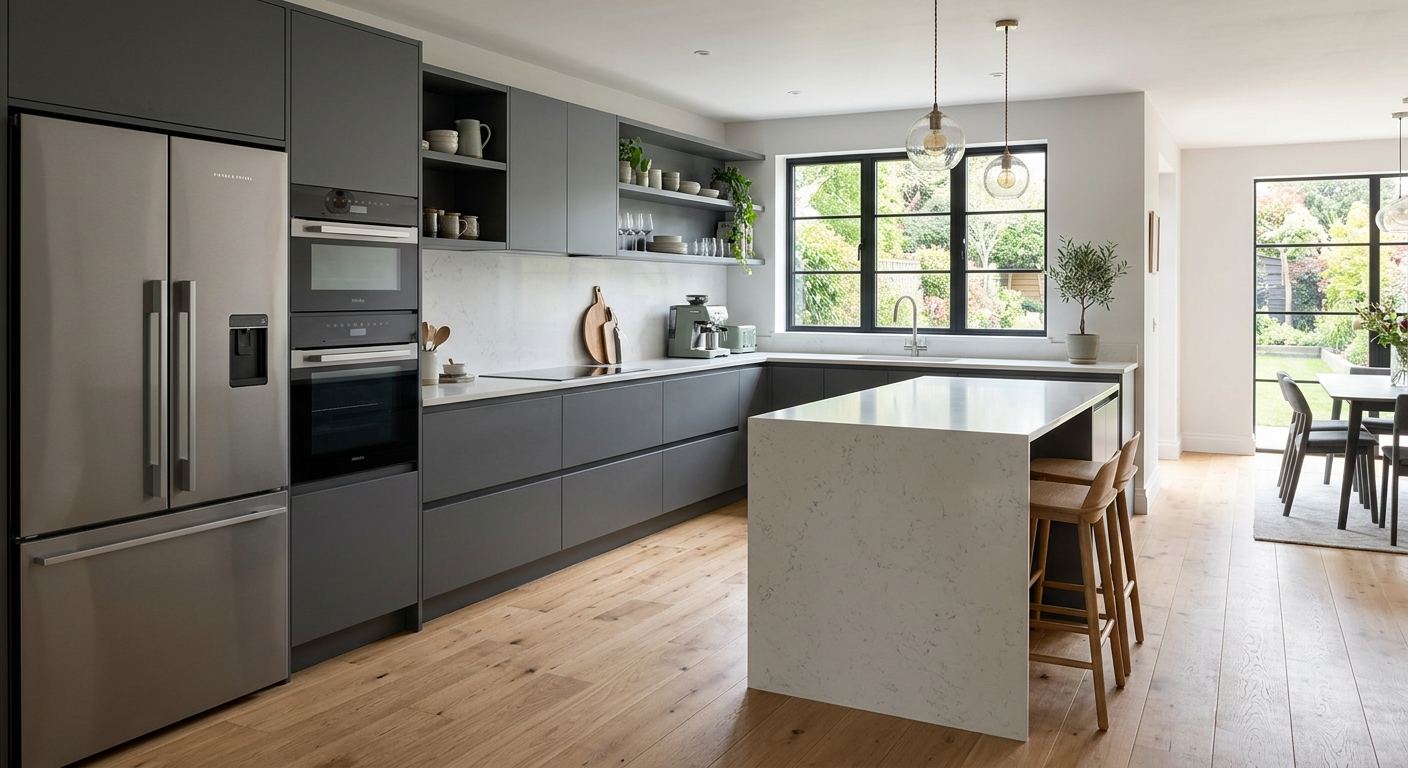
Kitchen renovation options and costs in 100 Mile House
Kitchen renovations are common in 100 Mile House, and the pricing usually starts with your finish expectations and how custom you want the kitchen to feel. With a local population of 1,980 (Statistics Canada, 2021 Census), the town has fewer contractors than larger centres, so scheduling and trade availability can influence timelines and labour rates. At the same time, British Columbia buyers in Cariboo tend to reward practical upgrades—especially where your kitchen supports day-to-day storage and resale appeal—so homeowners often target an “easy-to-market” look rather than extreme custom work. In Cariboo’s lower- and mid-value housing context, many projects land in laminate and stock cabinet territory, while higher-end renovations (often in neighbourhoods with more resale pressure and larger homes) move toward quartz and custom cabinetry.
Climate plays a supporting role rather than driving the main costs. In 100 Mile House, winter humidity swings and cold exterior temperatures can affect drying times for paints, adhesives, and flooring installs, and it can slow down workmanship if ventilation and subfloor moisture aren’t managed. More importantly, the cabinet package and countertop choice drive the bulk of the budget, and labour availability follows demand around busier seasons.
One area that typically sees strong kitchen-renovation trade demand is the hub around downtown 100 Mile House and the surrounding residential corridors, where turnover and resale refresh cycles are frequent. If you’re comparing options, the table below gives you a realistic planning range for common renovation tiers.
| Renovation Tier |
What's Included |
Typical Duration |
Price Range |
| Cosmetic refresh (paint, hardware, new appliances only) |
Cabinet paint or re-finish, new pulls/knobs, minor patching, appliance swaps (no plumbing or gas moves), basic cleaning and touch-ups |
3–7 days |
$3,500–$9,500 |
| Mid-range full renovation (new cabinets, counters, sink, tile) |
Stock/semi-custom cabinets, new counters, sink + faucet swap, backsplash tile, flooring patch/allowance, countertop and cabinet install, basic electrical touch-ups |
3–5 weeks |
$28,000–$62,000 |
| High-end full renovation (custom cabinets, stone counters, island) |
Fully custom cabinetry or premium semi-custom, quartz/natural stone, island build, higher-end backsplash (including slab features), upgraded lighting/electrical for island, sink + possible plumbing relocation |
6–10 weeks |
$62,000–$95,000 |
| Cabinet refacing only (new doors + drawer fronts, same boxes) |
Door and drawer front replacement, new end panels as needed, new hardware, lighting allowances (if wiring is already present) |
1–3 weeks |
$5,000–$22,000 |
| Countertop swap only (laminate to quartz or stone) |
Remove existing counters, install new quartz/stone, new undermount sink allowance (if compatible), backsplash/top transition adjustments |
4–10 days |
$8,000–$14,000 |
| Backsplash tile installation only |
Demo and disposal (if needed), tile supply allowance, layout/setting, grout and caulking, sealing where required |
3–7 days |
$1,500–$9,000 |
Prices are estimates only and vary by project scope, site access and material selection.
What affects the price of kitchen renovation in 100 Mile House
You can see the same “new kitchen” described by two different contractors in Cariboo with quotes that differ by 30–50%, even when the photos look similar. In practice, the variation usually comes from how each company prices labour productivity (schedule speed, trade coordination) and how they account for hidden conditions. Across British Columbia, local home values and household purchasing patterns determine whether most homeowners choose stock/laminate packages or premium stone and custom millwork. In higher-value pockets, homeowners are more likely to choose quartz or natural stone and semi-custom cabinetry because the upgrade cost can be recouped on resale. In more modest markets, laminate counters and stock cabinets dominate because they deliver a “clean and updated” look at a better ROI.
Layout changes are where uncertainty spikes regardless of finish level. Examples: removing a wall (structure + permits + engineering), adding an island (framing, electrical, and ventilation considerations), or moving plumbing/gas lines (cutting, patching, inspections, and extra material). In 100 Mile House, older housing stock often means the existing rough-in may not line up neatly with today’s standard cabinet sizes, so you might see additional framing and rework.
Concrete cost drivers you’ll notice locally: first, late-season cold and moisture can extend drying/curing times for adhesives and coatings, pushing trades to work more days and increasing overhead. Second, if your kitchen has limited access (tight hallways or steep driveways), transport and installation logistics for countertops can add labour. Finally, if you’re choosing mid-range full renovations in the $28,000–$62,000 band versus higher-end builds nearer the $62,000–$95,000 band, the cabinet tier and countertop material are typically the biggest swing factors—not the weather alone.
| Price Factor |
Why It Matters |
Cost Impact |
| Cabinet tier — stock vs. semi-custom vs. fully custom millwork |
Cabinet construction level changes pricing, lead times, and fitting complexity |
~$8,000–$45,000 swing depending on tier and design |
| Countertop material — laminate vs. quartz vs. granite vs. stone |
Material cost, edge profiles, and fabrication hours drive installation totals |
~$3,000–$14,000 or more for premium stone/top configurations |
| Layout change — wall removal, island add, plumbing/gas move |
Structural work, re-framing, inspections, and trades coordination add cost |
~$5,000–$25,000+ depending on what gets moved |
| Appliance package tier — builder vs. mid-range vs. pro-grade |
Higher-end appliances often need tighter clearances and more electrical/venting effort |
~$1,500–$12,000+ difference across the same kitchen footprint |
| Flooring — refinish existing vs. full replacement |
Matching existing flooring or pulling and replacing affects labour and transition detailing |
~$0–$6,000+ impact based on demolition and replacement scope |
| Backsplash — ceramic tile vs. marble vs. full-height slab |
Labour intensity rises with stone, larger format tiles, and height requirements |
~$1,500–$9,000 or more |
| Electrical — new circuits for island, under-cabinet lighting |
Permits, licensed trades, and patching/rewiring can add significant time |
~$500–$5,500+ depending on circuits and fixtures |
| Permit fees and licensed trade requirements |
Any permitted scope changes scheduling, inspection steps, and documentation |
Often ~a few hundred to several thousand dollars depending on scope |
Permits & regulations in British Columbia
In British Columbia, many kitchen updates can be done without a permit. Typical examples that usually do not require a permit include: repainting cabinets, swapping cabinet doors/fronts for a refacing job, replacing countertops that don’t involve moving plumbing or gas, installing a backsplash tile (as finish work), and changing appliances where the existing hookups remain untouched.
Where permits and licensed trades do come in is when you change the systems. If you move plumbing supply or drain lines, add or relocate electrical circuits (for example, new island outlets or under-cabinet lighting if wiring is added), or remove a load-bearing wall, you should plan for permits and inspections. Gas is the most tightly regulated: if you relocate a stove/range or make changes involving gas piping or a gas range hood, a licensed gas fitter must do the work, followed by inspection where required.
For a homeowner in 100 Mile House, verify before signing:
- Licence: ask for trade number details and confirm through the provincial online registry for the electrician and gasfitter.
- Insurance: request a certificate of insurance showing liability coverage.
- Coverage: confirm WCB/WSIB coverage (or the applicable worker coverage evidence) for the crew and subcontractors.
- Scope responsibility: ensure the contractor’s written contract states who pulls permits, schedules inspections, and covers trade compliance.
Cabinets, countertops and layout decisions in 100 Mile House
In a 100 Mile House kitchen renovation, the three decisions that most strongly shape both comfort and cost are: (1) cabinet tier, (2) countertop material, and (3) layout changes. Start with cabinetry because it drives the overall “look” and usually becomes the largest budget swing. Stock cabinets are the fastest and cheapest because they’re designed around standard sizes and lead times. Semi-custom is the most popular mid-range choice locally since it balances options (door styles, better internal organization, some sizing flexibility) with a predictable budget. Custom cabinets cost more, but they’re worth it when your kitchen has awkward alcoves, specific storage needs, or you want a precise fit that improves the day-to-day usability buyers notice.
Next, choose countertops for durability and realistic maintenance. Laminate is budget-friendly and forgiving during installation, but it can wear at seams and edges over time. Quartz is a common upgrade for resale-minded homeowners because it resists staining and is straightforward to maintain. Natural stone (granite/other stone) offers unique patterning, but it may require periodic care depending on the product. Butcher block adds warmth and is great for homeowners who love a more “workbench” feel—just know it demands regular sealing and can be impacted by moisture swings.
Finally, layout changes are where costs can jump quickly, even if finishes stay mid-range. Adding an island or relocating plumbing/gas is often justified only when the space gain improves traffic flow and storage—especially in older homes where the original layout can feel tight. For example, if you keep a cabinet-and-counter mid-range plan in the $28,000–$62,000 range but add an island that requires electrical and ventilation coordination, it can push the project toward the higher end of that band. If you want to keep costs controlled while still upgrading, a countertop swap or backsplash update pairs well with existing layout constraints.
| Option |
Durability |
Maintenance |
Best For |
Price Range |
| Stock cabinets (big-box) |
Good day-to-day durability; depends on hinge quality and build grade |
Low; focus on using proper cleaners and tightening hardware as needed |
Budget-conscious refreshes and faster turnarounds |
$12,000–$22,000 |
| Semi-custom cabinets (local dealer) |
Very good durability with improved internal organization and options |
Low; same care as stock but with more hardware upgrades |
Most 100 Mile House renovations aiming for resale-ready finishes |
$18,000–$35,000 |
| Custom cabinets (local millwork shop) |
Excellent durability; tailored joinery and fit |
Low to moderate; longevity is high but hinges and finishes still need care |
Unique layouts, challenging measurements, and premium upgrades |
$30,000–$55,000+ |
| Laminate countertop |
Moderate; can chip at edges if bumped and wear at seams over time |
Low; avoid standing water at seams and protect cutting surfaces |
Maximizing budget while still modernizing the look |
$3,000–$7,000 |
| Quartz engineered countertop |
High durability; resistant to staining and everyday impacts |
Low; simple cleaning and wipe-dry habits |
Resale-minded homeowners in British Columbia who want low hassle |
$6,000–$12,000 |
| Granite / natural stone countertop |
High durability; variations by slab and finish |
Moderate; may require periodic sealing depending on the stone |
Natural look and unique veining for a premium finish |
$7,000–$14,000 |
| Butcher block countertop |
Moderate to high with proper care; susceptible to moisture and dents |
Higher; regular sealing/oiling and careful drying in winter |
Warm aesthetic and homeowners who maintain surfaces |
$5,000–$10,000 |
| Marble countertop |
Moderate; more vulnerable to etching from acids and heavier staining |
Moderate to high; sealing and quick spill cleanup are essential |
Showpiece kitchens where appearance matters most |
$8,000–$14,000+ |
How to choose a kitchen renovation contractor in 100 Mile House
Start by verifying British Columbia licensing and coverage the way you’d want a builder to verify yours. For any electrical scope, confirm the work is performed by a licensed electrician. For any gas-related scope, confirm a licensed gas fitter is involved. Ask for a certificate of liability insurance and evidence of worker coverage (WSIB/WCB as applicable) for the crew and subcontractors—then confirm dates and coverage limits.
Next, get 2–3 itemised written quotes instead of a lump sum. You want a line-by-line breakdown for labour and materials: demolition, cabinet supply, countertop fabrication/installation, plumbing and electrical changes, backsplash tile, flooring patching, disposal, and any allowance items. Carefully read what’s excluded (for example, hidden mould removal, subfloor repairs, structural changes, or permit fees if the scope escalates). Confirm whether a permit pull is included in the price or billed separately, and whether disposal is handled (dump fees, hauling, and material sorting).
Warranty and payment terms protect you long after the kitchen looks new. Ask for a workmanship warranty length, and note whether product warranties are direct from the manufacturer and whether they’re transferable. For payments, keep it conservative: never pay more than 10–15% upfront, and use a holdback until the job is complete and deficiencies are corrected. Finally, lock in the timeline: request a start date and a completion estimate in writing, including lead-time assumptions for cabinets and countertops.
- Ask for a written schedule with key milestones (demo, cabinet install, counters template, final trim).
- Confirm how changes are priced (change orders, hourly labour rates, and material markups).
- Require proof of insurance and worker coverage before work begins.
- Check that permits are included when the scope triggers them (electrical, plumbing, gas, structural).
- Verify countertop template date and how delays are handled.
- Confirm who disposes of debris and whether costs are included.
- Look for clear scope boundaries on plumbing tie-ins and appliance hookup responsibility.
- Request details on backsplash: full-height or partial, substrate prep, and grout/caulk specs.
- Ask whether flooring transitions and caulking/finishes are included or billed separately.
- Ensure warranty covers labour for at least the first year and specify what qualifies as a defect.
- Confirm dust control plan for winter conditions and tight indoor spaces.
- Get all exclusions in writing, including hidden rot, uneven walls, and framing correction.
Red flags I see with kitchen renovations in 100 Mile House: quoting without a site visit, refusing to list line items (lumping labour and materials together), vague timelines with no allowance for cabinet/counter lead times, missing permit responsibility in the contract when electrical/plumbing/gas changes are discussed, and asking for large upfront deposits beyond 10–15%.
Frequently asked questions — kitchen renovation in 100 Mile House
Do I need a permit for a kitchen renovation in British Columbia?
In British Columbia, many finish-only updates typically do not require permits—think cabinet paint/refacing, countertop swaps where plumbing and gas aren’t moved, and backsplash tile installation. Permits and licensed trades generally become necessary when you change the “systems”: moving plumbing supply or drain lines, relocating a gas stove/range or making gas-related changes, removing a load-bearing wall, or adding new electrical circuits (for example, extra outlets for an island). In 100 Mile House, it’s common for older homes to need unexpected electrical/plumbing adjustments when standard cabinet sizes don’t align with existing rough-in. Before you sign, confirm in writing who pulls permits, who schedules inspections, and whether licensed trades are included—don’t rely on a verbal “we’ll handle it.”
What's the ROI on a kitchen renovation?
Kitchen renovations are one of the biggest drivers of buyer appeal in British Columbia, but ROI depends heavily on the finish tier and how well the kitchen matches the local resale profile. In lower- and mid-value Cariboo markets, ROI is strongest when you modernize without over-customizing—often pairing semi-custom or stock cabinets with quartz rather than going straight to full custom and premium stone. If your project lands in the $28,000–$62,000 mid-range band, you’re typically spending in a range that buyers can see as “smart and livable” versus “too bespoke.” In contrast, a high-end build in the $62,000–$95,000 band can deliver strong ROI when the layout and storage are genuinely upgraded (like a functional island), but it’s easier to overbuild on a resale-priced home. Your contractor should help you pick upgrades that improve usability first, then finish.
How do I budget for a kitchen renovation?
Budgeting well starts with choosing your tier. For 100 Mile House, a practical framework is: decide whether you’re doing a cosmetic refresh, a mid-range full renovation, or a high-end full renovation, then allocate contingency for surprises. Many projects in the $28,000–$62,000 band include new cabinets, countertops, a sink change, and tile—often with limited layout changes. High-end full renovations nearer the $62,000–$95,000 band typically involve custom or premium cabinetry and stone counters plus additional trades coordination (and sometimes electrical for an island). Also plan for winter realities: cold indoor temperatures can slow down drying/curing for finishes and can add labour days if prep surfaces need extra attention. Ask your contractor for an itemised quote and a line for disposal, any flooring patching, and any electrical/plumbing allowances so you’re not caught by extras.
Can I move my kitchen sink or stove?
Yes, you can move a sink or stove in 100 Mile House, but it’s usually where the scope and cost become least predictable. Moving a sink generally involves rerouting plumbing supply and drain lines, which triggers permitting and licensed plumbing work. Moving a stove can involve electrical (for induction) or—if it’s gas—licensed gas-fitting and careful ventilation considerations for the range hood. Even when finishes are mid-range, the “systems” work can push your kitchen from a predictable plan toward a higher budget tier due to added demolition, patching, and inspection scheduling. If you want to control costs, consider keeping the sink and stove in their current general zones and upgrading cabinets, counters, backsplash, and lighting around them.
What's the most cost-effective kitchen upgrade?
Often, the most cost-effective upgrade is a blend of cabinet refresh + a visible surface update. If your boxes are solid, cabinet refacing can deliver a big visual change without the labour of full demo and rebuild—typical cabinet refacing runs about $5,000–$22,000, depending on door styles and complexity. Pair that with a countertop swap and you can move the kitchen into a “new” look without changing the plumbing or gas lines. A backsplach tile install can also be a strong bang-for-buck when you’re trying to modernize the space—commonly $1,500–$9,000 depending on tile type and height. The biggest caveat: make sure the quote addresses what you’ll do about older walls (flatness, gaps, and caulking lines) so your finish work looks crisp.
Custom vs stock cabinets — is custom worth it?
Custom can be worth it, but it’s rarely the best first choice for every home in 100 Mile House. Stock cabinets are the most economical and fastest because they’re built around standard sizes, so lead times and installation effort are lower. Semi-custom is often the sweet spot when you want better organization, more door style options, and some flexibility without the price of full millwork. Custom cabinets are best when your layout is tricky (odd corners, tall appliance niches, or you need non-standard storage dimensions) or when resale buyers in your price bracket expect a truly tailored look. In practical terms, moving from stock to custom typically increases cabinet costs dramatically, while layouts and plumbing remain the same. If you’re working within the $28,000–$62,000 mid-range band, it’s usually smarter to spend on quartz counters or a well-planned island than to fully custom everything.