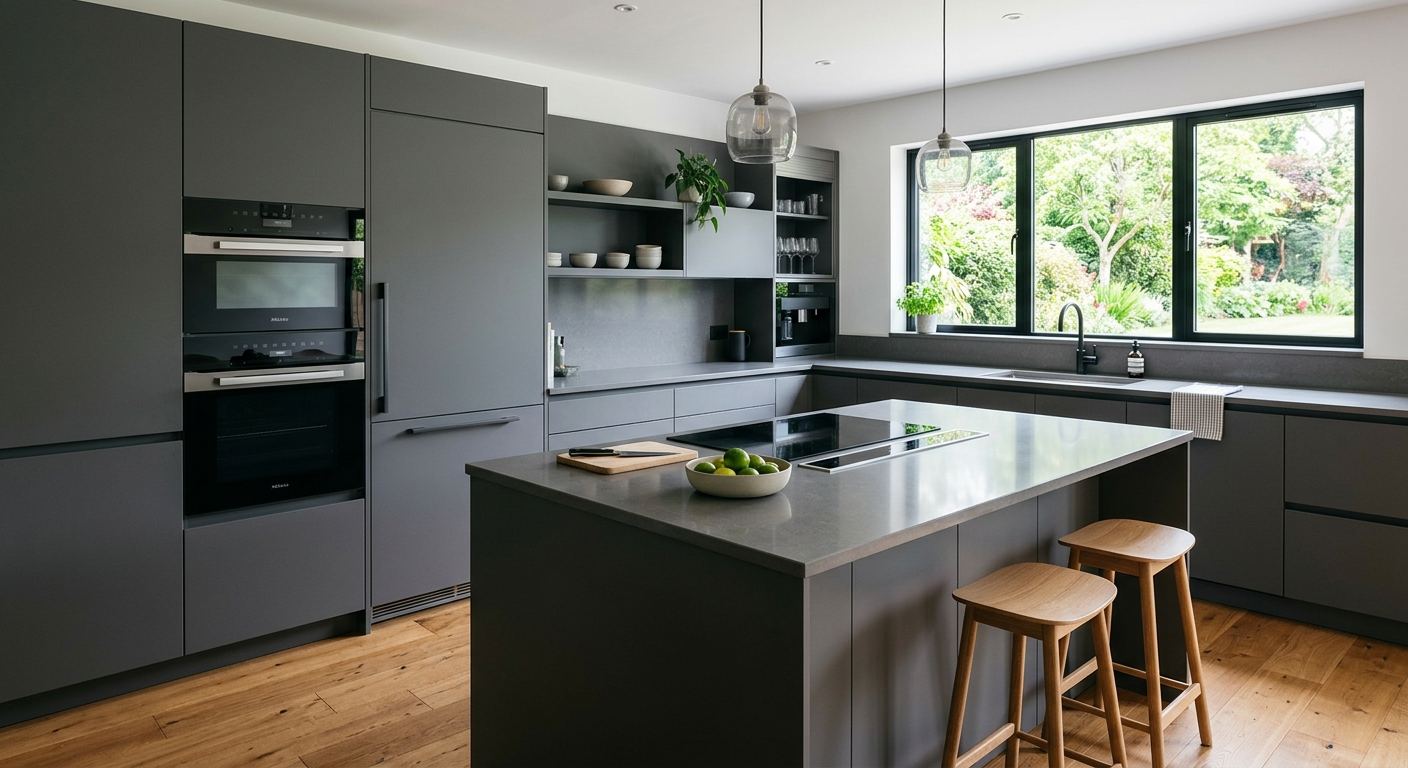
Kitchen renovation options and costs in Langford
Kitchen renovations in Langford are shaped by what buyers in this area expect, and by the choices homeowners make about cabinetry, countertops and layout. With a population of 46,584 in 2021 and a median household income of about $93,000 (Statistics Canada, 2021 Census), many Langford homeowners plan projects with resale in mind—so finishes typically land in the mid-range more often than the absolute lowest “refresh” tier. On Vancouver Island and the Coast, pricing is driven less by climate and more by local home values and finish expectations: coastal humidity and heavy rain don’t directly force higher cabinet costs, but they do influence material selection, ventilation, and how quickly contractors can schedule projects during busy seasons.
In higher-value pockets of Langford—particularly around the growing commercial and residential corridor near Langford Lake / City Centre—homeowners frequently request quartz or natural stone countertops and semi-custom cabinetry, which pushes projects toward the mid-range or high-end bands. Trade availability is also strongest there because contractors can stack work across nearby Saanich, Victoria-area, and Westshore jobs.
Below are realistic cost bands for the three most common approaches: a cosmetic refresh, a full mid-range remodel, and a high-end rebuild-style renovation. Use these as budgeting anchors, then compare quotes by scope (what’s included, what’s excluded, and whether plumbing/electrical moves trigger permit work).
| Renovation Tier |
What's Included |
Typical Duration |
Price Range |
| Cosmetic refresh (paint, hardware, new appliances only) |
Cabinet paint or repaint (doors only where applicable), new hardware, new appliances, touch-up flooring/trim as needed |
1–3 weeks |
$15,000–$35,000 |
| Mid-range full renovation (new cabinets, counters, sink, tile) |
New or semi-custom cabinets, countertop (often quartz), sink + faucet, backsplash tile, updated lighting as needed, re-set flooring/tiling |
4–8 weeks |
$40,000–$85,000 |
| High-end full renovation (custom cabinets, stone counters, island) |
Custom millwork, natural stone (granite/stone slab or premium engineered stone), island build, upgraded backsplash (often higher labour tile/stone), coordinated electrical/plumbing finishes |
8–14+ weeks |
$90,000–$150,000+ |
| Cabinet refacing only (new doors + drawer fronts, same boxes) |
Door/drawer front replacement, new hardware, optional cabinet interior organizers, limited counter/backsplash allowance depending on scope |
2–5 weeks |
$8,000–$35,000 |
| Countertop swap only (laminate to quartz or stone) |
Remove/reinstall counters, seam layout, sink cut-out adjustments as required, basic reseal and minor backsplash touch-ups |
3–10 days |
$3,000–$12,000 |
| Backsplash tile installation only |
Tile supply and install (ceramic/porcelain), prep/leveling, grouting, caulking and edge detailing around outlets |
1–2 weeks |
$2,500–$9,000 |
Prices are estimates only and vary by project scope, site access and material selection.
What affects the price of kitchen renovation in Langford
On Vancouver Island and the Coast, it’s common to see quotes for the “same” kitchen remodel swing by 30–50% across contractors and cities—especially when one proposal quietly includes layout changes, electrical upgrades, or premium millwork while another assumes keep-and-reuse. Even within British Columbia, the biggest drivers tend to be local home values and household income expectations rather than climate. In higher-value markets, homeowners often default to quartz or stone counters and semi-custom cabinetry because the renovation spend is easier to justify on resale; in more modest areas or secondary suites, stock cabinets and laminate or entry-level quartz typically deliver better ROI.
In Langford specifically, you’ll feel the difference in finish expectations because many homes are owner-occupied and renovation planning aligns with buyers’ preferences for durable, cleanable surfaces. About 19.4% of homes in the area were built before 1981 (Statistics Canada, 2021 Census), which matters: older framing and dated rough-ins can mean more labour to straighten walls, address subfloor transitions, or modify plumbing/electrical runs. That “foundation of the finish” work can add cost even if you choose mid-range materials.
Two concrete examples I see in Langford: (1) adding an island usually triggers more cost than people expect because plumbing/drain or gas-routed venting (if applicable) and additional electrical circuits must be planned early; (2) swapping to quartz is often straightforward, but changing the sink location or countertop edge profile can increase template and fabrication time. In most projects, layout choices are the unpredictable variable; the material tier (for example, $40,000–$85,000 mid-range vs. $90,000–$150,000+ high-end) is the predictable budget anchor.
| Price Factor |
Why It Matters |
Cost Impact |
| Cabinet tier — stock vs. semi-custom vs. fully custom millwork |
Different construction methods, hardware, interior options, and finish quality |
Can shift total budget by tens of thousands; cabinets are often 30–40% of the project |
| Countertop material — laminate vs. quartz vs. granite vs. stone |
Material cost, fabrication complexity (seams/edges), and thickness drive labour and waste |
Often a major swing factor; premium stone commonly moves projects into high-end bands |
| Layout change — wall removal, island add, plumbing/gas move |
Triggers structural assessment, new rough-ins, and schedule dependencies across trades |
Usually the largest unpredictable add; can push mid-range into high-end |
| Appliance package tier — builder vs. mid-range vs. pro-grade |
Electrical/gas rough-in needs, ventilation requirements, and trim/fitting complexity |
Moderate to large impact; pro-grade can add meaningfully even with the same layout |
| Flooring — refinish existing vs. full replacement |
Demolition and prep, moisture tolerance, and whether transitions need rework |
Full replacement typically adds cost and extends the schedule |
| Backsplash — ceramic tile vs. marble vs. full-height slab |
Labour intensity, pattern matching, and material weight/handling |
Can move a backsplash-only scope from “basic” to “premium” quickly |
| Electrical — new circuits for island, under-cabinet lighting |
Code-compliant outlets, lighting circuits, and coordination with cabinet installation |
Often a noticeable add; missing allowance is a common reason quotes diverge |
| Permit fees and licensed trade requirements |
Work involving permitted trades costs more to plan and requires inspections |
Can add administrative and inspection time, affecting both cost and timeline |
Permits & regulations in British Columbia
In British Columbia, not every kitchen change needs a permit. A typical countertop swap or cabinet replacement (without moving plumbing, gas, load-bearing walls, or adding wiring beyond what’s already there) is often treated as interior work and generally does not require a building permit. However, if you’re changing the layout—moving sink plumbing supply/drain lines, relocating a gas stove or range hood tied to gas, removing a load-bearing wall, adding new electrical circuits for an island, or adding substantial new ventilation tied to combustion—permits and licensed trades usually come into play.
Here’s the practical way Langford homeowners should think about it:
- Typically no permit: replacing cabinets in the same footprint, swapping countertops in place, installing a new backsplash, and replacing fixtures where supply/drain connections remain unchanged.
- Often requires permits + inspections: moving or extending plumbing/drain lines, relocating gas appliances, adding/relocating electrical circuits (especially under-cabinet lighting, island power, or new dedicated circuits), removing load-bearing walls, and any structural changes.
Before signing, confirm permit responsibility in writing. To verify a contractor’s compliance in Langford, ask for: (1) their liability insurance certificate (COI), (2) proof of worker coverage—WSIB/WCB where applicable, and (3) the specific licence for the trades they’ll perform. For licensed electricians and gas fitters, homeowners can check the online registry tied to the trade, then cross-check the licence number against what appears on the invoice. For added safety, request an up-to-date clearance letter where available and match it to the scope of work.
Cabinets, countertops and layout decisions in Langford
In a Langford kitchen renovation, the three most consequential decisions are: (1) cabinet tier, (2) countertop material, and (3) whether you change the layout. Cabinet tier determines how quickly you can finish and how closely the kitchen fits your space. Stock cabinets are the fastest and typically cheapest; semi-custom is the most popular middle ground because it balances lead time and fit; custom millwork costs more but lets you solve tricky wall conditions and awkward niches common in older homes.
Countertops determine durability and daily maintenance. Laminate is budget-friendly and functional, but it typically wears sooner at seams and edges. Quartz is a strong “busy kitchen” choice because it’s non-porous and resists staining better than many natural options. Granite and other natural stones are premium-looking and durable, but they can require periodic sealing depending on the specific stone and finish. Butcher block brings warmth, yet it needs ongoing oiling and good ventilation practices around cooking—important in coastal Vancouver Island homes where kitchens can run warmer with window insulation changes and exhaust fan upgrades.
Layout changes are where costs become hard to predict. Removing a wall or adding an island usually adds value when it meaningfully improves flow—especially for resale in Langford’s higher-demand pockets near City Centre. Example: if you’re choosing between a mid-range remodel and a high-end build, you might spend part of the budget on a kitchen island and better lighting while staying in a $40,000–$85,000 tier; but if the island requires major plumbing/gas rework plus custom cabinetry and stone, the project often rises toward $90,000–$150,000+.
| Option |
Durability |
Maintenance |
Best For |
Price Range |
| Stock cabinets (big-box) |
Solid for everyday use, but limited design flexibility |
Low; hinges and hardware wear with heavy use |
Fast projects, smaller budgets, straightforward layouts |
$15,000–$40,000 |
| Semi-custom cabinets (local dealer) |
Better materials and options; improved fit for real homes |
Low; easier to tailor interiors for storage |
Most Langford remodels aiming for a durable, resale-friendly look |
$25,000–$65,000 |
| Custom cabinets (local millwork shop) |
Highest build quality; ideal for awkward angles and special storage |
Low to moderate; quality hardware helps longevity |
Owners who want an exact fit and premium finish throughout |
$50,000–$110,000+ |
| Laminate countertop |
Good for light to moderate use; edges can chip over time |
Low; avoid standing water at seams |
Budget-conscious refreshes and rentals/secondary suites |
$3,000–$6,000 |
| Quartz engineered countertop |
Very durable and consistent; resists scratches and staining well |
Low; wipe clean like stone without sealing needs |
Busy family kitchens and resale-focused upgrades |
$5,000–$10,000 |
| Granite / natural stone countertop |
Extremely durable; performance varies by stone and finish |
Moderate; sealing may be required periodically |
Premium look where you’re comfortable with stone care |
$7,000–$12,000 |
| Butcher block countertop |
Durable but can mark; sensitive to heat and water exposure |
Moderate; regular oiling and smart drying habits |
Warm, traditional kitchens with attentive maintenance |
$4,000–$9,000 |
| Marble countertop |
High-end beauty; softer than quartz and can etch |
Higher; sealing and careful cleaning for stains/etching |
Statement kitchens where aesthetics matter most |
$8,000–$15,000+ |
How to choose a kitchen renovation contractor in Langford
Choosing the right contractor in Langford starts with verifying credentials for the work you’re actually doing. In British Columbia, licensing and insurance matter because kitchen scopes commonly involve multiple trades. Ask for: (1) the trade licences relevant to their scope (especially if plumbing/electrical/gas tie-ins are included), (2) liability insurance certificate of coverage (COI) naming you as applicable, and (3) proof of WSIB/WCB coverage where required for their workforce. A reputable crew will provide these documents without pushing back.
Next, get 2–3 itemised written quotes that separate labour and materials instead of using one vague lump sum. You want line items like demo, cabinet install, countertop fabrication/templating, plumbing and electrical allowances, backsplash tile labour, disposal, and any permit-related items. Read the scope carefully: ask whether permits (if required) are pulled by the contractor or you, whether demolition and debris hauling are included, and what’s excluded (under-cabinet lighting, drywall patching, subfloor repairs, water damage remediation, etc.).
Warranty is another area homeowners should not rush. Confirm workmanship warranty length and whether product warranties from manufacturers are included. Ask if warranties are transferable to the next owner—this matters for resale in a market where buyers notice cabinet door quality and countertop installation details.
Finally, payment structure should protect you: never pay more than about 10–15% upfront, and hold back a portion until completion and punch-list signoff. Timeline matters too—require a start date and completion estimate in writing, with dependencies clearly stated (counter fabrication lead times and trade scheduling).
- Use itemised quotes (labour + materials) rather than one “all-in” number.
- Confirm permit responsibility and whether fees/inspections are included if scope triggers them.
- Verify each trade licence relevant to the work (electrician/gas fitter/plumber where applicable).
- Request a current COI and ensure coverage aligns with your project dates.
- Ask for WSIB/WCB coverage proof for their workers.
- Check warranty: workmanship length, what’s excluded, and product/manufacturer warranty details.
- Confirm disposal and haul-away are included (not “by homeowner”).
- Ensure the quote includes electrical allowances for island outlets and under-cabinet lighting if planned.
- Confirm countertop templating timing and who schedules it.
- Ask how they handle hidden damage discovered after demo (water damage, subfloor issues).
- Get a written schedule with key milestones (demo, cabinet set, countertop install, backsplash, final trim).
- Use a payment schedule tied to milestones, not a large deposit.
Red flags I commonly see in Langford are contractors who: (1) won’t itemise materials and labour, (2) ask for a large upfront payment (well beyond 10–15%), (3) avoid discussing permits when plumbing/electrical/gas relocation is in the scope, (4) provide no proof of insurance/coverage, or (5) give only verbal timelines instead of dates in writing.
Frequently asked questions — kitchen renovation in Langford
What’s the most popular kitchen style in Langford right now?
In Langford and the broader Vancouver Island and Coast market, the most requested look is typically a bright, clean “transitional modern” style: simple flat or soft-arched cabinet doors, warm white or greige paint colours, and quartz countertops with subtle veining. Many homeowners also choose a two-tone approach—lighter uppers with warmer lower cabinets—to make the room feel bigger without going fully custom-cost. This style aligns well with the renovation budgets people can realistically carry in owner-occupied homes; for example, you’ll often see homeowners targeting a mid-range remodel around $40,000–$85,000 to get durable surfaces (quartz) plus the cabinetry look buyers expect. If your home is older (pre-1981), contractors also tend to recommend finishing details that visually “hide” minor wall or floor inconsistencies.
How do I know if I need to update my kitchen plumbing in Langford?
Look for signs like frequent leaks under the sink, slow drains, inconsistent hot water, water stains near shut-offs, or corrosion at supply lines—especially if your home is older (about 19.4% of homes were built before 1981, Statistics Canada, 2021 Census). You may also need updates if you’re moving the sink location, adding a dishwasher with a new run, or converting the layout for an island that changes drain paths. Even if you’re not moving fixtures, it’s smart to inspect shut-off valves and supply lines before countertop install; a countertop swap can still expose whether existing plumbing is ready for a long service life. A professional plumber can confirm what’s needed. If your scope stays within basic replacement, permits may not be required, but moving drain/supply lines typically triggers permit and inspection work in British Columbia.
What is the difference between a galley and open-concept kitchen?
A galley kitchen is a narrow layout with counters on opposite sides, usually with a clear walkway down the middle. An open-concept kitchen removes barriers to connect the kitchen to the living/dining space, often by removing a wall and adding sightlines. In Langford, open-concept renos are popular because they modernise the home for how people live today, but they’re also where costs can rise quickly: removing or modifying walls and rerouting plumbing/electrical can move projects toward the higher end of the budget spectrum. If you’re staying in a mid-range band (for example $40,000–$85,000), many homeowners keep the galley footprint and invest in cabinetry and quartz instead. Climate in BC doesn’t directly dictate the layout choice, but ventilation planning (range hood performance) becomes more important when cooking is more visible to living areas.
How do I get accurate kitchen renovation quotes in Langford?
To get accurate quotes, start by making decisions that drive cost: cabinet tier (stock vs. semi-custom vs. custom), countertop material (laminate, quartz, granite/stone), and whether you’re moving the sink, dishwasher, venting, or adding an island. Then request 2–3 itemised quotes with a labour/material breakdown—not a single lump sum—so you can compare apples to apples. Ask each contractor: is plumbing/electrical relocation included or excluded, are permits handled if required, and is disposal/haul-away included? For Langford homeowners, also ask about template lead time for countertops and how long cabinets take to arrive. If you’re budgeting for a smaller scope, a cabinet refacing only project often lands in the $8,000–$35,000 band, while countertop-only upgrades can be in the $3,000–$12,000 range. Clear scope prevents the 30–50% quote swings that happen when one contractor assumes “move nothing” and another assumes “move everything.”
What’s the best countertop material for a busy Langford kitchen?
For most busy Langford kitchens, quartz is the most practical “best overall” choice. It’s durable, resists staining well, and doesn’t require the periodic sealing that some natural stones need—helpful when you want low-maintenance day-to-day care in a coastal climate where kitchens can experience humidity swings. Quartz also offers a wide range of colours and realistic patterns that match today’s resale-friendly finishes. If you want to manage cost, laminate can work for a refresh, but it’s more sensitive at seams and edges over time, especially with heavy use. For a typical countertop-only change, many projects fall in the $3,000–$12,000 band depending on size, thickness, edge profile, and sink modifications. If you’re considering granite or natural stone, budget higher for materials and finishing; it’s beautiful but may require a bit more upkeep depending on the specific stone.
How do I add an island to my Langford kitchen?
Adding an island starts with verifying feasibility: spacing/clearances for walkways, whether you can support floor loads, and how you’ll handle power (outlets), lighting, and ventilation. If the island stays purely as a seating/breakfast area with no plumbing, you may only need electrical work for outlets and pendant lights; adding a sink or dishwasher on the island can require drain/supply line changes. In British Columbia, electrical additions typically need a licensed electrician; moving or extending plumbing and relocating gas (if applicable) typically requires permits and inspection. Budget-wise, island projects can quickly push a mid-range remodel toward the higher end, especially when plumbing/gas rework is involved and you’re aiming for semi-custom or custom cabinets and stone. If your island is part of a full renovation, plan around the mid-range $40,000–$85,000 band, while the “custom + stone + complex rough-ins” scenarios can reach $90,000–$150,000+.