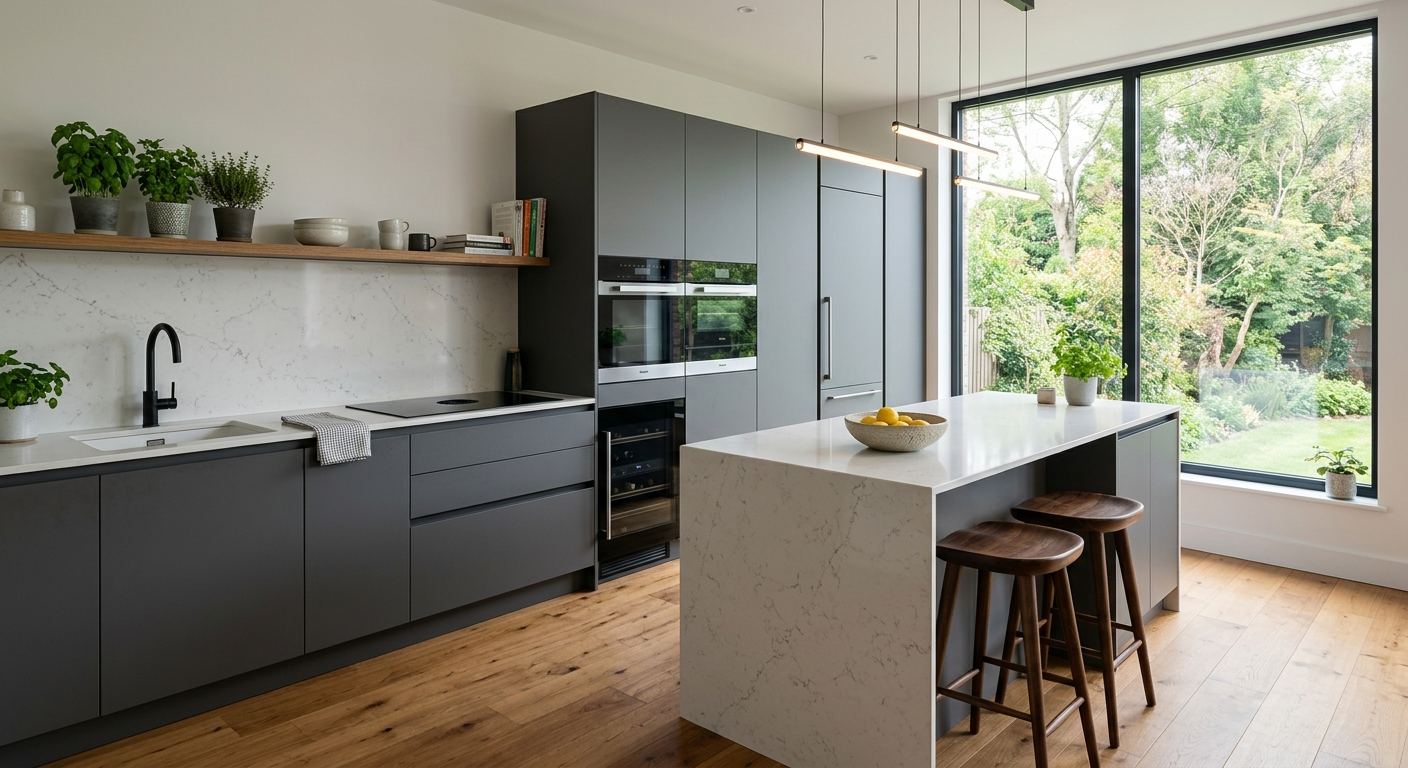
Kitchen renovation options and costs in Historic Downtown
Kitchen renovations in Historic Downtown, British Columbia can range from a simple refresh to a full rebuild, and the cost usually comes down to how owners want the finished look to compare with the local market. With a 2021 population of 9,910 and a neighbourhood mix that includes older, smaller-footprint homes, many homeowners are balancing value-focused upgrades with the need for better storage and day-to-day function (Statistics Canada, 2021 Census). In the Lower Mainland–Southwest, your renovation tier is often chosen more by expected resale payoff than by weather, because finish upgrades (like quartz or semi-custom cabinetry) are widely understood and easy for buyers to compare. That said, Historic Downtown homes are frequently older—so surprises like uneven walls, dated plumbing runs, and subfloor repairs can nudge even “mid-range” jobs upward.
Across the Lower Mainland–Southwest, contractor availability and schedule also affect pricing. The region’s demand tends to concentrate around Vancouver’s denser corridors and nearby trade capacity, so cabinetry and countertop lead times can be longer than in smaller centres. Climate plays a smaller role in cost than materials do: moisture and condensation from older venting can still drive extra prep work, but it rarely changes labour rates the way layout complexity does.
If you’re renovating around the busy shopping and transit corridor near Hastings Street in the Historic Downtown area, trade scheduling and material deliveries are typically in highest demand, so planning matters. Below is a practical comparison of common kitchen renovation options to help you map your scope before you start getting quotes.
| Renovation Tier |
What's Included |
Typical Duration |
Price Range |
| Cosmetic refresh (paint, hardware, new appliances only) |
Cabinet paint or repaint, new hardware, appliance swap, basic caulking/silicone at sink and backsplash edges |
1–3 weeks |
$8,000–$25,000 |
| Mid-range full renovation (new cabinets, counters, sink, tile) |
New semi-custom or quality stock cabinets, new countertop, sink + faucet, backsplash tile, removal/disposal, standard electrical and plumbing set-up if no major moves |
4–8 weeks |
$40,000–$85,000 |
| High-end full renovation (custom cabinets, stone counters, island) |
Custom cabinets/millwork, quartz or stone counters, island build, upgraded hardware, full backsplash (including premium materials), coordinated lighting and detailed trim work |
8–16 weeks |
$85,000–$120,000 |
| Cabinet refacing only (new doors + drawer fronts, same boxes) |
Door/drawer replacement, hardware upgrades, finish refinishing of existing box carcasses, minor adjustment to fit new components |
2–5 weeks |
$8,000–$35,000 |
| Countertop swap only (laminate to quartz or stone) |
Removal of existing countertop, quartz/stone installation, new sink cut-out (if compatible), standard edge profile, sealing and caulking |
1–3 weeks |
$15,000–$55,000 |
| Backsplash tile installation only |
Tile supply and installation, surface prep, thinset/tile setting, grout and caulking at edges; typically excludes cabinet repaint |
5–10 business days |
$1,500–$6,000 |
Prices are estimates only and vary by project scope, site access and material selection.
What affects the price of kitchen renovation in Historic Downtown
In Historic Downtown and across the Lower Mainland–Southwest, the same kitchen can end up with quotes that differ by 30–50% when finish level, cabinetry complexity, and labour sequencing change. The biggest drivers are local home value expectations and the finish tier buyers gravitate toward—not the climate itself. In higher-value Metro Vancouver areas, homeowners often default to quartz or stone counters and semi-custom cabinetry because the cost is easier to recoup on resale; in more modest markets, laminate and stock cabinets dominate because they deliver stronger ROI for the same layout improvements. In a smaller, older building stock like you commonly see in Historic Downtown, hidden patching and prep can push a “refresh” closer to a mid-range rebuild if surfaces and wall conditions aren’t ready.
Layout work is the most unpredictable cost. Removing a wall, adding an island, or moving a gas line tends to create the largest swings regardless of whether you choose laminate or stone. For example, a straightforward mid-range package can fall in the $40,000–$85,000 band, but adding an island with new electrical and plumbing tie-ins can push you toward the higher end of the region’s full reno range (up to $85,000–$120,000) even if cabinets aren’t custom.
Concrete Historic Downtown-style examples that often raise cost: older supply lines that don’t align with modern shutoffs, venting that requires rework for range hoods, and subfloor corrections when cabinets sit on uneven surfaces. Where costs can drop: keeping the sink in the same location and using a like-for-like countertop footprint reduces cutting, sealing, and scheduling complexity.
| Price Factor |
Why It Matters |
Cost Impact |
| Cabinet tier — stock vs. semi-custom vs. fully custom millwork |
Custom lines, interior organizers, and made-to-fit sizing change both material and install labour |
Often shifts total by 15–40% |
| Countertop material — laminate vs. quartz vs. granite vs. stone |
Material price, cutting complexity, edge profiles, and installation support (including lift/fit) vary widely |
Can change countertop scope by several thousand dollars |
| Layout change — wall removal, island add, plumbing/gas move |
These require coordinated trades and can trigger permits, inspections, and re-routing |
Typically the largest swing; commonly adds 10–25%+ |
| Appliance package tier — builder vs. mid-range vs. pro-grade |
Pro-grade units often demand tighter clearances, upgraded electrical requirements, and longer lead times |
Often shifts the budget by 5–20% |
| Flooring — refinish existing vs. full replacement |
Kitchen work can damage flooring; matching existing material can be difficult in older homes |
May add or reduce several thousand dollars |
| Backsplash — ceramic tile vs. marble vs. full-height slab |
Material weight, layout complexity, and cutting around outlets affect labour time |
Ranges from modest to meaningfully higher depending on finish |
| Electrical — new circuits for island, under-cabinet lighting |
New circuits add licensed electrical work, planning, and inspection time |
Can add thousands, especially with island work |
| Permit fees and licensed trade requirements |
Work involving plumbing changes, gas relocation, structural changes, or new electrical circuits needs formal compliance |
Varies by scope; usually increases cost and timeline |
Permits & regulations in British Columbia
In British Columbia, many “face value” kitchen updates don’t require permits—while other changes absolutely do. Swapping cabinets, replacing countertops, and updating surfaces (like painting or re-tiling a backsplash) typically do not require a permit, because the work is considered finish-level replacement. However, once you move beyond surfaces—moving plumbing supply or drain lines, relocating a gas stove, removing a load-bearing wall, or adding new electrical circuits—permits and licensed trades come into play. Gas work related to stoves/ranges and any gas-line relocation must be done by a licensed gas fitter, and electrical changes must be performed by a licensed electrician; both require inspections before you can safely close up walls and move on.
Here’s a homeowner-friendly way to verify the scope. Step 1: ask your contractor to list every task and label it “permit required” vs. “no permit.” Step 2: confirm who is pulling permits in writing—responsibility should be specified in your contract. Step 3: verify licensing and coverage before work begins: request the gas fitter’s licence details (where applicable), the electrician’s licence details, and your contractor’s liability insurance certificate. Step 4: ask for proof of worker coverage (WSIB/WCB) and keep a copy for your records.
Where to look: use the province/registry links for licence verification (search the appropriate trade directory online) and review the certificate of insurance for coverage limits. A clearance letter (when provided for certain coverage scenarios) should match the contractor entity named on your agreement.
Cabinets, countertops and layout decisions in Historic Downtown
The three most consequential decisions in a Historic Downtown kitchen renovation are (1) cabinet tier, (2) countertop material, and (3) whether you change the layout. If you keep your sink and major services in roughly the same spots, you can concentrate budget where it matters most: cabinetry functionality and a countertop surface that fits how you cook and maintain. Historic Downtown kitchens are often in older buildings where walls may not be perfectly level; that makes cabinet fit and shimming more important, and it’s one reason semi-custom is such a popular mid-range choice.
Cabinet tier affects both speed and how cleanly the kitchen will look. Stock cabinets are typically the fastest and cheapest route, while semi-custom balances cost with better sizing and more options for storage. Custom cabinets are highest cost but can be the best choice when you have odd corners, sloped ceilings, or want a built-in fridge/oven wall that reads seamless at resale.
On countertops, laminate is budget-friendly and still works for many homeowners, but quartz offers a big step up in stain resistance and day-to-day practicality—especially around sinks and prep zones. Granite or other natural stones are premium-looking and durable, but they require realistic sealing/maintenance expectations. Marble is the most elegant, but it’s also the most maintenance-heavy option due to softness.
Layout changes are the true cost lever. Removing an open-concept wall or adding an island can justify the expense when it meaningfully improves traffic flow and social space. If you’re not gaining usable workspace or storage, the return can be weak. For instance, upgrading from laminate to quartz on a standard countertop run can be a worthwhile jump, but using that same budget to move plumbing and add an island may quickly push the project toward the high-end band (often $85,000–$120,000) even if cabinet tier stays mid-range.
| Option |
Durability |
Maintenance |
Best For |
Price Range |
| Stock cabinets (big-box) |
Good for straight runs; may show gaps in older, uneven rooms |
Low upkeep; hinges/hardware wear is the main long-term factor |
Fast timelines and budget-led refreshes |
$8,000–$25,000 |
| Semi-custom cabinets (local dealer) |
High day-to-day durability with better sizing and options |
Low upkeep; choose quality hardware for smoother doors/drawers |
Most renovations aiming for strong resale look |
$25,000–$60,000 |
| Custom cabinets (local millwork shop) |
Best fit and finish for irregular spaces; built for your exact layout |
Low upkeep; longevity depends on material selection |
Hard-to-fit layouts and design-led islands/walls |
$60,000–$95,000 |
| Laminate countertop |
Resists normal use; seams can be a weak point if not well installed |
Easy daily cleaning; avoid excessive heat directly on surface |
Value upgrades and rental-to-midrange refresh goals |
$3,000–$7,000 |
| Quartz engineered countertop |
Very durable for stains and everyday wear; consistent look |
Minimal maintenance; wipe-clean convenience |
Busy households who want a low-fuss, premium feel |
$7,000–$12,000 |
| Granite / natural stone countertop |
Hard-wearing and heat tolerant; performance varies by stone |
Usually requires periodic sealing and careful stain management |
Premium look without engineered feel |
$9,000–$15,000 |
| Butcher block countertop |
Durable but can dent; water management matters near sinks |
Requires oiling and gentle care; wipe dry promptly |
Warm, traditional style and cooks who enjoy maintenance |
$6,000–$12,000 |
| Marble countertop |
Beautiful but softer; can etch with acids |
Higher maintenance; requires sealing and careful cleaning habits |
Design-focused kitchens where maintenance is acceptable |
$10,000–$20,000 |
How to choose a kitchen renovation contractor in Historic Downtown
Choosing the right kitchen contractor in Historic Downtown starts with verification. In British Columbia, ask for evidence of trade licensing where required, plus liability insurance and worker coverage (WSIB/WCB). To check: (1) request the contractor’s certificate of insurance and confirm the named insured matches the company on your contract; (2) verify worker coverage documentation for your project; and (3) for any gas or electrical scope, confirm the licensed trade credentials and that inspections are included in the schedule. Don’t rely on verbal assurances—collect copies before work starts.
Then get 2–3 itemised written quotes. A solid quote breaks labour and materials separately (cabinet supply, countertop fabrication/installation, tile labour, demolition/disposal, electrical/plumbing line items) rather than using one lump sum. Read the scope carefully: what’s excluded (light fixtures, under-cabinet lighting, drywall patching beyond the kitchen footprint), who pulls permits, and whether disposal is included in the price. Ask where the countertop measurements are taken and when any templates happen. Finally, confirm warranty terms: workmanship warranty length, who honours it, product/manufacturer warranty details, and whether coverage is transferable if you sell the home.
For payment, keep it controlled. Never pay more than 10–15% upfront, and use a holdback until key milestones are completed. Get start date and completion estimate in writing so you can plan your living situation and coordinate deliveries for cabinets and countertops.
- Confirm licence/coverage documents before signing (insurance certificate + WSIB/WCB/worker coverage).
- Require a detailed scope of work and exclusion list.
- Ask whether disposal (dump fees) is included or billed separately.
- Confirm who pulls permits and whether permit fees are included in the quote.
- Ensure electrical/plumbing scope is clearly itemised (new circuits vs. tie-ins).
- Check that countertop fabrication timing and template dates are on the schedule.
- Request cabinet installation method (shimming/leveling plan) for older walls.
- Verify warranty: workmanship duration and product warranty responsibilities.
- Use milestones tied to inspection-ready completion, not just hours worked.
- Keep a holdback until punch list items are signed off.
- Confirm protection plan for floors, hallways, and adjacent rooms.
- Ask how change orders are priced and capped if materials or labour rates rise.
Red flags I see in Historic Downtown when contractors cut corners: quotes that don’t identify who pulls permits, missing insurance/coverage documents, “all-in” pricing with no exclusions (especially disposal and drywall patching), no written schedule for cabinet/countertop lead times, and warranty terms that are vague or not in the contract.
Frequently asked questions — kitchen renovation in Historic Downtown
Should I reface or replace my cabinets?
If your cabinet boxes are solid and sit level, refacing can be the most budget-smart option because you avoid full demolition and replacement. In Historic Downtown, where older walls and flooring can be slightly out of square, a good contractor will confirm the existing carcasses are structurally sound before recommending refacing. If doors/drawers are dated but the boxes are fine, refacing can often keep you in a cabinet-focused range (for example, refacing scopes commonly land around $8,000–$35,000). Replacement becomes the better choice when boxes are sagging, you need better storage layouts, or you want to correct noticeable gaps. For many homeowners in the Lower Mainland–Southwest resale market, semi-custom replacement is the sweet spot when you’re aiming for a “new kitchen” visual impact.
Do I need a permit for a kitchen renovation in British Columbia?
In British Columbia, finish-only changes—like repainting, cabinet refacing/replacement, and countertop swaps—typically don’t require permits. Permits are usually required when you change systems: moving plumbing supply/drain lines, relocating gas connections for a stove or range, removing a load-bearing wall, or adding new electrical circuits (including island circuits). For Historic Downtown projects, it’s also common to need permits if you’re moving a sink or creating a new island layout with electrical and ventilation updates. Always confirm permit responsibility in your contract and ask your contractor to label each task as “permit required” or “no permit” before work begins. Gas/electrical work must be completed by licensed trades with inspections.
What's the ROI on a kitchen renovation?
ROI depends heavily on finish tier and how much you change the layout. In the Lower Mainland–Southwest, owners often choose quartz/stone and semi-custom cabinetry because buyers expect a modern, durable look, and those upgrades tend to be easier to justify on resale. That said, complex layout changes (new plumbing/gas/electrical routes) are where costs can rise faster than resale value in some cases. A practical way to budget is to aim for a scope that lands in a sensible band—mid-range full renovations often fall around $40,000–$85,000—and avoid unnecessary moves if your existing footprint already works. If you have a poor workflow or lack storage, a well-planned layout can improve daily use and strengthen the sale narrative. Your best ROI usually comes from “visible quality” (cabinets/counters) plus “functional fixes” (storage, lighting) rather than overbuilding.
How do I budget for a kitchen renovation?
Start by selecting your renovation tier, then add a realistic contingency. For Historic Downtown, older homes can need extra patching and levelling, so many homeowners set aside an allowance for “unknowns” once demolition reveals actual wall and subfloor condition. If you want a full renovation, common regional price bands for a complete kitchen are roughly $40,000–$120,000, while cabinet refacing and countertop-only swaps can be much lower depending on scope. Break your budget into: cabinetry package, countertop material and edges, backsplash/tile, labour, permitted trade work (if any), and disposal. Also include lead-time timing—if you order premium stone, you may need a schedule that prevents idle time for trades. Itemised quotes help you see what’s included (permits, disposal, plumbing/electrical changes) so you aren’t surprised mid-project.
Can I move my kitchen sink or stove?
Yes, but moving plumbing (sink) or gas (stove/range) is where approvals, trades, and cost uncertainty stack up. In British Columbia, relocating a sink typically involves moving drain and supply lines—often requiring permits and licensed plumbing work, plus inspection before closing walls. Moving a stove or range gas connection requires a licensed gas fitter and inspection as well. In Historic Downtown, where older layouts can have dated venting or plumbing runs, moving either fixture can uncover misalignments that add time. If you’re trying to control cost, keep the sink in the same general location when possible and consider an island layout only if you can justify electrical/plumbing routing. If the move is essential, ensure your contractor’s quote clearly lists those trade tasks rather than leaving them under “allowances.”
What's the most cost-effective kitchen upgrade?
The most cost-effective upgrade is usually the one that upgrades the “high-visibility surfaces” without triggering major system relocations. For many Historic Downtown homes, that means cabinet hardware and a refresh (paint + hardware + new appliances) when the boxes are already structurally good, or a countertop upgrade paired with a backsplash update if you want a bigger visual change. If your current cabinets are sound, refacing can also be a strong value move, often sitting in the $8,000–$35,000 range depending on size and finish. If your counters are worn or outdated, swapping to quartz is a common “best bang for buck” because it elevates the look and holds up well to day-to-day use. The biggest cost blow-ups usually come from layout changes and service moves—so the best ROI typically avoids moving plumbing/gas unless the new layout truly solves a real workflow problem.