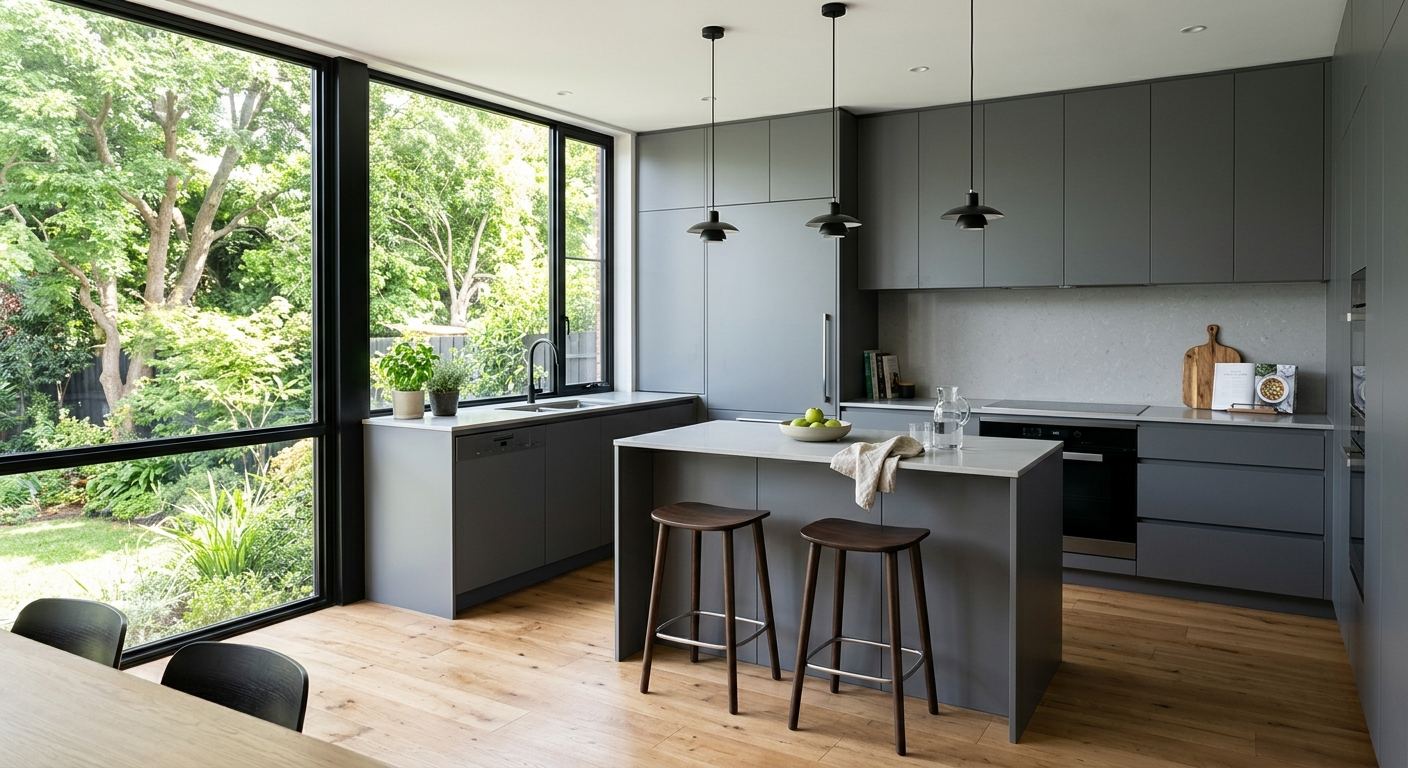
Kitchen renovation options and costs in Canoe
Canoe kitchen renovations tend to start with practical updates, then evolve as homeowners see how modern finishes look with the rest of the home. With only 1,081 residents (Statistics Canada, 2021 Census), Canoe itself is small, so most work is scheduled around contractor capacity from the wider Lower Mainland–Southwest. In Metro-style neighbourhoods across the region, renovation expectations are often higher because incomes and home values support more premium installs; that finish ladder is a big reason cabinetry and stone pricing can jump even when the kitchen size is similar.
In the Lower Mainland–Southwest, pricing is driven more by the home’s value and the intended finish level than by the climate itself. British Columbia’s coastal-to-damp air (including higher humidity swings) can affect what materials perform best over time—especially wood-facing products, sealants, and grout—but the bigger cost driver is still the market finish tier. As a result, you’ll usually see the biggest quote differences between a simple refresh (paint, hardware, and appliance swaps) and a full renovation that includes new cabinets, counters, sink, and tile.
Contractors also have practical constraints: older housing stock in the broader region can mean less predictable access for plumbing/electrical updates and variable subfloor conditions behind finishes. For demand, trades are often busiest around the town’s older core and the lake-adjacent residential areas where homeowners plan upgrades seasonally.
Here’s how local renovation tiers typically stack up, followed by what those numbers usually mean for your scope.
| Renovation Tier |
What's Included |
Typical Duration |
Price Range |
| Cosmetic refresh (paint, hardware, new appliances only) |
Cabinet paint or stain (no box changes), new pulls/hinges, appliance swap, minor caulking/touch-ups |
3–7 days |
$8,000 – $22,000 |
| Mid-range full renovation (new cabinets, counters, sink, tile) |
New semi-custom or mid-range cabinets, countertop install, sink + faucet, backsplash tile, flooring refresh as needed |
3–6 weeks |
$40,000 – $85,000 |
| High-end full renovation (custom cabinets, stone counters, island) |
Custom cabinetry, quartz/stone counters, island (if applicable), upgraded hardware, premium backsplash, coordinated lighting |
6–12 weeks |
$85,000 – $120,000 |
| Cabinet refacing only (new doors + drawer fronts, same boxes) |
Refacing veneer/doors/drawer fronts, new hardware, new reveal trims; counters typically stay |
1–3 weeks |
$18,000 – $45,000 |
| Countertop swap only (laminate to quartz or stone) |
Remove old counters, template and install new quartz/stone; disconnect/reconnect sink where needed |
3–10 days |
$6,000 – $12,000 |
| Backsplash tile installation only |
Remove existing backsplash (if any), prep surface, tile install, grout/seal, caulk at edges |
2–7 days |
$1,500 – $6,000 |
Prices are estimates only and vary by project scope, site access and material selection.
What affects the price of kitchen renovation in Canoe
Even in the same province, quotes for what looks like the “same” kitchen can swing 30–50% across the Lower Mainland–Southwest and other parts of British Columbia. In practice, the difference is less about weather and more about market finish expectations: in higher-value areas, homeowners more often choose semi-custom or custom cabinetry and quartz/stone countertops, which increases labour time (layout fit, millwork complexity) and materials cost. In lower-cost scopes, laminate surfaces and stock cabinets can keep the budget closer to the practical minimums.
For Canoe specifically, Lower Mainland–Southwest pricing patterns often spill over because many installers and suppliers are tied to that regional labour and logistics network. That means your budget is usually shaped by how “resale-ready” the finish needs to be. In high-value parts of the region, quartz or stone becomes the default because the added cost is easier to recoup on resale. In more modest markets, laminate and stock cabinets dominate because the ROI stays cleaner.
Layout changes are the wildcard regardless of finish. Removing a wall, adding an island, or moving a gas line can add labour, permitting, and sub-trade coordination—so the cost rises fast even if cabinets and counters stay mid-range (for example, a mid-range full renovation often starts around the $40,000–$85,000 band, then grows once plumbing/gas/electrical are changed).
Two common Canoe-specific cost examples contractors see: first, older homes can require extra time for shutoffs, drain alignment, and patching after countertop/sink work; second, coastal humidity can make “thin” backsplash detailing and grout lines fail sooner if moisture management and sealants aren’t done right. Finally, if you’re budgeting for new countertops within a countertop-only swap range ($6,000–$12,000), note that any coring into stone and sink relocation increases both material and labour.
| Price Factor |
Why It Matters |
Cost Impact |
| Cabinet tier — stock vs. semi-custom vs. fully custom millwork |
Custom sizing, specialty door styles, and internal layout complexity drive both material and install time |
Low to high: can change total cabinetry costs by $10,000s |
| Countertop material — laminate vs. quartz vs. granite vs. stone |
Material price, seam complexity, edge profiles, and fabrication lead times vary widely |
Countertop-only swaps can land in $3,000–$12,000 depending on product |
| Layout change — wall removal, island add, plumbing/gas move |
Structural, mechanical, and electrical scopes require more trades and coordination |
Often the biggest swing; can push mid-range into high-end |
| Appliance package tier — builder vs. mid-range vs. pro-grade |
Ventilation, electrical/gas requirements, dimensions, and finishes can require additional cabinet alterations |
Can add several thousand dollars and sometimes cabinet modifications |
| Flooring — refinish existing vs. full replacement |
Existing subfloor condition and underlayment type affects readiness and time |
Partial work usually cheaper; full replacement adds labour and disposal |
| Backsplash — ceramic tile vs. marble vs. full-height slab |
Prep quality, substrate flatness, and stone slab handling change both labour and material risk |
Backsplash tile-only typically $1,500–$6,000 |
| Electrical — new circuits for island, under-cabinet lighting |
More circuits and fixtures increase licensed work and inspection steps |
Can add notable cost even if finishes stay mid-range |
| Permit fees and licensed trade requirements |
Work that triggers permits adds admin time, inspections, and coordinating schedules |
Small line items, but they impact sequencing and total timelines |
Permits & regulations in British Columbia
In British Columbia, many “like-for-like” kitchen updates don’t require permits—especially cabinet and countertop swaps where you’re not changing plumbing, gas, structural elements, or adding new electrical circuits. Typically, you do not need a permit for: replacing cabinets with the same general footprint; swapping countertops; and installing a backsplash when the work is limited to surface finishes.
However, you do need permits and licensed trades for these common kitchen renovation items: moving plumbing supply or drain lines; relocating a gas stove or range hood connected to gas; removing a load-bearing wall; adding or moving electrical circuits (for example, new outlet runs for an island or adding under-cabinet lighting that requires circuit work); and any associated structural or major mechanical changes. Gas work must be done by a licensed gas fitter, and electrical work must be done by a licensed electrician—both typically require inspections after installation.
For a homeowner in Canoe, verify everything before signing: (1) ask for the contractor’s licence details (for trades, confirm the specific licensed trade identity relevant to the work); (2) request a current certificate of insurance and keep it in your project file; and (3) confirm coverage for workplace injury protection (WSIB/WCB coverage for the contractor and any employees). Where you’ll look: the contractor’s paperwork provided before work starts, the insurance certificate documents, and the trade registry entries that match the licensed individuals involved.
Always confirm who is pulling permits in writing—permit responsibility should be clearly stated in your contract, not assumed.
Cabinets, countertops and layout decisions in Canoe
The three most consequential decisions in a Canoe kitchen renovation are cabinet tier, countertop material, and layout changes. Start with cabinet tier: stock cabinets are the fastest and usually the cheapest; semi-custom cabinets are the most common balance of price and fit; and custom cabinets cost the most but offer the best sizing for awkward rooms, tall pantry runs, or special appliance garages.
Next, choose countertop material with both daily use and British Columbia conditions in mind. Laminate is budget-friendly and practical, but it can be less forgiving for seams and impact. Quartz is a popular middle ground—durable, consistent, and typically easier to maintain than natural stone. Granite and other natural stones add unique appearance, but require more careful sealing and more attention to edge finishing. For realistic budgeting, a countertop-only swap can run roughly in the $3,000–$12,000 range, with quartz often sitting in the higher end of that band compared to laminate.
Finally, layout changes are where the cost becomes less predictable. Removing an interior wall or adding an island can justify the spend if it meaningfully improves circulation, light, and seating—but “moving everything” just because you can will blow budgets. A concrete example: if you’re already planning a mid-range full renovation ($40,000–$85,000) and you keep the plumbing where it is, you preserve your budget. If you add an island that requires relocating plumbing or gas and adding new electrical circuits, that same scope can jump into the high-end range because multiple trades must coordinate and the cabinet layout must be rebuilt around the new services.
Coastal humidity in the Lower Mainland–Southwest also matters: reliable ventilation and proper sealing around sinks, backsplash edges, and under-cabinet areas help prevent early wear that can otherwise show up sooner in damp, salt-air-adjacent lifestyles.
| Option |
Durability |
Maintenance |
Best For |
Price Range |
| Stock cabinets (big-box) |
Good for straightforward layouts; seams and fit depend on how standardized your room is |
Simple cleaning; faster to replace minor components if damaged |
Quick refreshes where footprint stays the same |
$8,000 – $25,000 |
| Semi-custom cabinets (local dealer) |
Very strong day-to-day performance; better fit options for ceilings, corners, and appliance zones |
Routine wipe-down; focus on gentle cleaners to preserve finishes |
Most homeowners aiming for resale-ready results |
$18,000 – $45,000 |
| Custom cabinets (local millwork shop) |
Highest durability where construction matches your exact measurements and stress points |
Maintains value with proper care; hinges and hardware upgrades often last longer |
Challenging layouts, integrated appliances, and premium design |
$40,000 – $90,000 |
| Laminate countertop |
Decent surface wear; can be less resilient at seams and edges |
Easy daily cleaning; avoid impact at edges and excessive heat directly on surface |
Budgets that prioritize cabinet upgrades over stone |
$3,000 – $6,000 |
| Quartz engineered countertop |
High durability and stain resistance; consistent colour and pattern |
Low maintenance; sealant usually not required |
Most “best value” renos for Lower Mainland–Southwest buyers |
$6,000 – $10,000 |
| Granite / natural stone countertop |
Very durable with proper sealing; natural variation adds character |
Periodic sealing and careful cleaning for certain stone types |
Homeowners who want a premium, one-of-a-kind look |
$8,000 – $12,000 |
| Butcher block countertop |
Strong but can mark; requires protection where you chop and wet frequently |
Oil conditioning and prompt drying; more upkeep than quartz/stone |
Warm, casual styles and kitchens used for daily prep |
$5,000 – $9,000 |
| Marble countertop |
Beautiful but more sensitive to acidic spills and etching |
Higher maintenance; more sealing and careful cleaning habits |
Design-led renos where the look is the priority |
$10,000 – $14,000 |
How to choose a kitchen renovation contractor in Canoe
Choosing the right contractor in Canoe starts with verifying the credentials that protect you when something goes wrong. First, confirm British Columbia licensing for the trades relevant to your scope—gas work (licensed gas fitter), electrical work (licensed electrician), and any other regulated trade components. Ask for the licence information that matches the individuals actually working on your project. Second, request liability insurance documentation so you can see the coverage is current and appropriate for renovation work.
Third, confirm WSIB/WCB coverage. In plain terms: if workers are injured on your site, you want that claim handled through the correct coverage, not by passing costs to you. When reviewing documents, ensure the policy is active, and the coverage belongs to the contractor who is billing you—not just a subcontractor shell.
Then get 2–3 itemised written quotes (labour + materials breakdown), not one lump sum. Scope clarity prevents the classic budget creep: “We didn’t include disposal,” “Permits aren’t in our pricing,” or “Electrical for island outlets is extra.” Read the scope line by line: confirm whether permit pull is included, whether drywall/floor patching is included, and what’s included for demo and disposal.
Warranty matters too. Ask for workmanship warranty length and whether it covers the installed work (not just materials). Also confirm whether product/manufacturer warranties transfer if you sell the home.
Payment schedule: never pay more than 10–15% upfront. Hold back a portion until the job is complete and you’ve confirmed all punch list items. Get a start date and completion estimate in writing, including how delays from material lead times will be managed.
- Verify the specific licensed trades match your planned work (gas, electrical, plumbing).
- Check certificate of insurance dates and coverage limits for renovation projects.
- Confirm WSIB/WCB coverage for the contractor and any employees.
- Require itemised quotes for cabinets, counters, install labour, demo, and disposal.
- Ask who pulls permits and whether permit fees are included.
- Confirm electrical scope (circuits/outlets/lighting) is fully itemised.
- Get an explicit allowance for flooring patching and backsplash prep.
- Ask how material lead times are handled and how schedule risks are priced.
- Ensure the countertop template and install steps are scheduled and included.
- Review warranty: workmanship duration, what’s covered, and claim process.
- Confirm payment milestones align with inspection and sign-off, not promises.
- Ask for a detailed timeline with key trade sequencing (demo → rough-in → cabinets → counters → finish).
Concrete red flags I see too often in Canoe and across the Lower Mainland–Southwest: contractors who won’t provide licensing/insurance paperwork on request, vague scopes that omit permits/disposal, quotes that aren’t itemised (especially on electrical/plumbing scope), pushy payment schedules asking for more than 10–15% upfront, and timelines that don’t acknowledge cabinet/counter lead times.
Frequently asked questions — kitchen renovation in Canoe
Quartz vs granite countertops — which is better?
For most homeowners in Canoe and the broader British Columbia market, quartz is the “safer default.” Quartz is non-porous, typically requires little day-to-day maintenance, and it holds up well to everyday spills and frequent cleaning—important in kitchens that deal with damp coastal air where surfaces can stay cooler longer. Granite is also durable, but it’s a natural stone: you’ll want periodic sealing and a bit more care around acidic spills to avoid etching. If you’re deciding with budget in mind, quartz often fits neatly into the $6,000–$10,000 countertop range for many typical layouts, while granite or other natural stones commonly trend higher within the $8,000–$12,000 band depending on thickness, edge profile, and seam layout. The “better” choice usually comes down to maintenance comfort and whether you value consistent patterning (quartz) or natural variation (granite).
Should I reface or replace my cabinets?
Refacing is usually the best move when your cabinet boxes are structurally sound, the layout footprint is staying the same, and you want a modern look without the full demolition cost. In many Lower Mainland–Southwest projects, cabinet refacing is a mid-budget strategy that can land around the $18,000–$45,000 range, especially when you’re updating doors, drawer fronts, and hardware. Full replacement makes more sense if your boxes are sagging, you have water damage, or you want to redesign internal storage (pull-outs, drawer reconfiguration) and correct layout issues. In practice, I tell homeowners to choose based on what you’re fixing: if the “skeleton” is fine, reface; if the “bones” are failing or you want major changes, replace. If you’re considering a full renovation that typically ranges from $40,000–$85,000 for mid-range scopes, replacement can be more cost-effective than refacing plus patching later.
Do I need a permit for a kitchen renovation in British Columbia?
Often, no—if you’re doing like-for-like updates. In British Columbia, cabinet and countertop swaps typically don’t require permits when you’re not moving plumbing, relocating gas, removing a load-bearing wall, or adding new electrical circuits. For Canoe homeowners, the permit need usually kicks in when you’re changing how services run: moving water supply/drain lines, relocating a gas stove or gas-connected range hood, removing/altering load-bearing walls, or adding electrical circuits (for example, new outlets for an island or new under-cabinet lighting that requires circuit work). Gas work must be done by a licensed gas fitter, and electrical work by a licensed electrician, with inspections. Before you sign, make sure your contractor clearly states who pulls permits and how inspection steps are handled in the contract—ownership of that responsibility matters.
What's the ROI on a kitchen renovation?
Kitchen renovation ROI varies a lot in the Lower Mainland–Southwest because buyers respond to finish level, not just freshness. In higher-value areas, homeowners often get stronger resale appeal from quartz/stone counters, upgraded hardware, and a design-led layout, because those finishes match what buyers expect. In more modest scopes, ROI tends to be steadier when you keep spending focused—think cabinet refacing or a mid-range refresh—rather than trying to recapture every premium feature. Even so, it’s not guaranteed: ROI depends on whether the renovation matches your home’s value ceiling and whether the work is done cleanly (straight reveals, durable finishes, proper ventilation, and correct electrical/plumbing coordination). As a budgeting reference, mid-range full renovations commonly fall around $40,000–$85,000, while high-end scopes can go $85,000–$120,000. If you overshoot your home’s market positioning, ROI can drop.
How do I budget for a kitchen renovation?
I suggest budgeting in tiers and then adding a realistic contingency for the “unknowns” that show up during demo—especially in older homes. Start by choosing your renovation path: cosmetic refresh (paint/hardware/appliances only) may sit around $8,000–$22,000, while a mid-range full renovation commonly lands $40,000–$85,000 depending on cabinet tier and countertop choice. Then decide where your money goes: cabinets and counters are usually the biggest drivers, and backsplash tile installation only is typically $1,500–$6,000. Add in electrical and plumbing allowances if your layout changes—those can be the unpredictable cost even if finishes are mid-range. Finally, plan for lead times and schedule sequencing so you’re not forced into rush orders. A good rule of thumb is to expect some cost variation once the contractor opens walls and confirms the condition of plumbing runs, subfloor, and electrical junctions.
Can I move my kitchen sink or stove?
Yes, you can move a kitchen sink or stove, but it’s usually where renovation budgets change quickly. In British Columbia, moving plumbing supply/drain lines typically requires permits and licensed plumbing work. Moving a stove connected to gas—or changing the configuration of a gas range hood—requires licensed gas fitter involvement and inspections. That’s why contractors often recommend adjusting the layout only when the space gain is worth the coordination costs. If you move your sink, you’ll also need to consider the countertop supports, backsplash alignment, and under-cabinet waterproofing details that perform well in British Columbia’s damp stretches. If you’re aiming to stay in a tighter budget tier, keeping existing plumbing locations is the easiest way to control cost; otherwise your project may slide from a mid-range scope into a high-end total when new circuits, venting, and routing come into play.